© Valley Spirit
Qigong, Green Way Research,
Valley Spirit Center, Red
Bluff, California, 2003-2017
Green Way Research, Cloud
Hands Home, City of Vancouver, State of Washington, Northwest USA, 2017-
Disclaimer
五禽戲
Frolics of the Five Animals
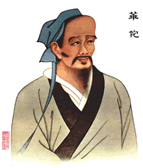
Hua Tuo (110-207 CE)
Famous
Chinese Physician and Proponent of the Five Animal Frolics
There is ample evidence, and common sense would suggest, that a variety of exercise routines, massage techniques, and health preserving methods (Daoyin) were used by people in ancient China to produce enjoyment, alleviate pain, prevent or ameliorate diseases, increase vitality, improve well-being, and contribute to longevity. Daoist philosophy has always encouraged and explored practices that contributed to bodily well-being and longevity, as well as combining these practices with methods for achieving mystical insight, bliss, and spiritual immortality.
"Breathing in and out in various manners, spitting out the
old and taking in the new, walking like a bear and stretching their neck like a bird to achieve longevity - this is what
such practitioners of
Daoyin, cultivators of the body and all those searching for long life like Ancestor Peng, enjoy."
- Chuang-tzu, circa 300 BCE. (1)
There was a feudal lord, the Marquis of Dai (King Ma), who lived around 160 BCE during the Western Han Dynasty. When the Marquis of Dai, his wife, and his son died, there were many objects placed in their family tomb as part of funeral rites and customs. In 1973, archeologists in China excavated the family tomb of the Dai family on the outskirts of the city of Changsha in Hunan Province. In the son's tomb they discovered a lacquered box containing medical manuals, documents, and a silk scroll on which were drawn 44 humans in various poses or postures. Under each pose was a caption with the name of an animal or the name of a disease that the posture might help prevent or cure. The chart or diagram (Tu) on this scroll shows Daoyin (Guiding/Leading Energy and Stretching/Pulling Out) exercises or poses. A number of the postures shown on this Daoyin Tu closely resemble some in the Eight Section Brocade and in the Five Animal Frolics (i.e., the bear, monkey, and bird). (2)
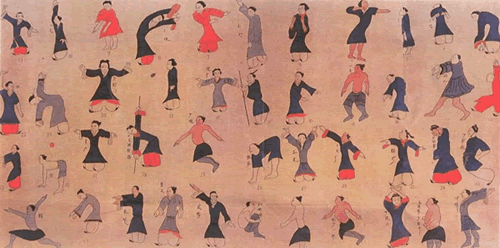
Improved artistic rendition of the Daoyin Tu, circa 160 BCE.
Another medical manuscript with Daoyin methods, the Yinshu (Stretch Book), dated at 186 BCE, related to the Daoyin Tu, describes 100 exercises, and gives advice on seasonal health regimens, hygiene, diet, disease prevention, sleep, and sexual behavior. (2) We have ample evidence that Chinese physicians, and the aristocratic and wealthy classes of ancient Chinese society, had access to therapeutic and holistic exercise and massage methods (Daoyin) well before the advent of the Eastern Han Dynasty (25-220 CE).
All of the books, articles, DVDs, and webpages about the Five Animal Frolics (Wu Qin Xi) say that the various Frolics exercises were organized into an effective combined set and promoted by the famous Chinese physician Hua Tuo. Hua Tuo (Hua To, Yuan Hua) lived from 110-207 CE.
"Hua Tuo was born around 110 CE, in Qiao of Peiguo (today called Haoxian or Bo) county, in what is now Anhui Province, one of the four major herb distribution centers of modern China. He lived for about 100 years, having died around 207 CE. He was an older contemporary of China's famous herbalist Zhang Zhongjing, who died around 220 CE. In the Chronicles of the Later Han Dynasty, it is said that: "Knowing well the way to keep one in good health, Hua Tuo still appeared in the prime of his life when he was almost 100, and so was regarded as immortal." (3)
"Hua Tuo also named Yuan Hua of Hao county in Anwei province, was the first famous Chinese surgeon. He is the first in the world to developed the use of anesthesia, and furthered the limited Chinese knowledge of anatomy. When using acupuncture and herbs, he preferred simple methods, using a small number of acupuncture points and formulas comprised of only a few herbs. He practiced Chi-kung and created the "Frolics of the Five Animals." (4)
"Hua Tuo (141-208 CE.) was a contemporary of Zhang Zhongjing. He traveled from town to town treating patients and learning from other doctor's practices. He is famous for his skill as a surgeon and his use of anesthesia. The anesthesia was given as a powder called mafeisan that was dissolved in a fermented drink before performing surgery. It has been suggested the powder may have been hemp since its uses were unknown at that time. Besides performing surgeries, Hua Tuo also recommended the use of physical exercises for his patients. He devised movements that were similar to the movements of five different animals. These were the tiger, deer, bear, monkey and bird. One of Hua Tuo's disciples called Fan An was a great acupuncturist. He devised methods to extend its use to the back and thorax." (5)
Unfortunately, few, if any, of Hua Tuo's written works have survived from the Eastern Han Dynasty (25-220 CE). There are no surviving documents from Hua Tuo that tell us how to do the Animal Frolics exercises, or even their names. One manuscript, The Classic of the Central Viscera, questionably attributed to Hua Tau, is considered one of the 10 most important pre-modern works on Chinese medicine. Hua Tuo is often called the "Father of Chinese Medicine." His name and image are still used on medical products like acupuncture needles to this day. (6)
"There are many stories, passed down from generation to generation, as to how Hua Tuo cured difficult diseases. He became known as the "Magical Doctor". His principle of resisting the onset of disease by working and doing exercises was also a major contribution to traditional Chinese medicine." (7)
Hua Tuo's life ended at age 97 in an unfortunate manner. He had been called and ordered to serve as a personal physician to Zao Cao, a ruthless general ruling the state of Wei. Zao Cao had severe headaches which Dr. Hua Tuo could not cure. General Zao Cao, for some unknown reason, became angry with Dr. Hua Tuo, and had him imprisoned and executed. (8, 6)
One of Hua Tuo's outstanding disciples, Wu Pu, lived for over 100 years, and practiced the Frolics daily. Wu Pu wrote a book called The Five Animal Classic, from which only a few fragments have survived. Wu Pu reported that Hua Tuo once said,
"Man's body must have exercise, but it should never be done to the point of exhaustion. By moving about briskly, digestion is improved, the blood vessels are opened, and illnesses are prevented. It is like a used doorstep which never rots. As far as Tao Yin (bending and stretching exercises) is concerned, we have the bear's neck, the crane's twist, and swaying the waist and moving the joints to promote long life. Now I have created the art called the Frolics of the Five Animals: the Tiger, the Deer, the Bear, the Monkey, and the Crane. It eliminates sickness, benefits the legs, and is also a form of Tao Yin. If you feel out of sorts, just practice one of my Frolics. A gentle sweat will exude, the complexion will become rosy; the body will feel light and you will want to eat." (9,6)
Master Sun Simiao (581-682 CE) is often associated with the text titled "Yangxing yanming lu" (On Nourishing Inner Nature and Extending Life) which provides a description of a squatting version of the Five Animal Frolics. (12)
A manuscript titled Yun Ji Qi Qian showing the Animal Frolics forms comes from the Song Dynasty (960-1279 CE). (10)
A 10th century heirloom brocade from Zhejiang Province depicts the Animal Frolics.
The "Jade Emperor's Mind-Seal Classic," added to the Taoist Canon around 1200 CE, is often quoted by Daoists:
"The sages awaken through
self-cultivation;
Deep, profound, their practices require great effort.
Breathing nourishes youthfulness.
The Shen depends on life form;
The Ching depends on sufficient Qi.
If these are neither depleted nor injured
The result will be youthfulness and longevity.
When the distant winds blend together,
In one hundred days of spiritual work
And morning recitation to the Shang Ti,
Then in one year you will soar as an immortal."
(11)
The Animal Frolics are pictured and described in a Taoist encyclopedia, the Yi Men Guang Du, compiled by Taoist Zhou Lujing, from the late 1600's. (10)
The Chifeng Sui (Marrow of the Red Phoenix), a collection of longevity methods by Zhou Lujing, is dated to 1578 and includes a description of an Animal Frolics set similar to what is practiced today. Also, from the 1620's are illustrated versions of the Five Animal Frolics in the "Illustrated Explanation of the Five Animals' Dance Practice," and in the "Elixir Book on Long Life and good Fortune." (12)
A successful doctor of Chinese Medicine and a qigong master, Hu Yao-zhen (1879-1973) , wrote a book titled "Wu Qin Xi" (Five Animal Frolics) in the 1940's that has been very influential. (6) One of the first published accounts of the Five Animal Frolics, in English, was by Jiao Guorui in the book Qigong Essentials for Health Promotion., 1988, in which he translated writings by Dr. Hu Yao-zhen.
Madame Guo Lin (1906-1984), a noted Beijing actress and artist, popularized her version of the Animal Frolics and a specific walking qigong style as a cure for cancer.
Both Master Kenneth S. Cohen and Master Paul B. Gallagher published books that discussed the Five Animal Frolics, and produced media which provided instruction in the Five Animal Frolics in the 1990's in America. (13)
References and Notes
5. Traditional Chinese Medicine History - Han Dynasty By Shen-Nong TCM.
6. "Way of Qigong," by Kenneth Cohen, 1997, pp.199-211.
7. Formation of the Chinese Civilization
8. "Hua Tuo" by Subhuti Dharmananda.
9. "Drawing Silk," by Paul B. Gallagher, 1988, 2007. Hua Tuo, History of the Later Han, Translated by Paul B. Gallagher, p. 6-9.
10. Ancient Way to Keep Fit, by Zong Wu and Li Mao, 1992, pp. 68-80.
12. "Chinese Healing Exercises: The Tradition of Daoyin," by Livia Kohn, 2008, pp. 162-169.
13. I have provided a more detailed bibliography for the Five Animal Frolics on this webpage. In addition, there is a general bibliography and web links on the Valley Spirit Qigong webpage.

Bibliography, Links and Resources
The Five Animal Frolics (Wu Qin Xi)
五禽戲
Alphabetical Index to the Cloud Hands Website
Anatomy of Hatha Yoga: A Manual for Students, Teachers and Practitioners. By H. David Coulter. Foreword by Timothy McCall. Honesdale,
Pennsylvania, Body and Breath, 2001. Index, bibliography, appendices, 623
pages. ISBN: 0970700601. MGC. 2002 winner of the Benjamin Franklin Award
for
Health, Wellness and Nutrition.
Ancient Qigong (Nei Gong): Five Animal Frolics. Instructional DVD, 2
DVDs.
Ancient
Way to Keep Fit. Compiled by Zong Wu and Li Mao.
Translated by Song Luzeng,
Liu Beijian, and Liu Zhenkai. Paintings by Zhang Ke Ren. Foreword by
Kumar
Frantzis. Bolinas, California, Shelter Publications, 1992. 211
pages, glossary. ISBN: 0679417893. Outstanding illustrations by Zhang Ke Ren. The
Five Animal Frolics are beautifully illustrated on pages 68-80.
Animal Frolics
Qigong: Bibliography, Resources, Lessons, Links, History. By Michael
P. Garofalo, M.S. Five Animal Frolics: Wu Qing Xi.
Animal
Speak: The Spiritual and Magical Powers of Creatures Great and Small.
By Ted Andrews. Llewellyn, 1993. 383 pages. ISBN: 0875420281.
"Shows readers how to identify his or her animal totem and learn how to invoke its energy and
use it for personal growth and inner discovery."
Animal Spirits and Nature
Spirits
Animal
Spirits: The Shared World - Sacrifice, Ritual, and Myth; Animal Souls
and Symbols. By Nicholas J. Saunders. Index, 182 pages. ISBN:
0316903051.
Animal
Wise: The Spirit Language and Signs of Nature. By Ted Andrews.
Dragonhawk
Pub., 1999. 400 pages. ISBN: 1888767340.
An
Overview of Chinese Medicine. By Paul Zabwodski.
Answers to
the Health Qigong Wu Qin Xi Chinese Health Qigong Association,
2009.
The
Art of Shaolin Kung Fu: The Secrets of Kung Fu for Self-Defense, Health and
Enlightenment.
By Wong, Kiew Kit. Charles E. Tuttle, 2002. 215 pages. ISBN: 0804834393.
Chapter 9, pp. 102-118, Shaolin Five Animals: Training of Mind, Energy, Essence,
Speed and Elegance. Sifu Wong created a 36 Movement Five Animal Frolics form for this book.
The five Shaolin animals are the dragon, snake, tiger, leopard, and crane. VSCL.
Awareness
Through Movement; Health Exercises for Personal Growth. Easy to Do
Health Exercises to Improve Your Posture, Vision, Imagination and Personal
Awareness. By Moshe Feldenkrais. San Francisco, Harper Collins, 1972, 1977. 173
pages.
ISBN: 0062503227.
Ba Gua Zhang (Pa
Kua Chang) has Eight Animals and a Bagua Qigong.
The Bear Frolic: Bibliography, Research, Notes, Lessons
Beginning Qigong: Chinese Secrets for Health and Longevity. By Stephen Comee. Tokyo, Tuttle Publishing, 1993. 120 pages.
ISBN:0804817219. VSCL.
Breathing Techniques
in Qigong and Taijiquan
Buddhist Qigong, Luohan Chi
Kung, Eighteen Buddha Hands Qigong
Cane, Short Staff,
Jo, Walking Stick
Chinese Health Qigong
Association
Chinesisches Qigong für die Gesundheit - Wu Qin Xi (German Edition with 1
DVD)
Chi
Kung, Qigong: Bibliography, Links, Quotations, Lessons, Instructions, Notes
Chi Kung: Five Animal, Five Elements. By Dr. Xue Zhi Wang, O.M.D., C.A.
Instructional VHS. 4115 University Way N.E. #111, Seattle, WA 98105.
Phone (206) 547-2435.
Chi Kung Fundamentals 1: Five Animals Video.
By Michael Winn. Instructional videotape, 90 minutes. Instructional audiotape. Telephone:
888-999-0555.
Chi Kung Quotations,
Poems, Sayings
Chinese Healing Arts: Internal Kung Fu. Edited by William R. Berk.
Burbank, CA, Unique Publications. 209 pages. ISBN: 0865680833.
VSCL. Includes numerous translations of classic works.
Chinese Healing Exercises: The Tradition of Daoyin. By Livia Kohn.
University of Hawaii Press, 2008. 268 pages. ISBN:
0824832698. History of Daoist health practices.
Chinese Health Qigong:
Five Animal Frolics for Beginners
Chinese Medicine
History - Hua To (Hua Tuo)
Cloud Hands Blog: Qigong, Taijiquan, Walking, Yoga and Gardening By Mike Garofalo.
Cloud Hands Website: Taijiquan and Qigong By
Mike Garofalo.
Comparative
History of Chinese and Western Medicine. By Ray C. J. Chiu, M.D..
The
Complete Book of Chinese Health and Healing. By Daniel Reid.
Random House,
1994. 484 pages. ISBN: 0877739293.
The Crane Frolic:
Bibliography, Resources, Lessons, Notes
Dancing
With Goddesses: Archetypes, Poetry and Empowerment. By Annis Pratt.
Bloomington, Indiana, Indiana University Press, 1994. Index, bibliography,
notes,
408 pages. ISBN: 0253208653. Chapter 11 is titled "Bear!",
pp. 340-368.
Dao De Jing (Tao
Te Ching) by Lao Tzu: Selected Translations, Bibliography, Commentary.
Compiled by Mike Garofalo.
Daoist Philosophy, World View, Beliefs, Scriptures
Daoyin Quotations,
Poems, Sayings
Daoyin Yangsheng Gong:
Bibliography, Links, Resources, History, Lessons, Guides, Quotes
The Deer Frolic:
Bibliography, Lessons, Links, Resources, Notes, Lore
Dragon Door Publications. St.
Paul, Minnesota. 1-800-899-5111.
The Dragon Frolic:
Bibliography, Links, Resources, Lessons, Notes, Lore
Dragon Qigong, Dragon Yoga: Bibliography, Links, Instructions, Notes
Drawing Silk: Masters' Secrets for Successful Tai Chi Practice. By
Paul B. Gallagher. Fairview, North Carolina, Total Tai Chi, 2007.
245 pages. ISBN: 9781419663127. VSCL.
The Five Animal Frolics are discussed on pages 5-10. A important source of
information about the
Frolics for Mr. Gallagher was the Qigong Master Kenneth S. Cohen.
Master Gallagher has provided us with a translation from some of Dr. Hu
Yao-zhen's Wu Qin Xi, "The Five Animal Frolic Classic." Master
Gallagher also offers an instructional DVD on the Five Animal Frolics.
Ecstatic
Body Postures: An Alternate Reality Workbook. By Belinda Gore.
Foreword by
Felicitas Goodman. Santa Fe, New Mexico, Bear and Company, 1995.
Endnotes,
284 pages. MGC. ISBN: 1879181223. The Bear Spirit Posture is
described and illustrated, pp. 49-54.
The Ecstatic Experience: Healing Postures for Spirit Journeys. By
Belinda Gore. Bear and Company, 2009. 160 pages. Includes 60
minute CD of trance rhythms. . ISBN: 1591430968. VSCL.
Ecstatic
Trance: New Ritual Body Postures. By Felicitas D. Goodman and
Nana Nauwald.
Binkey Kok, 2003. Workbook edition, 184 pages. ISBN: 9074597637. VSCL.
Eight
Dragons Qigong, Dragon Yoga: Bibliography, Links, Instructions, Notes
Eight Section Brocade
Qigong By Michael P. Garofalo, M.S. History and purpose of
this popular chi kung practice. Descriptions for each of the eight
movements, health benefits, comments, variations, extensive links and
bibliography, resources, quotations, animated .gif photographs of the movements,
and charts. This file is updated
on a regular basis as I add new material, links, notes, and resources. A.K.A: Baduanjin, Pa Tuan Jin, Eight Silken
Treasures, Ba Duan Jin, Pal Dan Gum, Ba Duan Gin, Pa Tin Kam, Otto Pezzi di Tesoro, Acht Delen
Brokaat,
Les Huit Exercices del la Soie, Eight Silken Treasures, Brocade Qigong, Wudang
Brocade Qigong, Silk Treasures Qigong, First Eight Buddha Lohan Hands. The
seventh movement of the Eight Section Brocade is called:
The Big Bear Turns from Side to Side.
The
Eight Treasures: Energy Enhancement Exercise. By Maoshing Ni, Ph.D..
With a preface and commentaries by Hua-Ching Ni. Santa Monica, California,
Seven Star Publications, 1996. Index, glossary, 196 pages. ISBN:
0937064742. VSCL.
Eighteen Buddha Hands Qigong, Luohan Qigong
Eighteen
Hands Lohan Qigong (King Mui Version) Description and photographs.
The Essence of Tai Chi Chi Kung: Health and Martial Arts. By Yang Jwing-Ming,
Ph.D.. Jamaica Plain, Massachusetts, YMAA Publication Center, 1990. Glossary,
appendices, index, 148 pages. ISBN: 0940871106. VSCL.
The
Essential Book of Traditional Chinese Medicine. By Liu Yanch
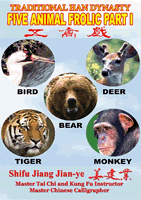
Five Animal Frolic, Part I. Instructional VHS/DVD, 120 minutes, by
Shifu Jiang Jian-ye. "Traditional Han Dynasty, Five Animal Frolic, Part
I."
Five Animal Frolic, Part II. Instructional VHS/DVD, 120 minutes, by
Shifu Jiang Jian-ye. "Traditional Han Dynasty, Five Animal Frolic, Part
II."
Five
Animal Frolic Handout. A set of attributions and associations for each
Frolic. From Three Treasures Tai Chi.
Five Animal Frolics.
Instructional DVD. From Authentic Eastern Health, Pennsylvania.
Five Animal Frolics.
UTube Video, 2:02 Min for each Frolic. Performed by Anson Rathbone.
5 Animal Frolics. An instructional DVD by Kenneth Cohen.
© 1990. Website:
www.qigonghealing.com
Lecture and demonstration of each Frolic set.
Five Animal Frolics.
Instructional videotape by Michael Gilman. 60 minutes VHS or
DVD. Five
Animal Frolics "An ancient form of Chi Kung, probably having strong
influence on the development of Tai Chi Chuan. These easy to do, fun to practice
movements are very complete for physical conditioning and internal health and
well being. Especially valuable for the internal organs. Michael takes you
through and explains these Five Animals in a simple easy to learn way. 60
minutes, produced for television."
Five Animal Frolics.
Instructional DVD by Paul Gallagher. 95 minutes VHS. "Five Animal
Frolics #1: China's Earliest set of Internal Exercises, based on the
Life-Enhancing Movements of the Crane, Bear, Monkey, Deer, and Tiger.
A complete invigorating fitness system for both body and mind which
generates energy and mental poise without ever causing strain on the heart or
joints. Many qualities of T'ai Chi, but much easier to learn for young or old.
This Video of the Frolics contains complete, step-by step descriptions and
explicit instructions for each movement. Excellent audio and video quality,
close-ups and multiple angles enable you to see and refine every detail of your
movement. Run-time is approximately 95 minutes; cost is $49."
Five Animal Frolics: A Form Workbook. A Complete Qigong Program for High Energy, Vitality and
Well Being. By John Du Cane. St. Paul, Minnesota, Dragon
Door Publications,
2002. Second Edition, 2002. 121 pages. Spiral bound
notebook. 100 photographs. No ISBN.
Scribd
Download PDF Format of document. VSCL.
Five Animal Frolics: Google Search
The Five Animal Frolics: A Practical and Workable Qigong Method. By
John Du Cane.
Five Animal Frolics
Qigong. Authentic Eastern Health. Instructional DVD, 60 Minutes.
Master Ping Zhao.
Five Animal
Frolics Qigong: Bibliography, Resources, Lessons, Links, History. By
Michael P. Garofalo, M.S. Five Animal Frolics: Wu Qing Xi.
Five Animal Frolics Qigong.
By Michael Winn. Includes instruction on Inner Smile and Six Healing
Sounds. Audio CDs, DVDs, books. VSCL.
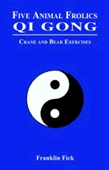
Five Animal Frolics Qi Gong: Crane and Bear Exercises
 By John DuCane. Dragon Door Publications, 2002. 121 pages.
ISBN: 0938045679.
By John DuCane. Dragon Door Publications, 2002. 121 pages.
ISBN: 0938045679.
Five Animal Frolics Qigong
"The oldest written exercise program for preventive medicine."
Five Animal Frolics Workshop by Robert Bates
Five Animal Play Shen-Nong.
Five Animal Play.
Dr. Alex Feng, Oakland, California.
Five Animal
Qigong. By Jusuf Hariman.
Five Animals
Play Distributed by Plum Publications. Instructional DVD, 60
minutes, #18062. "It is well known that "animal play" came into existence
with the creation of the famous doctor, Hua Tou. Hau's assistant, Peng, lived to
be over 90 and all information was supposedly passed from him. It was about two
centuries later that the Shaolin temple developed it Five Animals. The doctor's
original intent was strictly for health and encompasses imitating the movements
of the Monkey, Tiger, Deer, Bear and Bird. Only wood block prints still remain
of the original postures so there are many derivative versions. This is one and
not bad at that. The Five Animals doesn't exactly exist as a Chi Kung but it
might be considered a Dao Yun series. A very enjoyable exercise system."
Five Animal Sports Qigong. Instructional DVD, 180 minutes, by Dr.
Yang, Jwing-Ming and Kathy Yang.
YMAA Publication Center, 2008. ASIN:
B0018OZFOS. VSCL.
The Five Animals.
From "Kung-Fu, or Tauist Medical Gymnastics," by John Dudgeon, 1895.
Five Animals and Five Elements
DVD. By Wing Lam.
The Five Animals do the Six Healing
Sounds. By Michael Winn. Healing Tao Home Study Video, 2004.
Qigong Fundamentals 1. 1 DVD. Instruction in the Inner Smile, Ocean
Breathing, 6 Healing Sounds, and Five Animals. Also Qigong Fundamentals 1
includes lectures by Michael Winn on six audio CDs. VSCL.
Five Animals Kung Fu
Fundamental Training By Travis Alschbach. From Inside
Kung Fu Magazine.
Five Animals Kung Fu.
Shaolin Kung Fu, from Jueyuan, a martial artist, circa 13th century. From
Inside Kung Fu Magazine.
The Great Bear Star Steps
By Sat Chuen Hon.
Green Paths in the Valley Blog
Green Way Research.
Red Bluff, California.
The
Healing Promise of Qi: Creating Extraordinary Wellness Through Qigong and
Tai Chi.
By Roger Jahnke, O.M.D.. Chicago, Contemporary Books, 2002.
Index, notes, extensive
recommended reading list, 316 pages. ISBN: 0809295288. VSCL.
The
Health Benefits of Qigong Exercises. By John Du
Cane.
Hua To (Hua Tuo) - Biographical Information
"Hua Tuo's Five Animal Frolics,"
Zhou Lishang. T'ai Chi: The International Magazine of T'ai Chi Ch'uan: Vol. 29, No. 4, August, 2005, pp. 42-49. Translation by Yan Shufan.
Part 1. A detailed article on how to do the Frolics. This version of the Frolics set was developed by the
Shanghai University of Sports and approved by the State Physical Culture and Sports Bureau. The articles
includes set by set photos, instructions, and some very interesting
illustrations from the Ma Wang Dui Tomb No. 3 findings.
"Hua Tuo's Five Animal
Frolics," by Zhou Lishang. T'ai Chi: The International Magazine of T'ai Chi Ch'uan: Vol. 29, No. 5, October, 2005, pp. 42-49. Translation by Yan Shufan.
Part 2.
"On Hua Tuo's Position in the History of Chinese
Medicine." By K. W. Fan. The American Journal of Chinese Medicine,
Vol. 32, No. 2., 2003.
Huo To T'ai Chi Ch'uan: The Kung Fu of Six Combinations and
Eight Methods (LiuHe BaFa).
By Khan Conor Foxx. Publication date and source unknown.
Hua Tuo Wu Qin
Xi. By Huang, Qide. Published in 1983. 67 pages.
Integral Life Practices: A 21st Century
Blueprint for Physical Health, Emotional Balance, Mental Clarity, and Spiritual
Awakening. By Ken Wibur, Terry Patten, Adam Leonard, and Marco Morelli.
Integral Books, 2008. Index, 416 pages. ISBN: 1590304675. VSCL.
The
Jade Emperor's Mind Seal Classic. The Taoist Guide to Health,
Longevity, and Immortality.
Translated with commentary by Stuart Alve Olson. Rochester, Vermont,
2003. Index, bibliography,
216 pages. ISBN: 0892811358. Inculdes translations of
"The Immortals" by Ko Hung, and
"The Three Treasures of Immortality" by T'ien Hsin Chien. This
work was added to the Taoist Canon
between 912 and 1116 CE. VSCL.
Lifestyle Advice for Wise
Persons
Luohan Qigong, Eight Buddha Hands Chi Kung
The
Magician's Companion. A Practical and Encyclopedic Guide to Magical
and Religious Symbolism. By Bill Witcomb. St. Paul, Minnesota, Llewellyn
Pubs., 1993. Appendices, resources, 577 pages. ISBN: 0875428681. VSCL.
The
Magic of Shapeshifting. By Rosalyn Greene. Red Wheel Weiser,
2000.
258 pages. ISBN: 1578631718. According to Ms. Greene the most
common
animals people shift into are the wolf, fox, cat and bear.
Magic Pearl
Qigong: A Tai Chi Medicine Ball Exercise Routine and Meditation Technique.
Developed by Mike Garofalo.
Massage - Self-Massage,
Patting
The Monkey Frolic:
Bibliography, Links, Resources, Lessons, Notes, Lore
Moving Qi Gong: Frolics of the Five Animals. Instructional DVD.
Moving with the
Tao, Medical Qigong Instructional DVD.
Nature Spirits: How to
Create Relationships the Nature Spirits of Animals
One Old Druid's Final Journey:
Notebooks of the Librarian of Gushen Grove
Origins and
Development of Qigong
Plexus: History and Myth
Interesting collection of facts and observations about Mt. Hua in China. A
tomb dedicated to Hua To is found on Mt. Hua.
 By John Du Cane. St. Paul, Minnesota,
Dragon Door Publications,
2000. Instructional DVD, 48 minutes. Anti-Aging
Series. ISBN: 0938045210. Website:
www.dragondoor.com. VSCL.
By John Du Cane. St. Paul, Minnesota,
Dragon Door Publications,
2000. Instructional DVD, 48 minutes. Anti-Aging
Series. ISBN: 0938045210. Website:
www.dragondoor.com. VSCL.
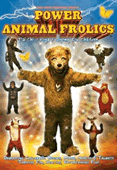
Power Animal Frolics: Tai Chi, Yoga, and Qigong for Children.
Starring Bliss Beary Bear. Instructional DVD, 82 Minutes.
Power of the Animals:
Learning five animal kung-fu will increase
your strength, endurance and martial arts effectiveness. By Qinn Early.
Qigong: Bibliography, Links,
Quotations, Lessons, Instructions, Notes
Qigong:
Small Circulation. By Yang Jwing-Ming. YMAA Publication Center,
2006. 360 pages. ISBN: 1594390673. VSCL. Essential
reading!
Qigong
Empowerment: A Guide to Medical, Taoist, Buddhist, and Wushu Energy
Cultivation. By Liang, Shou-Yu and Wu, Wen-Ching. Edited by
Denise Breiter-Wu.
Rhode Island, Way of the Dragon Publishing, 1997. Index, glossary,
348 pages. ISBN: 1889659029. VSCL.
Qigong Essentials:
Five Animal Frolics. Instructional DVD, 70 minutes, by Master Jesse
Tsao. Tai Chi Healthways, San Diego. "Five Animal Frolics is an
ancient Chinese Qigong practice. Hua-tuo, the most famous Chinese doctor in
ancient China, designed Five Animals Frolic based on Chuang-tzu's Taoist
practice and traditional Chinese medical philosophy. He observed animals in
nature and mimicked their daily activities to create movements for people
cultivating life energy. Each animal form has a special effect on a human
being's inner organ health: tiger form for liver energy flow; deer form for
kidney; bear form for spleen and stomach; ape form for the heart; bird form for
lungs. Five Animal Frolics can fully stimulate and awaken qi, the vital energy
inside of our body, contained within the meridian channels and cavities. Through
the stimulation and accumulation of qi, a person can clear out stress and
sickness and may not only acquire a new sense of physical and mental energy, but
create the conditions for longevity as well. Throughout 1700 years, routines
have been passed down from different people, resulting in various versions of
Five Animal Frolics. This video shows the most popular forms in China today, and
provides the basic "how-to" aspects of the routine. Master Tsao demonstrates the
complete form in both front and back view, along with detailed instruction in
posture-by-posture lessons. It is a good reference for home study, or a resource
for instructor's teaching preparation. Suggest 30 class hours."
Sample UTube Video of
this DVD. VSCL.
Qigong Essentials for Health Promotion. By Jiao Guorui.
Translated by Jiao Tielan. Beijing,
China Reconstructs Press, 1988. ISBN: 750720100. ASIN: B000B6TA54. The Animal
Frolics are discussed and explained on 190-236. The text includes
illustrations (line drawings). VSCL.
Qigong Five Animals.
UTube Videos: Part 1,
7:02 Min. Part 2,
7:04 Min. Part 3,
7:03 Min. Part 4,
Qigong Healing: The
Way of Qigong. By Kenneth S. Cohen.
Qigong
Meditation: Embroyonic Breathing. By Yang, Jwing-Ming.
Boston, Mass., YMAA
Publications, 2003. Index, glossary, 389 pages. ISBN: 1886969736. VSCL.
Qigong Quotations,
Poems, Sayings
Ripening Peaches:
Daoist Studies and Practices. Taoist scriptures, bibliography,
Quanzhen Daoism, Neidan, gardening, tea, history, qigong/daoyin, readings, etc.
The
Root of Chinese Chi Kung: The Secrets of Chi Kung Training. By Yang
Jwing-Ming, PhD., 1946-.
YMAA Chi Kung Series #1. Jamaica Plain, Massachusetts, Yang's
Martial Arts Association, 1989. Glossary, 272 pages. ISBN:
0940871076. VSCL.
Ruler, Stick, Chih, Bang - Tai Chi Ruler
Scholar
Warrior: An Introduction to the Tao in Everyday Life. By Deng
Ming-Dao. Harper
San Francisco, 1990. Index, bibliography, 351 pages. ISBN:
0062502328. VSCL.
Secrets
to Living Younger Longer: The Self-Healing Path of Qigong Standing
Meditation
and Tai Chi. By Michael Mayer, Ph.D.. Orinda, California, Body Mind
Healing
Publications, 2004. Index, bibliography, 281 pages. ISBN:
0970431066.
This book has a companion instructional video/DVD called "Body Mind Healing
Qigong."
Website: Body Mind Healing.
VSCL.
Serenity Qigong: An Instructional Guide to the Crane Frolic. By John
Du Cane. An instructional videotape, 41 minutes.
Shamanic
Experience: A Practical Guide to Contemporary Shamanism. By Kenneth
Meadows. Shaftesbury, Dorset, England, Element Books, 1991. Glossary, bibliography,
resources, index 196 pages. ISBN: 1852302267. VSCL.
Shapeshifters and Shapeshifting
Shaolin Buddhist Qigong,
Luohan Qigong, Eighteen Lohan Chi Kung
Shaolin
Five Animals Kung Fu. By Doc Fai-Wong. Unique Publications,
1987. 128 pages. ISBN: 0865680809.
Shaolin Kung
Fu makes use of Five Animals: Snake, Leopard, Tiger, Crane and Dragon.
The Shaolin Workout: 28 Days to Transforming Your Body and Soul the Warrior's
Way.
By Sifu Shi Yan Ming. Rodale Press, 2006. Index, 293 pages. ISBN: 1594864004.
VSCL.
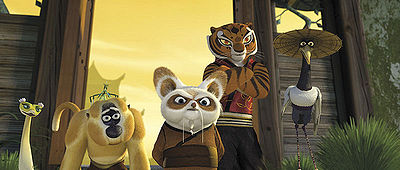
Snake,
Monkey, Mantis, Master Shifu Panda, Tiger, and Crane
Kung Fu Panda Motion
Picture
Shapeshifting in Celtic Myth. By Kenneth R. White.
Shapeshifting:
Shamanic Techniques for Global and Personal Information. By John M.
Perkins. Inner Traditions Intl. Ltd., 1997. 184 pages. ISBN:
0892816635. VSCL.
Simple
Fitness Exercises : Traditional Chinese Movements for Health & Rejuvenation.
By Jiawen Miao. Llewellyn Publications, 2000. Index, 111
pages. ISBN: 1567184952. Both a basic form (The Gentleman's ESB, pp. 31-54) and a more advanced form
(The Warrior's ESB, pp. 55-76) taught in this book using descriptions and
photographs. VSCL.
Simplified Yang Tai Chi
Chuan, Standard 24 Form
Simplified Chen Tai
Chi Chuan, 18 Movement Form, by Grand Master Chen Zhenglei
Six Taoist
Healing Sounds Research by Mike Garofalo.
The
Spirit of the Five Animals: Shaolin Martial Arts. By Tak Wah Eng.
Bo Law Kung Fu Federation, 2005. 171 pages. Simple descriptions,
with black and white photographs, for each animal form: Dragon, Tiger,
Leopard, Crane and Snake. VSCL.
The
Spiritual Legacy of the Shaolin Temple: Buddhism, Daoism, and the
Energetic Arts.
By Andy James. Foreword by Dr. Jerry Alan Johnson.
Summerville, MA, Wisdom
Publications, 2004. 179 pages. I SBN: 0861713524. VSCL.
Spontaneous Five
Animal Play Qigong (Zifa Wuqinxi Donggong).
Compiled and readjusted by Liang
Shifeng who is a major Qigong master from a southern province of China, called
Guangdong in the early 1980s.
Staff Weapons: Bibliography, Links,
Resources, Lessons
Sun Lu Tang's
Internal Martial Arts: Baguazhang, Xingyiquan, Taijiquan, and Qigong.
Bibliography, Links, Quotes, Resources, Instructions.
Shen-nong
Limited: History of Chinese Medicine
The
Spirit of the Five Animals. By Tak Wah Eng. Bo Law Kung Fu
Federation, 2005. 171 pages. ISBN: 097552013X. VSCL.
Subject Index to the Cloud Hands Taijiquan
and Qigong Website
Taijiquan (Tai Chi
Chuan) and Qigong
The Taoist Body. By Kristofer Schipper. Translated by Karen C.
Duval. Foreword by Norman Girardot. Berkeley, California, University of California
Press, 1993. Originally published in French in 1982 as Le Corps Taoiste.
Notes, bibliography, index, xx, 273 pages. ISBN: 0520082249. VSCL.
Taoist
Classics. The Collected Translations of Thomas Cleary. Boston,
Shambhala Press. Four Volumes:
Volume
One, 296 pages, 2003.
Volume
Two, 640 pages, 1999. Volume Three, 304 pages, 2001.
Volume
Four, 464 pages, 2003.
Taoist Philosophy, World View, Beliefs, Scriptures
The Tao
of Health, Sex and Longevity: A Modern Practical Guide to the Ancient
Way. By Daniel P. Reid. New York, a Fireside Book, Simon and
Schuster, 1989.
Index, 405 pages. ISBN: 067164811X. VSCL.
The Tao
of Meditation: Way to Enlightenment. By Jou, Tsung Hwa.
Scottsdale, Arizona,
Tai Chi Foundation, 1983, 2000. 176 pages. ISBN: 0804814651.
VSCL.
Tao Te Ching (Dao
De Jing) by Lao Tzu: Selected Translations, Bibliography, Commentary.
Compilation by Mike Garofalo.
The Tiger Frolic:
Bibliography, Links, Resources, Lessons, Notes
Tiger Frolic, Five
Animal Frolics, Demonstration by Master Howard Choy, UTube Video, 4:33 Minutes.
Tiger Gong and Bear Gong
By Jane Golden.
Totems:
The Transformative Power of Your Personal Animal Totem. By Brad
Steiger.
Harper San Francisco, 1997. 224 pages. ISBN: 0062514253.

Video Demonstrations Online
Animal Frolics Qigong, IIQTC.
Demonstration by Jessica Kolbe. Vimeo, 56 minutes.
Five Animal Frolics.
Demonstration by Master Jesse Tsao. UTube, 6:46 minutes.
Five Animals Qigong.
Demonstration by Master Xiao. UTube, 9:46 minutes.
Tiger Frolic.
UTube Video, 1:34 minutes.
Performed by Anson Rathbone, 2007. As taught by
Deguang at NESA's Medical Qigong Class.
Tiger Frolic, Five
Animal Frolics, Demonstration by Master Howard Choy, UTube Video, 4:33 Minutes.
Tiger Frolics UTube, 7:26
minutes.
WuDang Five Animals Qigong.
UTube, 6:30 minutes.
Vital Breath of the Dao: Chinese Shamanic Tiger Qigong (Laohu
Qigong). By Master Zhongxian Wu. Little Canada, Minnesota, Dragon Door
Publications, 2006. 246 pages. ISBN: Unknown. There is also a DVD to accompany
this book with a running time of 65 minutes called "Chinese Shamanic Tiger
Qigong." For more information call 1-800-899-5111.
Vitality Qigong: An Instructional
Guide to the Monkey and Deer Frolics. By John Du Cane.
Instructional videotape, 43 minutes.
Valley Spirit Qigong, Red
Bluff, California
VSCL = Valley Spirit Center
Library, Red Bluff, California
Warriors
of Stillness: Meditative Traditions in the Chinese Martial Arts.
Volume 1.
The Teachings of Grandmaster Cai Song Fang. Qigong Qi of the Center,
Essence of Taijiquan. By Jan Diepersloot. Walnut Creek,
California,
Center for Healing and the Arts. Glossary, 226 pages. ISBN:
0964997606. A study
of Wu Ji meditation, 13 postures, and push hands. VSCL.
The Way
of Qigong: The Art and Science of Chinese Energy Healing. By Kenneth
S. Cohen.
Foreword by Larry Dossey. New York Ballantine Books, 1997. Index,
notes, appendices, 427 pages. ISBN: 0345421094. MGC. One of my favorite books:
comprehensive,
informative, practical, and scientific. A very informative introduction to
the Five Animal
Frolics, and detailed descriptions of the Crane and Bear forms, with illustrations,
can
be found on pages 199-209.
The Way
of Qigong. By Ken Cohen. 5 audiocassettes, 6 hours.
Boulder, Colorado, Sounds True,
1993. ISBN: 1564552578. VSCL.
Ways of Walking:
Quotations, Bibliography, Resources, Links
The Web
That Has No Weaver: Understanding Chinese Medicine. By Ted J.
Kaptchuk,
O.M.D.. Chicago, McGraw Hill Contemporary Books, 2nd Edition, 2000.
Index, bibliography,
appendices, notes, 500 pages. Forward by Margaret Caudill, M.D., and by
Andrew
Weil, M.D. ISBN:
0809228408. An excellent introduction to traditional
Chinese medicine and modern research on the topic. VSCL.
What is Qigong.
By Kenneth S. Cohen.
Where
the Spirits Ride the Wind: Trance Journeys and Other Ecstatic
Experiences. By Felicitas D. Goodman, Ph.D.. Illustrated by Gerhard Binder.
Bloomington, Indiana, Indiana University Press, 1990. Index, bibliography, 242 pages.
ISBN: 0253327644.
A cross cultural study of the effects of body postures on altered states of
consciousness.
Extensive notes on the widespread instances of Bear postures, rituals and
totems.
Wild Goose Qigong: Links, Bibliography, Quotes, Notes
The
Wonders of Qigong. A Chinese Exercise for Fitness, Health and
Longevity.
Compiled by the China Sports Magazine, Beijing, China. Published by Wayfarer Publications, Los Angeles, CA, 1985. 111 pages. 275 line
drawings. ISBN: 0935099077. VSCL.
Wudang Five Animal Form.
Instructional DVD. Featuring Master Zhong Xue Chao..
Introductory video, 5:32 minutes. Instruction over-dub voice in
English. This DVD include 5 forms of Tortoise, Crane, Snake, Tiger, and
Dragon. All 5 animal's complete demonstration, introduction and teaching.
List of movements.
Wudang Five Animal Regimen
UTube Video, 5:53 minutes.
Wu Qin Xi Qigong.
UTube Video, 6:30 Min.
Wu Qin Xi. By
Hu, Yao-zhen
(1879-1973). Hong Kong, Xin Wen Shu Dian,
n.d..
Wu Qin Xi.
Chinese Health Qigong Assocation.
Wu Qin Xi (Five Animal Frolics): Chinese Health Qigong. Compiled by
the Chinese Health Qigong Association. Beijing, Chine, Foreign Languages
Press, 2007. 102 pages, includes an instructional DVD. ISBN:
9787119047799. VSCL.
"In 2001 the Chinese government showed great interest in regulating the Qigong
movement. The State Sport General Administration of China founded the Chinese
Health Qigong Association, as a mass-organization to popularize, spread and
research Health Qigong in cooperation with the Peking Sport University. In 2003
the organization presented the newly developed four Health Qigong Exercises on
the base of excellent traditional Qigong, including:
Yì Jīn
Jīng (tendon-changing classic),
Wu Qin Xi (frolics of five animals 五禽戲),
Liu Zi Jue
(the art of expiration in producing six different sounds),
Ba Duan Jin (eight excellent movements), to fit the people's needs of
promoting their health and body, and to develop traditional Chinese national
culture further. The Chinese Health Qigong Association is a member of the
All-China Sports Federation. During the process of developing the
exercises, strictly scientific research methods have been followed. Primary
experiments took place under supervision of Traditional Chinese Medicine, Modern
Medicine, Psychology, Athletic Science and other related subjects. The Four
Health Qigong Exercises can be seen as the essences from the related Qigong in
various schools, inherited and developed traditional Chinese national culture.
The new Health Qigong represented by the Chinese Health QiGong Association is
breaking with the old tradition of family-styles and close teacher-student
relation. It is hoped that the new standardisation is supporting the
international spread of Qigong in the western hemisphere. Starting in
September 2004 the "Health Qigong Magazine" became the association magazine of
the CHQA. It is the only national health qigong publication in China; edtited
through China Sports Press. After the successful 1st International Health
Qigong Demonstration and Exchange in 2005 the CHQA organized in August 2007 the
2nd International Health Qigong Demonstration and Exchange in Peking including
an international competition and the first Duan examination on Health Qigong. At
the same time, the 2007 International Symposium on Health Qigong Science was
organized where important scientific studies were made public."
- Wikipedia
Wu Qin Xi,
Five Animal Frolics Qigong: Bibliography, Resources, Lessons, Links,
History. By Michael P. Garofalo, M.S.
Xing Yi Quan (Hsing
I Chuan) makes use of Twelve Animals.
Yangsheng Gong, Daoyin,
Qigong:
Bibliography, Links, Resources, History, Lessons, Guides, Quotes
Yin Jin Jing (Muscle and Tendon Transformation Classic)
Qigong
Yuli Qigong. By
Jeff Smoley. Wujigong, Zhan Zhuang, 5 Animal Frolics, Jade Power Qigong,
and Eight Section Brocade. Jeff borrowed my
disclaimer.
Zhan Zhuang, Standing Meditation - Standing Like a Tree - Meditation and Qigong
Quotations - General
Animal Frolics Exercises, Animal Frolics Qigong, Chinese Yoga Animal Frolics
"Man's body must have exercise, but it should never be done to the point of
exhaustion. By moving
about briskly, digestion is improved, the blood vessels are opened, and
illnesses are prevented.
It is like a used doorstep which never rots. As far as Tao Yin (bending and
stretching exercises) is
concerned, we have the bear's neck, the crane's twist, and swaying the waist and
moving the joints to promote long life. Now I have created the art called the Frolics
of the Five Animals:
the Tiger, the Deer, the Bear, the Monkey, and the Crane. It
eliminates sickness, benefits the legs,
and is also a form of Tao Yin. If you feel out of sorts, just practice one
of my Frolics. A gentle sweat will exude, the complexion will become rosy; the body will feel light and you
will want to eat."
- Hua To, History of the Later Han, Translated by Paul B.
Gallagher,
Drawing Silk: A Training Manual for T'ai Chi, 1988,
p. 6.
"An ancient text, The Spring and Autumn Annals, states that in mythic times a
great flood covered much of China. Stagnant waters produced widespread disease.
The legendary shaman-emperor Yu cleared the land and diverted the waters into
rivers by dancing a bear dance and invoking the mystical power of the Big Dipper
Constellation. As the waters subsided, people reasoned that movement and
exercise can similarly cause the internal rivers to flow more smoothly, clearing
the meridians of obstructions to health. Qigong-like exercises are found on
ancient rock art panels throughout China. Chinese shamans used these exercises
and meditations to commune with nature and natural forces and to increase their
powers of healing and divination.
- Kenneth S. Cohen, What
is Qigong
"Daoyin
導引 (a.k.a. Tao Yin), which literally means
“guiding and stretching,” is a traditional Chinese form of “calisthenics” (Grk.:
“beautiful strength”; physical exercise) or “gymnastics” (Grk.: “to train”).
Traditionally and historically speaking, Daoyin practices are stretching
exercises, usually combined with breath-
- Daoyin
"Learn one
of the oldest, yet perennially popular forms of exercise in the world. In the
2nd century A.D., the great Taoist physician Hua To created a physical,
energetic and mental exercise system based on the movements and spirit of five
animals: the crane, bear, deer, monkey, and tiger. Develops strength, balance,
focus, flexibility, courage, and calmness. Used successfully by thousands of
people to regain health and fitness and treat chronic diseases."
- Healing Tao
Institute
Crane - to develop balance, lightness and agility. The Crain cools and
relaxes your whole body, balances the heart-energy, gently stretches your
ligaments and releases your spine.
Bear - to develop rooted power. The Bear creates greater leg strength,
fortifies the bones and develops energy in the kidneys, your fundamental source
of vitality.
Monkey - to develop suppleness and agility. Become quick witted, alert and
nimble.
Deer - to develop grace and relaxation. The Deer gives a long stretch to
the legs and spine, creating open, expansive movement with very flexible sinew
and bones.
Tiger - to develop muscular strength. The Tiger strengthens the waist,
sinews and kidneys and builds internal power.
-
Five Animal Frolics
"For optimal health, we
need body and spirit, exercise and meditation, awareness of the
inner world and the outer. In other words, health requires balance and
moderation. The goal
of qigong may be summarized as xing ming shuang xiu, "spirit and
body equally refined and
cultivated." Cultivate your whole being, as you would cultivate a
garden - with attention,
care, and even love."
- Ken Cohen, Essential Qigong, 2005, p. 2
"Firstly, we analyze its function in the aspect of psychological regulation
as it is required that the practitioner should do it before and during each
routines in the exercise of the Health Qigong Wu Qin Xi. The practitioner should
mind on the Dantian and rid of the distracted thoughts with quiet mind and
spirit before the exercise, get into the imitation of its physical activities of
each animal in the exercise. When practicing the tiger exercise, try to imagine
yourself as a fierce tiger in the mountains who is looking down upon other
beasts and stretching its own pawns and about to pounce on its prey; in the deer
exercise, imagine that you are prudent and mild, jogging on a green field; in
the exercise of the bear, you are a clumsy bear, composed and steady, freely
roaming the forests; in the monkey exercise, you become a happy and agile
monkey; in the bird exercise, you are a free bird with quiet mind and flying in
the sky. Therefore you can continuously regulate the mind state in the exercise
and it is helpful to the relaxation of the mind. The regular exercise of this
skill can transform and regulate the mind of the practitioner to relieve the
spiritual nervousness, improve the emotional stability, reduce the mental stress
and keep the healthy mind."
-
The Effect
of Precaution against Sub-health of the Health Qigong Wu Qin Xi.
Chinese Health Qigong Association. 2008.
"Many schools of Wu Qin Xi have sprung up in modern times, with different
modifications of the exercises. Some schools even name themselves after Hua Tuo.
Nevertheless, they all adhere to the fundamental principles of imitating the
movements of the five wild creatures and combining physical with mental
exercises. And they all have the common aim of strengthening muscles and bones,
promoting the circulation of Qi and blood, preventing and curing diseases,
maintaining good
health and prolonging the life span. The practice of Wu Qin Xi can be
divided into two types: One emphasizes the physical exercise of the trunk and
limbs to strengthen the bodily constitution. This is called "external exercise."
The other emphasizes mental exercises which are supposed to imitate the
spiritual activities and expressions of animals, to stimulate mental activity;
this is called "internal exercise." The former division can be further divided
into two groups. Vigorous practice mainly for self-defense is called
"Five-Animal Boxing," which can also be used for treating illness by means of
pounding or massage. When performed gently and gracefully, with the aim of
strengthening the body constitution and improving the spiritual mood, it is
called "Five-Animal Dance.""
- Origins
and Development of Qigong
"The patriarch of Chinese medicine, Hua Tuo (second century A.D.) was
one of the great early qigong masters. His "Five Animal Frolics"
imitate the movements of the Crane, Bear, Monkey, Deer, and Tiger and are still
practiced today. Hua Tuo said that just as a door hinge will not rust if it is
used, so the body will attain health by gently moving and exercising all of the
limbs."
- Kenneth S. Cohen, What
is Qigong
"The "Five Animal-Frolics" mimics the fierceness
of tiger, peacefulness of deer, calmness of bear, agility of ape, and lightness
of bird to train the body and mind. It can improve body strength, move blood and
Qi, and relax tendons and meridians so people will not get aged quickly. It can
also be used to cure chronicle diseases. Practitioner can practice all five
frolics or pick only one or two to practice based on his personal physical
conditions. During practice, it requires the practitioner to coordinate his
thoughts, breathing, and movements. If you can practice it persistently, you
will enjoy light spirit, enhanced appetite, improved agility, and firm steps.
This has the functions of nurturing spirit, regulating the flow of Qi and blood,
helping Jang and Fu, opening meridians, activating sinews and bones, and
benefiting joints. The "Five Animal-Frolics" is also effective in preventing and
curing lung diseases, asthma, high blood pressure, heart-crown disease, weak
nerve system, and indigestion, etc. In addition, frequent practice of the "Five
Animal-Frolics" can correct abnormal footings and walking postures, prevent
wilting of muscles, and improve body balance. It is also beneficial to other
symptoms. Practitioner should practice for 15 minutes twice daily, one in the
morning and one in the evening. Also, the practitioner should select a field
with fresh air and luxuriant vegetation."
-
Five Animal Frolics
"Born from the marriage of shamanic dance and the Chinese medical
study of energy systems,
The Animal Frolics offer a complete self-care toolkit of accessible techniques
to transform your health and well being."
- John Du Cane,
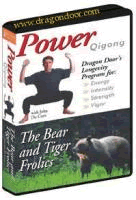
Power Qigong: The Bear and Tiger Frolics.
"The earliest Daoist reference to
Daoyin practice appears in chapter fifteen of the
Zhuangzi 莊子 (Book of
Master Zhuang), which is part of the so-
- Daoyin
"In the Welsh story of Taliesin, who as Gwion Bach, transforms himself
into various animal shapes to escape the wrath of the goddess Ceridwen. Gwion transforms himself into
a hare, a fish, a bird and finally a grain of wheat. Ceridwen in an attempt to catch him also
transforms herself. She becomes a greyhound, an otter, a falcon and a hen. It is as a hen that she
finally catches Gwion, who is at this stage a grain of wheat, she swallows Gwion and by so doing
becomes pregnant and eventually gives birth to Taliesin."
- Kenneth R. White, Shapeshifting
in Celtic Myth.
"Daoyin is an ancient Chinese body-mind exercise
originally aimed at health care as well as physical and spiritual purification.
The ascetics of past time believed it could be used to obtain the "eternal
youth" (changsheng bulao). Many different interpretations were
given to the word daoyin during the ages. The following two are the most
reliable: daoqi yinti - guide the qi and stretch the body; and
daoqi yinliao - guide the qi to obtain a healing effect.
Both interpretations describe important aspects of the exercise and are not
contradictory to each other. The first describes briefly the technique while the
second refers to one goal of the exercise; actually with daoyin we guide
the qi and move our body in order to obtain a beneficial effect to our
health. China has an ancient and deep tradition of body-mind care.
According to historical documents already during the feudal age (770-221 BC) the
so-called "life-nourishing ways" (yangsheng zhi dao) gained great
importance. They were methods aimed at enhancing a long, healthy and good life,
by means of dietetic regime, herbal preparations, gymnastic exercises and
spiritual cultivation (such as study, poetry, meditation, etc.). Many
famous thinkers of this time argued heatedly on these issues, proposing their
own "ways" and discussing those of their colleagues. Among the various
"life-nourishing ways", the physical exercise was almost universally regarded as
necessary and very effective. As "physical exercise" we have to think here
something much deeper and articulated than what we mean today. It was an
exercise involving body and mind in a great potentially unlimited effort of
self-purification. The ascetics of that time practiced and taught these
techniques in order to reach long life and immortality."
- Daoyin
"Shape-Changing in practice essentially breaks down into two main areas
that for the purposes of discussion I've decided to call "Out of body" shifting and
"Altered State" shifting. The two are related: altered state shapeshifting in particular using some of the methods of
consciousness altering employed in out-of-body voyages but they are sufficiently different to
enable them to be considered separately."
- Redvane Fox
"Sometime between the Eastern Zhou (ca 776-256
BCE) and the Qin (ca 221-206 BCE) Dynasties, they developed the Two Animal Forms
(Liangqinxi), which imitate the actions of a bear climbing a tree and hanging
from its branches and a crane stretching out its wings in flight. In the
former Han Dynasty (ca 206 BCE - 8 CE) a third form, the monkey, was added.
Then, over a century later, in the Later Han Dynasty (ca 25-220 CE) after the
Three Animal Forms (Sanqinxi) had been strongly influenced by Taoist exercises
for longevity, two more forms, based on the movements of the deer and the tiger,
were added by learned doctors of medicine who developed them to help give their
aristocratic patients healthier and longer lives, thus creating the Five Animal
Forms (Wuqinxi). Since then, the Five Animal Forms have give rise to a
number of forms of Qigong exercises, most notably the
Eight Pieces of Silk
(Baduanjin) , the
Everyday Stretching Qigong (Yijinjing) exercises, and the internal Qi
regimens of the various Shaolin and
Tai Chi schools,
which can all trace their ancestry back to the original Two Animal Forms and
Taoist breathing exercises."
- Stephen Comee,
Beginning Qigong: Chinese Secrets for Health and Longevity,
p. 59.
"The Five Animal Sports Qigong (五禽戲,
Wu Qin Xi). The Five Animal Sports is a well known medical Qigong set created by the famous Chinese medical doctor Hua Tuo (華陀
) during the East Han and Three Kingdom period (東漢﹐
三國)(25-420 A.D.). This set of medical Qigong imitates the natural movements of five animals. These animals are the
Tiger, Deer, Bear, Ape, and Bird. For nearly two thousand years, this set has proven very
effective for maintaining health, and for healing various illnesses."
- Yang
Jwing-Ming's Martial Arts Academy
Bear Tiger Monkey Deer Crane Dragon Animal Frolics Qigong
"Dear Michael,
I have liked your website for sometime and have
referred to it. As for the 5 Animal Frolics, frolic, this also has some
misleads. Hua-To's tomb is on Mt. Hua. As for Dr. Hua's
teaching, no one knows [again totem-symbol making, great doctor and great
mountain]. The original exercise was simple walking, not much more; the
more recent PRC pubs tend to go into 5 variations upon each of the 5 animals
5x5. Han Xingyuan, one of my teachers, believed that there was a relation
between the Hua To exercises and the Xing Yi animals - of which there where
originally only 3 forms, not 5. The 5 animals are actually 5
actions, virtually the same as those inherent in Hsing Yi: expand, rise, cross,
compress, sink. Your attempt to cross-culture, cross-time compare Hua To's animals to animals
to American Indian animals ... this is a common error of knowledge. Pyramids
exist in many locations, but this does not mean they where built
for the same reasons or even similar. Interesting otherwise."
- K. Conor Foxx, 10/27/07
"In the Han Dynasty, Hua Tuo (A.D.110-207), was
an outstanding medical Doctor and became known as the “Father of Traditional
Chinese Medicine”. He researched the physical activities of animals
specifically the characteristics of the Tiger, Deer, Bear, Monkey and Bird. He
also combined the theory of the energy flow and distribution of the meridian
lines with the physiological functions and pathological changes of the human
body, and its relationship between the movements of these five animals and the
five major organs of human beings. Using this information, he invented this set
of exercises, which he proudly called “My Doctor”. The Five Animals Frolics
were first documented in a chapter of the “Three Kingdoms Period – Biography of
Hua Tuo”, by Chen Shou, during the Western Jin Dynasty (A.D.265-316). Hua Tuo
was one of the first people, in the world, to use movements as a healing art.
The ancient health art of Five Animals Frolics Qi Gong has continued to be
practiced and benefited people’s health for over 1800 years. Practitioners use
this physical and mental exercise to increase their Qi accumulation, protect and
strengthen their internal health and prevent or cure diseases."
-
Frank Allen
"Legend has it that when Bodhidharma arrived at Shaolin [circa 525 CE], the
monks practicing there were frail and sickly and fell asleep when they tried to
meditate. He believed that strong bodies and good health would aid their
spiritual practices and supposedly taught them three qigong exercises that are
still practiced: The Muscle and Tendon Changing Classic (yi
jin jing), Bone-Marrow Washing (xi sui jing), and the Eighteen Lohan Qigong
(shi ba lo han gong). There is some disagreement
as to whether these exercise were from Indian yogic or Chinese qigong traditions
and whether they originated in Bodhidharma's time or later.
The movements of the original Eighteen Lohan Qigong (a lohan,
or arhat, is one who has reached the stage of nirvana) became the basis of
martial training and in time developed into a more complex system of 72
movements. By the time of the Mongol Yuan dynasty (1279-1368), these has
expanded to 170. These movements were expressed in the Five Styles, which
drew upon the fighting styles, characteristics, and spirits of different
animals. The dragon, tiger, leopard, snake and crane (or cock) styles
represented the training of spirit, bones, strength, qi, and sinews
respectively. It was said that to truly master this "mimic boxing"
(imitating various animals), the human ego had to be set aside, which is also
one characterization of the goal of Chan Buddhism."
- Andy James, The Spiritual Legacy of Shaolin Temple, p. 31
"Tao Yin is Dao Yin (Tao Yin) are a series of breathing exercises practiced
by
Taoists to cultivate Qi (Ch'i)
or internal energy of the body based upon the principles of
Traditional Chinese Medicine. The practice of Dao Yin was an ancient
precursor of Qigong,
and was practiced in Chinese
Taoist monasteries for health and spiritual cultivation. I has been
documented since 500 BC. Dao Yin is also said to be (along with
Shaolin Ch'uan) a primary formative ingredient in the well-known soft style
Chinese martial art of
T'ai Chi Ch'uan."
- Wikipedia
"In addition to cosmological
attunement, Daoist Daoyin frequently utilizes the orb-
- Daoyin
" The formation of Wu Qin Xi is first mentioned in the Biography of Hua Tuo
in History of the Three Kingdoms, written by Chen Shou of the Western Jin
Dynasty (265-316). In this book, the author writes, "Hua Tuo developed a set of
exercises called Wu Qin Xi, namely, first tiger, second deer, third bear, fourth
monkey and fifth bird, as physical and breathing exercises to cure diseases and
strengthen the feet for walking." In the Southern and Northern Dynasties period
(420-589), Fan Ye, the author of the Chronicle of the Later Han Dynasty,
made a similar statement. Unfortunately, no illustrations or diagrams showing
how to practice the original exercises as devised by Hua Tuo can be found in the
ancient literature. However, Tao Hongjing of the Southern and Northern
Dynasties, in his On Caring for the Health of the Mind and Prolonging the
Life Span, describes the exercises invented by Hua Tuo, and as he lived only
about 300 years after the latter it is assumed that Tao's account is accurate.
But as Tao Hongjing's explanations are not accompanied by illustrations; the
exercises are difficult to practice. This deficiency is made up for somewhat in
the Ming Dynasty (1368-1644) works, such as the Marrow of the Red Phoenix
by Zhou Lujing, and in the Qing Dynasty (1644-1911) works of the Miraculous
Book of Longevity by Cao Wuji and Diagrammatic Illustrations for Practice
of the Five-Animal Dance by Xi Xifan, where the practical movements of the
exercises are described in detail, with diagrams and drawings. These movements
are much modified from those in Tao Hongjing's work in that besides the physical
movements, the mental attitudes, concentration, etc., are also described. In
addition, physical exercises are integrated with the adjustment of the
circulation of Qi and blood. These ancient books provide a key basis for more
modern studies of the exercise."
- Origins
and Development of Qigong
"Animal Qigong is the oldest form of Qigong in history. Apart from the primitive dragon and bull dance some 4000 years ago, Bear moving" and "Bird stretching" are clearly documented as regular exercises for some Chinese people living 2300 years ago. Many forms of Qigong are named after animals, such as the flying crane, the swimming dragon, the snake and the turtle Qigong. The Five Animal Qigong was created 1500 years ago by Hua Tuo, an extraordinary healer. Over its history, it has evolved into different styles. Through imitating the movements, sounds and breathing of the tiger, deer, bear, monkey and bird, the Five Animal Qigong brings us back to our free human nature. It is enjoyable to practice and effective in revitalising our energy and rejuvenating our body. Symbolically, the animals are related to the five element colours, seasons, internal organs, sensory organs and emotions. The Hua style of Five Animals is practiced through simple forms of movements, meditation and spontaneous play of the animals. It is an important part of the Hua Gong system focusing on physical fitness and vitality. Internally it opens the Qi meridians and cavities and cultivates the Jing Qi Shen (body essence, vital energy and spirit). Externally it improves our bones, joints, tendons, muscles, hair and skin."
"In addition to the key points of Qigong exercise, the Frolics of the Five
Animals require attention to the following points:
1. Integration of Form and Mind
2. Flexible and Circular Movement
3. Slow and Fast Movement
4. Heaviness, Stability and Subtlety
5. Softness and Toughness
6. Order of the Frolics
7. Coordination of Movements with Respiration
8. Three-way Stability
9. Preparation
10. Conscientiousness
11. Perseverance in Practice
- Jiao Guorui, Qigong Essentials for Health Promotion, 1988,
pp. 193-195
"Chan (Zen) Buddhism was introduced to China around A.D. 550. During the
North-South dynasty, a monk named Bodhidharma traveled from India to Songshan
Mountain in the Henan province, the site of the Shaolin Temple. There he
meditated for nine years. At the age of 76, he began teaching healing arts to
the monks of the temple. Since the monks spent much of their time in meditation,
they were in poor physical condition. Bodhidharma gave them a set of exercises
that would develop the physical strength necessary to maintain the monastery and
protect them in the event of an attack. He gave them three exercises: lohan shi
ba (18 hands of arhats); yi ji jing (book of changing tendons); and xi shui jing
(book of washing bone morrow). At the end of the Ming dynasty (1368-1644), Zhue
Yuen, Li Sou and Bai Yu Feng developed the five animal form, which helped to
complete the new shaolin system and had a major impact on the state of shaolin
kung-fu. The shaolin five animals consist of dragon, tiger, snake, crane
and leopard. Each animal has characteristics that provide the practitioner with
an array of offensive and defensive techniques. Only through a mastery of each
of these animals can one hope to become a complete kung-fu stylist."
- Five Animal
Kung Fu
"In dwelling he has no shape, and in abiding he has no place. In movement he
has no form, and in quiescence he has no body. He is there but looks as if he
were gone, he is alive but looks as if he were dead. He comes in and out of the
spaceless and has gods and demons at his orders; he sinks into the unfathomable
and enters into the spaceless. He exchanges his form with what is different from
him. End and beginning for him are like a ring, and nobody knows his patterns.
This is how his essence and spirit can lead him to ascend to the Dao. This is
where the True Man roams.
As for inspiring and expiring while emitting the sounds
chui and xu, exhaling the old and inhaling the new [breath], hanging
like a bear and stretching like a bird, bathing like a duck and leaping like a
gibbon, glaring like an owl and staring like a tiger--these are for the people
who "nourish their form," and he does not confuse his mind with them.
- Huainan zi, chapter 7. Translation published in Fabrizio
Pregadio, "The Notion of 'Form' and the Ways of Liberation in Daoism,"
Cahiers d'Extrême-Asie 14 (2004): 119-20.
"Five Animal Frolics is an ancient system of qigong created by the famous
Chinese physician Hua Tuo (110–207 c.e.). Hua Tuo is commonly considered the
“Father of Chinese Medicine,” and was the first physician in history to employ
anesthesiology with surgery. These Five Animal Frolics are based upon the
natural movements of the Tiger, Bear, Monkey, Deer, and Crane. When performing
the exercises, mimic and imagine the attitude and bearing of each animal.
The Tiger (Hu,
虎) is fierce and untamed, employing quick striking power.
The Bear (Xiong,
熊) is steady and lumbering, exhibiting great strength.
The Monkey (Hou,
猴) is agile and quick with its jumping and circling of the legs.
The Deer (Lu,
鹿) is graceful and attentive with its leaps and rising extensions.
The Crane (He,
鶴) is light and exacting with its standing on one leg and circling arm
movements."
- Sanctuary of
the Dao
五禽戲
Frolics of the Five Animals
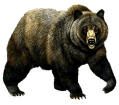
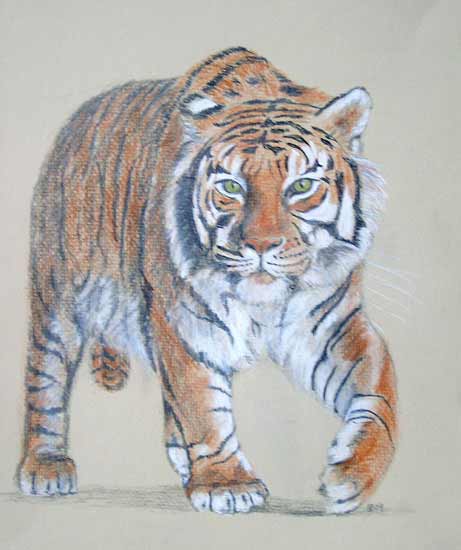
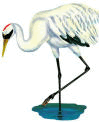
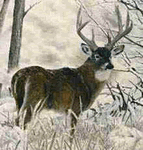
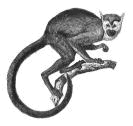
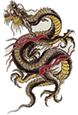
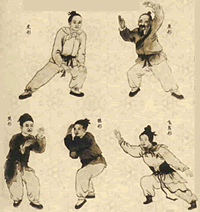
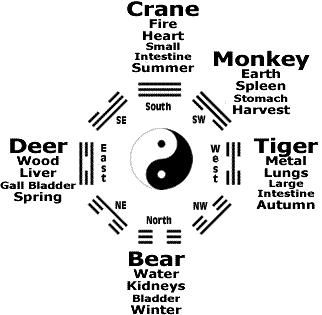
Five Animal Frolics Table of Correspondences
| Animal | Element | Season Time Age |
Direction Weather |
Organs Body |
Mental Psychological |
Animal Characteristics |
Energetics |
| Deer | Wood | Spring Green Morning Young 10-20 Planting |
East Wind |
Yin: Liver Yang: Gallbladder Joints, Tendons Tears Vision, Eyes |
Benevolence/Kindness Ren Anger, Shouting Spirit Patience & Subtlety |
Gentleness Calmness Alertness Herbivorous Woodlands |
Rising, Expanding, Lifting Sound: Hsü
|
| Crane | Fire | Summer Red Midday 30-40 Growth |
South Heat |
Yin: Heart Yang: Small Intestine Blood Vessels Muscles Sweat Touch, Hands |
Propriety Order Li Joy, Laughing Calmness Control/Chaos Heaven |
Lightness Herbivorous Primarily Omnivorous Sometimes Flying Longevity Steady/Balanced Migratory Marshlands |
Radiate, Disperse, Scatter, Rise Sound: He |
| Monkey | Earth | Harvest Yellow Afternoon 40-50 Transformation |
Center Southwest Humid |
Yin: Spleen Yang: Stomach Spit Muscles Joints/Wrists Taste, Mouth |
Trust Xin Pensiveness, Worry, Reflection Singing Empathy, Sympathy Humanity |
Openness Agility Herbivorous Curiosity |
Knot Sound: Hoo |
| Tiger | Metal | Autumn White Evening 50-60 Harvest |
West Dry Windy |
Yin: Lungs Yang: Large Intestine Nasal Mucus Whole Body Skin Smell, Nose Breathing |
Righteousness Integrity Yi Grief/Sadness/Crying Anxiety/Sorrow, Letting Go Body |
Ferocity Strength Awareness Carnivorous |
Speed Leaping Constrict Sound: Si |
| Bear | Water | Winter Blue Black Nighttime 70's+ Storage |
North Cold |
Yin: Kidneys Yang: Bladder Lower Back Spit Bones Hearing , Ears |
Wisdom Zhi Honesty Confidence/Worry Fear Earthiness Inner Focus |
Rootedness Lumbering Hibernating Sensitive Smelling Omnivorous |
Gathering, Absorbing Wavelike, Dropping Sound: Chui |
The assignment of alchemical and magickal correspondences to the Animals vary amongst practitioners of the Five Animal Frolics, qigong theorists, and Taoist Alchemists. The following authors have provided tables of correspondences: Mantak Chia, Kenneth Cohen, Franklin Fick, Mike Garofalo, Alan Graham, Livia Kohn, Joseph Morales, Ken Morgan, Nancy Seeber, Yang Jwing-Ming, and Oberon Zell-Ravenheart.
Readers should keep in mind that knowledge of these alchemical and magickal correspondences is of some usefulness to most practitioners. The true Adepts and playful Wizards will need to pay very close attention to correspondences. These associations have a long history in China and their meanings are part of the mental aspects of the Five Animals Frolics Daoyin practice. Daily practice of the Frolics, most often outdoors, is essential to embody these cosmic principles.
All of the Five Animals are Wild Animals. They are not normally considered "domesticated" animals (e.g., dogs, goats, cattle, pigs, chickens, cats, horses). Because of their intelligence and skills, monkeys have been tamed and trained by humans. Because of their size and wild nature, tigers and bears are especially dangerous around humans.
A wise person will always try to understand the cosmic forces that influence and/or rule our lives: the air we breathe, the sun that warms the earth, the water that sustains all living beings, the plants and animals of our world, the human technology that makes our lifestyles possible, the ideas and values that constitute our spirit. These forces are symbolized by Air (breath, energy), Fire (sun, hearth), Water (rain, snow, lakes, sea, ponds, wells), Wood (plants, trees, fruit, grains, food), Animals (Deer, Crane, Monkey, Tiger, Bear, etc., domesticated animals, food, humans), Metal (technology, science, agriculture, earthly resources), Humanity (persons, family, village, state, society, culture), Spirit (mind, wisdom, Shen, Dao), and the Unbounded (imagination, fantasy, mystical creatures, spirits, divine, Wu, Heaven).
In China, the Five Elements (Phases, Processes, Cycles) are: Earth, Fire, Water, Wood, and Metal. In the West, the Five Elements (Materials, Substances, Components) are Earth, Fire, Water, Air, and Spirit (Aether).
I have reflected on the Trigrams of the I Ching and how Baguazhang Qigong Animals correspondences might be aligned. Even in this area, the assignment of correspondences vary considerably amongst theoreticians and practitioners.
Notice how the assignment of the Five Animals to the Five
Elements varies depending upon the authority consulted:
| Authors | |||||||
| Animal | 1 Kohn | 2 Yang |
3 Garofalo |
4 Seeber |
5 Morgan |
6 Cohen |
7 Chinese Health Qigong Association |
| Deer | Liver Wood |
Kidneys Water |
Liver Wood |
Liver Wood |
Kidneys Water |
Kidneys | |
| Crane | Heart Fire |
Lungs Metal |
Heart Fire |
Heart Fire |
Heart Fire |
Heart Fire |
Lungs |
| Monkey | Spleen Earth |
Heart Fire |
Spleen Earth |
Spleen Earth |
Spleen Earth |
Heart | |
| Tiger | Lungs Metal |
Liver Wood |
Lungs Metal |
Lungs Metal |
Lungs Metal |
Liver | |
| Bear | Kidneys Water |
Spleen Earth |
Kidneys Water |
Kidneys Water |
Liver Wood |
Kidneys Water |
Spleen |
1. Kohn, Livia. "Chinese Healing Exercises: The Tradition of Daoyin." University of Hawaii Press, 2008. 268 pages. ISBN: 0824832698. p. 164.
2. Yang, Jwing Ming and Kathy K. Yang. "Five Animal Sports Qigong." Instructional DVD, 2008.
3. Michael Garofalo. Five Animal Frolics, 2009. Handouts: All Five, Deer, Crane, Monkey, Tiger, Bear, Dragon.
4. Sandy Seeber and Alan Graham. Five Animal Frolic Handout.
5. Ken Morgan. Medical Qigong Education Center, UK. Five Animal Frolics.
6. Ken Cohen. "Way of Qigong." pp. 201-209 and his instructional DVD.
7. Chinese Health Qigong Association. The Effect of Precaution against Sub-health of the Health Qigong Wu Qin Xi. 2008.
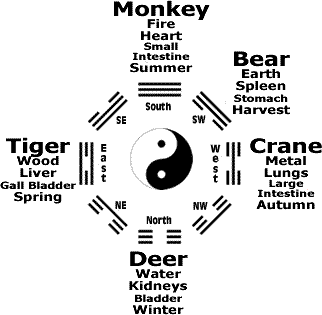
Grandmaster Yang Jwing-Ming and the Chinese Health Qigong Association both
use a different assignment of the Five Animals to the Five Elements. Here
is a
schematic for their assignment of correspondences:
General Remarks, Comments and
Suggestions
Regarding the Practice of the Five Animal Frolics
By Mike Garofalo
Variety
There are over 20 different modern versions of the "Animal Frolics." Nowadays, most sets of the exercises are done in a standing position. Many sets have two or three exercises for each animal, and you do the exercises for all five animals in each exercise session. Alchemical associations are important to some practitioners, and totally ignored by others.
All the Animal Frolics teachers do speak of the same general mind-body principles to follow while doing the Animal Frolics Daoyin (Qigong) exercises: calmness, slowness, relaxed (sung), balanced, deliberate, taking on and expressing the characteristics and nature of the specific animals, inner awareness, deep breathing, concentrated mind, not forcing (wu wei), playfulness, lightness, awareness of energy movement in the body-mind, serenity, delight ...
My Own Practices
In my private home practice, most of the time, I like to do just one Animal at a time. I do favor some spontaneity, freedom, and flexibility in choosing what Animal Frolic(s) to practice each day, and what movements from that Frolic that I choose to practice. Consequently, my private home practice is varied. Depending upon my interests, time available, mood, and what healing modality I feel is most needed by me, I feel free to play around with combinations and repetitions. We human beings, unlike our wild animal neighbors, are more varied and creative in our activities and responses to our environment. In some sense, we are "wilder" (i.e., more unpredictable, spontaneous, uncontrolled, liberated, unnatural, chaotic) than all other non-human animals, wild or domesticated.
When I teach the Animal Frolics, I teach one animal at at time, appropriate to the season, and just teach that one animal frolic set with explanations and commentary relevant to the specific wild animal, healing benefits, history, Five Elements, healing sound, seasonal aspects, natural history, etc.
I began my study and practice of Taijiquan and Qigong in 1986, and Yoga in 2001. Over the years, I learned the Animal Frolics from numerous instructional media (DVD or VHS), books, from instructors, at workshops, and from personal practice. I have been teaching Taijiquan and Qigong since 2000, and yoga since 2004, in Red Bluff, California. This webpage on the Five Animal Frolics has been online since 2003. In 2008, I attended a two-day Five Animal Frolics workshop taught by Kenneth Cohen in Sacramento, California.
Please read my own Disclaimer regarding the alleged benefits of qigong or taijiquan or yoga or walking or gardening. I'm not trying to sell anything in particular on these webpages, and have tried to be as inclusive and open-minded as possible in my references to books, articles, instructional media, and webpages about the Five Animal Frolics. You are welcome to be as skeptical, questioning, and critical of the research I am sharing with my many readers around the world. I welcome your suggestions, additions, comments, corrections, and ideas; and please send them to me via my email. Hopefully, we will all learn something, enjoy ourselves, improve our own health, and go on to help others improve their health and well-being.
Dangers
I believe that the Five Animal Frolics are relatively easy to perform. On the whole, they are quite safe to practice. They are suitable for persons of all ages to practice, and can be easily modified for special circumstances and limitations. They require a low level of cardio-vascular conditioning for performance. I believe that you will benefit in mind, body, and spirit from the regular practice of the Five Animal Frolics.
I have read authors, and listened to teachers, who say that you must learn the
Five Animal Frolics or another qigong form from a qualified teacher in person to
person lessons. These teachers and experts then go on to tell you a story
or two about persons who tried to learn the Frolics on their own and became
insane, injured, very sick, or possessed by demons
(Jinn). Then they relate anecdotes about persons who took
direct instruction from a master teacher (usually themselves for a fee, or their
teacher for a fee) and were cured of serious diseases, regained their health,
and reenergized themselves. I think it is important to learn from
qualified instructors. However, many master teachers have produced good
books and instructional DVDs on the subject of the Five Animal Frolics that you
can easily learn from in an efficient and effective manner. You are far more
likely to go insane, or get injured, or get very sick when you do nothing but
sit on your butt all the time. If you wanted
become a successful Power Lifter (i.e., maximum weight squat, dead lift, and
bench press) I would strongly recommend direct person to person instruction and
spotting from a
qualified trainer, considering the dangers of Power Lifting. Learning the
Animal Frolics, on the other hand, is relatively easy, quite safe, and lots of
fun; and, a good instructional DVD is quite sufficient, and less expensive, when
other alternatives are not available.
Always beware of glowing testimonials and uplifting anecdotes about the benefits and/or curative powers of any exercise regimen. Identifying casual relationships is a difficult scientific task. Try the exercise and see how it works for you. Do you enjoy the exercise and perform the exercise regularly? What is your state of mind, your energy level, your level of happiness? Are you stronger, more active, and more flexible? Are your minor aches and pains diminishing? How do your checkups with your physician go? This exercise activity is about YOU and not about what happened to John Q. Public from Kokomo, Indiana or Hong Kong, China. Persons with a serious disease will have a very difficult time in weighing treatment and exercise options and sometimes throw caution and skepticism to the wind, relying more on hope than on more scientific and evidentiary approaches.
Again, please read my own Disclaimer regarding the alleged benefits of qigong or taijiquan or yoga or walking or gardening.

Waving
Hands Like Clouds Homepage
© Michael P. Garofalo, 2003 - 2017, All Rights Reserved
This webpage was first posted on the Internet in January 2003 at: http://www.egreenway.com/taichichuan/five.htm
This webpage was moved to this URL on June 15, 2009: Animal Frolics Qigong, http://www.egreenway.com/qigong/animalfrolics.htm
This webpage was last modified or updated on April 5, 2017.
Valley Spirit
Qigong, Green Way Research,
Valley Spirit Center,
Gushen Grove, California, 2003-2017
Green Way Research, Cloud
Hands Home, City of Vancouver, State of Washington, Northwest USA, 2017-
Five Animal Frolics Qigong (Wu Qin Xi)
Alphabetical Index to the Cloud Hands Website
|
Tao Te
Ching |
|||||||||
| 1 | 2 | 3 | 4 | 5 | 6 | 7 | 8 | 9 | 10 |
| 11 | 12 | 13 | 14 | 15 | 16 | 17 | 18 | 19 | 20 |
| 21 | 22 | 23 | 24 | 25 | 26 | 27 | 28 | 29 | 30 |
| 31 | 32 | 33 | 34 | 35 | 36 | 37 | 38 | 39 | 40 |
| 41 | 42 | 43 | 44 | 45 | 46 | 47 | 48 | 49 | 50 |
| 51 | 52 | 53 | 54 | 55 | 56 | 57 | 58 | 59 | 60 |
| 61 | 62 | 63 | 64 | 65 | 66 | 67 | 68 | 69 | 70 |
| 71 | 72 | 73 | 74 | 75 | 76 | 77 | 78 | 79 | 80 |
| 81 | |||||||||
Return to the Top of this Webpage


Cloud Hands Blog of
Michael P. Garofalo

Facebook of
Michael P. Garofalo

Return to
the Alphabetical Index of Mike Garofalo's Hypertext Documents
TAGS, Search Terms, XReferences:
Hua To, Five Animal Frolics, Wu Hsing Chuan, Wu Win Xi,
Old URL webpage Links, before June 2009, for this New Webpage:
Animal Frolics: http://www.egreenway.com/taichichuan/five.htm
Animal Frolics: http://www.egreenway.com/qigong/five.htm