
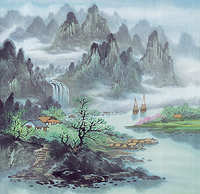
Wild Geese, 1926, by Ohara Shoson
大雁氣功
© Valley Spirit
Qigong, Green Way Research,
Vancouver, Washington, 2002-2018
By Michael P. Garofalo, M.S., All Rights Reserved.
Wild
Geese, 1926, by Ohara Shoson
Wild Goose (Dayan) Qigong
Bibliography, Links and Resources
Advanced Qigong Practice Program
Alphabetical Index to the Cloud Hands Website
Animal Frolics Qigong,
Five Animal Frolics, Wu Qin Xi Bibliography,
Resources, Lessons, Links, Quotes. Bear, Deer, Crane, Monkey, Tiger
Awaken
Healing Energy Through the Tao. By Mantak Chia. Santa Fe, New
Mexico, Aurora Press, 1983. 193 pages. ISBN: 0943358078. VSCL.
BC Wild Goose Qigong Club
Introduction, cures, links, articles, photos, club news.
The
Briefs of Wild Goose Qigong
Center for Traditional Qigong and Taijiquan.
Sifu Adam Wallace has taught Wild
Goose Qigong for over fiteeen years.
Chi Kung (Qigong, Dao
Yin, Yangshengong): Bibliography, Links, Resources, Lessons, Quotations, Notes,
Forms
Chi
Kung: Taoist Secrets of Fitness and Longevity. By Yu,
Wen-Mei. Burbank, CA,
Unique Publications, 1998. 167 pages. ISBN: 0865681651.
Instructions in Wild
Goose qigong. Yu, Wen-Mei was a student of Madame Yang, Jun-Mei, the
legendary grandmaster of this popular and complex school of energy cultivation.
An instructional
videotape is also available.
Chinese Healing Exercises: The Tradition of Daoyin. By Livia Kohn.
University of Hawaii Press, 2008. 268 pages. ISBN:
0824832698. History of Daoist health practices.
Cloud Hands Blog. By Mike
Garofalo. Online since 2005. A blog with
reflections, notes, suggestions, references, questions and answers, links and quotations about Tai Chi Chuan,
Qigong, Yoga, Gardening and Walking. Posts related to
Wild Goose
Qigong.
Crane Frolic, Five Animal
Frolics Qigong
Dao An or Si Dao An (The Peaceful Way). An early teacher of Wild Goose
Qigong during the Jin Dynasty (256-420 A.D.). Considered the founder of Dayan
Qigong. Associated with the Taoist Kunlun School from the Kunlun Mountains in the north-west of
China. Artcile on
Dao An in Qi Magazine, Issue #57
and #58.
Daoist
Body Cultivation: Traditional Models and Contemporary Practices.
Edited by Livia Kohn. University of Hawaii Press, 2006. 243 pages.
ISBN: 1931483051. VSCL.
Daoist Studies and
Practices: Ripening Peaches
Dao Yin (Qigong, Chi
Kung, Yangshengong): Bibliography, Links, Resources, Lessons, Quotations, Notes,
Forms
Dayan = Da Yen = Wild Goose = Da Yan
Dayan
Qigong Demonstration and instructional video CDs ( 2 VCDs). Features
demonstrations by
Grandmaster Madame Yang, Mei-Jun. Distributed by Mr. Wang Tao. Part
of Chinese
Alternative Medicine CD series. Subtitles in English.
Dayan
Qigong. By Madame Grandmaster Yang, Mei-Jun. Hai Feng
Publishing Co.
72 pages. In English. ISBN: 9622381847. Out of
print.
Dayan Qigong: A Relaxing Path to Health and Fitness
Dayan Qigong (Wild Goose
Breathing Exercises). By Madame
Master Yu, Wen-Mei. Burbank, California. Instructional videotapes. Part 1: This tape
includes demonstration of the complete exercises (Forms 1-64), basic acu-meridian points and a
step-by-step instruction of forms 1-22 . Part 2: This tape starts with a review of forms 1-22
followed by a step-by-step instruction of forms 23-55. Part 3: This tape
includes a review of forms 1-55, a step-by-step instruction of forms 56-64 and a daily practice
companion.


Da Yan Wild Goose Qigong: The First 64 Movements. By Simon Blow. Genuine Wisdom Centre, 2017. 232 pages. ISBN: 9780987341761.
Da Yen (Wild Goose)
Qigong The Taoist Center, Oakland, CA
The
Dragon and the Wild Goose: China and India. By Jay Taylor.
Praeger, 1991. 320 pages. ISBN: 0275936015.
Eight Section Brocade
Qigong By Michael P. Garofalo. History and
purpose of
this popular chi kung practice. Descriptions for each of the eight
movements, health benefits,
comments, variations, extensive links and bibliography, resources, quotations,
animated
.gif photographs of the movements, and charts. HTML format. This file is updated
on a regular basis as I add new material, links, notes, and resources. A.K.A: Baduanjin, Pa Tuan Jin, Eight Silken
Treasures, Ba Duan Jin, Pal Dan Gum, Ba Duan Gin, Pa Tin Kam, Otto Pezzi di Tesoro, Acht Delen
Brokaat,
Les Huit Exercices del la Soie, Eight Silken Treasures, Brocade Qigong, Wudang
Brocade Qigong, Silk Treasures Qigong, First Eight Buddha Lohan Hands.
External
and Internal in Ge Hong's Alchemy. By Evgueni A. Tortchinov.
Five Animal Frolics Qigong,
Wu Qin Xi Bibliography, Resources, Lessons, Links, Quotes
A
Flourishing Yin: Gender in China's Medical History, 960-1665.
University of California Press, 1999. 343 pages. ISBN: 0520208293. "This
book brings the study of gender to Chinese medicine and in so doing contextualizes Chinese medicine in
history. It examines the rich but neglected tradition of fuke, or medicine for women, over
the seven hundred years between the Song and the end of the Ming dynasty. Using medical
classics, popular handbooks, case histories, and belles lettres, it explores evolving
understandings of fertility and menstruation, gestation and childbirth, sexuality, and
gynecological disorders. Furth locates medical practice in the home, where knowledge was not the monopoly
of the learned physician and male doctors had to negotiate the class and gender
boundaries of everyday life. Women as healers and as patients both participated in the
dominant medical culture and sheltered a female sphere of expertise centered on, but not limited
to, gestation and birth."

Six Swans
By Warick Goble
Geese (Swans, Cranes) - Folktales, Fables, Legends, Myths, Information:
Five Animal Frolics
Qigong: Links,
Bibliography, Quotes, Notes
The
Golden Goose King: A Tale Told by the Buddha. Retold and Illustrated
by Judith Ernst. Parvardigar Press, 1995. ISBN: 0964436205.
Illustrated with meticulously finished opaque watercolor paintings based on early Buddhist art in
India.
Leda
(Goose) and the Zeus (Swan) mated and gave birth to Helen of
Troy.
Modern
Interpretaions of the Six Swans. By Heidi Ann Heider.
Nemesis,
the Greek goddess of retribution, is associated with a goose form.
Qigong (Chi Kung, Dao
Yin, Yangshengong): Bibliography, Links, Resources, Lessons, Quotations, Notes,
Forms
Swans
of the World: In Nature, History, Myth and Art. By A. Lindsay
Price. Council Oak Distribution, 2003. 196 pages.
The
Twelve Wild Swans: A Journey to the Realm of Magic, Healing and Action. By Starhawk. Harper San Francisco, 2001.
352 pages. ISBN: 0062516698.
Waterfowl:
An Identification Guide to the Ducks, Geese and Swans of the World. By
Steve Madge. Illustrated by Hilary Burn. Houghton
Mifflin Company, Reprint Edition, 1992.
The
Wise Goose - An Indonesian Tale
The wild goose is associated
with longevity in China. - Master Yao
Hatha Yoga: The Hidden Language; Symbols, Secrets and Metaphor. By Swami Sivananda Radha. Foreward by B.K.S. Iyengar. Spokane, Washington, Timeless Books, 1987, 1995. Index, 308 pages. ISBN: 0931454743. A wonderful book filled with lore, myths, symbols, stories, and metaphors about various yoga postures. Yoga postures that embody aspects of birds (pp. 180-225) include the Swan (Hamsasana), Crane (Bakasana), Eagle (Garudasana), Peacock (Mayurasana), and Cock (Kukkutasana).
Health and Long Life: The Chinese Way. By Livia Kohn and Stephen
Jackowicz.
Uinversity of Hawaii Press, 2005. 234 pages. ISBN: 1931483035.
The Historical
Origins and Ideological Sources of Religious Taoism
By Liu Feng and Lao An.
Hu,
Bingkun : Wild Goose Qigong Notes
Immortality, The Peaches of
Immortality from the Queen Mother of the West, Queen of Kunlun Mountains
Immortal
Sisters: Secret Teachings of Taoist Women. Edited by Thomas
Cleary. North Atlantic Books, 1996. Reprint edition. 90 pages. ISBN:
1556432224.
Introduction to Dayan
Qigong. By Ronnie Robinson.
Kunlun Mountains: Geography
Historical
- Han - Map Map
Geography
Map
Mount Kunlun, Mount K'un-lun, K'un-lun Shan
Shang-gri-la,
the city of paradise, is supposedly located in the Kunlun Mountains.
The "Isles
of the Blessed" or P'eng-lai are also located in the Kunlun
Mountains.
The Kunlun
Mountains are an important symbol in Taoism, equivalent to the Buddhist Mt. Sumeru (Meru), or
cosmological "world mountain."
Emei
Mountain and the Leshan Giant Buddha
"According to a Tang scholar of the 7th century,
Daoxuan (596-667), "Kunlun"
and Himalaya were one and the same. Many scholars suspect the Chinese legend of "Xiwangmu" being
a goddess of Indian origin, albeit it is difficult to
convince others without historical evidence."
Learning Dayan Qigong.
By Michael Tse. Qi Magazine, # 55.
List of Movements of Wild Goose Qigong, First Form,
Movements 1-64
List of
Movements of Wild Goose Qigong (Pre-64 Form), Gentle Path Tai Chi Chuan Association
Lone Fliers in
the Red of Dusk: Ducks and Geese
Metaphors, Clichés, Terms:: Loose as a goose; Wild goose chase, What's good for the goose is good
for the gander: goose flesh; Goosing (poking someone in the rump); Goose that lays the golden egg; Loosey-goosey;
Microcosmic
Orbit Illustration for Wild Goose Qigong
Movements of Wild Goose Qigong, First Form, Movements 1-64,
List
Norwich Tse Tai
Chi and Qigong Club in England
One Old Druid's Final
Journey: The Notebooks of the Green Wizard
Pathways in the Green Valley Blog.
Mike Garofalo writes about gardening, natural history, walking,
mind-body arts, philosophy, and the Eight Ways. Online since 2003.
Formerly titled: The Green Way Blog, and the Valley Spirit Blog.
Peaceful
Dragon School - Dayan Qigong Master Young.
Peaches of Immortality from
the Queen Mother of the West, Queen of Kunlun Mountains
Persistence and Grace
of the Wild Goose. An Introduction to Dayan Qigong. By
Ronnie Robinson. Taijiquan and Qigong Journal, Vol 7, Issue 1,
2002. 15Kb.
The Possible Society
of California: Dayan Qigong By Bett Martinez, Dayan Qigong
teacher
and student of Master Hui Liu.
Qigong Institute.
Berkeley, Menlo Park, CA.
Relaxing Into Your Being. The Water Method of Taoist Meditation Series,
Volume 1. By
Bruce Kumar Frantzis. Fairfax, California, Clarify Press, 1998.
Reader's Edition.
208 pages. ISBN: No ISBN given. Master Frantzis lectures on
dissolving are important
for the Wu Ji qigong meditation posture.
Qigong for Health and Vitality. By Michael Tse.
UK.
Qigong
for Women: Low-Impact Exercises for Enhancing Energy and Toning the Body.
By Dominique Ferraro. Healing
Arts Press. Published by Inner Traditions.
176 pages. ISBN: 0892818387.
Queen Mother of the West,
an important Taoist Goddess, lives in a palace on Mount
Kunlun.
"In The
Journey to the West, the Lady Queen Mother is the wife of the Jade
Emperor and lives
in Heaven. Elsewhere, She is often known as the Queen Mother of the
West,
wife of the Lord
King of the East and ruler of Mount Kunlun, home of the Taoist Immortals.
In either case, She
tends the orchard where the Immortal Peaches grow."
Queen Mother of the West - Xiwangmu: Legends Links Notes
Queen Mother of the West - Hsi Wang Mu (Chinese name)
Queen Mother of the West - Seiobo (Japanese name)
"The Queen Mother of the West and the King Father of the East, surrounded
by flying
winged-people, appear together in the Han copper mirror. This signifies that she had
become a
center for those who aspire to Fly to Immortality." The
Golden Mother of the Jaspar Lake
"There are birds associated with the myth of the Queen Mother of the West."
Transcendence
& Divine Passion: The Queen Mother of the West in Medieval China.
By Suzanne Elizabeth Cahill.

Queen Mother of the West and Wild Goose
Ripening Peaches: Daoist Studies and Practices
The
Root of Chinese Chi Kung: The Secrets of Chi Kung Training. By Yang
Jwing-Ming, PhD., 1946-.
YMAA Chi Kung Series #1. Jamaica Plain, Massachusetts, Yang's
Martial Arts Association, 1989. Glossary, 272 pages. ISBN:
0940871076. VSCL.
A Safe and Delightful Approach to Good Health By Bingkun Hu, Ph.D
Search Terms: Dayan Qigong, DaYan, Da Yen, Wild Goose, Wild Goose
Breathing Exercises,
Wild Geese Qigong, Wildgans Qigong.
Secrets
to Living Younger Longer: The Self-Healing Path of Qigong Standing
Meditation
and Tai Chi. By Michael Mayer, Ph.D.. Orinda, California, Body Mind
Healing
Publications, 2004. Index, bibliography, 281 pages. ISBN:
0970431066.
This book has a companion instructional video/DVD called "Body Mind Healing
Qigong."
Website: Body Mind Healing.
VSCL.
Subject Index to Cloud Hands Website
Tai Chi Chuan:
Bibliography, Lessons, Links, Resources, Instructions
Taoism
and Kunlun Mountains - Links
Taoist
Ways to Transform Stress into Vitality: The Inner Smile and Six
Healing Sounds. By Mantak Chia. Healing Tao Books, 1991. 115
pages. ISBN: 0935621008.
The
Taoist Body. By Kristofer Schipper. Translated by Kare C.
Duval. Foreward by
Norman Girardot. Berkeley, University of California Press, 1972, 1993.
Index, bibliography, notes, 273 pages. ISBN: 0520082249. "Kristopher
Schipper, who has developed the symbolic relationship of the human body to the image of a sacred
mountain to a considerable extent, states that the body of the meditating Daoist adept is
seen in particular as Mount Kunlun, the mountain considered the most sacred in Daoist
mythology."
Secret
Anatomic Terminology Refer to pp. 103-123. "The
left eye (the sun) is the dwelling
of the Father of the East, the yang energy of spring; the right one shelters the
Mother of the West, the Original Energy of the Great Yin. The Father is call
"Non-Action," the Mother, "Nature." She reigns over Mount K'un-lun. She is still
called Reclining Jade or the Jade
Maiden of Obscure Brillance." p. 110.
Taoist Center - Da Yen
(Wild Goose) Qigong
Taoist Studies and
Practices: Ripening Peaches
Tse Qigong Centre. Master
Michael Tse. Grandmaster Yang Meijun.
UK Taiji Qigong Foundation (UKTQF)

Videos of Performances of the Wild Goose Qigong
Wild Goose
Qigong 大雁氣功 - 前
64 式 - 講解 UTube Video, 8:06 minutes. An older man, in yellow,
in a secluded park-forest setting.
Wild Goose Qigong. Demonstration by Master Lu Gui Rong. Parts 1,
2 and 3. UTube, 3:15 minutes each part. Older man in a secluded
setting.
Wild Goose Qigong - UTube Search
The Way
of Qigong: The Art and Science of Chinese Energy Healing. By Kenneth
S. Cohen.
Foreword by Larry Dossey. New York Ballantine Books, 1997. Index,
notes, appendices,
427 pages. ISBN: 0345421094. MGC. One of my favorite books:
comprehensive,
informative, practical, and scientific.
Wen Mei Yu Internal Arts
Grandmaster. Burbank, CA.
Wilde, Julian
England
Wild Goose QigonG:
With Dr. Bingkun Hu Notes
Wild Goose Qigong: Woman
Healing
Wild Goose Qigong. By
Michael Tse.
Wild Goose Qigong, List of Movements, First Form, Movements
1-64
Wild
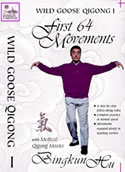
Goose Qigong 1: the First 64 Movements. Instructional DVD by Master
Bingkun Hu. Three Geese Productions, 2004. 50 Minutes. VSCL.
Wild
Goose Qigong 2: The Second 64 Movements. Instructional DVD by Master
Binkkun Hu. Three Geese Productions, 2008. 55 Minutes.
Wild Goose Qi Gong, Part 1. By Lu Yuzhi.
Instructional VHS videotape, 120 minutes.
Part 1, Movements 1-64 of the First Form
Distributed by: Wayfarer.
"By Lu Yuzhi. Wild Goose Qigong is one of the most popular qigong systems
in China. It imitates the movements of wild geese and emphasizes stretching and opening the joints.
There is an initial demonstration of the entire 64-movements of the first form,
followed by step-by-step teaching of groups of movements. Each movement is shown three or more times. There are
front, rear and side views. At the conclusion, there is a demonstration of the form from the
rear. Narrated by Jiang Jian-ye." Wayfarer
Wild
Goose Qigong, 1st Set of 64 Movements. By Michael Tse. Tse
Qigong Centre, 2001. 213 pages. ISBN: 1903443016.
Wild
Goose Qigong, 2nd Set of 64 Movements, Part 1. By Michael Tse.
Tse Qigong Centre, 2004. 170 pages. ISBN: 1903443032.
Wild Goose Qi Gong, Part 2. By Lu Yuzhi.
Instructional VHS videotape, 120 minutes.
Part 2, Movements 1-64 of the Second Form
Distributed by: Wayfarer
Demonstrations of the entire form. Each movement is taught separately
with 3 to 4 views
of the movements. Narrated by Jiang Jian-ye.
Wild Goose (Dayan) Qigong, First 64 Movement Form. By Master Lu Gui Rong.
Instructional videotapes: Part 1, Movements 1-34, 59 minutes. Volume 44 of
Traditional China's Living Treasures Series. Part 2, Movements 35-64, 72 minutes. Volume
45. Distributed by: One
Hand, Wayfarer "Master Lu Gui Rong's journey of the internal martial arts has spanned
over 50 years. He is a master of Wu (Hao) taijiquan, Yang taijiquan, and Dayan (Wild Goose) qigong. The
first 64 Movement form deals primarily with the "post natal body" and addresses
illnesses or injuries
that have developed as a result of everyday life. It focuses on the 12 primary
channels or meridians, the collaterals, and emphasizes the Ren, Du, Chong, and Dai channels
of the body. Dayan Qigong is one of the most popular styles of qigong practised in
China due to its accessibility to all ages. Master Zhang Yu of Shanghai was master Lu's
teacher, as well as, a senior student of Grandmaster Yang Mei-jun of
Beijing, 27th inheritor of
Kunlun Taoist Dayan Qigong." Wild
Goose Qigong
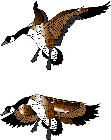
Wild Goose (Dayan) Qigong, Second 64 Movement Form. By Master Lu Gui Rong. Instructional videotapes: Part 1, Movements 1-42, 67 minutes. Volume 46 of Traditional China's Living Treasures Series. Part 2, Movements 42-64, 77 minutes. Internal Five Elements Form, Volume 47. Distributed by: One Hand, Wayfarer. "The second 64 Movement form deals primarily with the "pre natal body" and addresses problems you were born with or genetically inherited from your parents. Having dredged the channels in the first form, the 2nd 64 Movement form is designed to clear the channels to absorb qi, expel turbid qi. and restore organ balance. The twisting, stretching, and pressing produce stronger qi fields and intensify the circulation of the 8 collaterals. It is recommended that you practice the 1st 64 Movement form for at least 3 months before adding this form. The form repetition is divided into 5 groups, which are repeated 4 times each. There are also two repetitions of the movements 1 to 42, as well as, the entire form." Wild Goose Qigong

Master Lu Gui Rong
Wild Goose Qigong. Natural Movement for Healthy Living: History,
Exercises,
Results. By Zhang, Hong-Chao. Edited by James
O'Leary. Boston, YMAA Publications, 2000. Index, 105 pages. ISBN: 1886969787.
Produced and distributed by YMAA
Publications Center. Master Zhang studied
Wild Goose Qigong from 1985-1987 with Madame Grandmaster Yang, Mei-Jun,
while he was a Wushu instructor and graduate student at the Wuhan Institute
of Physical Education. VSCL.
Wild
Goose Qigong. Instructional videotape. By Master
Zhang, Hong-Chao. YMAA Publications, 2000. 50 Minutes. ASIN: 1886969949. Produced and distributed by YMAA
Publications Center.
Wild Goose Qigong Center.
Sifu Lee Masters. Vancouver, B.C.

Wild Goose Qigong.
Dr. Hu, Bing-Kun.
Workshops
Articles
Instructional DVDs
Overview
of 9 Wild Goose Qigong instructional videotapes by Dr. Hu, Bing-Kun. Dr.
Hu's Workshops on Wild Goose Qigong in California.
Wild
Goose Qigong I - First 64 Movements Video and DVD
Wild
Goose Qigong 2 - Second 64 Movements
Wild
Goose Qigong 3 - Kunlun Baugua
Wild Goose Qigong 4 - Tripod and Spiral
Wild Goose Qigong 5 - Soft Palms
Wild Goose Qigong 6 - Patting the Meridians
Wild Goose Qigong 7 - Back Stretching
Wild Goose Qigong 8 - Five Element Qigong
Wild Goose Qigong 9 - Chest Opening Aromatic Qigong
"Dr. Bingkun Hu is a medical Qigong Master and Qigong therapist. He
has been practicing Qigong and traditional chinese medicne (TCM) for over 50 years and has studied
with many of China's greatest contemporary Qigong masters. With his background in
Traditional Chinese Medicine and a Ph.D. in Western Psychology, Dr. Hu has been instrumental in
bringing the essence of both the Taoist and Buddhist Qigong to the American public in a
systematic and approachable way. In 2001, he was awarded "Outstanding People of the 21st
Century" in honor of his "Outstanding Contribution to Medical Qigong" by the
International Biographical Center in Cambridge, England. Dr. Hu's publications include 11 Qigong video
tapes, 9 of which are devoted to Wild Goose Qigong, one through eight. Dr. Hu also has a
private practice in Berkeley, CA."
Wild Goose Qigong (Da Yan). By Yang Meijun. 166 pages. English. "This book contains the first and second sets of 64 Actions of Da Yan, or Wild Goose, Chi Kung - one of the most popular sets in China. It includes 122 diagrams and detailed explanations of the movements, along with guides for practice and information about the exercises from the Traditional Chinese Medicine perspective. In particular, the diagrams showing the meridians are very clear." Distributed by the Tai chi and Chi Kung Institute, Australia.
Wild Goose Qigong List of Movements
"Wild Goose Qigong Travels West." Kungfu
Magazine, February/March 1997.
Woman Qigong: Taiyin,
Wild Goose
By Sat Chuen Hon.
"Taiyin
Qigong is a healing practice for women. Originating in the Kunlun Mountain region on the border of
China, it was transmitted
along the ancient Silk Route. Taiyin traces its roots back to the times of the
early Persians and their priestess temple ritualistic dances. Later on, the woman Taoist
master Sun Bei Er laid down the foundations of Taiyin Qigong in her canonical writings Songs of the
Inner Elixir."
A Woman's Qigong Guide. By Yanling Lee Johnson. YMAA Publications,
2001.
153 pages. ISBN:
The
Wonders of Qigong. A Chinese Exercise for Fitness, Health and
Longevity.
Compiled by the China Sports Magazine, Beijing, China. Published by Wayfarer Publications, Los Angeles, CA, 1985. 111 pages. 275 line
drawings. ISBN: 0935099077. Includes the Wild Goose Qigong by Yang, Meijun (pp.46-62)
- includes detailed descriptions of each of the 64 movements along with clear line
drawings. I believe that this article by Meijun Yang, published in
1985, was the
first English language publication available in the U.S. that provided
detailed information on the Wild Goose Qigong 64 movement form.
Yangshengong (Qigong,
Chi Kung, Dao Yin): Bibliography, Links, Resources, Lessons, Quotations, Notes,
Forms
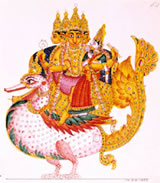
Vahana, the Cosmic Goose,
carries the Indian Creator God,
Brahma, and Saraswati, his Shakti or life force.

Yang, Mei-Jun, 1895-2002 Madame Qigong Grandmaster
Biography 1 Biography 2 Biography 3
Her granfather's name was: Yang Tak-Shan.
"Grandmaster
Yang, Mei-Jun was one of the true giants of modern qigong and energy medicine. She was the 27th Lineage holder of the Kunlun School Taoist tradition
- a tradition that dates back to the Jin dynasty (265 AD). Yang, Mei-Jun passed away
in 2002 at the advanced age of 107 years old."
- Wild Goose
Qigong.
"Yang Meijun is widely regarded to be the official
lineage holder of this wonderful qigong system. She began her qigong training at the age of 13 when her 73 year old
grandfather taught her. Although small in stature this remarkable woman worked for many
years developing and preserving this unique system of Qigong. In 1978, after the death
of her husband she decided to publicly teach her many systems of qigong. Being
over the required age of 70 years she also began to teach the Wild Goose, Dayan Qigong
as she wanted to pass its many benefits on to others. Yang Meijun is Director of
Special Commission for Dayan Qi Gong and serves as a council member of China
Scientific Research Institution of Qi Gong and honorary advisor to Beijing Qi Gong
Research Association."
- Ronnie Robinson, Persistence
and Grace of the Wild Goose.
Students of Madame Grandmaster Yang, Mei-Jun teaching in the English speaking
world
include: Master
Madame Yu, Wen Mei; Master Tse Wei Jing;
Madame Hui Liu;
Master Hu, Bing-Kun; Dr.
Amelia Barili.


Author of book and three videotapes on Wild Goose Qigong.
"Master Wen Mei Yu is a Master Instructor of Chinese Internal Arts of Qigong and Taijiquan. She began Qigong training in 1953 in Shanghai and her life has since been devoted to studying and teaching the healing methods and practice of Qigong and Taijiquan. Her instructors in Qigong include Guo Ling, creator of Guo Ling Qigong, a system designed to overcome cancer; and Yang Mei Jun, one of the greatest exponents of the Taoist Dunlun School and Zhao Jin Xiang, Creator of the Soaring Crane System of Qigong." Resource Center
Zhang, Hong Chao.
Chinese Martial Arts Master in Chicago.
Zhan Zhuang: Standing Meditation
Return to the Index for this Webpage

Wild Goose Qigong
Quotes and Information
"In the north-west of China, high above the Himalayas, are the mystical
Kunlun Mountains. Nearly
1700 years ago a hermit named Si Dao An (the Peaceful Way) observed the
movements of the many wild geese that haunt the area and began to incorporate these bending,
stretching, twisting and fluttering techniques into a health-enhancing routine called the Dayan Gong
or Wild Goose Qigong. Since then over 30 generations have taught this skill to the
world. The 27th generation inheritor, Grandmaster Yang Mei-Jun (who died in 2002 aged 107) was the first to
open the Dayan Gong outside China ... through Master Tse Wei Jing Who is the only
authorised senior instructor of the Kunlun Mountains Qigong in the East of England."
- Julian Wilde,
Norwich Tse Tai
Chi
"Wild Goose Qigong belongs to the Kunlun School, so it is
also called Kunlun School Qigong.
This school began in the Sichuan Province in China. The most famous
practitioner of Wild
Goose Qigong was Dao An, who spread it during the Jin Dynasty (265-420
A.D.). Because he
was the most famous teacher of Wild Goose Qigong, he was crowned as its founder
by later
generations. Later on, Wild Goose Qigong spread to northern China,
and was kept by Wan Li
at Wutai
Mountain. Emperor Qian Long, during the Qing Dynasty (1368-1840 A.D.),
promoted
religion and established temples all over the country so that Wild Goose Qigong
could be passed down to the present."
- By Hong-Chao Zhang, Wild
Goose Qigong, p 12
"Dayan Qigong is a content-rich set
of system consisting of two categories: dynamic and silent. For the former, the routine forms imitate wild goose's shape, movements or even
habits, with the aim letting the internal energy flow smoothly within the body along the channels and
meridians, thus moving away the thwarting blocks. In a whole, all forms shine out the feeling of
wonderful harmony consisting both softness and hardness, of unrestrainedness, simpleness, and
lightness. Also, some strange feeling may arise to the heart that seems to fly over the wild
stretch of ocean and the vastness overpowers all consciousness."
- Dayan
Qigong
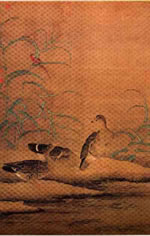
Huang Chu Tsai
Wild Geese and Rushes
Sung Dynasty
"Dayan Qigong is from the Taoist Kunlun systems and was
originally developed in the Jin Dynasty (1115 - 1234), but for many years remained a closely guarded
secret. Legend has it that before one was allowed to teach this system they had to study for
many years and could not teach it until they reached the age of 70 years. ... Dayan
Qigong is a Chinese internal system of two sets of 64 movements which are designed to boost the Qi
energy system, clear negative energy, increase mental clarity and thereby and leave the
practitioner feeling revitalised, refreshed and both mentally and physically stimulated.
Regular practice helps to stimulate the health Qi flow through the meridians whilst helping to
clear negative or stagnant Qi. It contains a number of beautiful bird-like movements which are
easy to learn and delightful to perform."
- Ronnie Robinson, Persistence
and Grace of the Wild Goose
"The next theme of [Ge
Hong's Alchemy, Chapter 18] is the parallel between human body and state. In the first part of the chapter Ge Hong already gave a highly
symbolical description of the human body with its subtle energetic centres (here the body obtained an image of
the sacred mount of Kunlun with its palaces and chambers of immortals; astral
imaginary of constellations was also important for this passage). At the concluding part of the chapter Ge
Hong simply in a rather traditional way gives analogies between parts of the body and functions
of the state. His conclusion: to master one’s own body is the same as to master the state;
pneumata (qi) of the body is the same as common people (min) in the state. The Daoist
practitioner must nourish the pneumata like lord of the state who must take care of his subjects. Here Ge
Hong states that the presence of the True One in the body as a result of the cultivation of
pneuma gives piece and stability to the souls of hun and po. It will
lead to the prolongation of life (nian ming yan) and the elimination of all evil
(bai hai que). The shou yi practices are extremely helpful (even in a greater degree than the amulets and
charms described in chapter 17 of BPZNP) for exorcisms in the wilderness of remote
mountains and forests where the Daoists prefer to cultivate their alchemical skill."
- Evgueni A. Tortchinov, External
and Internal in Ge Hong's Alchemy
"Stimulated by such a longing, the theory of immortality appeared in
areas along the east coast of the country, while in West China, there appeared the advocation of the theory
of nourishment of life initiated by the philosopher Zihua Zi. In the following ages, along with
the development of the arts of nourishing life and curing diseases, some achievements were made in
improving health and curing diseases, and there were legendary figures who enjoyed
miraculous longevity.
For example, Peng Zu, a high official of the Shang Dynasty, lived for more than
800 years because he constantly took in cassia twigs and was good at doing physical and breathing
exercises. For another example, Duke Rongcheng of the Zhou Dynasty, who claimed to be the
teacher of the Yellow Emperor and once made an audience with King Mu of Zhou, was particularly
good at nourishing life and doing physical and breathing exercises. In his old age,
consequently, his hair turned black again from white, his teeth cut again after they came off, and
lived as long as the legendary Lao Zi did. All this reflected the good wish of the ancients
for a long life. To make such a dream come true, people began to seek for the so-called elixir of
life. A well-known Chinese myth goes that Chang'e, wife of the formidable bowman named Yi, stole
and drank the
liquid of elixir distilled by the deity the Holy Mother of the West for the
banquet held by King Mu of the Zhou House on Mt. Kunlun, and, as a result, she flew and ascended into
the palace in the moon. It is true that it is nothing but a myth, but from it we can still
perceive the eagerness of the people of antiquity to find some kind of elixir and a way to
immortality."
- Liu Feng and Lao An, The
Historical Origins and Ideological Sources of Religious
Taoism
"They went on to the Kunlun
Mountains where they visited Xiwangmu [Queen Mother of the West] in her palace beside a lake named Yaochi (meaning jasper, an attractive coloured stone). He [King Mu, c. 300 BC]
presented her with jade of exquisitely fine quality and three hundred bolts of
brocade. She entertained him at a banquet beside the lake, feasting him with fabulous fruits and
delicacies. Among them were a lotus that bloomed in winter with pods containing a hundred seeds, black dates two feet
long from trees that bore every hundred years, and crisp, cool peaches that ripened only every ten thousand
years, and conferred immortality on those who tasted them."
- Legends:
King Mu and the Queen Mother of the West
'In the south of the West Sea, on the bank of the Sandy River,
in back of the Red Water
and in front of the Black Water, there is a great mountain named Kunlun.
On this mountain, there is a deity with a human face and a tiger body, and the body has
white
stripes and a tail. This deity wears a Xing (jade flower) and has tigher
teeth and a leopard
tail. She swells in a cave and her name is Xiwangmu. Everything is
in this mountain."
-
Master Zhongxian Wu, Vital Breath of the Dao
"The Chinese also traditionally group ducks and geese together, saying
they have in common webbed feet, short legs, long necks and the way they stretch their feet out
behind them in flight.
In East Asia, migrant species breed in Siberia and northeast China, and in
autumn follow routes through Japan or Korea, past Taiwan and Hong Kong. Some even cross the
equator and take up temporary residence in the southern hemisphere. When they catch sight
of wetlands along the way with an agreeable climate and plenty of plant life to feed on, they come
down to land.
After a short rest, some continue south, but ducks mostly take the easy option:
if they can find a suitable spot, they will settle down for the winter."
- Lone
Fliers in the Red of Dusk: Ducks and Geese
"In Taoist tradition it is said that "Starry
Beings," immortals from another galaxy, or a higher plane of existence descended to the Kunlun Shan 6,000 years ago bringing with
them the secrets of the universe. These beings lived among humans and taught the secrets of life.
They reincarnated as buddhas, boddhisattvas, and immortals. The Himalayas and the Kunlun
Shan enclose the Qing Zang Plateau, which encompasses Tibet and part of Qinghai Province. The Kunlun
Shan stretches 1000 miles past dreary provincial towns and desolate roads, its
snow-and-glacier-clad peaks rising abruptly along the north edge of the vast dry Tibetan plains."
- Hexagram
30 Lao
Tzu Shows the Way to Immortality
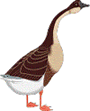
"In Ancient Egypt as well as in Ancient China the goose was
considered a messenger between Heaven and Earth. In China geese are still a symbol of marriage, because of
their lifelong pair-bond.
In the Roman empire, the goose was the sacred animal of Juno, a goddess of
light, marriage and childbirth, who was later considered adviser and protectress of the Roman
people. A story tells of how geese saved the Romans with their warning cries when the Gauls attacked the
citadel of the Capitol. The Celts associated the goose with war, possibly because of its
watchful nature and aggressive temperament. Warrior gods were sometimes depicted with geese as
companions. Remains of geese have been found in warrior's graves. The Britons kept geese,
but did not eat them. They were, however, sometimes used as sacrificial offerings. The
goose, with its steady, powerful flight and migratory habits, can be associated with travelling,
undertaking a journey to a new destination. This journey can be difficult and may take
long. The goose can help people find the perseverance needed to go on with their quests. In earlier
times, shamans were aided by spirit geese on their journeys to other worlds."
- Geese
- The Animal Files
"Wild Goose Qigong claims that “there are no intentional movements without
awareness. Wild Goose Qigong
advocates “wu-wei” (or “doing nothing”) and “tuo-yi” (“reduce one’s awareness to
the minimum”). A good
example is Wild Goose-1 (the first 64 Movements). We often tell our beginning
learners that the movements in
this set of qigong are supposed to describe the daily activities of a wild
goose. There are three parts to this qigong.
Part One is “The Goose Wakes Up”. It stretches itself, it brushes up its wings
and shakes them. It plays innocently.
A made-up story is even included: “Then the goose looks at the moon, which is
reflected in the water and tries to scoop it up."
Part Two is “The Flying Goose”. Flapping its wings, the care-free wild
goose skims over a smooth lake. It looks at the
water and dips down to drink the water. Then the goose is playing with he
“qi”. It tries to grasp the qi. It holds and
rotates the qi-ball. It pushes out the dirty qi, and tries to receive the
fresh qi from its lower back. In Part Three, the
goose is first flying up into the sky. Now it is flying over the water.
Then it is looking for some food. After that, it is
looking for its nest. At last, the goose goes to sleep. When beginning,
learners are encouraged to be pre-occupied
with the daily activity of an innocent wild goose, when they are imagining that
they are “flapping their wings” beside
shimmering lake under a full moon, their heart beat will be naturally slow down,
and their mind will gradually be quieting
down too. At the same time, they will be more responsive to the instructor’s
words on how to relax themselves through
the shifting of body weight. Wild Goose Qigong is a medical qigong. We practice
it because of its health benefits. When
we have better qi flow, our blood circulation will improve. We will have more
oxygen supply to our brain. Our mind will
be more alert. We will get stronger, and we will have more physical strength,
etc.."
- Bingkun Hu, Ph.D.,
A Safe and Delightful Approach to Good Health
"Historically, Wild Goose Chi Kung is supposed to have
originated with Hua Tuo a Chinese physician who lived around 100 AD.. He promoted a set of ancient exercises
known as Daoyin to help patients who were ill. It was further developed by the legendary
teacher Dao An and became preserved as an art by the Kunlun school of Taoism. (The Kunlun mountain
range borders on Tibet)."
- David Fiske
"Domesticated geese are symbolic of the home, women, fidelity, and
married life. In China, a pair of geese may be given to a bride and groom as symbols of marital
faithfulness. Around the world, stories are told about greedy farmers who foolishly kill the goose that lays the
golden egg. Medieval
bestiaries compared the gray goose favorably to the
devout Christian who lives a quiet life and modestly abstains from wearing colorful clothing. He maintains a vigilant watch
over his soul and keeps himself from all worldliness, unnecessary talk, and slander.
However, the white goose is a symbol for the fancy dresser, the chatterbox, and the malicious gossip.
The wild goose and its migratory ways are the mainstays of goose symbolism. Refugees and the
homeless are sometimes
compared to weeping wild geese because of the their
vulnerable situations. Many lessons in teamwork have been taken from the habits of migrating geese. Their
V-shaped flying pattern, rotation of the lead position, and encouraging honking have become emblems of
cooperation,
interdependence, and encouragement. Because two geese are said to
stop and assist a wounded or sick goose until it either gets well or dies, the goose has become a
symbol of loyalty."
- Christ Story
Goose Page
"There are four sections to this Qi gong. Section I
(movements 1-36) is to open channels and points repeatedly to expel toxins and draw in healthy air. Section II
(movements 37-44) are brisk movements to expel deeper toxins. Sections III (movements 45-55)
are to draw in healthy qi. Section IV (movements 56-64) are to adjust the blood and air,
balancing yin and yang in the body. ... Dayan (wild goose) is a bird of longevity and
high-energy and Qi Gong refers to the stimulation of the physical motion of the Bio-energy field
of human body. Dayan Qi Gong has obtained its name from imitating the movements and
habits and characteristics of wild geese. Dayan Qi Gong belonging to the Taoist
Kunlun School originated in Jin Dynasty and has been in circulation for more 1000 years.
For a long time in the past , Dayan Qi Gong was passed on secretly in the Taoist school. It has
a huge system consisting of more than 70 sets of motional and motionless Gong methods.
The practice of Dayan Gong may wonderfully result in curing sickness, reaping good
health, promising longevity and increasing intelligence, bringing about eventually an
overall improvement of physical and mental functions."
- Dayan/Wild Goose
Qigong
"Listen to all, plucking a feather
from every passing goose,
but, follow no one absolutely."
-
Chinese Proverb
"The Wild Goose Qigong Practices are a complete healing system. It is one of
the most famous and widely practiced qigongs in China today. It is well known
for its lovely and graceful movements and suggests the image of an innocent
carefree wild goose. These special birds have been observed for centuries by the
Kunlun Mountain School practitioners who sensed the beauty and harmony of freely
flowing energy (Qi or Chi) in these soaring geese. Contrary to the Western
belief of "no pain, no gain," the circular and spiral movements of Wild Goose
Qigongs are designed to be played effortlessly and with fluidity. As for the use
of awareness, Wild Goose Qigong claims that there are no intentional movements
without awareness. Therefore, using too strong an intentionality in one's
awareness can only inhibit the gentle moving of Qi. Wild Goose Qigong advocates
"wu-wei" (or "non-doing") and "tuo-yi" ("minimizing effort"). As a
movement oriented qigong, Wild Goose movements are meant to activate various
acupoints and allow energy to flow in the major channels in the front, back and
sidees of the torso and through the limbs. Wild Goose qigong can increase inner
strength and flexibility, improve immune function and circulation, cultivate
efficiency of breath and movement, and help develop sensitivity to our inner
energy flow. Perhaps the most wonderful thing about the Wild Goose qigong
is that it is completely enjoyable. The movements are dance-like and feel light
and joyful while the meditations are peaceful and relaxing."
- Bingkun Hu,
What is
Wild Goose Qigong
"A second Grandfather, he of the North, spoke again: "Take courage, younger brother," he said, "on earth a nation you shall make live, for yours shall be the power of the white giant's wing, the cleansing wing." Then he got up very tall and started running toward the north; and when he turned toward me, it was a white goose wheeling. I looked about me now, and the horses in the west were thunders and the horses of the north where geese. And the second Grandfather sang two songs that were like this:
"They are appearing, may you
behold!
They are appearing , may you behold!
The thunder nation is appearing, behold!
They are appearing, may you behold!
They are appearing, may you behold!
The white geese nation is appearing, behold!"
- Black Elk Speaks, 1932, p. 22, as told to John G. Neihardt.
"According to my Sifu, Master Michael Tse, Sigong (Yang Mei
Jun, the late 27th generation inheritor) would often say, "Dao De De Dao Zheng Dao Xing",
which
translates as "When virtue and morality is the path the right Dao will
flourish". This may be taken to mean that right thoughts and actions bear right results and when
the heart is right the Dao will reveal itself. This is especially important
today as society teaches us to be selfish and to want more so we cause problems for others
and remain unsatisfied, damaging our hearts. Many of whom practice Qigong only
consider the body (the movements) and mind (meditation) and neglect the heart (to
be open, develop compassion, and practice giving) and so they remain undeveloped.
Qigong is Character and Life training and a 'human skill' which means that through the
practice we can achieve our full potential as human beings. Health means to be
whole in this regard. Without the philosophy put into practice the skill itself is just
an empty shell.
Sigong also would also reiterate that Qigong is not about opening the Sky-eye,
or developing healing skills, Qi transmission, or special abilities but about
teaching us to connect with nature and to follow the natural way. This is how we attain
longevity."
- Sifu Adam Wallace, E-mail
to Mike Garofalo on 9/20/2004.
"Da Yen Qi Gong is an ancient system of movement that enhances your
health and well being by improving the
circulation of your qi (life force). It was developed in ancient China nearly
1500 years ago by a Buddhist monk.
The graceful and fluid movements of the form imitate the wild goose. In fact, Da
Yen means wild goose, and qi
gong means "mastery of qi." Each of the sixty four movements are designed to
accumulate qi in the body and
bring it to specific points on the acupuncture meridians. It is a simple and
non-strenuous exercise that with daily
practice can be mastered by people of all ages, body types and physical
conditions. Weekly classes include
instruction and correction of movements along with a series of stretching
exercises and systematic massage of
certain key points and meridians. For generations in China this form was
handed down as a secret doctrine.
The leading practitioner and Master was 102 year old Yang Mei Jung who began
learning the form from her
grandfather at the young age of 13. Her Grandfather learned it from a Taoist
monk in secret. Master Yang
herself was testimony to the benefits of Da Yen Qi Gong. At 101 years old she
was able to leap several feet
in the air and had been known to cure terminally ill people with Qi from her
hands."
- Taoist
Center - Da Yen (Wild Goose) Qigong
"Da Yan Wild Goose Qigong – The 1st 64 movements ‘Da Yan’
translates to ‘great bird’ and is an ancient cultivation practice originating
from the Jin Dynasty about 1700 years ago. Daoist Masters from the sacred Kunlun
Mountains, in the Northern Himalayan area in south-west China, would observe the
migrating geese which descended in this area each year. They would mimic the
movements of these great birds and started to developed the Da Yan Wild Goose
Qigong system. Its healing and spiritual legacy was passed down through many
generations; however Dayan Qigong was withheld from the general public until
1978. Then 27th lineage holder Grand Master Yang Mei Jung (1895-2002) decided to
teach this ancient Qigong practice and share its healing benefits to improve the
quality of life of all people. The 1st 64 movement set deals primary with the
‘post-natal body’ relating to the energy that one gathers after birth. The
movements representing the flight of wild geese are slow, graceful movements and
strong, quick movements designed to release stale Qi and to gather fresh Qi,
helping to restore balance and stimulate the entire energy system of the body."
- Simon Blow,
Da Yan Wild Goose Qigong: The First 64 Movements
"In creating many of the qigong systems the early originators
were known to have adapted the natural, flowing
qualities of animals, birds and serpents. Each system incorporates elements of
the various creatures to depict the
manner in which the movements should be performed. In our consideration of this
we should think about the fact
that the only creature that suffers from stresses that result in ailments to the
mind and body is man. Other creatures
carry no postural problems from the stresses of modern living!
The goose is a very strong bird that flies for incredibly long distances when
migrating in winter. Its strong energy
allows it to sustain the rigours of the long demanding journey ahead. Dayan
Qigong uses a wide variety of movements
that are designed to release negative energy and gather positive energy. It
contains slow, fluid, movements and quick,
strong movements. There are two sets of 64 movements, each set taking
approximately 15 minutes to perform. The
slow movements perform a kind of qigong massage on the internal organs like the
liver and spleen. There are gentle
movements where the hands vibrate over particular internal organs or acupoints.
These help to transmit energy from
the Laogong point in the centre of the palm, where the energy can often be felt
as warm or tingling, to stimulate the
energy system of the internal organs. Some of the faster movements act to
directly stimulate acupoints with a stronger
'surge' of energy to clear the area and ensure a freer pathway it to flow. We
massage internal organs with through the
hands and also perform a routine where each finger and thumb moves rapidly to
stimulate the related internal organs.
There are movements which are performed in the upright, vertical position, which
are similar to tai chi stepping and
others which sweep down from a high position to a very low posture helping to
stimulate and strengthen the upper
and lower back area. It is an extremely dynamic holistic system working on the
entire energy system of the body.
The movements are dynamic and static at the same time, combining strength with
grace, bringing beauty and
serenity to the performance of the form and inducing relaxation and freedom in
the body."
- Ronnie Robinson,
An Introduction to
Dayan Qigong
"For
Wild Goose Qigong, we believe that proper body movements can naturally generate
the desired
qi-flow. Therefore, we don’t need to utilize our awareness to “lead” the
flowing of qi. Also, when the
body movements are well designed and properly arranged, they can naturally evoke
many desired breathing
patterns, so that we don’t need any separate breathing training. That is
why we call Wild Goose Qigong
“a movement-orientated” qigong, which means: when we start to practice Wild
Goose Qigong, we only
concentrate on doing those lovely and graceful movements, and let the Wild Goose
movements and postures
naturally stimulate and induce the desired flowing of qi. In Wild Goose
Qigong, we use awareness only to
feel the flowing of qi, and not to direct the flowing of qi. Also, we
encourage beginners to be absorbed in
doing those lovely circular and roundish movements and let our breathing
coordinate itself with each movements.
In this way, practicing Wild Goose Qigong is safer for beginning learners.
It eliminates the possibility of using
too strong an intentionality in one’s awareness, which may result in inhibiting
the gentle flowing of qi."
- Bingkun Hu, Ph.D.,
A Safe and Delightful Approach to Good Health
"Dayan Qigong (a.k.a., Wild Goose Chi Kung) is a
gentle 10-minute Chinese healthcare practice that mimics the habits of a
majestic wild goose. It incorporates gentle flowing movements with natural
breathing. This practice is often referred to as “a relaxing path towards health
and fitness” because of its broad success among people of varying abilities,
including the elderly and people with limited mobility. The root of Dayan (Wild
Goose) Qigong comes to us from the late Grandmaster Yang Mei Jun. She was the
27th generation inheritor of the entire body of Dayan Qigong knowledge that has
been practiced and protected for 1,700 years in the Kunlun Mountains of China.
She died just shy of her 108th birthday, in July of 2002. Dayan Qigong is not a
religious practice. It is a healthcare practice, the origins of which date back
4,000 years ago to the Yellow Emperor’s famous medical text, called the Huang Ti
Nei Ching (sometimes just referred to as the Nei Ching). Like any other
system of health care, qigong is not a panacea, but it is certainly a highly
effective health care practice. Many health care professionals recommend qigong
as an important form of alternative complementary medicine. Qigong creates
an awareness of and influences dimensions of our being that are not part of
traditional exercise programs. The gentle, rhythmic movements of qigong reduce
stress, build stamina, increase vitality, and enhance the immune system. It has
also been found to improve cardiovascular, respiratory, circulatory, lymphatic
and digestive functions. Qigong's great appeal is that everyone can
benefit, regardless of ability, age, belief system, or life circumstances. There
are qigong classes for children, senior citizens, and every age group in
between. Since qigong can be practiced anywhere or at any time, there is no need
to buy special clothing or equipment. Anyone can enrich their lives by
adding qigong to their daily routine. Children learn to channel their energy and
increase concentration; office workers learn how to reduce stress; seniors
participating in gentle movements begin to feel stronger and more substantial.
Many say that qigong improves their quality of life. Caregivers practice to
develop their ability to help others. Prisons instituting qigong programs help
to restore balance in inmates lives, and midwives use qigong techniques to ease
child birth."
- Dayan Qigong
Return to the Index for this Webpage
Wild Goose Qigong
First Form, Movements
1-64
List of Movements
Movements 1-20
|
1. |
||
|
2. |
Spread Wings |
|
|
3. |
Close Wings and Hiss |
|
|
4. |
Fold Wings |
|
|
5. |
Snap |
|
|
6. |
Fold Wings |
|
|
7. |
Snap |
|
|
8. |
Lift Arms |
|
|
9. |
Clasp Hands above Bai Hui |
|
|
10. |
Palms to the Sky |
|
|
11. |
Palms to the Earth |
|
|
12. |
Twine Hands |
|
|
13. |
Recover Air |
|
|
14. |
Flap Wing & Pull Left Toe |
Repeat 3 times |
|
15. |
Push Air |
|
|
16. |
Scoop Up Air |
|
|
17. |
Turn Body and Recover Air |
|
|
18. |
Flap Wing & Pull Left Toe |
Repeat 3 times |
|
19. |
Push Air |
|
|
20. |
Scoop Up Air |
|
Wild Goose Qigong, First Form
Movements 21 - 40
|
21. |
Twine Hands |
|
|
22. |
Wave Hands Like Clouds |
Right, Left, Right |
|
23. |
Look to the Rear |
Twist the Waist |
|
24. |
Drop Arm to Recover Air |
|
|
25. |
Spread Single Wing |
Right Side |
|
26. |
Step Forward & Extend Arm |
|
|
27. |
Wind Hand Around Head |
|
|
28. |
Press Down |
|
|
29. |
Prop Up |
|
|
30. |
Recover Air |
|
|
31. |
Scoop the Moon |
|
|
32. |
Turn Body |
|
|
33. |
Step Forward & Look at Palm |
Laogong to Third Eye |
|
34. |
Look Up To the Moon |
|
|
35. |
Press Air |
Repeat 3 times |
|
36. |
Turn Body & Press Air |
Repeat 3 times |
|
37. |
Swim Upward |
|
|
38. |
Look Down at Water |
|
|
39. |
Pat Water & Fly Away |
Left, Right, Left |
|
40. |
Drink Water |
Repeat 3 times |
Wild Goose Qigong, First Form
Movements 41 - 64
|
41. |
Gaze at the Sky |
|
|
42. |
Shake Exilir Field (Dan Tien) |
Recover Air, Repeat 3 times |
|
43. |
Grasp Air |
Repeat 10 times |
|
44. |
Turn Palm & Gather Up Air |
Repeat 10 times |
|
45. |
Fountain to Hold Ball |
|
|
46. |
Rotate the Ball |
Repeat 10 times |
|
47. |
Turn Body & Rotate the Ball |
Repeat 10 times |
|
48. |
Fountain (Hold Air) |
|
|
49. |
Pass Through Air |
Repeat 8 times |
|
50. |
Raise Arms |
Draw in Yang Qi |
|
51. |
Drop Wings |
|
|
52. |
Flap Wings to the Back |
|
|
53. |
Fly Up Left & Fly Up Right |
Repeat 7 times |
|
54. |
Turn Body |
|
|
55. |
Fly Up to the Sky |
|
|
56. |
Skim Over Water |
Left ... Right, Repeat 7 times |
|
57. |
Turn Body |
Laogong to Big Toe |
|
58. |
Fly Upward |
|
|
59. |
Look for Food |
|
|
60. |
Turn Body |
|
|
61. |
Look for the Nest |
|
|
62. |
Turn Body and Swim |
|
|
63. |
Sleep Peacefully |
Recover Air |
|
64. |
Closing |
|
Return to the Index for this Webpage
Waving
Hands Like Clouds Homepage
© Valley Spirit
Qigong, Green Way Research,
Vancouver, Washington, 2002-2018
By Michael P. Garofalo, M.S., All Rights Reserved.
Disclaimer
This webpage was last modified or updated on November 13, 2017.
Return to the Index for this Webpage

Cloud Hands Blog of
Michael P. Garofalo

Facebook of
Michael P. Garofalo

Return to
the Alphabetical Index of Mike Garofalo's Hypertext Documents