Valley Spirit Taijiquan
Cloud Hands Blog Study with Mike Garofalo
Research by
Michael P. Garofalo
I began to revise and update this webpage in September, 2008. Its purpose is to record my travels along the Way of the Short Staff. I had already prepared a fairly comprehensive and popular webpage on Staff Weapons. During 2013, this webpage on the short staff will be researched and expanded so as to exclusively focus on my practice and knowledge of the Way of the Short Staff. By "short staff" I mean a straight wooden staff or cane from 30" to 50" long.
I welcome suggestions, comments and information from readers about good resources, links, books, pamphlets, videos, DVDs, VCDs, schools, workshops, events, techniques, forms, etc.. Please send your email to Mike Garofalo.
Many "Thanks" to Master Thomas (Toma) Rosenzweig in Los Angeles for the information he sent to me on the short staff. Thanks also to Jose Marrero and Jeff Raymer.
In 2013, I will be learning by studying, practicing, and documenting four different aspect of the cane. First, I will be learning and practicing the Chen Style Taijiquan Dan Dao (Broadsword) 23 Movement Form with my cane; and the Shaolin Cane by Master Ten Mancuso. Second, with my cane, I will continue practicing the Eight Immortals Tai Chi Cane Form, Routine 1, based on the Yang Style of Taijiquan, as taught by Master Jesse Tsao; and the 32 Standard Sword Form. Third, I will continue practicing the basic cane exercises and drills found in the instructional DVDs The Exercise System of the Cane, The Basic Foundations of the Cane, and the Intermediate Techniques and Drills for the Cane as taught by Master Mark Shuey, Sr., from Cane Masters. Fourth, while walking, I will do a modified version of the the Magic Pearl Qigong, other modified Qigong sets, and various fitness and martial practices with my cane. Fifth, I will continue to do research on the cane and short staff, and continue to improve this webpage.
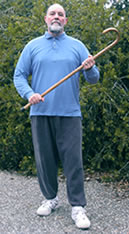
I use a 40" pure hickory heartwood combat cane for all my weapons practice; and, adapt other short staff, sword, and broadsword routines and techniques for practice and performances with my hooked wooden cane. The only weapon I practice with on a daily basis is a wooden cane; and the only weapon I teach now in my Taijiquan classes is the cane. Also, whenever I take a long walk, anywhere, I bring my cane along.


Best wishes for Good Fortune, Good Health, Peace, and Prosperity in 2014.
Michael P. Garofalo, M.S.
Valley Spirit Taijiquan
Green Way Research, Red Bluff, California, © 2014
Short Staff Weapons
Bibliography, Links, Resources,
Forms, Guides, Lessons, Media
A Note to Readers: The
Cloud Hands website has been online continuously since 2001.
In 2008, over 1,900,000 webpages (excluding graphics) were
served to readers
around the world from the Cloud Hands website.
This short staff webpage was served to over 19,500 readers in 2010. Since 2005, I have also provided an associated
blog to point to changes and
additions at the Cloud Hands website:
The Cloud Hands: Mind/Body Movement Arts
Blog.
Since Cloud Hands is a very well-established and stable website, it provides
readers with a good and secure starting point for their online research into
Taijiquan and Qigong. The Cloud Hands website is funded entirely by
Green Way Research, with
volunteer efforts by Michael P. Garofalo.
Unfortunately, as everyone knows, many other websites and webpages appear and
then disappear from the Internet scene. Authors do not pay to keep up
their web hosting services, loose a "free hosting" option, change
filenames, or decide to remove
webpages for various reasons. Consequently, links to some good webpages become
invalid and files are no longer found on the Internet. You may find a some of these "dead
links" to nonexistent webpages cited below; and, there is no way to avoid this
troublesome situation. For this reason, when you do find a good and useful
webpage, be sure to save the webpage to a folder on your hard drive or server.
I am inconsistent about italicizing non-English words in this
webpage. Too much italicizing makes for more difficult reading for me.
I welcome and encourage your suggestions for how to improve
this webpage. Your comments, ideas, contributions, and constructive
criticism are encouraged. Send your suggestions to
my email box.

Aikido of Manhattan, Aikido Jo Practice 2:12 Minutes Video
Aikido Jo Katas: 13, 31, 25
Video Clips
Right and front views.
Aikido Short Staff:
Way of the Short Staff
Aikido 13 Jo Kata. Right
View.
Aikido 13 Jo Kata. Aikido World for Beginners.
Aikido 13 Jo Kata and 31 Jo Kata Videos.
Ki Shin Tai Dojo (Look in video clips)
Aikido 13
Jo Kata, Video clip, 16 seconds. Wałbrzyski Klub Aikido
Aikido 31 Jo Kata.
By Stefan Stenudd. 13KB. Photographs and brief descriptions.
Aikido 31 Jo Kata with Awase. By Jonathan Diesch. A two
person kata.
Aikido 31 Count Jo
Kata and Kumi Jo. By Jonathan Diesch. Descriptions.
Aikido 31 Jo Kata No Kumi
(Iwama Ryu) Saito Sensei
Aikido 31 Jo Kata.
Demonstrated by Saito Sensei. Narration in French. UTube, 5:34.
Front view, side view, footwork view,
Aikido 31 Jo Kata.
Written and graphical instructions.
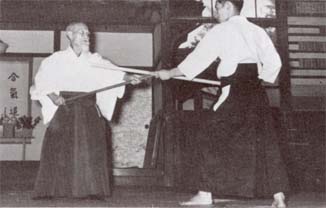
Aikido Founder Morihei Ueshiba practicing Jo techniques with his son.
Aikido 31 Jo Kata and 13 Jo Kata Videos.
Ki Shin Tai Dojo (Look in video clips)
Aikido 31 Jo Kata in Four
Directions. By Sensei Stephan Stenudd. Descriptions and b&w
photos of each movement sequence, includes video clips.
Aikido 31 Jo Kata - U Tube Videos
Aikijo - Staff Techniques in Aikido. By Morihiro Saito of Iwama
Aikido. Instructional DVD, 45 minutes.
This video includes:
31 Jo Kata, 20 Jo Suburi, 31 Jo Kumiko, 10 Kumijo, and 13
Jo Awase.
Aiki Ken and Aiki Jo: The Sword and Staff of Aikido. Instructional DVD.
Aikido
Weapons. Instructional DVD by Patricia Guerri.
Aikido Weapons Techniques: The Wooden Sword, Stick and Knife of Aikido.
By Phong Thong Dang and Lynn Seiser. 124 pages. Tuttle Publishing
Co., 2006.
ISBN: 0804836418.
Alphabetical
Index to the Cloud Hands: Taijiquan and Qigong Website
The Correct Length for a Jo Stave.
Interview with Morihiro Saito. Aiki News #74, April 1987. Interview by
Stanley Pranin. History of Jo.
Jo: Art of the Japanese Short Staff. By David Lowry and Mike
Lee. Black Belt Communications,
Inc., 1987. Eight printing, 2002. Glossary, 191 pages. ISBN: 0897501160.
VSCL.
Martial Arts
Techniques for the Cane and Short Staff. By Michael P. Garofalo.
Mastering Aikido Level 5 Bo-Jo (Wooden Staff Techniques) Instructional
DVD, 52 minutes.
Saito Sensei,
Morihiro Saito Sensei, 1928-2002, 9th Dan Shihan. Head of the Iwama
Dojo and keeper
of the Aiki-jinja. Saito Sensei is an Aikido grand master who trained with
Morihei Ueshiba for 23 years.
Tribute and
photographs. Saito Sensei was a noted organizer of Aikido jo katas.
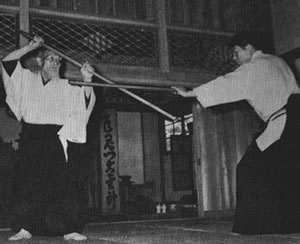
Morihei Ueshiba Sensei and Morihiro Saito Sensei
Seitei Jodo or Zen Nihon
Kendo Renmei Jodo, is a modern form of
jodo created by the
Japanese
martial artist
Shimizu Takaji and presented to the All Japan Kendo Federation in 1968.
The Staff: Bibliography, Links, Quotes, Notes, Lessons
Strikes with the Stick and Cane. 60 strikes are described by Tom Lang.
87Kb, PDF.
Techniques for the Cane and Short Staff
Traditional Aikido of
Santa Rosa. Bo and Jo katas, one person and two person, are part of
the training program at this dojo. "O-Sensei,
the founder of Aikido, was skillful with both sword and staff, frequently demonstrating the same movements to be effective even
while empty-handed."
The Bo is a stave, about 7' feet long. A Bo Kata is a formal standardized exercise with the Bo. Bojutsu means the techniques of using the Bo.
Vendors, Retailers, and Manufacturers of Jos, Short Staffs,
Canes, Walking Sticks
Videos Online about the Aikido Jo
Aikido Jo - Google Video Search
Aikido Jo Kata, 13 Moves, 16 seconds, Wałbrzyski Klub Aikido
Aikido 13 Jo Kata By Sensei Francis.
Aikido Jo Kata, 31 Moves, 33 seconds, Wałbrzyski Klub Aikido
Aikido Staff Kata #2, Richard Polichetti, 25 seconds

Return to the Index at the Top of This Webpage
Walking Stick, Bo-Jutsu, Bo-Cane, Shillalah,
Stick, Zhàng, Ji Pang E, Hanbo
杖
Zhàng: a cane, staff, rod, or walking stick, Guai Gun (Hooked Cane)
Duanbang 短棒, Chang
杖, Bang 棒
Cane, Canne, Stock, Bastón, Canna, Тросточка
canne de marche, gehender stock, bastón que camina, canna ambulante, гуляя
тросточка
Advanced Techniques and Takedowns of the Cane. Instructional DVD, 45 minutes. Developed by Grandmaster Mark Shuey, Sr., founder of Cane Masters. Cane Masters Instructional Video Series, Volume 4. "Featuring the devastating power of the crook, the fourth ranking video shows a wide variety of takedowns and control techniques specifically designed for the cane, as well as defensive techniques for use against a variety of weapons." VSCL.
All-Round Fighting in
Edwardian London: Pierre Vigny. By Graham Noble.
American Street Combat with Cane.
Bill Miller.
Asian
Fighting Techniques Featuring Long Staff and Cane. Demonstration and
instruction by Christopher Keith and James Bouchard. Instructional DVD, 88
minutes, color. Shami Production, 2006. ASIN: B000KJU2DG.
Basic
Foundation of the Cane. By Grandmaster Mark Shuey, Sr., Founder of
Cane Masters. Instructional DVD.
"As
the “backbone” of our self defense techniques, this video shows all the blocks,
strikes, punches, twirls, swings, etc. in the Cane Masters system demonstrated
both right and left handed. If you are serious about learning how to use the
cane, this video is a must!" Cane Masters Instructional Video Series,
Volume 2, Blocks, Strikes, Swings, Jabs and More.
Beginner's Guide to Using a Cane
Beifang Qi
Taiji Zhang. Instructional DVD, 54 Minutes, 2006. Tai Chi Cane
Kata. Developed by James Bouchard. "Beifang Qi Taiji Zhang means
'Northern Energy Taiji Cane.' This exciting original form was created to
introduce the cane to Taiji practitioners, and to introduce Taiji principles to
martial artists interested in the cane. Beifang Qi includes sets of
"Qigong" or "energy exercises", multiple views of the form and a complete
section on basic applications. Each movement is named for easy reference and the
DVD version includes interactive menus. Beifang Qi Taiji Zhang is
appropriate for novices, yet experienced martial artists will find new levels of
understanding. Endorsed by Cane Masters International."
Video Clip
VSCL.
Notes. This DVD also
includes a warm up Qigong routine that is useful for everyone. It will be of
special interest to those who practice the
Eight Section Brocade Qigong form. There are eight movements in the Beifang
Qi Qigong form: 1. Lifting the Sky, 2. Press Earth and Sky, 3. Drawing the Bow,
4. Look Over Shoulder, 5. Touch the Earth, 6. Bear Swims with Cane, 7. Willow
Tree Stretch, and 8. Wave Away Demons.
Beifang Qi Taiji Zhang (Northern Energy Taiji Cane): List of Movements,
Directions and Notes by Michael P. Garofalo.
Beginner's Guide to Using the Cane.
By Don Rearic. 12Kb.
Black
Belt Ranking Video for the Cane. Instructional DVD, 45
minutes. Developed by Grandmaster Mark Shuey, Sr., founder of Cane
Masters. Cane Masters Instructional Video Series, Volume 6.
"This
video contains information on the required Cane Masters Kata, cane care
techniques, advanced techniques, and an interview with Grand Master Mark Shuey.
Along with the curriculum on the other five instructional videos, you will now
have everything you need to learn in order to pass your Black Belt test, or to
increase your knowledge of the cane." VSCL.
Bodhidharma's (Damo) Cane
Kung Fu Demonstration. UTube Video, 2:01 minutes.
"Broadsword and Singlestick - with Chapters on Quarter-staff, Bayonet, Cudgel, Shillalah, Walking Stick, Umbrella and other Weapons of Self Defence; The Quarter-Staff" By Allanson-Winn, R.G. and C.
Phillipps-Wolley.
London : George Bell & Sons. 1st edition, 1898.
Cane In Chinese:
杖
Zhàng: a cane, staff, rod, or walking stick.
Also spelled:
Zhàng.
Chang, Jeung, Zoeng.
The
Cane: Ancient Weapon for Seasoned Practitioners. By Bruce Cohen.
Kung Fu Magazine article, 3/09.
Cane and Walking
Stick Martial Arts and Exercises
The Cane as a Weapon.
By A. C. Cunningham. Civil Engineer, U. S. Navy. For sale by Army
and
Nave Register, Washington, D., C., 1912. National Capital Press, Inc.,
Washington, D. C. PDF format, 25 pages, 1.3 MB.
Mirror1
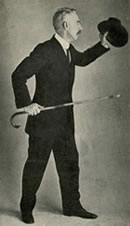
The Cane: Beginning and Intermediate Levels. Cane Masters
International Association. "This
spiral bound manual touches on the warmups and stretches of the cane, in
addition to beginning and intermediate levels of self defense. Over 200 pages of
text and images based on the first three instructional videos. Written by Grand Canemaster Mark Shuey, Sensei Bruce Vinciguerra and Canemaster David Kelly."
VSCL.
Cane Blocks and Strikes. By
Master Thomas (Toma) Rosenzweig.
Cane Exercises with a Stretch Band. By
Master Thomas (Toma) Rosenzweig.
Cane Fighting.
By John Vesia. "The cane as an effective fighting
weapon is nothing new and has made appearances in a number of cultures. In
Portugal, the fighting cane is called the jogo do pau. In France,
savateurs train with la canne. Cannistes wear protective gear and fencing
helmets in matches. A similar weapon in Japan is the jo, a wooden staff
about four feet long."
The
Cane for Self Defense. Demonstration by Gordon Oster.
Instructional DVD, 80 minutes, color. Turtle Press, 2006. ASIN:
B000H0MGLE.
Cane Fu, Kane Fu. Magazine and newspaper articles on teaching exercise
with canes for seniors.
Article 1,
Article 2,
Article 3.
The
CaneMaster: A Self Defense Expert, Fitness Teacher, and Healer.
Information about the programs of Dave Mcneil of Goju Shorei, and Mark Shuey Sr.
of Canemasters. Hapkido Cane-Do Kai information.
Cane Links Valley
Spirit Taijiquan, Red Bluff, California.
Cane Masters: Basic
Foundation and Street Techniques Videos. A product review by Phil
Elmore. "The Martialist: Magazine for Those Who Fight Unfairly."
Cane Masters:
Your Source of Self-Defense and Exercise Using the Cane. Numerous
canes, instructional
videotapes,
and related supplies and equipment are sold.
Are you interested in actualtests 640-864? Get our self paced certkiller 000-035 and testking 642-902 study packages to pass your testking 646-206 without any difficulty in testking VCP5-DCV.
Cane Masters International Association (CMIA). Board of Directors.
The Cane of
Shaolin. By Ted Mancusco.
Cane Research Project at Valley Spirit
Taijiquan
Self-Defense Arts and Fitness Exercises Using a
Cane, Walking Stick, or Short Wooden
Staff
All documents were created by Michael P. Garofalo, M.S.
Published by Green Way Research, Valley Spirit Taijiquan, Red Bluff, California,
2009
These documents normally include a list of the movement names in the specific
cane or short staff form, and the final direction to face for each named movement
sequence.
Some documents provide detailed descriptions for each of the movement
sequences. All documents include some commentary, notes, and a
bibliography of books, media, and links. Many of these documents are in
Adobe PDF read/print only format. The documentation of this research is an
ongoing project of mine from 2009-2011; consequently, many documents are still
very incomplete. Over time, I intend to provide descriptions for each movement,
including: 1) the
martial technique used, 2) the direction of technique application, 3) the poetic
name, and 4) the final
leg stance. Nearly all of these forms can be practiced with a cane or walking
staff under 40" long; and some with a longer short staff up to eyebrow
length.
Development Key:
C: Undergoing current development, current project. F = Research completed, project finished. L = Develop Later, incomplete, not researched. My current research in the Spring of 2009 is on the Shaolin Kung Fu Cane, the Eight Immortals Cane I and the Tai Chi Kung Fu Fan.
Ba Gua Staff. Created by Professor Jiang Zhou Chun, and taught by Shifu Jiang Jian-ye. 16 movements. List of names and directions.
VSCL.
Bodhidharma's Shaolin Cane (Damo Cane, Shaolin Damo Kung Fu Cane);
as
taught by Master Shi Deyang. 21 movements in 3 sections. List of
names and directions. VSCL.
Cane Research Project and
Blog Notes from
Michael Garofalo, Valley Spirit Taijiquan.
Cloud Hands Taijiquan
Bibliographies, Instructions, Guides, and Research in Taijiquan and Qigong.
Chen Taijiquan
Broadsword Form. As taught by Grandmaster
Chen Zenglei. 23
Postures/Movements. Practice with cane. List of Names. F
Chen Shen-Pu's Taijiquan Short Staff. Created by Grandmaster Chen
Shen-Pu, and taught by Shifu Jiang Jian-ye.. 74
movements. List of Names. F
Eight Dragons Baguazhang Cane Forms. By Michael P. Garofalo.
Valley Spirit Taijiquan, Red Bluff, California.
L
Eight Immortals Taijiquan Cane, Routine One, Yang Style of
Taijiquan. As taught by Master Jesse Tsao. 36 movements in 10
lessons.
List of names, directions, descriptions, bibliography, and notes.
Eight Immortals Taijiquan Cane, Routine Two, Chen Style of Taijiquan.
As taught by Master Jess Tsao. 36 movements in 10 lessons. List of
Names.
How I Use Instructional DVD's to Learn Cane Forms
F
Martial Arts
Techniques for the Cane and Short Staff. Lists, notes, comments,
techniques, and bibliography. 384 Kb+
Northern Energy Taiji Cane
(Beifang Qi Taiji Zhang). As taught by
Sensei James Bouchard. 24
movements. List of names and descriptions.
Shaolin Kung
Fu Cane.
As taught by Shifu Ted Mancuso. List of the names of the movements,
directions, detailed descriptions
for 16 lessons, bibliography, notes, and comments.
Standard Simplified
Yang Style Sword Form. 32 movements. Detailed
descriptions and illustrations. Practice with a cane. F
Tchoung Ta-Tchen
Walking Stick Form. Created by Grandmaster Tchoung
Ta-Tchen. 35 Movements. List of names.
Way of the Short Staff.
Comprehensive bibliography of books, media, links, and resources. Includes
research on cane, short staff, walking stick, jo, etc.. F
Way of the Staff.
Comprehensive bibliography of books, media, links, and resources. Includes
research on the staff, bo, gun, quarterstaff, pole, etc.. F
Wudang Tiger Tail Short Staff
. As taught by Shifu Jiang Jian-ye. 48 movements in this
Wudang Mountain Taoist sort staff form. List of names. F
Yang Family Tai Chi Short Staff by Xu Minshan. As taught by Shifu Jiang
Jian-ye. 104 postures. List of names. F
Cane Quest. A must visit website
for cane collectors! Fascinating information on the history and lore of canes.
Cane Self Defense Advice. By
Master Thomas (Toma) Rosenzweig.
Canes and Martial Arts Weapons
Canes and Walking
Sticks Construction. By Betty Rahbar.
Canes
and Walking Sticks - Google Links
Cane Self Defense UTube Videos
Cane - Tai Chi Chuan, Taijiquan
Canes: There Not Just for Walking Anymore
CD Davis Group Self-Defense
Tactical Products Including Cane
The
Cane: Weapons Arts of a Gentleman. Instructional DVD by Emil Farkas.
55 Minutes.
The Damo Cane.
Shaolin Single Cane. VCD instructional video. The
Damo Cane VCD
for Self-Instruction. Demonstrated and Explained by Feng Yan.
Language: Chinese and English. Published by Henan Electronic Audio and
Video Press. ISRC CNF420100730. The original creator of the Damo
Cane was Cheng Tongshan, a well-known boxing master. See also
Shaolin Cane.
Defense Cane I. Instructional DVD. C Davis Group.
Defense Cane 2. Instructional DVD. C Davis Group.
Don Jong: The Hapkido Cane.
By Scott Shaw.
Dragon Head Walking Cane.
Instructional DVD by Grandmaster Wing Lam.
Erle
Montigue, Fa-Jing Stick, Yang Family Medium Stick
Erle Montique, Fa-Jing Stick Fighting
Eight Immortals Tai Chi Cane Form
The
Exercise System with the Cane. Instructional DVD, 45
minutes. Developed by Grandmaster Mark Shuey, Sr., founder of Cane
Masters. Cane Masters Instructional Video Series, Volume 1: Isometric,
Stretching, Resistance, Basic Techniques.
"The
material in this video is based solely on the physical fitness aspects of using
the cane either with our without a resistance band. You will see not only the
proper technique of performing each exercise, but also a graphic representation
of that portion of the body being stressed. We have had many doctors,
chiropractors, and physical therapists report that they have patients who have
benefited greatly from this program." VSCL.
The Fighting Cane: Armed,
Elegant and Invisible. By Ted Truscott. 13Kb.
Goju-Shorei Weapons
System. By Master Dave McNeil. Cane system. A detailed textbook (288 pages). videos, canes and other products are offered for
sale. Goju-Shorei is a three weapons system: cane, knife, and fan.
Goju-Shorei Weapons System, Video
1, Yellow and Orange Ranks. Katas and techniques. This is the
foundation tape for all the other ranks. Instructional
VHS, 41 minutes.
Goju-Shorei Weapons System, Video
2. Purple and Green Ranks. Instructional VHS, 40 minutes.
With the Progressive Strike Zones, the student will add cane to cane contact to
the learning process. Two
katas and 20 techniques round out this videotape."
Hapkido Cane: Big Stick
Fighting from the Dojo to the Street. Instructional DVD by Alain
Burrese. 150 minutes.
Hapkido
Cane-Do Kai. A martial art developed by
Joe Robaina.
History of the
Korean Cane (Ji Pang E). By Master James Benko. 10Kb.
How to Walk Safely with a Cane. By Sifu John Chow.
Hsing I Cane
Form by Master Huang Su Chun UTube Demonstrations. List of
movement name in
English and Chinese
from Poetry in Motion Tai Chi
Chuan website by Jeff Raymer.
Index to the Cloud
Hands Website A detailed, alphabetically arranged, subject index
to webpages and documents offered at the
Cloud Hands Website.
Intermediate Techniques and Drills for the Cane. Instructional DVD, 45
minutes. Developed by Grandmaster Mark Shuey, Sr., founder of Cane
Masters. Cane Masters Instructional Video Series, Volume 3, Intermediate
Techniques and Defensive Drills.
"This
video utilizes the elements shown in the “Basic Foundation” tape and combines
them into easy to follow techniques to ward off attacks by a single opponent. 45
minutes long, the video is complete with practice drills for fighting and
self-defense with a partner."
VSCL.
Martial Arts
Techniques for the Cane and Short Staff. By Michael P. Garofalo.
Martial Cane Concepts.
By Michael Janich. A Realistic System of Walking Stick Self Defense.
Instructional DVD, 70 minutes. Paladin Press, 805966056937.
Master the Cane.
Featuring Grandmaster Ted Gambordella. Instructional DVD,
Mastering the Cane.
Featuring Ted Tabura. Instructional DVD.
Personal
Self-Defense with a Walking Cane
Purchasing a Cane or Walking Stick
Raising
Cane: The Unexpected Martial Art. By Octavio Ramos.
Velluminous Press, 2006. 188 pages. ISBN: 1905605102.
This book features fairly detailed explanations with illustrations of many cane
strikes, blocks, and maneuvers by a former sheriff.
Black and white photographs and descriptions of all cane techniques.VSCL.
The Return of the Cane: A Natural History of the Walking Stick. By
Gerard J. Van Den Broek. International Books, 2007. 120 pages.
ISBN: 9057270501. "Much more
than a study of walking sticks as antiques and collectibles, this fascinating
book also explores the myths and symbols associated with sticks and canes.
Noting that apes use sticks as tools, to humans the stick is also a form of
power. Batons, clubs, dueling sticks, scepters, staffs, and magic wands are
cited and discussed showing the ancient association of sticks with authority,
piety, strength, wisdom, and the supernatural; a chapter is devoted to famous
canes in history and literature; and photographs and
illustrations throughout present canes of various woods, decoration, and
rarity." VSCL.
Self-Defense with a Cane. By E. W. Barton-Wright, 1901.
Self-Defense with a Cane,
Part 2. By E. W. Barton-Wright, 1901.
Self-Defense: Cane 1. Instructional DVD. Cane workshop by
Charles Davis.
Shaolin Cane: Bibliography, Links, Resources
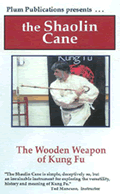
The Shaolin Cane:
The Wooden Weapon of Kung Fu. Instruction by Ted Mancuso.
Instructional DVD, 60 minutes. Plum Publications, Santa Cruz, California,
© 2005. "In
this presentation by Ted Mancuso, he utilizes a
traditional Shaolin cane set taught to him by one of his teachers, Lam Kwong
Wing, to explore the very nature of weapons work. Introductory remarks bring new
points to light about the usefulness of weapons work especially, with simple,
easily available instruments.
Among the topics covered, Mr. Mancuso discusses and
demonstrates: Basic strikes and their applicability to all weapons.
Grips and the "flexible hand" concept. The traditional Northern Shaolin
Boxing Cane form. In-depth stepwise breakdowns of each section of this
fast and mobile form. Examples of applications, including running
commentary explaining more than just the movements but the reasoning behind cane
defenses. According to this teacher,
"Over the years students have come to me
and say, - I'd like to learn the cane from you.
When I ask why they always say something
like, - For my father. He's getting old. At that point I have to explain to them
that this is one of the most dynamic weapons sets in the entire Shaolin arsenal.
After all, if you think about it handing a simple stick to a Kung Fu artists who
can do sword, spear, whip and dagger is just like saying "anything goes." This
is definitely not your grandfather's cane form."
In this instructional DVD, the
lineage of this particular Shaolin Cane form is given as: Ted Mancuso was
taught by Lam Kwong Wing, who was taught by Yim Shang Mo, who was taught by Gu
Ru Shang, who was taught by Yan Gi Wen, who was taught by Yan Di Gong, who was
taught by Wang Bang Cai, who was taught by Gan Feng Chi, who was taught by Monk
Zhao Yuan He Shang. Read the short essay by Ted Mancuso on
The Shaolin Cane.
VSCL.
Shuey,
Mark Sr. Karate Master and Cane Grand Master.
Biography 1,
Biography 2.
Founder of Canemasters.
President of Cane Masters
International Association (CMIA). Interview by WMA.
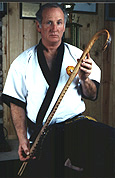
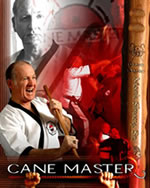
Mark Shuey Sr.
Cane Grandmaster
The Staff: Bibliography, Links, Quotes, Notes, Lessons
The Stick and Cane in Close Combat.
By Tom Lang. Unique Publications. ISBN: 0865682577.
"The result of a
7 year intensive study of grappling techniques with the stick and cane, the book
presents more than 120 jointlocks, takedowns, chokes, holds, disarms, surprise
attacks, rolls, strikes, and exercises with the stick and cane in 750
photographs. These techniques were collected and refined from those described in
more than 120 books and videos on the topic as practiced in several traditions,
as well as from my 35+ years of experience in the martial arts. It is the
largest collection of these techniques yet published.
Street Techniques of the Cane. Instructional DVD, 45
minutes. Developed by Grandmaster Mark Shuey, Sr., founder of Cane
Masters. Cane Masters Instructional Video Series, Volume 4.
"We have combined a variety of
blocks and counters introduced in our other instructional videos into a series
of techniques designed for self-defense in a true street situation. GM Shuey and
his son will show you some great “down and dirty” tactics against a number of
different attacks."
Strikes with the Stick and Cane. 60 strikes are described by Tom Lang.
87Kb, PDF.
Tai Chi Chuan, Taijiquan - Cane, Short Staff
Tai
Chi Partner Cane From (San Tsai Tuan Kun). By Sifu Michael Gilman and
Stephani Morel, Port Townsend, Washington.
Detailed instructions with b&w photographs online. An instructional
videotape is also available for Sifu Gilman, and available
online. "This is a useful, short (11
movements per side) partner form. When the transition is added, one ends up with
a beautiful, instructive partner or solo form. These lessons are divided into
sections. The first is the Introduction and all the applications for the form.
The second and third sections break down each of the two sides and teach the
movements. The last section shows the form performed as a partner
form. Keep in mind that there is a companion VHS video tape available through
the on-line store." Tai Chi Partner Cane (San Tsai Tuan Kun).
Three Powers Stick, Short Stick practices. There are videos on UTube for
each lesson: Lesson
One 8:32,
Lesson Two:
9:15,
Lesson Three, 8:27,
Lesson Four,
9:11,
Lesson Five, 8:55,
Lesson Six,
9:24,
Lesson Seven, 6:04.
Taiji Zhang: Japanese, Chinese, and Okinawan Styles. Instructional
DVD, 2006. By Christopher Keith and James Bouchard.
Tchoung Ta-Tchen Walking Stick
Form. 35 movements. A lively taijiquan walking stick or cane
form
Techniques
for the Cane and Short Staff. By Michael P. Garofalo, M.S., Valley
Spirit Taijiquan, Red Bluff, California. January 2009. 100Kb.
Includes Strikes - Two Hands, Strikes - One Hand, Blocks - Two Hands, Blocks -
One Hand, Sweeps, Pull Downs, Chops, Jabs, Pokes, Punches. The document
provides a bibliography, links, and resources. The document includes brief
descriptions for each short staff and/or cane technique.
Thunder
Stick Form developed by Chen Pan-Ling and as taught by Chen
Yun-Ching.
Traditional Tai Chi Eight Immortals Cane, Routine One. Demonstrated by
Master Jesse Tsao. Routine One is based on the Yang Style of Taijiquan. Instructional DVD, 64 minutes. Produced by
Tai Chi Healthways,
San Diego, 2008.
Master Tsao developed this cane form himself, with grandmaster Zhu Tiancai's
support.
Traditional Tai Chi Eight Immortals Cane, Routine One. These
lists and
detailed descriptions of each movement are for the use of students at the
Valley Spirit Taijiquan Center
in Red Bluff, California. Routine One is based on the Yang Style of
Taijiquan, and we teach the Yang Style of T'ai Chi Ch'uan at the
Valley Spirit Taijiquan Center.
This tai chi cane form is taught on an instructional DVD by
Master Jesse Tsao.
Master Tsao developed this cane form himself, with grandmaster Zhu Tiancai's
support. All students studying this Tai Chi Cane form should purchase this
very good
instructional DVD from Master Jesse Tsao
for their home study.
A.
List of Movements, List of Lessons, and References for Routine One, (PDF Format,
27Kb, 4 pages).
B.
List of Movements, and Lesson List for Routine One (PDF Format, 18Kb, 1 page).
C. Lesson 1: Descriptions of the movements in Routine One, Movements 1-4
(PDF format, 33 Kb, 4 pages).
D.
Lesson 2: Descriptions of the movements in Routine One, Movements
5-9
(PDF format, 35 Kb, 4 pages).
Traditional Tai Chi Eight Immortals Cane, Routine Two (Cannon Cane).
Demonstrated by Master Jesse Tsao. Routine Two, Cannon Cane, is based on
the Chen Style of Taijiquan. Instructional DVD, 65 minutes.
Produced by Tai Chi
Healthways, San Diego, 2008. Master Tsao developed this cane form
himself, with grandmaster Zhu Tiancai's support.
Training with Canes
Discussion
Valley Spirit Center Library Collection = VSCL, Red Bluff, California.
Valley Spirit Taijiquan Cane Links
Vendors, Retailers, and Manufacturers of Canes, Walking
Sticks, Short Staffs
Videos on U Tube:
Tai Chi Cane,
Taijiquan Cane,
Hapkido Cane
VSCL = Valley Spirit Center Library Collection, Red Bluff, California.
Walkiing Cane
Information: History, Facts, and Usage of Canes
The Walking Stick Method of
Self-Defense. By H. G. Lang, 1923. Published by Kirk Lawson.
118 pages.
The Walking Stick Method of Self-Defense. By Officer. Published
by Palladin Press, 2004. 96 pages. ISBN: 1581604386.
"Wang Shu-Chin's T'ai Chi Walking Stick," By Manfred Erich Rottmann, T'ai Chi
International Magazine of T'ai Chi Ch'uan, Vol. 18, No. 6, December, 1994,
pp. 26-29. Wang Shu-Chin (1904-1981).
According to Marnix
Wells, Chen Pan-ling taught Wang Shu Chin the 24 movement walking stick
form.
Way of the Short
Staff. By Michael P. Garofalo, M.S. A comprehensive guide to the
practice of the short staff, cane, jo, walking stick, gun, zhang,
whip staff, 13 Hands Staff, and related wood short staff weapons. A
detailed and annotated guide, bibliography, lists of links, resources,
instructional media, online videos, and lessons.
Includes use of the short staff and cane in martial arts, self-defense, walking
and hiking. Separate sections on Aikido Jo, Cane, Taijiquan cane and
staff, Jodo, exercises with a short staff, selected quotations, techniques,
selecting and purchasing a short staff, tips and suggestions, and a long section
on the lore, legends, and magick of the short staff. Includes "Shifu
Miao Zhang Points the Way." Published by Green Way Research,
Valley Spirit Taijiquan,
Red Bluff, California. Updated on a regular basis since October, 2008. Filesize:
335+ Kb. Related to Mike's popular webpage on the
Staff.
The Ways of Walking:
Quotes, Poems, Sayings, and Lore
Winning Katas of the Cane. Instructional DVD,
51
minutes. Developed by Grandmaster Mark Shuey, Sr., founder of Cane
Masters. Cane Masters Instructional Video Series, Volume 5, Winning Katas
with Techniques.
"Mark
Shuey Sr. shares his advanced techniques and winning katas with you in this 51
minute tape. These are the same katas he used to win 50 first places, 6 Grand
Championships, and the World and National Titles in 1998 and 1999! This fifth
video in the ranking series will help you put the finishing touches on your
journey to becoming a Canemaster." VSCL.
Workshops, Seminars, Lectures, Demonstrations on the
Cane, Walking Stick, Jo, Short Staff
Videos Online about the Cane
Ji Pan Gi Hyung (Cane Form) 6:01
Three Powers Cane Form, Michael Gilman, Lesson One
Cane Notes and Information
"So what are the areas that a "CaneMaster" excels in? All
Master level cane practitioners excel in cane self defense, teaching ability,
exercising with the cane and natural healing. By taking a look at three of the
pioneers of the art of the cane and the way in which they present their art, we
find the commonalities that define the masters. GM Dave Mcneil of Goju Shorei
has made the isometric cane exercises and stretches an integral part of
conditioning for the cane in his system. He has also incorporated "seikufujutsu"
a type of Japanese restorative massage as part of his advanced dan requirement.
Of course, the self defense tecniques and kata are the foundation of the system.
GCM Shuey of the CMIA, in addition to the self defense techniques and kata
incorporates cane isometrics, stretches, cane exercise bands for resistance
training and has entered the physical rehabilitation arena with his unique cane
exercise system to the point where some medical insurance companies have offered
reimbursement for his programs. GCM Shuey has brought the cane to the general
public beyond its self defense and fitness context. Anyone who uses the cane as
a medical aid can now turn it into a valuable equalizer. CM Robaina of the
Cane-Do Kai likewise presents the cane as a complete martial art that offers
self -defense, personal fitness and natural healing. Robaina who owns the Cane
Masters Cane-Do Kai dojo in Miami, actually has a personal fitness and healing
practice revolving around the cane. Robaina integrates cane stretches,
isometrics, exercise bands and a yoga-pilates like cane exercise system. He also
developed the "Quantum Cane" energy healing technique that he currently teaches
to lay people as well as licensed health care professionals. CM Robaina holds
the credentials to bring this system to the public since he is a degreed
exercise physiologist, Master of Sports Science, certifed Specialist in
Performance Nutrition, Licensed Massage Therapist, and Board Certified Doctor of
Naturopathy. So based on the approach of three of the premiere cane exponents
today we can agree that a CaneMaster is a teacher of self protection, personal
exercise, healing, and recuperative technques. A valuable contributor of good to
society."
- The CaneMaster: A
Self Defense Expert, Fitness Teacher, and Healer.
Return to the Index at the Top of This Webpage
Karate
Jo, Jo Do
Shindo Muso Ryu, Kendo, Arnis,
Escrima
Advanced Stick Fighting. By Masaaki Hatsumi. Tokyo, Japan, Kodansha
International, 2005. 208 pages. Translated by Bruce Appleby and Doug
Wilson. ISBN: 4770029969. VSCL. Large collection of black and
white photographs of Masaaki Hatsumi.
Arnis - Wikipedia
This Filipino martial art uses rattan sticks (cane, baton).
Beikoku Rembukan (Martial Spirit Polishing
Hall) Dojo, Shindo Muso Ryu
The Bo
and Other Long Wooden Staff Martial Arts Techniques
Bo:
Karate Weapon of Self-Defense. By Fumio Demura. Santa Clarita,
California, Ohara Publications, 1976. 183 pages. 36th printing,
2002. ISBN: 0897500199. VSCL.
Buying a Jo Staff: Sellers, Distributors, Vendors,
Retailers, Manfacturers
Chico Kodenkan
Chico, California.
Sensei Delina
Fuchs, Yodan.
Defensive Cane. Instructional
DVDs. By the CDavis Group.
European Jodo Federation (FEJ), Shinto Muso-ryu
The Evolution of
Classical Jojutzu. By Dave Lowry. 23Kb.
Excellent overview.
The
First Walking Stick Kata. Excellent detailed instructions with chart,
Japanese names for techniques, footwork diagrams, and photographs. From
the Bushido Karate Academy.
Goju-Shorei Weapons
System. By Master Dave McNeil. Cane system. A detailed textbook (288 pages). videos, canes and other products are offered for
sale.
Google Search:
Aikido Jo,
Shinto Muso Ryu Jo,
Google Search Blogs:
Aikijo,
Shinto Muso Ryu
The
Japanese Short Staff. By Don Zier and Tom Lang. Burbank
Publications, California, Unique Publications, 1985. Glossary, 97 pages.
ISBN: 0865680582. VSCL.
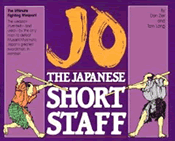
Jo and Bokken Katas of
Aikido. By Greg Henry.
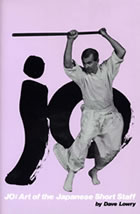
Jo: Art of the Japanese Short Staff. By David Lowry and Mike
Lee. Black Belt Communications,
Inc., 1987. Eight printing, 2002. Glossary, 191 pages. ISBN: 0897501160.
VSCL.
JoDo, La Voie du Bato.
By Pascal Krieger. In French and English. 467 pages. "Elève de
l'Ecole du Budo de Tours, j'ai pu lire
ce livre grâce à la bibliothèque mise en place par Joël Barillet,mon enseignant.
J'ai lu beaucoup de livres mais peu m'auront transformé autant. Je ne voulais
pas m'en séparer aussi j'ai demandé à Pascal Krieger, après une visite sur
son site web, si je pouvais
acheter un des exemplaires restants. Plus aucun exemplaire ne restait (ha la
mise à jour des sites
web). Avec la permission de Pascal Krieger, avec l'aide de ma société et
de mon école, je le mets à votre disposition sur le web."
Jo: The Combat Weapon of
Japan and Okinawa. By William Durbin.
Jodo Training
Curriculum, Shindo Muso Ryu
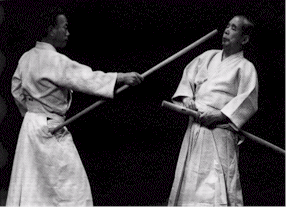
Kaminoda Sensei and Shimizu Takaji Sensei (right)
Jo Do Videos: Tru-Flyte Martail Arts
Jo: The
Japanese Short Staff. By Don Weir. Unique Publications,
1985. 102 pages.
ISBN: 0865680582.
Jo 31 Kata in 4 Directions
By Sensei Stefan Stenudd.
Kendo - Wikipedia.
This martial arts uses bamboo wooden swords (shinai), about the length of
the Jo, in fighting.
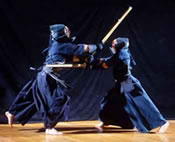
Kihon, Uchi Tsuki Waza, 12 Basic Jo Techniques, From Shinto
Muso-ryu Jodo System
Kobudo: The Okinawan Weapons Arts.
By Charles C. Goodin.
Koryo.Com: The Traditional
Martial Arts of Japan Lots of depth to this website.
Links with Information about Shindo Muso Ryu Jodo and Related Topics
The Little Book of Jodo.
By Eric Tribe and Kim Taylor. 140 pages.
"The Little Book of Jodo covers
the ZNKR seitei jo. With over 500 black and white photos it covers the kihon
tandoku (solo exercise),
kihon sotai (partner basics exercise) and the
kata
(partner applications)."
The Pure Flow of
the Jo. Sensei Kishioka Tsuneo. An article by Wayne Muromoto.
Purple Heart Wooden Swords and Staff
Shindo Muso Ryu Jodo: Links and Information
Shindo Muso Ryu Jodo (Japanese Stick Fighting)
Shinto Muso-ryu Jo
Shinto Muso-ryu Jodo
Resources from Koryu Books
Shinto Muso Ryu Jo Work, Featuring Shimizu Takaji.
Short Stick and Cane (Tahn
Bong and Ji Pang E Sul). Instructional DVDs and book by Grandmaster Benko,
PhD. Instructional DVD, 100 minutes.
Advanced Cane DVD,
Korean Cane Techniques Book.
Strikes with the Stick and Cane. 60 strikes are described by Tom Lang.
87Kb, PDF.
Total
Stick Fighting: Shintaido Bojutsu. By Aoki Hiroyuki.
Kodansha Europe, 2000.
140 pages. ISBN: 4770023839.
Tsunami Shotokan Karate
Cane Work
Twenty Basis Jo Techniques
21 Kb.
Vendors, Retailers, and Manufacturers of Jos, Short Staffs,
Canes, Walking Sticks
Workshops, Seminars, Lectures, Demonstrations on the
Cane, Walking Stick, Jo, Short Staff
Return to the Index at the Top of This Webpage
Taijiquan
Cane
Zhàng 杖
(Cane) or Gān
or Gun
杆(Staff),
Biān 鞭
Gān
杆 (Whip Staff, Short
Wooden Staff)
Duanbang 短棒,
Chang 杖, Bang 棒
Ba Ji Staff. Taught by Shifu Jiang Jian-ye. This 36 posture staff form was created by Grandmaster Wu Lian Zhi. Produced by Shifu Jiang Jian-ye of the Capital District Tai Chi and Kung Fu Association of New York, 29 West Dillenbeck Drive, Albany, NY 12203. This VHS videotape is 121 minutes and priced at $50.00. Website: Jiang's Tai Chi Videos. This is a long staff (bo, gun) wushu form.
Beifang Qi
Taiji Zhang. Instructional DVD, 54 Minutes, 2006. Tai Chi Cane
Kata. Developed by James Bouchard. "Beifang Qi Taiji Zhang means
'Northern Energy Taiji Cane.' This exciting original form was created to
introduce the cane to Taiji practitioners, and to introduce Taiji principles to
martial artists interested in the cane. Beifang Qi includes sets of
"Qigong" or "energy exercises", multiple views of the form and a complete
section on basic applications. Each movement is named for easy reference and the
DVD version includes interactive menus. Beifang Qi Taiji Zhang is
appropriate for novices, yet experienced martial artists will find new levels of
understanding. Endorsed by Cane Masters International."
Video Clip
VSCL.
Notes. This DVD also
includes a warm up Qigong routine that is useful for everyone. It will be of
special interest to those who practice the
Eight Section Brocade Qigong form. There are eight movements in the Beifang
Qi Qigong form: 1. Lifting the Sky, 2. Press Earth and Sky, 3. Drawing the Bow,
4. Look Over Shoulder, 5. Touch the Earth, 6. Bear Swims with Cane, 7. Willow
Tree Stretch, and 8. Wave Away Demons.
Beifang Qi Taiji Zhang (Northern Energy Taiji Cane): List of Movements,
Directions and Notes by Michael P. Garofalo.
Cane Links Valley
Spirit Taijiquan, Red Bluff, California.
Cane Research Project at Valley Spirit Taijiquan
Cane (Zhang, Gun) of Taijiquan
Chen
Shen-Pu's Taijiquan Short Staff 74 Form. Taught by Shifu Jiang
Jian-ye, 1950-. The title on the DVD is "Traditional Chen Family Tai Chi
Short Staff."
This 74 movement form was created by Grand Master Chen Shen-Pu, 1902-2000.
Part 1, Movements 1-34; color, 120 minutes. Part 2, Movements 35-74;
color, 121 minutes. Available in DVD or VHS format, for about $45.00 US
each. Vendors:
WLE,
Wayfarer,
Jiang. Produced by Shifu Jiang Jian-ye of the Capital District Tai Chi and Kung Fu Association of New York,
29 West Dillenbeck Drive, Albany, NY 12203, c 2000. Website: Jiang's
Tai Chi Videos. "This is an elegant, dynamic form with many
techniques. Good physical skills are recommended to learn this 74 movement form.
Includes a short clip of the creator at age 94. Following warm-up exercises,
movements are repeated 3-4 times, depending on the difficulty. There are front
and back views at slow and regular speeds. There are also reviews of segments,
front and back." 1
"Master Chen Shen-Pu used his extensive training in
external and internal forms such as Tai Chi, Xing Yi, Bagua Zhang and Wushu to
create this short staff form. A lesser known form, it is still a
key ingredient to the Chen stylists repertoire."2
This form is for the 13 hands short staff.
Discussion
Chen Tai Chi
Short Staff: List
of Movements of 74 posture short staff form created by Master Chen Sheng-Pu;
prepared by Gary McClellan. Chen Shen-Pu's Taijiquan Short Staff 74
Movements Form,
List of Movements and References prepared by Michael P. Garofalo. I have not found any
references in any standard Chen Family Taijiquan sources that state that Chen Shen-Pu's Taijiquan Short Staff 74
Movements Form, or other short staff or cane forms, are part of the Chen Family Taijiquan
repertoire as are pole and spear forms. VSCL.
Chen Shen-Pu's Taijiquan Short Staff 74
Movements Form, List of Movements and References prepared by Michael P.
Garofalo.
Chen Tai Chi Broadsword and
Do Staff. Instruction by Master Qing
Zhou Chen.
Chen Tai Chi 48 Movement
Short Staff Demonstration by Huang Kang-Hui. UTube video, 2:29 min.
Chen Tai Chi Short Whip Staff. Taught by Shifu Jiang Jian-ye. Three, 120 minute VHS
videotapes in this series. A 147 movement form in the Chen style, created by Hong Jun-sheng, an indoor
student of Chen Fa-ke. Cross Whip Staff and Field Whip Staff are
taught. Produced by Shifu Jiang Jian-ye of the Capital District Tai Chi and Kung Fu Association of New York, 29 West
Dillenbeck Drive, Albany, NY 12203. Website: Jiang's
Tai Chi Videos.
Chen Taiji Short Staff 48
Movement Form Utube video, 2:29 minutes.
Chen Zhaobao Taijiqun. UTube video, 3:20 minutes.
Cloud Hands Blog: Taijiquan and
Qigong
Dao (Saber, Broadsword) and Taijiquan
Bibliography, links, resources, quotes, notes.
The
Complete Book of Tai Chi Chuan: A Comprehensive Guide to the Principles
and Practice. By Wong Kiew Kit. Shaftesbury, Dorset, Element,
1996. Index,
bibliography, 316 pages. ISBN: 1852307927. The reasons for Wu Tang
Tai Chi Chuan
favoring the sword over the staff, and for its limited use of weapons, are
discussed in the chapter on Tai Chi weapons, pp. 278-285.
"Cultivating Jin with T'ai Chi Spear." By Gerald A.
Sharp. T'ai Chi, Volume 27, No. 2, April, 2003, pp. 40-47. Includes many photographs.
Eight Dragons Baguazhang Cane Forms. By Michael P. Garofalo.
Valley Spirit Taijiquan, Red Bluff, California.
Eight Immortals Staff, Baxian Gun. A 61 posture staff form from Wudang
Mountains. It was created by imitating the features of the Taoist Eight
Immortals:
1) He Xian-gu (with lotus flowers), 2) Li Tie-guai (with pilgrim's gourd and
iron crutch), 3) Cao Gou-Jiu (with castanets), 4) Le Dong-bin (with fly-wisk
and sword), 5) Han Xiang-zi (with a flute), 6) Zhuang-li Quan (with fan and
peach of immortality), 7) Lan Cai-he (with basket of flowers), 8) Zhang Guo-lao
(with drum). Baixian Gun is part of the Wudang Eight Immortal School which
is only handed down secretly to some favored disciples.
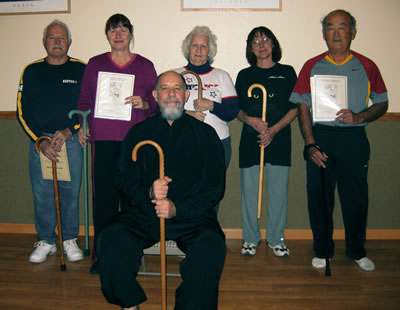
We Passed Level 1 Requirements for the Eight Immortals Taijiquan
Cane Form.
We practiced together twice a week for the past four months, and many studied
and practiced this Taijquan Cane Form
more hours every week.
Read about the awarding of Level 1 certificates.
Eight Immortals Taijiquan Cane, Routine One, Based on the Yang Style of
Taijiquan. As taught by Master Jesse Tsao. This series of documents
was prepared by Michael Garofalo, M.S., for students studying the Eight
Immortals Taijiquan Cane at
the Valley Spirit Taijiquan Center, in Red Bluff, California.
Eight Section Brocade
Qigong By Michael P. Garofalo. 280Kb+. History and
purpose of
this popular chi kung practice. Descriptions for each of the eight
movements, health benefits,
comments, variations, extensive links and bibliography, resources, quotations,
animated
.gif photographs of the movements, and charts. HTML format. 65
pages in Word.doc
format. This file is updated
on a regular basis as I add new material, links, notes, and resources.
Google:
Tai Chi Cane,
Tajiquan Cane,
Green Way Research
Red Bluff, California
Hsing I (Xing Yi) Chaun Five Elements Staff. Instructional DVD.
"In this instructional video, Xingyi master Di Guoyong explains and
demonstates the techniques and form of Xingyi Five-element Staff.
Interlinked Staff is a traditional and routine with smooth and
consistently strong movements. Strikes are fierce and vigorous, reflecting the
characteristics and style of Xingyi Quan. It is a form well known throughout
China. Movements of the Five-element Staff are concise and easy to learn and
practice. Its skills are clear, methods are explicit, strength is great, and
ability of skillful attack is strong. Five-element staff does not have flashy
forms or techniques, but like Five-element Boxing pays great attention to the
whole strength, body strength and work strength. Five-element Staff techniques
are also named after the names of chop, drill, snap, cannon, crosscut in
Five-element boxing." Vendors:
One,
Two, Three.
Index to the Cloud
Hands Website A detailed, alphabetically arranged, subject index
to webpages and documents offered at the
Cloud Hands Website.
Jian
(Sword) Taijiquan: Bibliography, Links, Resources, Quotes, Notes
"Jin Yiming's Walking Stick Exercises." By Jin
Yiming. T'ai Chi: The International Magazine of T'ai Chi Ch'uan, Vol. 29, No. 1, February 2005, pp. 39-47.
A 22 form
exercise system. Descriptions of each exercise and line
drawings.
Magical Staffs in Taoist Rituals. By Chen Yaoting.
Martial Arts
Techniques for the Cane and Short Staff. By Michael P. Garofalo.
The Old Yang Style Tai Chi Staff - Two
Person Fighting Form List of movements for both partners.
Purchasing a Short Staff (Gun, Jo) or Zhang (Cane)
Ripening Peaches:
Daoist Studies and Practices. Taoist scriptures, bibliography,
Quanzhen Daoism, Neidan, gardening, tea, history, qigong/daoyin, readings, etc.
Shaolin Cane, Bodhidharma's Cane, Damo's Cane
Shifu Zhang's Mysterious Taiji Cane
The Staff: Bibliography, Links, Quotes, Notes, Lessons
Sword
(Jian) Taijiquan: Bibliography, Links, Resources, Quotes, Notes 180Kb.
Tai Chi Cane (Zhang): Eight Immortals Taijiquan Cane, Routine One, Based on
the Yang Style of Taijiquan.
Tai Chi Chuan Walking
Stick. Kung Fu magazine, August 1996. The walking
stick forms are part of the Tchoung style of t'ai-chi ch'uan, developed by Grandmaster
Tchoung Ta-tchen. Sifu Kurland teaches this
form.
Tai
Chi Partner Cane From (San Tsai Tuan Kun). By Sifu Michael Gilman and
Stephani Morel, Port Townsend, Washington.
Detailed instructions with b&w photographs online. An instructional
videotape is also available for Sifu Gilman, and available
online. "This is a useful, short (11
movements per side) partner form. When the transition is added, one ends up with
a beautiful, instructive partner or solo form. These lessons are divided into
sections. The first is the Introduction and all the applications for the form.
The second and third sections break down each of the two sides and teach the
movements. The last section shows the form performed as a partner
form. Keep in mind that there is a companion VHS video tape available through
the on-line store." Tai Chi Partner Cane (San Tsai Tuan Kun).
Three Powers Stick, Short Stick practices. There are videos on UTube for
each lesson: Lesson
One 8:32,
Lesson Two:
9:15,
Lesson Three, 8:27,
Lesson Four,
9:11,
Lesson Five, 8:55,
Lesson Six,
9:24,
Lesson Seven, 6:04.
Tai Chi Stick and Staff. Instructional DVD by Mark Peters.
Taiji Sticking
Staff This webpage discusses use of the long staff and includes
descriptions and photographs of a two person routine.
Tai Chi
Sword, Saber and Staff. By Stuart A. Olson. Yearning K. Chen
Series, Volume 5. Bubbling Well Press, 1986. ASIN: 0938045032.
Taiji and Shaolin Staff Fundamental Training. Performed by Yang,
Jwing-Ming, PhD. Boston, YMAA, 2003. Instructional VHS
videotape. 90 minutes. ISBN: 1594390088.
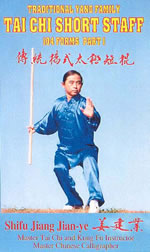
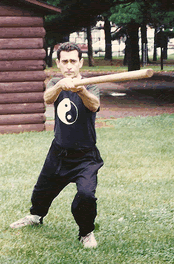
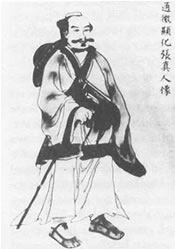
Taiji Fa Jing Stick,
Yang Medium Stick. Instruction by Earle Montague. UTube video, 5:12
minutes.
Taijiquan Cane (Zhang): Eight Immortals Taijiquan Cane, Routine One, Based
on the Yang Style of Taijiquan.
Taijiquan Walking Stick Form
of Master Chen Pan-Ling.
Taijiquan Walking Stick Form of
Master T.
T. Liang. Taiji
Weapons: Cane, Saber and Double Edged Sword. Instructional video by
Paul Gallagher, 60 minutes. The cane form was created by Master T. T.
Liang (1900-2002). "The weapon sets are the final stage of T'ai chi solo training. each
weapon has its own particular function and spirit, and develops the body and
ch'i in a different way. Starting with the cane, a basic level weapon,
progressing to the saber, and going on to the extremely subtle and sophisticated
sword, this video gives you complete and detailed instruction in each of these
weapon sets."- Paul Gallagher. "Knowing T.T. Liang, I would not be
surprised if he drew from several sources to create his cane form. In his
expanded Yang system, the cane was a stepping stone weapon that one used to
begin training with weapons where one didn't need to pay close attention to edge
angle, using the blade flat, etc, that one must when using a blade. There are
certainly some jian movements in his
cane form." -
Dan Pasek. "Not
historically, there is no mention [of stick forms] in any of the Yang Family
writings, or those by their direct students, of the first three generations of
Yang Family teaching any weapons other than
jian, dao,
gun and
chiang. Later teachers in the
Yang lineage created new forms such as the walking stick and the fan. T.T. Liang
created his own stick form; and Wang Yen-nien created a fan form.
I believe Master Liang taught his "Cane" form to many students, but
personally, the only weapon I studied with him is the
jian. So my knowledge of the Cane
is quite limited. My classmate and senior student of Liang, Paul
Gallagher, produced a how to video that includes instruction on Liang's Tai Chi
Cane form that you might find useful."-
Scott Rodell. Video
1
Taiji Stick Form.
UTube video, 49 seconds.
Taiji Sticking
Staff. By Zhang Yun and Peter Kindfeld
Taiji
Staff. By Chip Ellis.
Taiji Walking Stick.
UTube, 1:11.
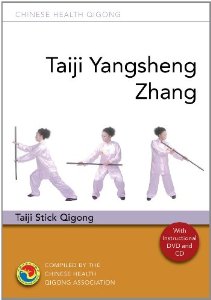
Taiji Yangsheng Zhang: Taiji Stick Qigong (Chinese Health Qigong)
 By the Chinese Health Qigong Association. Singing Dragon, 2014. 96
pages. 1 instructional DVD. ISBN: 978-1848191945. VSCL.
By the Chinese Health Qigong Association. Singing Dragon, 2014. 96
pages. 1 instructional DVD. ISBN: 978-1848191945. VSCL.
Taoist Secret Style Xuan
Wu Staff. VCD Product. In Chinese. WuDang style
staff demonstrated
and taught by You XuanDe. 2 hours.
Tchoung Ta-tchen Walking Stick Form, Yang Taiji Tuan Kun.
Grandmaster Tchoung Ta-tchen
(1911-2000) taught in China, Taiwan, Vancouver, and Seattle. There is a right
hand version and left hand version of this solo stick/cane form; and a partner
form developed by Tchoung Ta-tchen's senior students. The walking
stick forms are part of the Tchoung style of t'ai-chi ch'uan, a Yang
style variant, developed by Grandmaster Tchoung Ta-tchen. Sifu
Harvey Kurland
and Sifu Andrew Dale, master instructors, teach this
form. "Tchoung
had a particular interest is studying the sword and stick forms. He learned
several sword styles from the top masters of the day. The sword forms had names
such as "Green Duckweed Sword", green bamboo sticks of the beggars style, Kun
Lun (Kwin Lin) sword, Heaven and Earth sword, as well as the t'ai chi sword,
double sword, as well as Yang and Wu t'ai-chi knife sets. He developed his own
t'ai chi Tuan Kune or walking stick form which he taught to his
students." -
Harvey
Kurland. Kung Fu
magazine, August 1996. "The cane should be performed like you are using a
whip. Quick in hand action and footwork. This form is the creation
of Grandmaster Tchoung Ta-tchen. Based upon the pattern of the San Tsai
Jian (Three Powers Sword). This form combines two other styles he studied
from a Taoist martial arts teacher: the Beggar's Bamboo stick and the Green
Duckweed stick." Section One is the right hand side, Section Two the left hand
side, and Section Three is "actually the
Bagua Cyclone Saber Form which adapts very easily to the cane applications."
-
Xin Qi Shen Dojo, Yang Taiji Tuan Kun. There is a list of movement names, 37
movements, Taiji
Tuan Kun,
Section
One, from Xin Qi Shen Dojo. The Xin Qi Shen Dojo (Wuji.com) in Seattle now offers a Yang Taiji
Weapons demonstration DVD, which includes a demonstration of the solo cane form,
according to their
Winter 2009
Newsletter. There is a list of movement names,
Solo Cane Form (33
movements), and the
Partner Cane Form (15
movements) from
Gene Burnett, Ashland OR. Gene Burnett offers a
demonstration DVD of the Taiji Weapons in this style of Taijiquan. He
demonstrates Tchoung's Cane Form, both the Left Side and Right Hand, and the
Right Side and Left Hand sequences. The demonstration includes
multiple repetitions of each side of the solo cane form; and a good
demonstration of both sides of the partner form and skillful partner play with a
lady partner
(VSCL). There is a list of the movement names for
Tchoung's Solo Walking Stick Form, Section One, Left Side, Right Hand, 35 movements,
including directions, notes and a bibliography by Mike Garofalo. Gene
Burnett has been helpful to me in learning about this cane form: [T'ai-Chi
for Geniuses. A Practice Companion for the Genius in Everyone.
By Gene Burnett, Ashland, Oregon.
Bloomington, Indiana, IUniverse Inc, 2009. 284 pages. EBook:
9781440111921.]
Techniques for the Cane and Short Staff
Thunder
Stick Form developed by Chen Pan-Ling and as taught by Chen
Yun-Ching.
Traditional Ba Gua Staff with Applications. Taught by Shifu Jiang Jian-ye.
120 minute VHS
videotape. A 19 movement form in the Ba Gua Zhang style, created by Professor Jiang Zhou
Chu. Produced by Shifu
Jiang Jian-ye of the Capital District Tai Chi and Kung Fu
Association of New York,
29 West Dillenbeck Drive, Albany, NY 12203. Website: Jiang's
Tai Chi Videos.
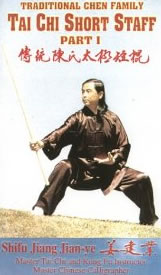
Traditional Chen Family Tai
Chi Short Staff. Taught by Shifu Jiang
Jian-ye, 1950-. This 74 movement form was created by Grand Master Chen Shen-Pu, 1902-2000.
Part 1, Movements 1-34; color, 120 minutes. Part 2, Movements 35-74;
color, 121 minutes. Available in DVD or VHS format, for about $45.00 US
each. Vendors:
WLE,
Wayfarer,
Jiang. Produced by Shifu Jiang Jian-ye of the Capital District Tai Chi and Kung Fu Association of New York,
29 West Dillenbeck Drive, Albany, NY 12203, c 2000. Website: Jiang's
Tai Chi Videos. "This is an elegant, dynamic form with many
techniques. Good physical skills are recommended to learn this 74 movement form.
Includes a short clip of the creator at age 94. Following warm-up exercises,
movements are repeated 3-4 times, depending on the difficulty. There are front
and back views at slow and regular speeds. There are also reviews of segments,
front and back." 1
"Master Chen Shen-Pu used his extensive training in
external and internal forms such as Tai Chi, Xing Yi, Bagua Zhang and Wushu to
create this short staff form. A lesser known form, it is still a
key ingredient to the Chen stylists repertoire."2
This form is for the 13 hands short staff.
Discussion
Chen Tai Chi
Short Staff: List
of Movements of 74 posture short staff form created by Master Chen Sheng-Pu;
prepared by Gary McClellan. Chen Shen-Pu's Taijiquan Short Staff 74
Movements Form,
List of Movements and References prepared by Michael P. Garofalo. I have not found any
references in any standard Chen Family Taijiquan sources that state that Chen Shen-Pu's Taijiquan Short Staff 74
Movements Form, or other short staff or cane forms, are part of the Chen Family Taijiquan
repertoire as are pole and spear forms.
Traditional Chen Family Tai Chi Short Form, List of Movements and References
prepared by Michael P. Garofalo.
Traditional Tai Chi Eight Immortals Cane, Routine One. Demonstrated by
Master Jesse Tsao. Instructional DVD, 64 minutes. Produced by
Tai Chi Healthways,
San Diego, 2008. Routine One is based on the Yang Style of Taijiquan.
Master Tsao developed this cane form himself, with grandmaster Zhu Tiancai's
support.
Traditional Tai Chi Eight Immortals Cane, Routine Two (Cannon Cane).
Demonstrated by Master Jesse Tsao. Instructional DVD, 65 minutes.
Produced by Tai Chi
Healthways, San Diego, 2008. Routine Two, Cannon Cane, is based on the
Chen Style of Taijiquan. Master Tsao developed this cane form himself,
with grandmaster Zhu Tiancai's support.
Traditional
Eight Immortals Taijiquan Cane, Routine One, Based on the Yang Style of
Taijiquan. As taught by Master Jesse Tsao. This series of documents
was prepared by Michael Garofalo, M.S., for students studying the Eight
Immortals Taijiquan Cane at
the Valley Spirit Taijiquan Center, in Red Bluff, California.
Traditional
Yang Family Tai Chi Short Staff 104 Forms. This short staff form was created in 1974 by Xu Minshan, who was an indoor
student of Yang Chengfu. Xu Minshan created the form to combine Yang style Tai Chi Chuan postures with
the traditional Yang style long staff form. This long form, suitable for persons at all skill levels,
is taught using two
instructional VHS videotapes featuring Shifu Jiang Jian-ye (1950-). Tape 1,
Part 1, teaches movements
1-50 of this form (VHS, 112 minutes). Tape 2, Part 2, teaches movements 51
-104 of this form (VHS, 112 minutes).
Produced by Shifu Jiang Jian-ye of the Capital District Tai Chi and Kung Fu
Association of New York, 29 West Dillenbeck Drive, Albany, NY 12203. These videotapes were produced in
2002, and priced at $45.00 each. Website: Jiang's
Tai Chi Videos. Shifu Jiang Jian-ye began his studies of Wushu in 1955 in China and he was educated in China. He is a physical
education, tai chi, kung fu, and calligraphy teacher. This videotape begins with an introduction of Shifu Jiang,
includes a little history of this short staff
form, includes a number of short staff warm up exercises, and then teaches the
form. Each movement is
introduced, named, and then illustrated. A front view of the movement is
shown as the teacher provides verbal instructions and tips. The front view is repeated and then a back
view of the movement is shown. I find the instructions clear and understandable; and the videotape production
is good.
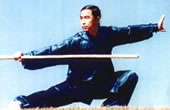
Traditional
Yang Family Tai Chi Short Staff 68 Forms.
This long form, suitable for persons at all skill levels,
is taught using two
instructional VHS
videotapes featuring Shifu Jiang Jian-ye (1950-). "Traditional Yang
Style Tai Chi Staff is a classic weapon routine. This form comes from Grand Master Sun Jixian. At the age of 18
he went to Bejing to study with Grand Master Wang Jiaoyu. Wang Jiayou was an indoor student of Yang
Banhou who was the son of Yang Luchan, the founder of Yang family Tai Chi Chuan."
Traditional Zhao-Bao Family Tai Chi Staff. Taught by Shifu Jiang
Jian-ye. Two 120 minute videotapes.
Includes applications. Produced by Shifu Jiang Jian-ye of the Capital District Tai Chi and Kung Fu Association of New York,
29 West Dillenbeck Drive, Albany, NY 12203. Website: Jiang's
Tai Chi Videos.
Traditional Zing-Yi Staff with Applications. Taught by Master Jiang
Jian-ye.
This 50 posture staff form was created by Ji Long Feng at the end of the Ming Dynasty. Produced by Shifu Jiang Jian-ye of the Capital District Tai Chi and Kung Fu
Association of New York,
29 West Dillenbeck Drive, Albany, NY 12203. This VHS videotape is 120 minutes and priced at $50.00. Website: Jiang's
Tai Chi Videos.
Valley Spirit Center, Red
Bluff, California VSCL = Valley Spirit Center Library
Vendors, Retailers, and Manufacturers of Short Staffs,
Canes, Walking Sticks
VSCL = Valley Spirit Taijiquan Library Collection, Red Bluff, California.
Walking Stick Retailers and Manufacturers
"Wang Shu-Chin's T'ai Chi Walking Stick," By Manfred Erich Rottmann, T'ai Chi
International Magazine of T'ai Chi Ch'uan, Vol. 18, No. 6, December, 1994,
pp. 26-29. Wang Shu-Chin (1904-1981).
Mr. Yoshikatsu Kohno told me on 2/5/09 that this walking stick form had 24
movements, was Xing Yi based, and was done with a walking stick of about 1 meter
in length.
Wind
Sweeps Away the Plum Blossoms: The Principles and Techniques of Yung Style
Tai Chi Spear and Staff. By Stuart A. Olson. Bubbling Springs Press, 1986.
ISBN: 0938045008.
Winding Dragon Wudang Staff.
Pan Long Men Wudang Martial Arts. Featuring Sun, Xiang.
Workshops, Seminars, Lectures, Demonstrations on the
Cane, Walking Stick, Jo, Short Staff
Wudang Short Staff.
Featuring Master You, Ming Sheng. Wudang Song Xi Branch Series.
Tiger Tail Stick.
Wudang Stick Training
Methods. Earle Montague. UTube video, 4:25 minutes.
武当山虎尾鞭杆
Wudang Shan Hu Wei Bian Gun
Wudang Tiger Tail Short Staff
Wu Dang 13 Hands Staff, Whip Staff, Wooden Walking Stick Form
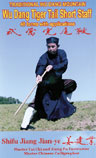
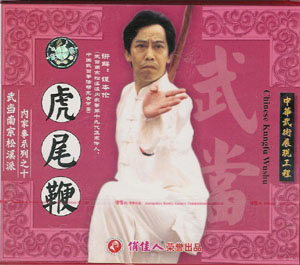
Wudang Tiger Tail Short Staff.
Demonstration by Master You, Ming Sheng. "The Wudang Song Xi Style of Kung
Fu offers this short stick form, which is also called the "Tiger Tail Stick".
This is a traditional internal
routine. Every form contains both defending & attacking applications.
This form has
the fierceness of the broadsword, the convenience of a staff, and the agileness
of sword."
Wudang Tiger
Tail Short Staff. An instructional VCD
featuring Ben Tan. "A
nice set with a "short" staff, often called a whip. Reverse hand and off angles
whipping style attacks. Well constructed with a number of hand changes. Back and
front hand motions combined. Distinctive Tiger Tail motions as ground sweeps.
VCD 1 hour, in Chinese only." This form is from the
Wu-Tang Nan-Zong Song-Xi Style, or Wu-Tang Souther
Sect Pine and Stream Style. Available from
Plum
Publications. Also available from
Wudang Tiger Tail Short Staff.
Wudang Kung Fu Series -
Stick-Wielding Arts, Products No.:VCD0424, 1 VCD.Instructional VCD.
"Weapon is considered to be a hand extension. This weapon routine is similar to
its bare hand routine, using softness to defeat firmness, following the pattern
to gain a beneficial vantage point. Wooden sticks, bamboo sticks or even
umbrella can be used as a weapon for this routine. The weapons are often used to
attack opponents with its backward stroke, moving in all directions, from left
to right, making the opponent unable to fight back. Once the opponents lose
control for a single moment, their defeat is irreversible."
Wudang Tiger Tail
Short Staff. "Wu Dang Short-Stick Skilled Fighting Form (Also called
Tiger-tail Whip) is a mysterious routine set that kept hidden for a long time
and in fact, it is of category of Internal Kung Fu. More than 40 forms consist
of the whole set and each one is simple and be free from any extravagance. The
whole set looks seemingly putting more emphasis upon defense but actually every
pose has the hidden nature of fierce assault. In terms of defense and fighting,
all postures look more close and tight ready for awaiting any attack, so, it is
more applicable than general forms." VCD format.
Wudang Tiger Tail Short Staff.
Taught by Shifu Jiang Jian-ye. "Traditional
Wu Dang Mountain, Wu Dang Tiger Tail Short Staff, 48 Forms with Applications. 114 minute
instructional DVD
or VHS videotape. Produced in 2004 by Shifu Jiang Jian-ye of the Capital District Tai Chiand Kung Fu
Association of New York,
29 West Dillenbeck Drive, Albany, NY 12203. Website: Jiang's
Tai Chi Videos. "This 48-form short staff routine from Wu
Dang Mountain is an in-door form that is short but effective and is taught with
applications. It is taught step-by-step with multiple angles and repetitions.
There are reviews of segments and demonstrations at the end. It is a
useful in-door secret form. The whole form is short and efficient."
All CDTKA instructional media include
an introduction to the skills and qualifications of Shifu Jiang Jian-ye. After
presenting two or three postures, the Shifu Jian-ye presents martial arts
applications for each postures. He also reviews, at slow and regular speeds,
sequences of postures. There are demonstrations of the entire form, front view,
at regular speed, and a demonstration of the entire form, back view, and a slow
speed. The instruction is in clear, precise
and detailed English. Many repetitions at different speeds. VSCL.
Wudang Tiger Tail Short Staff: List of Movements and Notes. Names of
each of the 48 postures in this Wudang Mountain Taoist Short Staff Form.
The "Short Staff" is sometimes called a "13 Hands Staff" or "Whip Staff."
Prepared by Michael P. Garofalo, M.S.. March 2009. Names are based
on the teaching by Shifu Jiang Jian-ye in his instructional DVD,
Wu Dang Tiger Tail Short
Staff.
"The Wudang Mountains (simplified Chinese:
武当山; traditional Chinese:
武當山; pinyin: Wǔdāng Shān), also
known as Wu Tang Shan or simply Wudang, are a small mountain range in the
Hubei province of
China, just to the south of the manufacturing city of
Shiyan.
In years past, the mountains of Wudang were known for the many Taoist
monasteries to be found there, monasteries which became known as an academic
centre for the research, teaching and practice of meditation, Chinese martial
arts, traditional Chinese medicine, Taoist agriculture practises and related
arts. As early as the Eastern Han Dynasty (25-220AD), the mountain attracted the
Emperor's attention. During the Tang Dynasty (618-907), the first site of
worship - the Five Dragon Temple - was constructed. The Hall of Yuzhen is the
cradle of Wudang kung fu. In 1417, Ming Dynasty Emperor Zhudi (朱棣) decreed
Wudang to be the "Grand Mountain" and ordered the construction of the Hall of
Yuzhen for Master Zhang Sanfeng. Wudang Mountain
martial arts is known far more for its swordplay, and Shaolin Temple for its staff work."
- Wikipedia
武当山虎尾鞭杆
Wushu Shaolin Staff. Taught by Shifu Jiang
Jian-ye. Produced by Shifu Jiang Jian-ye of the Capital District Tai Chi and Kung Fu
Association of New York,
29 West Dillenbeck Drive, Albany, NY 12203. This DVD or VHS videotape is
75 minutes. Website: Jiang's
Tai Chi Videos. This is a long staff (bo, gun) wushu form.
Yang Tai Chi Staff. Taught by Shifu Jiang Jian-ye. This short staff form was created
by Sun Jixian, who was an indoor
student of Yang Banjou. This long form, suitable for persons at all skill levels,
is taught using two
instructional VHS videotapes featuring Shifu Jiang Jian-ye (1950-). Tape 1,
Part 1, teaches movements 1-34 of this form (VHS, 120 minutes). Tape 2, Part 2, teaches movements
35-68 of this form (VHS, 117 minutes). Produced by Shifu Jiang Jian-ye of the Capital District Tai Chi and Kung Fu
Association of New York, 29 West Dillenbeck Drive, Albany, NY 12203. These videotapes were produced in
2002, and priced at $45.00 each. Website: Jiang's
Tai Chi Videos.
Yang Style of Tai Chi Chuan. Includes
numerous staff forms.
Zhao-Bao (He Family) Tai Chi Staff. Instructional DVD by Jiang
Jian-ye.
Videos Online about the Taijiquan Short Staff
Bagua Cane Ian Sinclair of Cloud Mountain Martial Arts
Tai Chi Stick Form. UTube video, 2:52 min.
"The
Chinese staff is called
gun
(棍 pinyin gùn).
Its practice is commonly divided into two main areas: Northern staff techniques
(influenced by spear play) and Southern staff techniques. Many styles and
techniques exist but the best known outside of China is the Shaolin Temple staff
techniques as practiced by the monks in Chinese medieval times (Tang dynasty
900s-1000s) and later by their disciples in pre-modern China (1600s-1900s) by
anti-Manchu/Ching dynasty revolutionaries (Han Chinese patriots) prior to the
wide-spread use of firearms. The techniques made their usual dissemination
throughout the rest of Asia to be blended in with other countries' native
fighting techniques.
There are many forms of staff used as a
staff of office; an item which symbolises a position, rank or prestige. In
China, there are two types of staves: the wenren zhang ("the scholar
staff")(文人杖) which is a symbol of status, and the shiyong zhang(實用杖)
("practical staff") which has more practical uses. Compasses, telescopes,
weapons, and even medicine could be put within the much thicker shiyong zhang
to be taken out when necessary. The zhang (杖)itself could often be used
as a gun (棍), a fighting stick."
- Wikipedia - Staff
Stick
Return to the Index at the Top of This Webpage
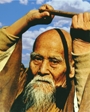
Aikido
Founder Morihei
Ueshiba with Jo, 1966
Quality
Posters from Aikido Journal
Other Martial Arts Styles of Short Staff
Advanced Stick Fighting. By Maasaki Hatsumi. Kodansha International, 2005. 208 pages. ISBN: 4770029969. VSCL.
Arnis: Toma Modern Arnis.
Master Thomas (Toma) Rosenzweig. Home of Modern Arnis in Los Angeles.
Phone: 1-818-339-4051.
Ba Gua
Zhang (Pa Kua Chang) Short Staff Practices
Bagua Cane Form.
Demonstrated by Ian Sinclair. UTube video, 0:58 min.
Bagua Pole Form. Demonstration by Erle Montague. Video,
Bagua Seven Star Short
Staff. UTube video, 1:04 min. Seven Star Stick (staff, rod,
pole) (Qi Xing Gan)
"Throughout eastern Asia, these stars compose the Northern Dipper. They
are colloquially named "The Seven Stars of the Northern Dipper" (Chinese:
北斗七星;
pinyin: běidǒu
qīxīng;
Japanese Hiragana:ほくとしちせい;
Korean: Hangul:
북두칠성, Romaja:
Bukduchilseong; Vietnamese : chòm sao Bắc Đẩu). The seven stars are very
important in
Taoist
astrology."
- Big Dipper
Bagua Staff.
八卦棍. UTube video, 1:08 min.
Bagua Staff.
UTube video, 1:39 min.
Ba Gua Staff with
Applications. Created by Professor Jiang Zhou Chun, "a respected
professor of martial arts (Wu Shu)." Taught by Shifu Jiang Jian-ye on a 124 minute instructional DVD.
This 19 movement form is in the "traditional" Ba Gua Zhang style. The
title on the DVD cover is "Traditional Ba Gua Staff with Applications." Produced in 2000 by Shifu Jiang Jian-ye of the Capital
District Tai Chi and Kung Fu Association of New York, 29 West Dillenbeck
Drive, Albany, NY 12203. "It combines elements that
characterize Baguazhang with movements that are specific to staff techniques. It
develops flexibility throughout the body, and increases joint mobility."
Website: Jiang's Tai Chi
Videos. Vendor: WLE.
This is primarily an eyebrow length staff form; however, it can be practiced
with a waist high staff. VSCL.
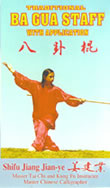
Ba Gua Staff. Created by Professor Jiang Zhou Chun, and taught by Shifu Jiang Jian-ye. List of movement names, detailed descriptions, notes, bibliography, and links. By Michael Garofalo.
Bagua Swimming Dragon Staff
Form. Created by Chen Pan-Ling. Demonstration DVD by his son,
Chen Yun-Ching. No. 1: Dragon Lifts His Head. No. 2: Dragon
Emerges from the Sea. No. 3: Dragon Turns Its Body. No. 4:
Dragon Looking Behind. No. 5: Dragon Shakes Its Tail. No. 6:
Dragon Playing Roughly. No. 7: Dragon Rolls Over. No. 8:
Dragon Displays Its Invincible Prowess. This a long staff set of 6:32
seconds. The staff is an eyebrow staff length. My Bagua teacher,
Shifu Kent Howard, learned this bagua staff form.
Baguazhang
VCDs. Includes some staff forms in various bagua styles.
Ba Gua Zhang ( Pa
Kua Chang): Bibliography, links, resources, quotes, and notes.
Circle walking internal martial arts. By Michael P. Garofalo.
210 Kb+. Baguazhang
includes some staff forms.
Baguazhang Pole Form. Instructional DVD by Erle Montague.
Cheng Style
Baguazhang Swimming Body Staff. VCD.
Eight Circular Bagua Staff
Instructional video, 35:22 minutes.
Eight Directions Seven Star Staff. Created by Andrew Dale of the Xin
Qi Shen Dojo.
Eight Dragons Baguazhang Cane Forms. By Michael P. Garofalo.
Valley Spirit Taijiquan, Red Bluff, California.
Seven Star Praying
Mantis Kung Fu History
Seven Stars Bagua Staff. "Classical Baguazhang, Volume XVII, Bagua Seven
Stars Staff." By Joseph Crandall.
Smiling Tiger Martial
Arts, 2008, 96 pages. "This is an introduction to the English public
of the Bagua Seven Stars Staff. Presented here are the routines for this weapon
from two different lineages, that of Guo Gumin and that of Liu Xinghan. Both
versions are similar, but have some interesting differences. This book allows
the student to compare and contrast the two lineages." ISBN:
978-1-929047-78-9.
Yang Wulang Bagua Staff
(Hongquan). UTube video, 2:13 min.
Bian Gan (Whip Staff),
Zhang Xigui. UTube, 3:59 min.
Bodhidharma's or Damo's
Cane Wushu UTube, 2:01 min.
Bodhidharma's Short Staff Form,
Damo Gun. UTube, 1:25 min.
British Quarter Staff
Association "The British Quarterstaff Association teaches men the art
and technique of the quarterstaff, a weapon whose use predates written history.
Today, the British Quarterstaff Association provides men with a form of
training that is rooted in British traditions, through regular
classes and
events. As a combat form, the use of the quarterstaff requires learning sets of
attacks and defenses, coordination of eye, hand and body and how to focus
intention. More fundamental than these is learning how to use posture and weight
shifting to direct energy economically. Still more fundamental is adopting
the approach of the warrior.
Working regularly with the staff develops strength. Confronting fear
develops courage. Observing the effective use of techniques develops skill. The
aim of the warrior is to use strength, courage and skill in all circumstances,
not just when he holds a staff."
"Broadsword and Singlestick - with Chapters on Quarter-staff, Bayonet, Cudgel, Shillalah, Walking Stick, Umbrella and other Weapons of Self Defense; The Quarter-Staff" By Allanson-Winn, R.G. and C.
Phillipps-Wolley.
London : George Bell & Sons. 1st edition, 1898.
Cane Links Valley Spirit
Taijiquan, Red Bluff, California
Cane Research Project at Valley Spirit Taijiquan
Canary Islands Stick Fighting. JUEGO DEL PALO - Stick Fencing of the Canary Islands. Journal of Western Martial Art , May 2000, by Tony Wolf.
Canary Islands Stick Fighting.
Martial Arts of the World. An Encyclopedia of History and
Innovation
(Thomas Green & Joseph Svinth (Eds.), ABC-CLIO,
2010):
Canary Islands Stick Fighting and Wrestling
by Carlos Gutiérrez García (University
of León, León, Spain) and Juan
Carlos Martín (University of León, León, Spain).
Definitions:
Short staff or stick weapons: Arnis sticks, Hanbo, Jō (Japanese stick weapon),
Kurunthadi, Kubotan, Otta, Shillelagh, Tambo, Tonfa, Yawara, Yubi-bo.
Long weapons (staff and spear weapons):
Arbir (Indonesian halberd), Bisento (Chinese origin halberd), Bō (Japanese staff
weapon), Eku, Gun (staff), Ji (halberd), Jogo do Pau (Portuguese Staff and
baton), Guan dao or Kwan dao (large Chinese halberd), Kurunthadi, Ox
tongue, Lathi, Pudao (long handled sword), Halberd, Monk's Spade, Nagamaki
(Japanese
polearm), Naginata (Japanese polearm), Qiang (spear), Quarterstaff, Sarissa,
Sibat (Filipino/Indonesian spear), Spear, Taiaha (Maori wooden duelling
spear/staff), Kanabō (Japanese iron staff), Yari (Japanese spear).
Eight Immortals Taijiquan Cane, Routine One, Based on the Yang Style of
Taijiquan. As taught by Master Jesse Tsao. This series of documents
was prepared by Michael Garofalo, M.S., for students studying the Eight
Immortals Taijiquan Cane at
the Valley Spirit Taijiquan Center, in Red Bluff, California.
Egyptian
Royal Regalia -
Scepter and Staff
Fatal
Flute and Stick Forms: Wah Lum Kung Fu. By Poi Chan.
Unique Publications, 1985. 151 pages. ISBN: 0865680590.
The
Fighting Staff. By Dwight C. McLemore. Paladin Press, 2010.
234 pages. ISBN: 1581607148.
Five Tigers Swarm a
Herd of Sheep Staff Form. List of movements. Used in Shaolin
staff practices, kung fu, and Chen Style Taijiquan.
The Ferocious Enchanted Staff of
Ancient Monks. By Dr. Leung Ting. 95 pages.
This book consists of the origination, form, and application of the “ferocious enchanted staff” – a translation from a hand-transcribed book of ancient times!
*****
The
Forbidden Kingdom. A major fantasy
motion picture,
distributed in 2008. All dialogue is in English. Starring Jackie Chan (Lu Yan the drunken Taoist
immortal and an old Boston pawnshop owner), Jet Li (a quiet Buddhist monk and the
immortal Monkey King),
Michael Angarano (Jason, an American teenager), Liu Yifei (Golden Sparrow, a
beautiful young woman seeking revenge), Li Bing Bing (the White Haired
witch-sorceress),
and Collin Chou (the evil Jade Warlord
sorcerer). Directed by Rob Minkoff. Martial Arts
director; Yuen Woo-Ping. Screenplay by John Fusco. Cinematography by
Peter Pau. Multiple producers, and distributed by the Lion's
Gate Studio and the Weinstein Company. 104 minutes, DVD, with many extra features
and outtakes. This film features many beautiful and elaborate sets from the largest film studio in the
world, Hengdian
World Studio, or "Chinawood," near Shanghai, China. This was the first
on-screen collaboration between the famous Hong Kong actors
Jackie
Chan and Jet Li.
The magical
staff of the Monkey King must be returned to free the Monkey King imprisoned in
stone by
the evil Jade Warlord, and a team of four (Chan, Li, Angarano, and Yifei) go on a
quest to return the staff and must battle the evil doers (Bing, Chou) along the
way. Plenty of sorcery
special effects, dramatic high
flying and high quality martial arts fighting, excellent cinematography, superb
scenery in China, and a complex blend of Chinese myth, lore and philosophy. The plot
will appeal more to persons under 20 years of age, followers of Chinese martial
arts and lore, lovers of quests and coming of age tales, fanciers of the
picturesque, and, of course, to aficionados of the staff. Many
elements from the epic Chinese story, Journey to the West, and other
characters from Chinese folklore and martial arts films are integrated in this
fantasy story. Michael Angarano's character of Jason (a dreamy weak teenager
transformed into a brave warrior), is a blend of Daniel LaRusso
in the Karate Kid, Bilbo Baggins in The Lord of the Rings,
and Dorothy in the The Wizard of Oz. Jason is mentored and taught
martial arts by Lu Yan the drunken Taoist/Zen man (played by Jackie Chan) and the quiet Buddhist monk
(played by Jet Li). Magickal time travel
and shape-shifting add complex twists to the fantasy.
*****
Forza: The Samurai Sword Workout. Kick Butt and Get Buff with High Intensity Sword Fighting Moves. By Illaria Montagnani. Photographs by Bill Morris. Berkeley, California, Ulysses Press, 2005. 140 pages. ISBN: 1569754780. Practice is done with a wooden replica of a Smuarai sword - a cane would suffice.
Horse Hair Whisk (Fu
Chen), Taoist Ceremonial Whisk "Before before the disciple leaves
for three years, the Daoist master gives him a three things to remind the
disciple of his objectives, First, he gives him a red belt, 3.3 feet long,
to remind the student to tame the mind for this time period, to be serious, and
to keep his mind at peace. Second, the Fu Chen (horsehair whisk) to
remind him to befriend good people and help others. If he is enamored with
something and is tempted to return to society, he must whisk away these ideas,
like the Fu Chen. Third, the disciple is given a sword. If he has lost his
way and has lost himself, the disciple remembers that his master has given him
the sword to cut away these ideas, so that he may continue on his path."
Horse Hair Whisk, Taoist Exercise Form. A vigorous and lively exercise
form. Video demonstrations:
Demonstration 1,
Demonstration 2. The whish is used to shoo away flies and other
insects.
Index to the Cloud
Hands Website A detailed, alphabetically arranged, subject index
to webpages and documents offered at the
Cloud Hands Website.
Irish
Stick Fighting, Faction Fighting, Celtic Martial Arts, Bata
Irish Stick Fighting -
Uisce Beatha Bata Rince. Whiskey Stick Dancing.
Jogo do Pau. Journal of Manly Arts.
Korean Tahn Bong, By
Grand Master James S. Benko, Ph.D.
Kung Fu Walking Stick
Demonstration. UTube, 0:45 min.
Martial Arts
Techniques for the Cane and Short Staff. By Michael P. Garofalo.
Praying Mantis Staff With Applications. Taught by Shifu Jiang Jian-ye.
122 minute VHS
videotape. A 25 posture combination of Seven Stars, Plum Flower, and Liu He Praying Mantis
styles. Produced by Shifu Jiang Jian-ye of the Capital District Tai Chi and Kung Fu
Association of New York, 29 West Dillenbeck Drive, Albany, NY 12203. Website: Jiang's
Tai Chi Videos.
Self-Defense with a Walking Stick. By E. W. Barton-Wright.
1901. 50K. Illustrations and
commentary.
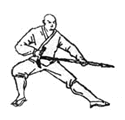
Shaolin Cane
Bodhidharma's Damo Cane
Kung Fu Form. UTube Video, 2:01 Min.
The Damo Cane.
Shaolin Single Cane. VCD instructional video. The
Damo Cane VCD
for Self-Instruction. Demonstrated and Explained by Feng Yan.
Language: Chinese and English. Published by Henan Electronic Audio and
Video Press. ISRC CNF420100730. The original creator of the Damo
Cane was Cheng Tongshan, a well-known boxing master. See also
Shaolin Cane.
The Damo Cane.
Shaolin Kung Fu. Demonstration and instruction by Sheng Yuefeng.
"The Damo Cane Kung Fu, also called the Shaolin single cane Kung Fu, is among
the rare weapons in Shaolin Kung Fu forms. This form has been passed on to only
a few persons by now. It is famous for weirdness and cleverness. This
program is based on the principles of higher starting point, authentic theories,
and excellent works. Hearty and generous impartation here is aimed at
quick and effective acquirement by any learner."
Vendor 2.
Subtitles in English and Chinese, and instruction in English option.
Instructional VCD. My copy had a bad hissing sound in the audio.
Instruction was a bit to fast. This set is not the same as the Shaolin
Bodhidharma's Cane as taught by Master Shi Deyang. It appears to be a
wushu competition form. VSCL.
Damo's T Cane.
UTube Video, 47 sec.
Damo Gun - Bodhidharma's
Short Staff. Video, 1:26 min.
Dragon Head Walking Cane of
Shaolin Kung Fu. Instructional DVD by Grandmaster Wing Lam.
Gun, Staff, Cudgel, Long Staff, Eyebrow Staff
of Shaolin
Kung Fu Walking Stick Demonstration. Video, 1:26 minute.
Nine Province Short Staff (Shaolin). Video, 1:06 min.
Shaolin Bodhidharma's Cane Demonstration and instruction by Master Shi
Deyang. Instructional DVD. 21 Posture/Movements Form. "The Shaolin Bodhidharma's Cane is one of the rare weapons in Shaolin Wushu. It has a unique
shape, just like a walking stick in an old man's hand. The movements in this
routine are fierce, vigorous, simple, natural and poised. It cleverly and
reasonably utilizes the techniques of attack and defense, so it can both attack
and defend. This routine lays especially stress on the eyes techniques. When the
hands move, the eyes follow them. If preserving in practicing this routine, you
may able to improve the strength of hands." Subtitles in English.
DVD, 45 Minutes.
Vendor 2.
Vendor 3.
VSCL.
Shaolin Bodhidharma's Cane as taught by Master Shi Deyang. List of 21
movements in 3 Sections; and, a bibliography.
Shaolin Damo Cane.
Damo Cane also called Single Cane. It is said
that it was named after Damo because high monk Damo always has a cane with him.
Its movements include Lun, Ya, Jia, Sao, & Pi.
Shaolin Damo Cane
Demonstration. UTube Video, 42 sec. Demonstration by Sheng
Yuefeng.
Shaolin Cane
By Ted Mancusco.
Shaolin Cane
Instructional VCD, in English and Chinese. Instructor: Shi Yongkan.
The Shaolin Cane:
The Wooden Weapon of Kung Fu. Instruction by Ted Mancuso.
Instructional DVD, 60 minutes. Plum Publications, Santa Cruz, California,
© 2005. Available for purchase from both
Plum Publications
and
Amazon. "In
this presentation by Ted Mancuso, he utilizes a
traditional Shaolin cane set taught to him by one of his teachers, Lam Kwong
Wing, to explore the very nature of weapons work. Introductory remarks bring new
points to light about the usefulness of weapons work especially, with simple,
easily available instruments.
Among the topics covered, Mr. Mancuso discusses and
demonstrates: Basic strikes and their applicability to all weapons.
Grips and the "flexible hand" concept. The traditional Northern Shaolin
Boxing Cane form. In-depth stepwise breakdowns of each section of this
fast and mobile form. Examples of applications, including running
commentary explaining more than just the movements but the reasoning behind cane
defenses. According to this teacher,
"Over the years students have come to me
and say, - I'd like to learn the cane from you.
When I ask why they always say something
like, - For my father. He's getting old. At that point I have to explain to them
that this is one of the most dynamic weapons sets in the entire Shaolin arsenal.
After all, if you think about it handing a simple stick to a Kung Fu artists who
can do sword, spear, whip and dagger is just like saying "anything goes." This
is definitely not your grandfather's cane form."
In this instructional DVD, the
lineage of this particular Shaolin Cane form is given as: Ted Mancuso was
taught by Lam Kwong Wing, who was taught by Yim Shang Mo, who was taught by Gu
Ru Shang, who was taught by Yan Gi Wen, who was taught by Yan Di Gong, who was
taught by Wang Bang Cai, who was taught by Gan Feng Chi, who was taught by Monk
Zhao Yuan He Shang. Read the short essay by Ted Mancuso on
The Shaolin Cane.
VSCL. I think this is an excellent instructional DVD.
Shaolin Cane.
List of movements, instructions, notes, and references. Prepared by Mike
Garofalo. Based on the Shaolin Cane Form as taught by Ted Mancuso.
"So yes, there probably was a time when monks
were encouraged to use their humbled wooden instruments as a first and stolid
line of defense. In the case of Shaolin there are many legends and much
silliness about the Temple and its denizens. But one thing often admitted
through the centuries is that the wooden weapon work of the Temple was at times
of a very high caliber. It might have been the best in the world for its era.
This is not unexpected. Quite often Wushu styles find a certain weapon that most
perfectly characterizes their brand of skill. Pi Gua is famous for its saber
work. Ba Ji for its spear. Praying Mantis loves the two-handed straight sword.
Shaolin at one time boasted an astounding 200 stick sets. And that's quite
possibly true considering the amount of information coming into the Temple.
These wooden weapons varied greatly. Some were eight feet or more up to 12 feet.
Many were the famous "eyebrow" length. Then there were short sticks often called
whips or cudgels. And, of course, there were canes. Basically, the Da Mo
Cane - the most famous cane set from the Temple - utilizes a square necked
instrument. (There are actually a number of sets all claiming to be called after
DaMo the Buddhist founder ) The other significant variation of the Shaolin Cane
is its curve necked brother. There are many types: Dragon Cane, Iron Cane, but
the curved and the straight are the major designations. The Shaolin Cane we
present does not distinguish between the two but can easily use either version."
- The
Cane of Shaolin. By Ted Mancuso.
"Shaolin Gun is the most famous weapon. It was the earliest weapon of Shalin
Kung Fu. During Ming Dynasty, Shaolin Monks took part in several battles with
stick weapon to fight with rebellion group. From then on, Shaolin stick started
to become famous. The Shaolin stick movements was passed on form generation to
generation with the strict firmly style. The book “Shaolin Stick Movements of
Buddhism” was a famous sutra of Shaolin Stick. The most typical sticks movements
as bellow: Shaolin Feng & Huo Gun (Wind & Fire Stick), Shaolin Yinshou Gun
(Negative Hand Stick), Shaolin Duan Gun (Short Stick), Shaolin Da Ye Cha Gun
(Big Rough Stick), Shaolin Shao Huo Gun (Cook-firing Stick), Shaolin Yuan Hou
Gun (Monkey Stick)."
-
China Wushu
Shaolin Short
Stick. Instructional VCD from Plum Publications. "A short form
of 33 movements. Somewhat like a Plum Blossom form hitting the cardinal angles.
Some tips on application given by ShihFu Liu Zhi-Hai himself. Quick short
moves."
Shaolin Staff, Gun, Stick, Long Staff, Cudgel,
Eyebrow Staff
Shaolin Tai Tzu Style Short Stick. Instructional VCD, 60 minutes, Chinese
Only. This routine combines the staff methods of 5 Yin Hands and 7 Yang
Hands.
Thunder Stick Form developed by Chen Pan-Ling and as taught by Chen Yun-Ching.
24 Movements. List of Names.
Tongbiquan Wushu:
Master Huang Baoshan (1905-1998) Stick of LuDa, Nine Rings Zen Cane,
Old Man Guards the Field Stick.
Traditional Dat Mo Stick Martial Arts. Master Deng Er Qian. List
of 48 movements in English and Chinese. "It is believed that the
Traditional Dat Mo Stick Form comes
from the Shaolin Temple and predates
the burning of the temple in Henan. The Dat Mo
Stick has two lineage branches: 1.
Shaolin Si, 2. Tagou School.
It is also believed that there are two sections of the Dat Mo Stick, Section 1 -
composed of 40 forms and Section 2 - composed of 48 forms. The monks usually
performed the two sections together as one set." There is an
instructional DVD on this Dat Mo Cane/Stick Form, titled "In the Shadow of the
Masters" by Bob Fermor, available from the Guan Yu International Academy of
Martial Arts. [The length of the cane in
this form is somewhat longer than a hooked cane, from the floor to under the armpit - what we
might call a "crutch." The Shaolin Temple at Henan was
burned
three times: 574 CE, 1644, and 1927; and was vandalized and damaged during the
Maoist Cultural Revolution in the 1960's.]
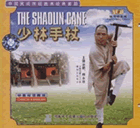
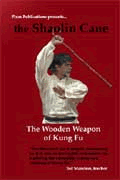
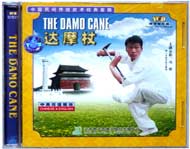
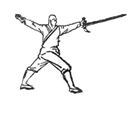
Special Taoist Taiji Stick and Ruler Qigong. By Feng Zhiqiang.
Compiled by
Wang Fengming. 205 pages in English, 127 pages in Chinese.
Staff Fighting Forms (Jian Dan Gun Fa Dui Lian, 簡單棍法對練)
Staff Spinning
Techniques and Fire Spinning
Stick and Pole Weapons. By George Hernandez. 80Kb. An
informative and detailed overview of this type of weapons.
Stick
Fighting. By Masaaki Hatsumi and Quintin Chambers.
Kodansha International, 1981. ISBN: 0870114751.
Stick Fighting
Google Video Search
Stav Rune Breathing Walking Stick Form
Strikes with the Stick and Cane. 60 strikes are described by Tom Lang.
87Kb, PDF.
Tai Chi Chuan, Taijiquan - Cane, Short Staff
Taiji Ruler Exercise techniques using a short
stick (Taiji Bang) and walking movements. Popular amongst Chen
Taijiquan practitioners.
"Taiji
Staff (太極棍, Taiji Gun). The staff is the first long weapon in
Taiji. The principles of feeling (listening), following, sticking, and adhering
remain the key to the training. Taiji staff also has two-person sticking
training."
Taiji Sticking
Staff This webpage discusses use of the long staff and includes
descriptions and photographs of a two person routine.
Techniques for the Cane and Short Staff
Tchoung Ta-Tchen Walking Stick
Form. 35 movements. A lively taijiquan walking stick or cane
form
Thunder
Stick Form developed by Chen Pan-Ling and as taught by Chen
Yun-Ching.
Tiger Tail Short Staff: List of Movements and Notes. Names of
each of the 48 postures in this Wudang Mountain Taoist Short Staff Form.
The "Short Staff" is sometimes called a "13 Hands Staff" or "Whip Staff."
Prepared by Michael P. Garofalo, M.S.. March 2009. Names are based
on the teaching by Shifu Jiang Jian-ye in his instructional DVD,
Wu Dang Tiger Tail Short
Staff.
Toma Modern Arnis. Master
Thomas (Toma) Rosenzweig. Home of Modern Arnis in Los Angeles.
Phone: 1-818-339-4051.
Traditional Filipino Weapons,
847 Hamilton Ave., Waterbury, CT 06706. 203 596 9073.
Sandata4UsAll@aol.com.
Recommended by Master Rosenzweig.
Valley Spirit Taijiquan Cane Links
Vendors, Retailers, and Manufacturers of Short Staffs,
Canes, Walking Sticks
Walking Stick Form of Master
Chen Pan-Ling. A walking stick form was taught by Chen Pan-Ling
(1892-1967.) "This form was brought to the U.S. at various times by
different martial artists; as such you'll find a few unique flavors of it. The
form is practiced in four lines and most count it at around 25-33 postures.
Interestingly, since broadsword (saber) moves influenced the form greatly, you
can also perform the sequence with a broadsword rather than a stick. This
version was brought to the United States at different times by Meng Shan-Fu, Kai
Sung, Chen Yun-Ching (1939-), and students of Wang Fu-Lai such as Hiromi Hangai Johnson
(www.hiromitaichi.org).
Each had their own technique and emphasis. As such, the flavor differs slightly
with each practitioner although the moves are basically the same. Chen Yun-Ching,
who is a son of Chen Pan-Ling, calls this form "Thunder Stick" and has a
DVD
available of it through his student James Sumarac
and from
Plum Publications."
This webpage includes six embedded UTube videos. Demonstrations:
Video 1 by
Dmitry Deitch,
Video 2 by Binyamin.
According to Marnix
Wells, Chen Pan-ling taught Wang Shu Chin the 24 movement walking stick
form; but others disagree.
"Just my two cents on the
walking stick form - it is listed in Mr. Chen's bagua book and several of his
other books as a Shaolin form. It is not in the "self invented" section of the
forms listing. I assume Chen Pan-Ling learned this form from his father. I have
seen Mr. Chen Yun Ching do it a couple of times. It is pretty short."
Discussion. The walking
stick form taught by Master Chen Pan-Ling has been called a Shaolin,
Xing Yi, and Tai Chi stick form by different knowledgeable persons.
Vendor: Plum
Publications. "In
regards to the short stick, when Chen Yun-Ching was here in the States in 2006, he
said that his father developed this form (Thunder Stick) in response to villagers that were
having problems with stray dogs and bandits. The villagers asked CPL if he could
teach them a simple weapon defense form. CPL extracted simple movements from his
Shaolin knowledge base and then taught this form so that the villagers could use
canes to defend themselves. Besides using a short staff, Chen Yun-Ching actually
demonstrated the form with a cane with the hook handle and was very impressive."
-
Tom Karls. 二十四棍(鐵) 24 stick (walking stick).
Hal Mosher, an authorized Chen
Pan Ling system teacher, told me that there are no names for the movements in
this form.
The Walking Stick Method of
Self-Defense. By H. G. Lang, 1923. Published by Kirk Lawson.
118 pages.
Walking Stick Retailers and Manufacturers
Wang Shujin (1904-1981) According to Kent Howard, Wang Shujin always carried a
cane or walking stick with him, and he could use it effectively in martial
applications. Shifu Howard said Wang Shujin practiced a cane form taught
to him by Chen
Pan-Ling (Thunder
Stick) and a Xing Yi cane form.
Wendy's Walking Sticks and Cane Links
Western China
Staff Sets: 30 VCD's from
Plum Publications. "The Western region of China is often associated with
Taoism and the interchange of religious ideas from India. This style has a huge
amount of stick work. Single stick, double jointed staff (Big Sweeper), double
short sticks (Nunchaku): all are here with an unusual number of high quality
sets. Here we have a variety of performers all giving renditions of staff
skills. This style has a huge repertoire of staff work including single short,
single long, double short, big sweeper and more. There are not only a lot of
sets but the typical eyebrow length staff is used in a variety of ways including
reverse grip. Along with Shaolin, which for a time was probably the greatest
staff style in the world—boasting 200 sets— the Western Staff is a truly
masterful selection of forms." Bian, Tan Bian (Single Whip, Whip Like) forms,
and Gun forms.
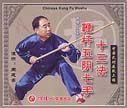
Western Staff Style Husk Staff. Cai Zhi Zhong performs Ku Zi Gun. "This is a three VCD set with no forms on it. Instead there are many exercises. This is a great series for people who want to really practice stick arts. Each section contains a few moves done symmetrically with a refrain, something like the staff version of a short Tan Tui set. Each section is named, performed, repeated and then broken down. Great for instructors and students who want practice patterns. This rare art was once the property of the Gao family, Gansu, and has only recently come forward. Excellent routines." Plum Publications. VSCL.
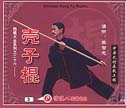
'Nanquan, beitui
Dongqiang xigun'
'Fists in the south, legs in the north
Spears in the east, sticks in the west'
Workshops, Seminars, Lectures, Demonstrations on the
Cane, Walking Stick, Jo, Short Staff
Xing
Yi (Hsing I) Staff. Video and
List of
Postures.
Videos Online about the Short Staff in Other Martial Arts Styles
Black Tiger Stick Form. UTube, 1:10 minutes.
French Stick Fighting (Canne de Combat) Online Video. 2:26 minutes.
French Stick Fighting (Canne de Combat) Online Video. 3:03 minutes.
Wushu Stick Form. UTube, 3:46 minutes.
Wushu Stick Form. UTube, 2:51 minutes.
Whip Staff Cudgel. UTube, 1:58 min.
Whip Staff (Bian Gan). UTube, 3:59 min.
Xing Yi Short Staff Form. UTube, 1:34 minutes.
Xiao Yao Style Cane Form. VCD, 60 minutes. Plum Publications.
Return to the Index at the Top of This Webpage
Fitness and Walking
The Use of Canes, Sticks, and Weighted Staffs in
Conditioning Exercises
"Besides being a most useful and practical
accomplishment, this new art of self-defense
with a walking-stick is to be recommended as a most exhilarating and graceful
exercise."
- E. W. Barton-Wright, 1901
Body Bar and BOSU Training DVD
Body Bar Deep Definition DVD.
Presenters: Rob Glick, Carey Bond, and Lashaun Dale. DVD, 130
minutes.
Body Bar:
133 Moves for Full Body Fitness. By Gregg Cook and Fatima d'Almeida-Cook.
159 pages. VSCL.
Cane Exercises with a Stretch Band. By
Master Thomas (Toma) Rosenzweig.
Cane Research Project at Valley Spirit Taijiquan
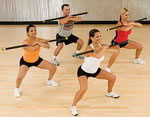
Danda Yoga. Dr. Maun Gyi.
Exercises with a Cane - Google Search
The
Exercise System of the Cane. Instructional DVD, 45
minutes. Developed by Grandmaster Mark Shuey, Sr., founder of Cane
Masters. Cane Masters Instructional Video Series, Volume 1.
"The
material in this video is based solely on the physical fitness aspects of using
the cane either with our without a resistance band. You will see not only the
proper technique of performing each exercise, but also a graphic representation
of that portion of the body being stressed. We have had many doctors,
chiropractors, and physical therapists report that they have patients who have
benefited greatly from this program."
Fan, Tai Chi Fan, Kung Fu Fan, Fan Dance
Hiking Poles and Walking
Sticks An interesting collection of short articles about
Martial Arts
Techniques for the Cane and Short Staff. By Michael P. Garofalo, M.S.,
Valley Spirit Taijiquan, Red Bluff, California. January 2009. 100Kb.
Includes Strikes - Two Hands, Strikes - One Hand, Blocks - Two Hands, Blocks -
One Hand, Sweeps, Pull Downs, Chops, Jabs, Pokes, Punches. The document
provides a bibliography, links, and resources. The document includes brief
descriptions for each short staff and/or cane technique.
The Staff: Bibliography, Links, Quotes, Notes, Lessons
Tai Chi Chuan, Taijiquan - Cane, Short Staff
Tai Chi Fan, Kung Fu Fan, Fan Dance
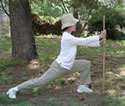
Tai Chi Ruler, Bang, Hand Stick Practice
Using the French Cane for
Fitness. By Frederic Morin.
Vendors, Retailers, and Manufacturers of Short Staffs,
Canes, Walking Sticks
Versa
Bar: Weighted Bars, 4' long (12lb, 18lb, 24lb)
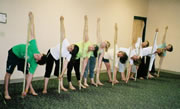
Walking Staff Related
Articles and Book Excerpts
Walking Stick Retailers and Manufacturers
The Walking Stick: Hiking and
Walking - Sticks, Poles and Staff
Walking Stick Method of
Self Defense. A twelve part manual created by Mr. H.G. Lang who
was a British Officer of the Indian Police. It was written in 1923. PDF
format.
Walking Sticks:
Catalog and Links The Sei Do Kai Catalog.
Wampanoag
Carved Walking Sticks
The Ways of Walking:
Quotes, Poems, Sayings, and Lore
Weight Training with the Staff: You can always use a body bar or iron
staff.
Return to the Index at the Top of This Webpage
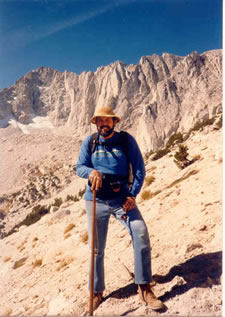
Sierra Nevada, California
Rock Creek Basin, Mt. Starr (12,870'), 1985
Mike Garofalo, a hiker, who agrees with the late Colin Fletcher's praise for the
walking staff:
"Although the vast majority of
walkers never even think of using a walking staff, I unhesitatingly include
it among the foundations of the house that travels on my back. I still take
my staff along almost as automatically
as I take my pack. It is a third leg to me - and much more besides.
On smooth surfaces the staff helps maintain
an easy rhythm to my walking and gives me something to lean on when I stop to stand and stare. Over rough going of any kind, from tussocky grass to pockety rock, and also in a high wind,
it converts me when I am heavily laded from an insecure biped to a confident triped. ... It
may well be, too, that the staff also gives me
a false but subconsciously comforting feeling that I am not after all completely defenseless against attack by
such enemies as snakes, bears and men."
- Colin Fletcher, The Complete Walker III, 1984, p. 78
Quotations
Short Staff: Jo, Walking Stick, Cane, Zhang
Jodo, Aikijo, Jojutsu, Gun Quan, Zhang Quan
Facts, Legends, Lore, Literature
The Magical Staff: Quotes,
Legends, Lore
"The craft of cutting a walking stick
no doubt stretches back through time to when Man first walked on two legs. At first simple tools, they would quickly have come to be carved and decorated.
The known history of walking sticks however, begins much later in mid fifteenth century Europe when
sticks have been found ornately carved with historical events. The term 'cane' was introduced in Britain during
the reign of King Henry VIII to refer to sticks made of imported exotic woods. Today the word continues to
refer to the use of exotic woods as well as to mean a stick with a simple taper and without a curved
handle."
- Phoenix Walking Stick Company
"Many backpackers never consider a walking stick or staff, yet for me this is as essential as a sleeping bag or a pair of boots. It was not always so; I backpacked for a decade and more without using a staff. Then I started using Nordic skis in winter and spring, and I discovered that when I had to carry the skis on my pack, using the poles improved my balance. Initially I began picking up stout sticks to help me climb steep inclines and ford streams. I realized that having a staff with me all the time could be useful when, on a week-long, early summer walk in Iceland, I couldn't find a stick to pick up-Iceland is virtually treeless. Shifting, slippery pebble and gravel beds mixed with large areas of soft, thawing snow and deep rivers made for a difficult walk, which a staff would have eased. Without one, I was constantly off balance, slipping and stumbling along. The main reason to use a staff is for balance on rough terrain and river crossings. Staff in hand I can negotiate steep scree slopes, boulder fields, and tussocky moorland with confidence, even with the heaviest load. But a staff has even more uses. On level ground and good trails it helps maintain a walking rhythm. When crossing boggy ground or snow, it can probe for hidden rocks and deep spots as well as provide support. It can hold back bushes, barbed wire, stinging plants, and other trail obstructions. Perhaps most useful of all, it saves energy. I am convinced it takes some weight off my feet, particularly when I lean heavily on it as I climb steep slopes. The German mountaineering equipment company, Edelrid, quotes "mountain doctor" Gottfried Neureuther as saying that "each place ski pole takes between 5 and 8 kilograms weight off the lower part of the body, which is equivalent to a total of 13 tons during a one-hour walk on flat ground and an amazing 34 tons total load reduction when walking downhill... ."
"Many people do not like the walking cane for Self-defense because it does
not go along with their age, attire or, they simply do not want to be associated
with someone who may be disabled. They do not wish to have the stigma that is
often associated with the cane. There is a strength in that appearance.
The strong appearing to be weak might be all the edge you need in a lot of
physical confrontations. That’s a "Combat Ruse." A young attacker who is strong
might make the incredible mistake of thinking you are easy prey, to find out all
too late that you’re not. The Cane gives even more reach than the average
telescoping baton in some cases and is legal in more areas than that weapon.
Perhaps the greatest strength of all is in the presentation. The Cane is already
"drawn." You can strike immediately with it. There is an old saying in Gun
Circles, "The fastest draw is to have the gun in your hand when the trouble
starts." This applies to the knife as well, and the stick. The strength of the
Cane is, it is a Cane! It’s not a gun or a knife, it is already out in the open
and you can strike instantly with it."
- Don Rearic, The
Beginner's Guide to the Cane
"The jo, like its larger sibling the
Bo (long staff), was
never an effective weapon on the battlefield in comparison to the
sword, spear and bow just to name a few. Although the jo and most other staves
could be used to lethal effect when
thrust at vital points of the body, but when faced with a fully armoured
opponent those vital points would in most
cases be covered. As a result there were very few
ryu that were
dedicated to the staff-arts in the warring era since
other more effective weapons were available. There are several ryu that include
jo-techniques in it's system. One
example is the jo-tradition found in the koryu art
Tendo-ryu
Naginatajutsu, founded in 1582. In Tendo-ryu, which
uses the Naginata as the primary weapon, there are techniques with the jo that
simulates a scenario where the
naginata has been cut in two and the wielder has to defend himself with the
staff-portion only. With the onset
of peace with the start of the Edo-period (1603-1867), the conflicts with heavy
armoured warriors became
a thing of the past. In this era, the jo-art would come into its own against
non-armoured samurai and
other opponents. Various other martial arts also include elements of jojutsu not necessarily
related to Shinto Muso-ryu. One of the
most famous promoter of the jo outside of Shinto Muso-ryu in modern times, and
indeed in the martial arts
community as a whole, was the founder of
Aikido,
Morihei Ueshiba. Ueshiba trained in a variety of ryu
including Yagyu swordsmanship, but is not known to have trained in Shinto
Muso-ryu. It is generally
believed that Ueshiba used his training in
sojutsu
(spear) to create a set of techniques for the jo.
(Ueshiba also used the longstaff
bo to perform the same
techniques.)"
- Shinto
Muso-Ryu - Wikipedia
"The bokken (wooden staff-sword) was usually used as a training tool and
simulated the length of a sword. Miyamoto Musashi (author of the book of strategy "Go Rin No Sho" - "A Book of Five Rings") is considered by many to be the greatest swordsman in Japanese history. Many of his duels were
won using only a bokken.
He believed that fencing technique transcended the weapon used.
... Muso Gonnosuke was defeated by Miyamoto Musashi and allowed to live. He later developed the jo. The wooden jo
is around 4 feet long. This
length advantage over the sword allowed Muso Gonnosuke to defeat Miyamoto
Musashi in a rematch. He spared Musashi's life but that is the only known defeat suffered by Musashi. The
jo and bokken are two of the weapons used in aikido to commemorate that battle."
- Gabrielle's
Staff Techniques By Donald Plunkett. 13K
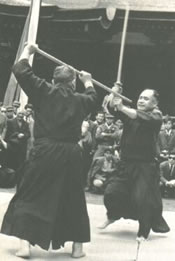
"Gonnosuke withdrew to a Shinto shrine at Mount Homan in Chikuzen province, (modern-day, Fukuoka Prefecture), where he would practice daily in perfecting his swordsmanship, praying and performing shinto purifying rituals for 37 days. It is also said, however, that he spent several years on the road studying other martial arts in various dojos until he ended up in the Shinto-shrine. After one of his regular (exhausting) training sessions he collapsed from fatigue and reputably had a vision of a divine being in the form of a child, saying to Gonnosuke: "know the solar plexus [of your opponent] with a round stick". In another version he had the vision in a dream late at night. He took it upon himself to create the jo deliberatly longer than the average katana of the day, 128 cm as opposed to the swords total length of approx. 100 cm, and use that length to his advantage in a fight. Gonnosuke, drawing on his own considerable experience with the spear, longstaff, naginata and sword, also devised a set of five jo-techniques for use to counter and defeat a swordsman.
Arguably he also developed techniques to specifically hinder Musashi's trade-mark x-block.
As the tradition goes, Gonnosuke, now armed with the jo, would again face Musashi in a duel and defeat him through the use of the superior length of the jo to keep Musashis swords out of range of Gonnosuke and thus hinder him from using the X-shaped technique effectively. Gonnosuke had Musashi at his mercy but let him live as a way of returning the favour granted in the first duel. Musashi, who was said to be impressed by how Gonnosuke had learned humility from his earlier arrogance and his new skills, made friends with Gonnosuke, and they would be each other companions during their travels.
The claim that Musashi was defeated, (at all), is still a matter of debate and is generally taken with a grain of salt."
- Muso Gonnosuke Katsuyoshi (circa 1600), Wikipedia
Article
"In Zen
Buddhism,
the keisaku (Japanese:
警策; kyôsaku in the
Soto school) is a flat wooden stick or slat used during periods of
meditation to remedy sleepiness or lapses of concentration. This is accomplished
through a strike or series of strikes, usually administered on the meditator's
back and shoulders in the muscular area between the shoulder blades and the
spine. The keisaku itself is thin and somewhat flexible; strikes with it, though
they may cause momentary sting if performed vigorously, are not injurious.
The word "Keisaku" may be translated as "warning stick", and is wielded by the
jikijitsu.
"Encouragement stick" is a common translation for "kyosaku". In Soto Zen, the
Kyosaku is always administered at the request of the meditator, by way of bowing
one's head and putting the palms together in
gassho, and then exposing each shoulder to be struck in turn. In
Rinzai Zen, the stick is requested in the same manner, but may also be used
at the discretion of the
Ino, the one in charge of the meditation hall. Even in such cases, it is not
considered a punishment, but a compassionate means to reinvigorate and awaken
the meditator who may be tired from many sessions of
zazen."
- Keisaku, Zen
Encouragement Stick
"Seng Chou, another famous martial arts
monk, is well known in the history of Shaolin Temple. He was one of the most
knowledgeable and respected monks and a great martial artist. He later became a
great abbot traveling throughout the country spreading the scripture of
Buddhism. He had thousands of disciples. Once, Seng Chou was walking in the
forest and saw two tigers were in a fierce fight. He attacked the tigers with a
cane. The tigers got angry with him. His great fighting sensibility, his light
Qigong and his endurance finally wore the tigers out. He broke the tiger's fight
up and gave the tigers a good lesson by defeating them both, though he broke his
cane."
-
History of Shaolin
"The stick is the ancestral weapon. Even our closest cousins – chimpanzees and bonobos – have been observed fighting with sticks. There are many kinds of fighting sticks. In English, stick, staff, bat, baton, rod, cudgel and truncheon; in Chinese, gun, bang, chang and more. In Shaolin weapons training, mastery of the short stick is the foundation of sword technique. Mastery of the long staff is the foundation of pole-arm technique. In our school specifically,
"French Cane Fencing (French canne): The art
of defending oneself with a walking stick, developed in France by the 16th
century but little practiced after the beginning of the 20th. In cane
fencing, unlike
singlestick, the thrust was as important as the cut. Also, possessing no
handguard, the cane was much more maneuverable than the singlestick. Cuts with
the cane were usually given after one or more flourishes, or
moulinets
(French: “twirls”), which served to confuse an assailant and lent momentum to
the cut. The thrusts were similar to those in
foil fencing but often carried out with both hands grasping the stick,
giving greater force and enabling the cane to be used at very close quarters.
French canes were made of tough
wood, about three feet (one metre) long, and tapered toward
the point. In practice matches, masks, gloves, padded vests, and shin guards
were worn. Today, organized cane fighting is overseen by the Comité National de
Canne de Combat et Bâton, in Paris."
-
French
Cane Fencing
"I have no fitting gifts to give you at our parting ... But take these
staves. They may be of service to those
who walk or climb in the wild."
- J. R. R. Tolkien, The Two Towers
"Weapons such as the La Baton, a seven foot staff rod
approximately one inch diameter were commonly practice by Savate practitioners. It was particular famous among hillside and
farming communities of France and Spain. There is no particularly evidence on where the La Baton came from but
it has been suggested that this weapon came into existence by farmers and sheep herders tools such as
walking staffs and garden tools.
The more famous and popular weapon incorporated by Savate is the La Canne. A
1/2 inch diameter flexible stick approximately 36 inches in length. Savate combines traditional fencing
motions along with kicking techniques when wielding this dowel shape stick at the opponent. This weapon is
fast and flexible making it a fierce companion."
- Boxe Francaise Savate
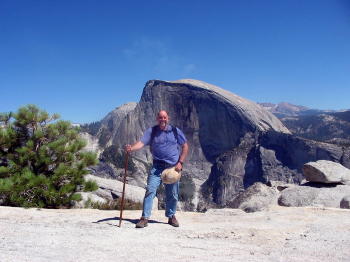
Yosemite National Park, California
Looking east from North Dome (7,450 feet) towards Half Dome
Mike Garofalo, Hiker, 2006
Chinese Chan Buddhist Master Shoushan held up a bamboo staff before a group and said, "If you call it a bamboo staff, you are clinging. If you do not call it a bamboo staff, you are ignoring. So tell me, what do you call it?" - Wumenquan, # 43.
"Andrew Chase Cunningham was a fencing and self defense
instructor attached to the US Navy during the early years of the 1900s. In 1912
he produced a booklet on practical self defense with a walking stick, under the
title "The Cane as a Weapon". A PDF of that booklet has been floating
around the Net for years, but never attracted much attention, probably because
Cunningham only included 12 photographs of himself in various "attitudes of
defense" with his cane, as an appendix at the end of the booklet. The rest of
the booklet consists of large chunks of text, and although it's reasonably
well-written, without pictures it's difficult to follow what he's saying.
An expanded re-print became available in 2006, including all of the original
text and pictures plus a new introduction and 170 new photographs of the system
in action, which make it much easier to follow the technical instructions.
Cunningham's system was unusual in that it didn't just treat the cane as a
substitute sword. Acknowledging the risk of an attacker grabbing the cane if it
was held in an orthodox fencing position, Cunningham advocates three guard
positions. In two of them the cane is held low in the right hand with the left
hand up in a boxing defense position, and the third guard is a double-handed
grip on the weapon. Targets, defenses and attacks are sensibly chosen.
Cunningham was well aware of the "de-fanging the snake" principle and many of
his parries are actually counter-strikes to the attacker's hand or wrist,
usually followed by a combination of cuts and thrusts to the face, throat or
solar plexus area. He also advocates striking to the attacker's knee/shin region
while sidestepping or retreating away from the initial attack. Much
attention is paid to using the cane ambidextrously, quickly shifting grips from
one hand to the other, and to the different types of striking techniques
(snapping cuts, half-arms cuts, circular cuts, etc.) The system is versatile
enough to cope with attacks from an opponent wielding a stick, knife or other
short weapon, or attacking with punches or kicks. He offers some sensible
advice about how to fend off a group of attackers, and even discusses how to use
a bowler hat as a "shield" in the off-hand and how to fight off an attack by a
dog."
-
Devon
"A staff is a large, thick
stick or
stick-shaped object used to help with
walking, as a
status symbol,
as a component of traditional
barrel making, or as a
weapon.
The plural form of staff was originally staves (compare wolf,
wolves and knife, knives), and in British and International English
this is still preferred. In American
English the usual plural form has become staffs, except in
fantasy literature. The old English plural form staves collectively
describes the wooden sticks bound by
iron
hoops to form
traditional wooden
barrels. Examples of staffs in
Western Martial Arts include the English
quarterstaff and the French
bâton, and there are many martial arts, such as Italian
Liu-bo, based around such staff-like weapons. The
Indian
Silambam
staff has been used as a weapon since at least the 2nd century, evident from
references in ancient
Sangam literature of the time. The
martial art associated with the Silambam staff is also known as Silambam.
This staff was later incorporated in several
Malay martial arts such as
Silat."
- Wikipedia -
Staff (Stick)
The Magical Staff: Quotes, Legends, Lore
"The walking stick or "cane" has long held a place in man's
history, its roots leading back to the "big stick" wielded by prehistoric man as a weapon of both self-defense and
aggression. Civilized man carried on the tradition. Ancient Egyptians and Greeks represented their rulers and gods
carrying staffs which symbolized authority. These staffs became the scepters of kings during the Middle
Ages. The staff's role as an aid to travel was exemplified in the hands of pilgrims and shepherds. These wooden
staffs usually were heavy sticks about 5 feet long. Very often the tops of the sticks held secret
compartments for carrying valuables or for smuggling contraband. Records show that silkworm eggs were smuggled into
Europe via a hollow staff. The first tulip bulb introduced into Holland also was reported to have
made a similar entrance."
- The
Walking Stick in History, Vigo County Historical Society
"Traditional European systems of stick fighting included a wide variety of
methods of quarterstaff combat, which
were detailed in numerous manuscripts written by masters-at-arms. Many of these
methods became extinct but
others adapted and survived as folk-sports and self defence systems. Examples
include Portugal's
Jogo do
Pau,
France's
bâton français and Italy's scherma di bastone. Giuseppe Cerri's 1854 manual
Trattato teorico e
pratico della scherma di bastone is influenced by masters of the Italian
school of swordsmanship,
Achille Marozzo and perhaps
Francesco Alfieri.
The French system of
la canne is
still practised as a competitive sport. A self-defense adaptation of la canne
developed by Swiss master-at-arms Pierre Vigny in the early 1900s has been
revived as part of the
curriculum of
Bartitsu. British stick fighting, known as
single
stick or cudgels, was a popular pastime in the UK from the 18th to the
early 20th century, when it was included in the
Olympic Games. Although interest in the art declined, a few
fencing coaches continued to train with the stick and competitions in this style
of stick fighting was re-introduced
into the Royal Navy in the 1980s by commander Locker Madden. The art continues
to gain a small following
amongst the martial art community in the UK, Australia, Canada and the US. Some of the most advanced stick fighting systems come from the
Philippines.
Filipino martial arts are known
worldwide for their combat stick fighting systems. The weapons vary in design,
size, weight, materials and
methodology.
Baston
or olisi, eskrima sticks, are traditionally crafted from
rattan or
kamagong."
- Stick
Fighting - Wikipedia
"The staff makes the body a little lighter,
If used the way it's supposed to be used,
And makes moving through the forest brighter
If skill and technique is not abused.
"Three points of contact" is the
defensive shield
That can cut down on many a fall,
When a stick, limb, or vine is suddenly revealed
And a spill down a hill might call.
When heavy undergrowth does appear
And penetration is the thing to do,
The staff is the perfect tool to have near
To create a path you can go through."
- James Ebb Huggins, Jr., The
Walking Staff
"The correct use of the bo (sai, tonfa, kama, naginata, sword) can
produce a stimulating and practical means of "extension" training. It offers a means of martial arts training and discipline. Weapons training teaches the meaning of control, timing, distance, and flexibility as one unit. The
practitioner is required to possess speed, coordination, strength, and endurance in utilizing the respective weapons."
- History of the
Bo Staff
"Another advantage of carrying a cane is that criminals size up everyone they
see for victim potential and when you carry a cane, you look armed and dangerous
because they are thinking of such things. They will (maybe) find a less prepared
victim. At the same time, to the general public you look totally normal and
civilized, even elegant. If you have already trained in cane use and feel
competent to defend yourself, this will show in your bearing and body language,
which may deter a criminal attack. But of course, if you never learn
how to hit hard, nor develop your hitting power, if you never learn how to keep
an aggressor from taking it away from you, your self defense capability is
severely impaired. Why wait until you need a cane as a mobility aid to start
training in its use for self defense? If you wait until you need a cane to learn
its various uses and the self defense aspects, you may not be able to achieve
your full potential of skill and will lose out on the many fitness benefits
available to the practicing student. Any normally healthy 50+ year old can learn
a system for self defense with the cane and get hours of relaxing exercise while
learning a skill that will help with your peace of mind when out of your normal
experience. If you want just self defense, look for a teacher that has
stripped the art out of the style. If you can't learn the "how to" of a move in
three tries, it is probably no good for self defense. If you can't perfect it in
ten practice tries, it is also probably too complicated to be practical. If you
want an extended exercise system with a lot of exercise and a life time of
learning, consider taking a martial art that teaches cane work or even as an
add-on to the cane work you have found."
- Ted Truscott, The
Fighting Cane
"The traditional Yang style actually doesn't have many weapons.
In the main they are divided into two groups: long and short handled weapons.
The short weapons are the 67-move sword and 13-move sabre. Now the long weapons.
We used to include the long spear (or Yang style 13-move spear), but later for
safety reasons removed the spear head so that it became a long staff. The
techniques for the staff remain the same as the original spear form. Later the
long staff practice turned mainly into a way of training to emit energy (fa1
jing4). This is usually referred to as dou3 gan1 or 'shivering staff'."
- Master Yang Jun
"Shaolin Kung Fu is famous for its staff, which has become
an unofficial symbol of Shaolin weapons. Philosophically, the Shaolin staff manifests what Shaolin Kung Fu stands for: simple yet versatile, hardy
yet compassionate. It is difficult to find a weapon simpler than a staff,
yet the techniques for other weapons, like the spear, halberd, mace, battle axe, scimitar, sword or dagger, are all
incorporated in staff training. A staff, like a Shaolin disciple, is made for all seasons. And though it
is hardy, its combat application
is a hallmark of compassion, since it is devoid of any sharp or pointed parts
which can maim or kill an
opponent."
- Wong Kiew Kit, The Complete Book of Tai Chi Chuan, 1996, p.
280.
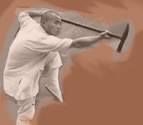
"At the turn of the century, a western European stick fighting system was enjoying the same degree of popularity as Eastern martial arts are today: The French system of La Canne ('The Cane') could be taught as a competitive sport, as a method of self-defense, or as a combination of both. There are numerous local and regional variants of the system in its early days, involving different striking patterns and body movements. Many of these depended upon the respective teacher's background and other combative systems, such as foil, sabre, broadsword (even epee play) frequently being supplemented with techniques taken from French boxing, wrestling and even ballet. In the last decades of the 19th century, one La Canne instructor gained notoriety for his system's combative effectiveness. His name was Pierre Vigny. Little is known about his life. That which we know is derived mainly from a (very rare) manual adapted and published by the Superintendent of Agency Police in Kathiwar, Lang, for the police constabularies of India. Lang had studied Vigny's system in Europe and taught it to numerous Indian policemen and instructors until it became the standard system for Indian police stick fighting, displaying lathi and Salambam in the process. Vigny developed his system from the cutting methods of sabre and broadsword, combined with his hands, from the notorious street thugs of Paris and encounters with hostile Apaches. He writes that during these encounters, he was able to ward off and defeat several Apaches using only his lightweight umbrella in a sword-like fashion. In La Canne, Vigny prefers a lightweight cane with a heavier end to use as a striking tool - if the cane was made from Malacca or ash root with a natural thickening or branch knot at the end. The rationale for his choice of a lightweight weapon: He wished all blows to come from a whipping turn of the wrist, believing that only a certain weight was required to hit if you attacked body parts that are particularly vulnerable. He thus held that good speed generated power. Vigny's system did not include the numerous spins and acrobatic manoeuvres used in the modern sport of La Canne, nor did he advocate shifting the stick from one hand to the other in combat. The footwork and body positions of his system varied, depending on the particular technique he was using. Patterns resemble those of prizefighting and fencing. At the turn of the century, Vigny immigrated to New Orleans, where his system became rather popular. It is rumoured that Teddy Roosevelt was tutored in the Vigny system."
"Jogo do Pau ("the stick game," or "stick-fencing") is a fighting style employing a simple staff, approximately the height of the player, in techniques of attack and defense. In the generic sense, stick fighting has been practiced throughout the world and was refined as a practical technique in some European countries such as Portugal, France. England (quarter-staff) and also in the majority of Eastern countries, including India, China, Japan (bo-jutsu), Thailand, Vietnam and Afghanistan. In the latter nations that still preserve their medieval customs of combat, any tourist who ventures a little into the interior of the country can witness bloody individual combats, including inter-clan rivalries fought with staves.
Human beings have always had to fight to survive and humans have always employed tools. The simple stick was almost certainly among the first tools to be turned to martial purposes, as an instrument of attack and defense against animals. As societies evolved from the nomadic hunting and food gathering stage, conflicts arose; competition over resources, etc. boiled over into personal combat, and people created series of specific movements, attacks and defenses, with their utilitarian sticks. The specific nature of these actions depended on geographic conditions, as well as cultural and other factors. This new fighting technique varied not only by country, but also by the length of the stick or staff most commonly employed. Few stick fighting methods were developed for staves over two meters in length.
Afghan and Indian forms of stick-fighting included training and combat with a wide variety of wooden weapons, of different lengths and timbers. Other forms, such as the English quarter-staff, probably so-called because the fighter gripped his weapon with his right hand one-quarter of the way along its length, employed robust hardwood staves. The quarter-staff was two meters long, requiring management with both hands; as with the Portuguese Jogo do Pau, it doubled as a sport and as a combat system.
However, the different techniques used for the diverse
lengths of staff are very similar both throughout Asian countries, largely
inspired by the Indian style, and in the majority of the Occidental countries,
such as England and France. The various stick fighting styles and the combative
matrix that they are part of (generally in the rural areas) each have a
characteristic tone. This seems to be the result of deep cultural trends that
define the degree to which agonistic aggression is related to a fundamentally
ludic or "sporting" approach. The great difference between the Occidental and
the Asian styles lies in the mentality with that they practice their
techniques."
-
Jogo do Pau. Journal of Manly Arts.
"Well I carry my martial cane every day on my walk. The Tai Chi implements
that I prefer are wooden -- not because (they claim) Chi flows better through
it, but because I like the feel and weight of it and the fact that it can go
almost anywhere. Also it’s less dangerous to practice partners than edges or
metal. Not only is the weapon behavior a manifestation of the skill and
coordination of muscular energy against physics, as you point out, but it does a
couple of other things: it helps explore an extended range of space, and
provides feedback, if you pay attention, to help correct body mechanics and
refine positioning."
- Bob Gotsch
"The major trend in thought on boxing reflected in the Epitaph [Epitaph
for Wang Zhengnan (1669), composed by Huang Zongxi] is emphasis on the
concept of "stillness" overcoming "movement" or the mental in relation to
physical aspects of boxing. This was not necessarily a new concept. Yu Dayou
advocated it in his manual on staff fighting (1565), and its basis can be traced
to Sun Zi's Art of War (c. 476 B.C.). This concept involves taking
advantage of an opponent's movement and thus might be perceived as a defensive
approach to countering offensive action. This more disciplined "military"
approach was at variance with some of the more "individualistic" and "flowery"
movements which characterized many popular styles, which were conveniently
described as "Shaolin boxing" in the Epitaph."
- Stanley Henning,
Ignorance, Legend and Taijiquan
The Magical Staff: Quotes, Legends, Lore
"The Chinese word gun (棍
pinyin gùn) refers to a long Chinese staff weapon. It is known as one of the four major weapons, along with the spear, saber, and the sword, called in this group "The Grandfather of all Weapons".
There are various kinds of gun and these include (from olden days): Monkey Staff (猴棍), Biangan (鞭杆), Mad Demon Staff (瘋魔棍), Tianqi Staff (天齊棍), Staff of Five Tigers and Goat Herds (五虎群羊棍), Nunchaku (二節棍), Taiji Staff of Thirteen (太極十三杆), Taiji Quarterstaff (太極大杆), Taiji Staff (太極棍), Staff of Eight Trigrams and Seven Stars (八卦七星竿), Staff of Eight Fairies (八仙棍), Flail (槤枷).
The types of gun normally used nowadays for exercises and competitions are the bailangan (白栏杆) and the nangun (南棍)."
- Wikipedia Gun
(Staff)
"Speak and you get Nanten's staff,
Do not speak and you still get Nanten's staff."
- Zen Koan
Take a look at the Zen painting of Nanten's staff by Nakahara
Nantembo (1839-1925)
Zen Masters would pound their ceremonial staff on the ground
when making a point during a lecture or discussion.
For more Zen Koans using the staff as a teaching prop
see below.
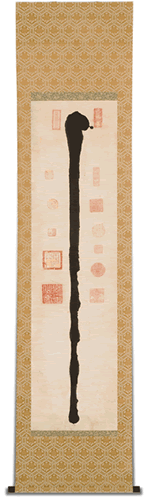
Zen Staff by Unmon Sokudo (1690-1765)
"The literal English translation of tahn bong
sul is "short staff techniques". This may seem confusing at first because we
tend to associate a "staff" as something which is quite long. A more figurative
interpretation of "tahn bong" would be "short stick". However, in order to
maintain the integrity of the literal translation "short staff" will be used.
Tahn bong techniques can be found in martial arts styles in almost every country
in the world. Throughout Asia it is often one of the training tools and/or
weapons of fighting arts in many countries; Japan, Okinawa, Philippines, China,
Viet Nam, Malaysia, Indonesia, Burma, Thailand, Korea, and many more. Tahn
bong sul (short stick techniques) are helpful in developing concentration and
physical awareness of techniques, both in empty-hand and weapon training.
The tahn bong is versatile for quick blocks, strikes, traps, disarms, and
counterattack movements. It can be easily concealed, as in being hidden in a
jacket or behind ones back. Tahn bong techniques and training
methodologies have guidelines which are designed to direct the practitioner in
order to help insure the applications are both practical and precise. Though
specific training methodologies may vary from school to school and even from
instructor to instructor, the basic theories, concepts and principles of tahn
bong techniques remains constant. Once educated in these methodologies, an
individual, under the guidance of a qualified instructor, is able to create an
almost limitless series of techniques. How many techniques and variations to
each technique is only limited by the knowledge and imagination of the
individual."
- Korean Tahn
Bong, By Grand Master James S. Benko, Ph.D.
"The
walking-stick has features in common with several existing martial arts weapons:
The stick can be held in two hands and used like the bo or con,
(quarterstaff) to block and strike. The techniques for jo, or
short stick, are almost all suitable for the walking-stick. The handle
provides a hook which can be put to various uses, much like the hooked kama.
The handle allows use of many of the techniques developed for the tonfa,
especially when the tonfa is held reversed. The walking-stick can also be
held on the handle with the shaft along the fore-arm, reinforcing blocks like
the tonfa. Any techniques developed for swords, rapiers etc. also have
application. But unlike the above weapons, the walking-stick can be
carried anywhere in a non-aggressive manner and is thus a suitable self-defence
weapon, especially for walkers."
- The
First Walking Stick Kata.
"Remarkably most legends involving saints with a staff as their
characteristic object, tell us a tale featuring a key element of human
existence: water. According to these stories the staff itself is an
instrument enabling the saint to strike a wellspring. Obviously the well
itself became a site of worship and eventually even pilgrimage. Either
because it had been struck by someone who would later be a saint (the
association with the holy person), or thanks to the Christianization of the
sacred source or pool."
- Gerard J. Van Den Broek, The Return of the Cane, p. 69
[Dowsing]
"The jo can be used to strike like a sword, sweep like a naginata,
thrust like a spear (yari). Its two ends can be used, unlike the single point of a sword, and its ma-ai (fighting distance) can
be varied according to the hand grip you take. Because of its speed and changeable ma-ai, it is a formidable
weapon."
- Muso Shindo-Ryu Jodo
"The most popular Shaolin Kung Fu 'tool' was the staff.
A long stick that had a variety
of uses and purposes. It is a multi-purpose implement that can be used for many
things
other than self defense. A staff is used as a walking stick, to carry loads on
your back,
carry and transport two water buckets, as a lever, tent pole, writing implement
(in the
sand) and many more. This is also the weapon that almost all Chinese martial
arts
consider to be "The Father of all Weapons". It is also highly effective and
recommended
for all martial artists to learn.
There were of course many staff types as there are different woods, people and
ways
of using. But in general most staffed weapons can be but into 5 specific sizes
(general
lengths - all Shaolin weapon dimensions were measured in 'natural' measurements
relating to the user):
Dragon Staff (app 1½ person lengths or 8 to 9 foot)
Shaolin Staff (app 1 person length or 5½ to 6½ foot[also Rat Tail Staff, very
flexible, Bai La Wood])
Carry Staff (app ¾ person length)
Cudgel or Walking Stick (app half person length and very stout)
Flute, Ruler (app fore arm to fore arm and hand length)"
- Chinese Weapons

"The jo was also adapted by Morihei Ueshiba, the founder of aikido, to teach
the principles of aikido.
His use of the weapon is called aikijo. Aikijo resembles
jodo in that both
involve fencing with the jo,
but differs in the nature and purpose of the fencing. Jodo techniques are often
faster and sharper because
angular attacks and defenses are part of its combat orientation. Aikijo
techniques are slower and softer
because circular movements can blend [with] attacks and defenses and reduce the
attitude of conflict.
Inserting and entwining techniques are not found to the same extent in aikijo as
they are in jodo, nor are
the numerous targets of atemi waza. Aikijo does have
jo-taking and
jo-keeping
techniques, but these
are aikido throws in which the jo is incidental to the throw rather than
essential to it. Thus, while aikijo
is more limited than jodo because it has fewer targets and fewer kinds of
movements, it is also much
broader in that its application does not depend on a four-foot staff but on the
fundamental
movements of aikido."
- D. Zier and T. Lang Jo, The Japanese Short Staff,
1985.
"One of the best tools to help in crossing treacherous terrain is a staff
about 4 to 6 feet long and 1 1/2 inches in diameter. Light, dry wood, such as a
small jack pine cut to suitable length makes an adequate one. A staff becomes a
third leg in uncertain footing and often prevents a nasty fall. With such a
staff, you can poke firmly into a stream bottom and, by moving either one leg or
the staff at a tirne (never both together), always have two "legs" to give you
balance. You can probe for holes, big rocks, or soft spots in the bottom of
muddy streams. If you are with a partner, you can hold the staff between you and
support each other. In crossing the glacial creeks of the Far North, a staff of
driftwood or scraggly timber found on the spot often represents the difference
between crossing or staying on the same side. Such creeks, even in midsummer,
have their source only a few miles away in the high glacial fields above. When
you ford them in early morning, the creeks are low and clear, the flow reduced
by the cold of the night. After a warm day, they are roaring, muddy demons,
three times as deep, and vicious enough to roll rocks of glacial wash the size
of buckets down in a seething boil that can often be heard for miles. A good
rule for crossing creeks and streams is to ford them either at the slow end of a
deep pool or just before a long stretch of placid water breaks into a riffle. At
these two places the water will be shallower and the current slower. Usually
this is the widest parts of the stream. A hiking staff is also useful in desert
areas. In some desert country, like portions of Arizona, there is a saying of
the oldtimers that "everything that grows either sticks or bites you." This
isn't literally true, but poisonous snakes and insects, and the various forms of
cacti, keep the hiker constantly on his guard. He must continuously wind in and
out among the sharp-tined cacti plants, some of which would penetrate the tough
hide of a horse's leg, and be on the watch for harmful reptiles. A staff is
useful for breaking an occasional spine out of the way or for defending yourself
against desert rattlers... ."
- Clyde Ormond,
The Complete Book of Outdoor Lore and Woodcraft, 1964
"The Aikido Jo is a straight,
smooth and round stick of Japanese White-Oak, roughly 4 feet in length and ¾ to
1 inch thick. It is a very versatile weapon, able to be held and used either
end, and able to strike like a sword,
or strike by thrusting the tip to the target. It also has a great defensive
advantage, with its long reach and repertoire
of techniques that flow smoothly from one to the next, in the hands of an
experienced practitioner is also a very
formidable weapon. As with the bokken, jo training is a very important part of
Aikido. Many of the jo movements
are related to empty-hand movements, so study of one helps the other. It teaches
us an extra dimension of
distancing between us and the opponent, and introduces us to the use of hip
movement to create smooth,
easy flowing movement, an inportant ability when faced with multiple attackers.
It is not entirely certain where O-Sensei derived the Aikido stave techniques
from. They are definitely different
from Shindo-Muso Ryu Jo-Jutsu, a style of stave techniques designed to deal
specifically with attacks by a
swordsman. Many of the Jo techniques exhibit a similarity to yari (spear) and
naginata (halberd), which O-Sensei
is known to have studied, Hozoin Ryu Yari-Jutsu being one of them. The Kashima
Shinto Ryu also teaches
jo, naginata and yari techniques, it is possible that Aiki Jo is a construction
of O-Sensei's based upon
these known styles."
- Stick
Training
"When a peasant army appeared before the Shaolin temple gate, Jin Na Luo, a
monk who tended the stove, grabbed his fire stoker and laid it about him with
such fearlessness and vigour that the Red Turbans scattered in utter confusion.
Jin Na Luo became known as the first of the Shaolin Staff Monk. The Gun
(Staff) was the first weapon ever actually used by the martial arts
practitioners of Shaolin Temple. Even today the art of handling the Gun is still
the most profound and best known of any other weapon practiced at Shaolin."
- Ancient
Chinese Weaponry
"Jodo should be done to build one's character. Jodo should
be like a steering wheel. The road is life. There are
all kinds of ways one can go down the road. Use Jodo to steer as straight
a course as possible through life."
-
Sensei Shimizu Takaji
"The three ways to develop strikes are: 1. Solo striking. Just hitting
"air." This is the basis for learning the movement. 2. Solo striking on a
heavy bag. Raise the bag high enough so you can hit the bottom of it. If that is
not possible, make a "Tire-Man" or a similar workout dummy that is substantial
and will give you feedback. 3. Using a training partner with a focus
mitt."
- Don Rearic, The
Beginner's Guide to the Cane
"Today, it is not practical to walk the streets with any of the
four weapons just described [sword, saber, staff/pole, spear]. However, a
cane or walking stick can easily be adapted to many of the basic techniques of
the four traditional weapons to devastating effect for self-defense. Some
tai chi schools have developed walking-stick forms for this purpose. Only
a little creativity is required to make the conversion."
- Bruce Frantzis, Tai Chi: Health for Life
"This Immortal was named Li Tie
Guai and referred to as "Iron Cane" Li because of the iron crutch that he
carried. Li is always depicted as a beggar with a crutch. The story is told
that he had attained such a high level of magic skill that he was often called
from Earth to the Celestial Heavens to perform his magic. When Li traveled to
the celestial regions, he traveled only in spirit, leaving his body on Earth in
the charge of one of his disciples. On one occasion, Li was gone longer than
usual and the disciple thought that Li had actually died. So, he burned his
body. When Li returned to Earth and found that his body was gone, he looked for
the body of a recently deceased individual to enter. The only body he could
find was the body of a lame beggar. Li entered this body and thus is always
depicted as a beggar with an iron crutch. He also carries a pilgrim's gourd and
he is sometimes shown standing with a deer or standing on a crab. It was
said that Li Tie Guai possessed the supreme swordsmanship but most often
appeared poor, down trodden, and acted like a clown - not having a care in the
world. Lu Shui-Tian said that Li's contribution to the Eight Immortals Sword
was strategy because he appeared as a clown and beggar yet possessed the
highest sword skill of all of the Eight Immortals."
- Pa Kua Chang
"Lee Tie Guai's direction is south, and his element is fire. He’s shown as a street beggar, carrying a magic staff and an iron crutch. His staff and the gourd that he also carries are symbols of medicine, and he can create medicines due to his mastery of energy. He’s a benevolent saint, believed to help the poor and the sick. He occasionally travels to the Heavens in the form of a dragon, but also visits Earth when needed, rising a chimera."
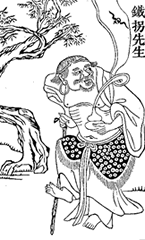
"The Master with the Iron Crutch [Li T‘ieh-kuai, Lee Tie Guai] offers a striking contrast to the other
members of the group. Hideous, hairy, deformed, and scantily clad in filthy
rags, he is the type
of that repulsive legion haunting to the present day every city in China, and
preying upon a long-suffering public, which is moved to the giving of alms not
so much by pity as by feelings of horror and fear. His recognized emblem is the
bottle-gourd or calabash that forms part of the equipment of every hsien;
and to the gourd is generally added a more distinctive object, his crutch. A
mysterious vapour—a kind of fata Morgana—floats upwards from the mouth of
the gourd, and in its midst is seen the image of the sage's hun, which
may appear in nondescript shape as in our woodcut, or in the guise of a
miniature double of his bodily self. Sometimes the hun is replaced by a
spherical object representing the "Philosopher's Stone". In the form with
which nature endowed him, the sage Li T‘ieh-kuai was a fine man of imposing
presence. While yet of tender age he heard Tao. Choosing a mountain
cave for his abode, he set himself to the cultivation of mental and physical
purity as taught by the Taoists. Li Lao Chün (Lao Tzŭ) and The Master Wan Ch‘iu
used often to come down from heaven to visit his rocky hermitage in order to
instruct him in the subject of his studies. One day T‘ieh-kuai was going
to meet Lao Chün by appointment on Hua Shan, and so he gave a pupil of his the
following instructions: "My p‘o," said he, will remain here while my
hun goes upon a journey. If by chance in seven days' time my hun has
not returned, you may then burn the p‘o." The pupil received an
urgent message to visit his sick mother, and, impatient of delay, burnt his
master's body on the sixth day. The following day in due course T‘ieh-kuai
returned to find his p‘o gone, and no habitation left for his hun,
till he spied lying near by the corpse of one who had died of starvation. Into
it the wandering soul entered, giving it new life; and that is the reason why Li
T‘ieh-kuai, instead of his original handsome appearance, has now the loathsome
shape of a cripple."
- W.
Perceval Yetts, 1916,
The Eight
Immortals
"In most Chinese martial arts schools, the staff
is called Gun, and it is usually about five to six feet long. In Taiji Quan
practice, however, the staff is
called Gan, and often the sound “er” is added, so that the word is pronounced “Ganer.”
It may also be called Da Gan Zi, which means long staff or
pole. The length of a Gan depends on the height of the practitioner, but it
usually exceeds seven feet. The bottom end of the staff is bigger than the
tip. The staff is made of wood called Bei La or white wax, and the complete
trunk of a single tree is used to make each staff. When a white-wax tree
grows to sufficient height, it is cut down and given a special treatment to
increase its toughness. The wood has a naturally springy quality and a lot of
tensile strength. Because of this characteristic, even a hard strike to a staff
will not cause noticeable vibration in the hand of the person holding it.
When a staff is used for a long time, its color gradually changes from white to
a shiny, dark brown because of the accumulation of sweat that soaks into
the wood from the practitioner’s hands. This makes the staff easier to
manipulate and improves its overall effectiveness.
In Taiji Quan, long staff practice is commonly called Taiji Zhan Gan or Taiji
sticking staff. It can also be called Taiji Nian Gan, which means Taiji
adhering staff; Taiji Zhan Nian Gan, which means Taiji sticking and adhering
staff; Taiji Dui Zha Gan, which means Taiji stabbing staff; or Taiji Shisan
Gan, which means Taiji thirteen-skill staff. In the term Zhan Gan, Gan means
long staff and Zhan means to stick or adhere. In Taiji Zhan Gan then, the
staff practice that follow Taiji Quan principles, a sticking or adhering skill
is used to maintain contact between your staff and that of your partner at all
times.
In olden times, all famous masters intently practiced Zhan Gan daily and
achieved a high level of mastery in sticking staff. The basic principles of Zhan
Gan are exactly the same as those of Taiji push hands. One can think of the long
staff as simply making one’s arms longer. Although all push hands
principles and skills apply to staff training, the latter is more difficult than
the former. Traditionally, people started to practice sticking staff only after
they were adept at Taiji form and push hands training. Sticking staff training
not only increases one’s ability to use different kinds of internal force, but
also is beneficial for footwork skills and body movements, especially for
learning to move the waist. Sticking staff training is the best way to
understand
high-level Taiji Quan skills.
The long staff is a special weapon, and it has unique features. By tradition,
thirteen key words are used to express its primary functions. They are: Kai
or open; He, close; Fa, launch; Beng, explode; Pi, chop; Dian, point; Zha, stab;
Bo, move; Liao, raise; Chan, wind up; Dai, lead; Hua, slide; and Jie,
interrupt. The difference between Taiji staff skills and the staff skills of
other styles is that all Taiji staff skills are based on Taiji Quan principles.
So all
Taiji sticking staff techniques exemplify Taiji Quan concepts and derive from
Taiji Quan principles. To master staff skills, you must understand the
differentiation and balancing of Yin and Yang. You must also understand the
meanings of: Zhan, which is to stick upward; Nian, which is to adhere to;
Lian, which is to link; Sui, which is to follow; Ting, which is to listen; Yin,
which is to lure; Hua, which is to dissolve; Na, which is to control; and Fa,
which
is to launch. The meaning of traditional Taiji Quan injunctions, such as: “to
know yourself and your opponent"; “to lure in and fall into emptiness”; "to
borrow force from your opponent and use his force to beat him back"; “to use
mind rather than strength”; “to use softness to defend against
hardness”; "to use stillness to control motion"; “to yield yourself and follow
your opponent”; "to launch later but reach first"; and “to use four ounces to
defend against a thousand pounds”, should be applied in all sticking staff
applications."
- Zhang Yun and Peter Kindfeld,
Taiji Sticking
Staff
"Aiiki-jo teaches principles and concepts of aikido via the
staff, i.e. extension and showing quite graphically the movement
of circles and spirals in technique. (Jo-dori vs. Tai-jutsu) like Shiho-nage,
kote gaeshi, irimi-nage, can all be expressed
through Jo-nage/dori, one of the best I have seen show this relationship is Andy
Sato head of Aikido World Alliance.
If you ever get the chance to train with him do so. Secondly the 31 count kata
which spawned the Kumi jo was Saito's
attempt to simplify and standardize movements, using sweeps, strikes and tsuki's
that are both similar to empty hand,
and Ken, the so call Riai of aikido. These Katas that now are used teach the
aforementioned Maai, timing, footwork,
and bear little resemblance to actual empty hand technique, but do teach us
movement principles that are fundamentally the
same. Now contrast that with SMR, which has a totally different organization to
its kata and uses the Jo completly different.
For example, the thrusts done in SMR very different than in Aiki-jo, as well,
most katas, are Ken vs. Jo, secondly the
rhythm of practice is different too. Just like the rhytmn of daito-ryu is very
different than the rhytmn of Aikido practice.
Secondly the stance is different too. SMR is there to teach you combative
principles that in theory are there to provide
you with the tools to be successful in a combative situation, albeit, rare that
I will be attacked by a katana wielding
person when coincidentally I have a Jo. Whereas Aiki-jo is used as a supplement
to my empty handed Aikido. If
I had my choice, I would put more principles of SMR in Aiki-jo than the other
way around."
-
Dan
Hoover, AikiWeb Forum
"Shintō Musō-ryū, or Shindō Musō-ryū,(神道夢想流) most commonly known as
Jodo (杖道), is a
koryu (old
school)
of jojutsu,
teaching the art of handling the Japanese quarterstaff
jo.
The purpose of the art on a purely technical level is
to teach how to defeat a swordsman in combat using the jo and a vareity of
weapons with emphasize on the proper
distance, timing and concentration.
The art was founded by
samurai
Musō Gonnosuke Katsuyoshi (夢想權之助勝吉) in the early
1600s and,
according to
legend, first put to use in a
duel with
Miyamoto Musashi. The original art created by Muso Gonnosuke has evolved and
been added upon ever since its inception and up to modern times. The art was
successfully brought outside of its original
domain in
Fukuoka and outside of
Japan itself in
the 19th and 20th century. The spreading of Shinto Muso-ryu beyond
Japan was largely the effort of
Shimizu Takaji, considered the 25th Shihanke, and with the assistance
of his own students
who helped spread the art further in the world partially through the cooperation
with the Kendo
community first initiated
by Shimizu Takaji. The Kihon no Uchi
Tsuki Waza, or basic techniques, are a system of twelve techniques drawn from
the existing jo kata
(with minor modifications from the original kata) and used as a way to better
introduce a new student to
jodo. The kihon
were systemized mainly by Shimizu Takaji at his
Tokyo dojo in his
effort to make jodo more appealing to new students
and easing their introduction to kata training. Shimizu's peer Takayama Kiroku
would bring the kihon techniques back
to Fukuoka where they were formally adopted into Shinto Muso-ryu. Shimizu
Takaji also removed and/or modified
some of the more dangerous techniques and early kata so as not to cause injuries
to newer students. Kihon are trained
both individually tandoku dosa and in pairs sotai dosa, with the
shidachi using the fo and the uchidachi using the sword."
- Shinto Muso-Ryu -
Wikipedia

Return to the Index at the Top of This Webpage
Purchasing a Short Staff (Jo, Cane, Walking Stick)
Sizing and Selecting a Short Staff (Jo, Cane, Walking Stick)
Retailers and Vendors for Canes, Walking Sticks, and Short Staffs
How to Choose the Size of Your Cane? Suggestions from Fashionable Canes.
How to Size your Cane for a Correct Fit. Suggestions from Cane Masters.
Sizing Your Cane or "Wait Don't Cut Off Too Much."
Comments:
Since I am 6' 6" tall, I prefer a cane, for active walking, that is 3" to 4" longer than determined by the first three procedures listed above. When I reach out with the cane and touch the ground, in front of my foot, I like my elbow to be bent about 15° to 25° up from the extended/straightened position. If the cane is too short, for me, I have to straighten the arm too much, and the end of the cane may not touch the ground where I want it. Again, I use a pure hickory heartwood cane, Instructor's Walking Cane, 40" (103 cm) long and 1" (2.54 cm) in diameter, from Cane Masters. Others prefer a cane placed closer to the hip and leg so as to mostly be able to push directly down to lift the torso up, or mostly to support an unbalanced body. I prefer a curved crook neck wood cane to function more effectively and primarily as a walking stick for stability on uneven terrain, fitness exercises, and self-defense. Experiment yourself to find the best cane "fit" for your needs!
Since you can simply cut any solid wooden short staff down to the length you prefer, purchasing a Jo/Cane that is too long is not a problem without an immediate solution.
Sensei Fuchs told me that the length of the jo used in Aikido should actually be determined by the distance from the floor to under your armpit when standing up straight (for me this is a 13 Hands Staff). Another source said it should be equal to the distance of your arms fully extended to the side, and the distance from left finger tip to right finger tip.
Short staff also named as Biān 鞭 Gān 杆 (whip staff) has a length of 13 times the width of practitioner's hand. Shifu Jiang says that the Wu Dang short whip staff is 13 hands long, and the stafff for use in the Chen Shen-Pu Short Staff form is 13 hands long. For me, relative to the size of my hands and height (6'6"=198cm), my "13 Hands Staff" is 54" long (137.2cm).
The "Eye Brow Staff" is a staff about the length from the ground to your eyebrow when you are standing up straight.
The Correct Length for a Jo Stave. Mokuren Dojo Blog. "The story goes that Muso Gonnosuke, founder of jojutsu, received a vision from god during a prolonged fast at a temple. God apparently told Muso that he would be able to beat Musashi if he would use a stick of certain dimensions. The magical dimensions translate into metric as about 128cm long or into English as about 51 inches long. Serious, fanatical jojutsu guys are typically sticklers for this 128cm standard. There is no flexibility in the standard for smaller or larger participants. I am not a koryu snob. I am more of the ideal of making jodo my own thing - taking ownership of the art - and I say that the standard is not magic. It seems to me that you need a jo to be short enough that you can palm both ends and move your shoulders through a wide range, and 6-8 inches longer than a normal 40-42 inch bokken. That seems to put the natural length of the jo between about 46" and 52".
"Our select ash is
lighter in weight than the hickory. But the ash is not as strong as the
hickory. Choose the ash if you are using the staff as a primarily thrusting
weapon. Fewer strikes. While the hickory is heavier, it is also more resistant
to impact damage. Pick the hickory if you plan on striking with the staff in
your training."
- Purpleheart Armories
Company FAQ
Anyone out there know of a company making a replica of the staff of the Monkey King used in the film Forbidden Kingdom?? Email me!
Mike Garofalo's short staff weapons; his favorites:
I am 6'6" (198 cm) tall, and have practiced with a variety of short staff weapons
over the years. Currently, I practice daily only with a cane.
I use an Instructor's Walking Cane, 40" (103 cm) long and 1" (2.54 cm) in
diameter, from
Cane Masters.
This cane weights 1lb, 2 oz (510 gm). This beautiful martial arts combat cane is made of pure hickory heartwood, has
multiple notches at three key gripping points, has a rounded hooked horn, and has a rubber
covered tip. I also own the same
Instructor's Walking Cane made of
oak
- a gift from my children.
This cane has a rounded tip to the crook. The curved
crook end is just a little wider and larger than with other canes. The
cane is
thoroughly sanded, and very smooth to the touch. It does not attract any undue attention as a weapon,
and appears to be a ordinary, sturdy, and practical walking cane suitable for a
big fellow like me. Make no
mistake, however, the Instructor's Walking Cane is a true combat weapon, as well
as a practical walking stick. Make sure it has enough length for your
walking stride. Most canes I see people use are a
bit too short for a good walking stick.
I use this 40" pure hickory heartwood combat cane for all my weapons practice; and, adapt other short staff, sword, and broadsword routines and techniques for practice and performances with my hooked wooden cane. The only weapon I practice with on a daily basis is a wooden cane; and the only weapon I teach now in my Taijiquan classes is the cane. Also, whenever I take a long walk, anywhere, I bring my cane along. I gave away all my swords, sabers, and longer staff weapons to my son.
My older students like the cane because it is very inexpensive, unobtrusive, ordinary, easy to carry, practical, effective as a weapon, and appropriate for older persons. Many people practice with a straight wooden stick, 34"-41" long, 3/4"-1" in diameter. There is no curved crook end to their wooden stick.
Many short staff forms work better with a 46" to 52" straight wooden staff (Jo, Guai Gun, 13 Hands Staff). I have used a number of staff weapons of this size:
2) Jatoba Brazilian Cherry Jo Staff, 48"
(122 cm) long x 1 1/8" (2.85 cm) in diameter, Weight:
1 pound, 7 ounces. The
Sakura Ultima Brand Extreme Hardwood Hanbo, Aikido Jo.
3) Red Oak Jo Staff, 50" (127 cm) long x 1" (2.54 cm) in diameter from
Martial Arts Mart.
4)
Finished Rattan Jo Staff, 49" long x 1" diameter, from
WLE.
5) White Oak Jo
Staff, 50" long and 1 1/4" diameter, from
WLE.
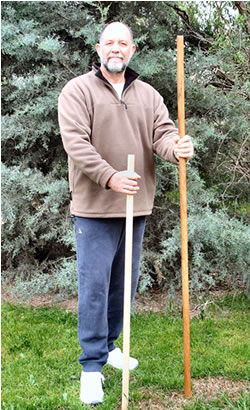
(1)
(5)
Retailers and Manufacturers of Short Staff
Products
Walking Staff, Jo, Bo, Cane, Walking Stick, Shepard's
Staff, Hiking Staff/Stick
All Combat Martial Arts Supplies:
Staff and Bo Weapons
Antique Cane Auction at Kimball Sterling
Brazos Walking Sticks Walking sticks, staffs and canes.
Cane Masters. Quality canes and customization options. Excellent choice for purchasing combat canes designed for martial artists.
Canes and Walking Sticks: A Stroll Through Time and Place. By Jeffrey Snyder. 2004, 288 pages.
Custom Jo Staffs by Mark Taylor
Dragon Walking Stick Cane (high grade of high impact Polypropylene, 39.5 inches) from Cold Steel
Fashionable Canes and Walking Sticks A wide selection of canes for sale online, and useful information.
Custom Bo Staffs. Created by Mark S. Taylor, Woodtrades.
How to Walk Safely with a Cane. By Sifu John Chow.
Google: Canes and Walking Stick Stores,
Karate Depot Martial Arts Equipment: Bo and Jo
Make Your Own Walking Sticks: How to Craft Canes and Staffs from Rustic to Fancy. By Charles Self. 2007, 128 pages.
Making Walking Sticks for a Hobby. By David Dawson. 2000, 56 pages.
Pikes, Pole-Axes, and Staff Weapons. From Armouronline.
Purple Heart Wooden Swords and Staff
Stickmaking: A Complete Course. By Andrew Jones and Clive George. 2008, 176 pages.
Walking Sticks and Canes Books
Walking Sticks: Catalog and Links The Sei Do Kai Catalog.
Walking Stick Manufacturing. UTube Video, 8:45 min.
Wampanoag Carved Walking Sticks
Weighted Bars: Hampton Gel Grip and CAP Difinity Toning Bars, 50" long (5, 8, 10, 12, 15 and 20lb bars)
Weighted Bars: Versa Bar: Weighted Bars, 4' long (12, 18, and 24lb bars)
Wing Lam Enterprises - Bo and Staff Weapons
Workshops, Seminars, Lectures, Demonstrations on the Cane, Walking Stick, Jo, Short Staff
Dragon Walking Stick 39.5" Black 32oz Polypropylene
"The mythical dragon has captured the imagination of man for centuries. Asian folklore casts them as benign creatures, man's allies in a hostile world, or as symbols of imperial Chinese power, used as motifs on palace walls, and on soldier's breastplates. In the west, they were known to be fierce adversaries, fire breathing, cleaver beasts who rained destruction and leveled villages. The brave knight who slew one could return to his village after winning the hand of the fetching fair maiden he saved from the dragon's wrath.
Legends aside, a dragon is a powerful creature possessed of extraordinary physical attributes, which command respect across the board. It is for this reason we have chosen to use the dragon as the inspiration for our latest walking stick. It is modeled after an intricately carved Dragon Stick from our President, Lynn C. Thompson's collection and is reproduced using expensive, hand engraved injection molds. The detailing is astonishing, with scales running the full length of the undulating shaft, and a fearsome face with snarling fangs, it is an imposing stick you'll be proud to be seen with on almost any occasion.
It is fashioned, like many of our other walking sticks, from the highest grade of high impact Polypropylene available, assuring its imperviousness to the elements and guaranteeing it is virtually indestructible. Black in color and sinuous in shape and form, it offers light to medium support and a number of grip options making it unusually suitable as an aid to balance as well as a powerful ally in an emergency self defense situation."
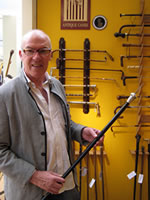
A cane collector
Return to the Index at the Top of This Webpage
Mystical and Magickal
Uses of the Staff
Short Staff, Cane, Stick, Wand
Definitions: Shujo or Shakujo: A Buddhist priest's staff made from wood and
metal.
Eight of Wands and Chaos
Magic
The Green Wizard's Reading
List
Magical Staffs in Taoist Rituals. By Chen Yaoting.
The Staff: Bibliography, Links, Quotes, Notes, Lessons
Staffs and Wands -
Handcrafted: Sticks, Stones and Beyond
"The title of Monkey Pole, or Monkey King Staff, is a curious reference
to the legendary Monkey King character from Chinese mythology. The Monkey King is a mythical figure whose exploits are
described in the 400-year-old Chinese classic Journey to the West.
The Money King was an immortal, a
god-like creature who was characterized by mischievous acts and defiance of the ruler of Heaven. His weapon of choice
was a great rod of iron that he had stolen from the Dragon King of the Eastern Sea. He bound the ends of his
staff with gold and engraved it with the words "Gold-bound Wand of my Desires."
Imbued in the staff itself were magic powers that allowed it to change size from the finest of needles to a length that could span the
distance between Heaven and Earth.
The mercurial nature of the Monkey King's staff is said to represent the
flexible nature of the Buddhist doctrine and its ability to be applied to all situations great and small."
- Hung Chur Kwun - The Hung
Gar Monkey Pole Set Refer also to the major 2008 film: The
Forbidden Kingdom.
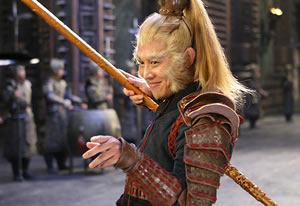
Jet Li as the Monkey King
"Monkey King", or known to the
Chinese as "Journey to West", written by Wu Ch'eng-en(1500?-1582), a
scholar-official, is one of the renowned classical Chinese novels about an
allegorical rendition of the journey, mingled with Chinese fables, fairy tables,
legends, superstitions, popular beliefs, monster stories as well as whatever the
author could find in the Taoist and Buddhist religions. It was based on a true
story of a famous Chinese monk, Xuan Zang (602-664). After years of trials and
tribulations, he traveled on foot to what is today India, the birthplace of
Buddhism, to seek for the Sutra, the Buddhist holy book. When he returned to
China, or the Great Tang as was called that time, he started to translate the
sutras into Chinese, thus making a great contribution to the development of
Buddhism in China.
The Monkey King is an indeed rebellious extraordinary being, born out of a rock,
fertilized by the grace of Heaven. Being extremely smart and capable, he
learned all the magic tricks and gongfu from a master Taoist, being able to
transform a single hair from his head into seventy-two different images such as
a tree, a bird, a beast of prey or a bug as small as a mosquito. Using
clouds as a vehicle he can travel 180,000 miles in a single somersault and
wields a huge iron bar that supposedly serves as ballast of the seas and can
expand or shrink at its owner's command - his favorite weapon in his later
feats. He claims to be the King in defiance of the only authority over heaven,
the seas, the earth and the subterranean world -- Yu Huang Da Di, or the "Great
Emperor of Jade" in Chinese."
- Adapted from HaiWang
Yuan, Western Kentucky University Refer also to the major 2008
film: The
Forbidden Kingdom.
Master Tung Kwo asked Chuang Tzu:
"Show me where the Tao is to be found."
Chuang Tzu replied;
"There is nowhere it is not to be found."
"By tradition the [Dragon Gate Quanzhen Daoist] priests possess seven sacred
objects: “The first object is the meditation cushion which tames the monsters of
the mind. The second is the robe which subdues the mischievous mind. The third
is the bowl which holds only purified (meatless) food. The fourth is a straw hat
for protection against wind, rain, frost, and snow. The fifth is a horse-hair
whisk or fan for sweeping away the dust of the mundane world. The sixth is a bag
for carrying the sacred scriptures. The seventh is a staff for clearing the
obstacles that block the clear wind and bright moon of the Tao." The
priests will also apply the following cultivations in their daily life: “When
walking, the gait should be like that of a crane and the body should move like
an immortal floating with the winds. When sitting, the body should be still as a
rock. When sleeping, it should be curved like a bow. When standing, it should be
like a tall pine. Your body should be as flexible as a willow in the wind and as
relaxed as the petals of a lotus.”
- Shi Jing and Shi
Dao, Introduction to Quanzhen Daoism and the Dragon Gate Tradition
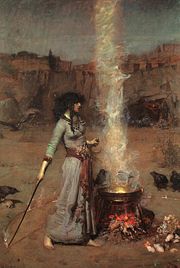
The Magic Circle
By
John William Waterhouse
"Devi prachanda dora danda daitya
darpa winashine
Roopam dehi jayam dehi
Yasho dehi dwisho jahi.
"Oh Goddess, with your great staff you have
destroyed the demons of egoism and thought.
Grant me freedom, victory, fame and destroy
all hostility."
- Devi Puja (Worship of the Goddess)
Krishna Das,
Pilgrim Heart
"Staves are a traditional prop for the elderly and infirm, and this has led
to their association with
wisdom.
The ability of a staff to perform wonders is also featured prominently in the
scriptures of
Judaism,
Christianity, and
Islam. Moses
and Aaron, in
their task to liberate the Hebrews from Egypt and deliver them to the Promised
Land, employ
staves.
The staves are capable of performing miraculous feats to demonstrate the power
and authority of God. Staves are also associated with
wizards and other users of
magic and
sorcery. Haraibou (literal translation meaning 'purification stick')
were staves that were used by the miko (Japanese female exorcists) to
fight demons in
Japanese lore."
- Wikipedia - Staff
(Stick)
"In Egyptian hieroglyphics, the king was
recognized by the staff he carried. When Howard Carter in 1923 opened the tomb
of young King Tutankhamen, the archeologist discovered over 130 walking sticks,
many beautiful, some made of gold, and some elaborately carved—dating back to
the year 1,358 B.C., more than 3,300 years ago."
- Cane Quest
"And the Lord spake unto Moses, saying, "Speak unto the children of Israel, and take of every one of them a rod according to the house of their fathers, of all their princes according to the house of their fathers twelve rods: write thou every man's name upon his rod. And thou shalt write Aaron's name upon the rod of Levi: for one rod shall be for the head of the house of their fathers. And thou shalt lay them up in the tabernacle of the congregation before the testimony, where I will meet with you. And it shall come to pass, that the man's rod, whom I shall choose, shall blossom: and I will make to cease from me the murmurings of the children of Israel, whereby they murmur against you. And Moses spake unto the children of Israel, and every one of their princes gave him a rod apiece, for each prince one, according to their fathers' houses, even twelve rods: and the rod of Aaron was among their rods. And Moses laid up the rods before the Lord in the tabernacle of witness. And it came to pass, that on the morrow Moses went into the tabernacle of witness; and, behold, the rod of Aaron for the house of Levi was budded, and brought forth buds, and bloomed blossoms, and yielded almonds. And Moses brought out all the rods from before the Lord unto all the children of Israel: and they looked, and took every man his rod."
”Then the Lord said to Moses, “Say to Aaron, ‘Take your staff and stretch
out your hand over the waters of Egypt, over their rivers, over their streams,
and over their pools, and over all their reservoirs of water, that they may
become blood and there will be blood throughout all the land of Egypt, both in
vessels of wood and in vessels of stone.” So Moses and Aaron did even as the
Lord had commanded. And he lifted up the staff and struck the water that was in
the Nile, in the sight of Pharaoh and in the sight of his servants, and all the
water that was in the Nile was turned to blood. The fish that were in the Nile
died, and the Nile became foul, so that the Egyptians could not drink water from
the Nile. And the blood was through all the land of Egypt."
- Exodus 7: 15-22.
Rod of Aaron, Staff of Moses
"He guides me in paths of righteousness for his
name's sake. Even though I walk through the valley of the shadow of death,
I will fear no evil, for you are with me;
your rod and your staff, they comfort me. "
- Psalms, 23:3-4
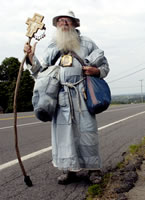
“When Pharaoh speaks to you, saying, ‘Work a miracle,’ then you shall say to
Aaron, ‘Take your staff and throw it down before Pharaoh, that it may become a
serpent.’ So Moses and Aaron came to Pharaoh, and thus they did just as the Lord
had commanded and Aaron threw his staff down before Pharaoh and his servants,
and it became a serpent. Then Pharaoh also called for the wise men and the
sorcerers, and they also, the magicians of Egypt, did the same with their secret
arts. For each one threw down his staff and they turned into serpents. But
Aaron’s staff swallowed up their staffs.’
- Exodus 7: 9-12
"There are historical associations connected with it which give the staff a
sentimental value if we look back to the first British Boy Scouts of a Culhulain
armed with staffs, the pilgrims or "good turn trampers," with their cockleshells
and staffs, the 'prentice bands of London with their cloth yards and their
staffs, the merry men of Robin Hood with bows and quarter staffs, down to the
present-day mountaineers, war-scouts, and explorers; these all afford a
precedent which should have its romance and meaning to the boy if properly
applied. The ceremony of enrolment of the Scout can and should be made a
moment of impressive feeling for the boy when he is invested with the hat and
staff that mark the Scout, and which equip him for his pilgrimage on that path
where he "turns up right and keeps straight on." The officer who fails to use
such opportunity is missing one of the most important chances in the Scout life
of his boy. He should expect of the boy a reverence and affection for his
staff---such as the swordsman has for his sword, or the hunter for his rifle.
Let the Scout individualize his own staff, even to decorate it in his own way if
he likes, but let him keep to his staff. To jumble all staffs into a bundle and
put them away in a corner after parade, or, worse, to let them get lost and thus
excuse their appearance on parade, is to neglect a valuable help to the moral
training of the lad."
- Robert Stephenson Smyth Baden-Powell,
The Scout's Staff
"Professional and patient centered organizations (in fact most medical
associations around the world including the World
Health Organization) use the "correct" and traditional symbol of medicine,
the staff of Asclepius with a single serpent encircling a staff,
classically a rough-hewn knotty tree limb. Asclepius (an ancient
Greek physician deified as the God of Medicine) is traditionally depicted as
a bearded man wearing a robe that leaves his chest uncovered and holding a
staff with his sacred single serpent coiled around it,
symbolizing renewal of youth as the serpent casts off its skin. The single
serpent staff also appears on a Sumerian vase (circa 2000 BCE) representing
the Healing God Ningishita, a prototype of the Greek Asklepios."
-
The Caduceus vs the Staff of
Asclepius (Asklepian)
"Basho said to his disciple: "When you have a staff, I will give it to you. If
you have no staff, I will take it away from you."
Mumon's comment: When there is no bridge over the creek the staff will help
me. When I return home on a moonless night the staff will accompany me. But if
you call this a staff, you will enter hell like an arrow.
The Song of the Staff
By Milarepa
"Listen, my dear, inquisitive patron!
Do you know who I am?
I am the Yogi, Milarepa,
Who follows the ascetic way;
I am a yogi, great in strength and perseverance,
Who has no limitation.
The staff in my hand
Grew on a huge rock.
It was cut by a sickle and became
A companion of wild stags.
It came from Nepal, in the South;
From it I hung the Mahayana Sutras;
I take it with me to the marketplace;
It was offered to me by a faithful follower.
This is the story of my walking staff.
If you do not understand my meaning,
Listen then with great care:
The stout end, cut from near the root,
Symbolizes being "cut off" from Samsara.
The thin end, cut from near the top,
Symbolizes the "cutting off of all doubts and confusions.
It is two cubits long and represents
The twin qualities of a Buddhist.
Of good quality and pliant, it is like
The original Mind-Essence - good and sound.
The varnish, of a pleasant brown, is like
The great harmony of the "Original Mind Nature."
Straight and supple, it symbolizes
Unmistaken practice and devotion.
The tiny grooves you see, represent
the Perfection of the Bodhi-Path,
The four joints in the cane
Are the For Infinite Wishes,
The three knots symbolize
the Three Bodies of the Buddha.
It never changes color. This represents
The immutable reality of the Root Principle.
Its head, curved and covered, displays
The "beyond-playwords" nature of reality'
Its white glittering appearance shows
The Dharmakaya - immaculate and pure.
The hollows symbolize the void nature of all beings,
The spots are a symbol of the sole Tig Le.
The scattered black marks indicate
that Tibetan yogis and Repas
Have few disturbing thoughts.
This cane most excellent represents
My devotion and practice in compliance with the Dharma.
Its elegance and loveliness displays
My disciples' sincerity and faith.
The iron ferrrule on the tip conveys
The perseverance of yogis in the hermitage.
The handle, wrapped with copper, represents
the mastery and attraction of Dakinis.
The nail attached to the tip displays
The bravery and diligence of yogis;
The hanging brass ring represents
The increase of inner merits.
The ornament of Sha Bran hanging down
Is the flexible understanding of the yogi.
The thong of two twisted ropes represents
The entering of the Two-in-One Path;
The Mother-and-Son thongs intermingling,
The meeting with the Mother of the Three Bodies.
The bone-ornaments hanging on the staff
Mean many travels for the yogi.
The flint and bellow signify
That all he sees and meets
Are the yogi's friends.
The white shell hanging on the staff
Means that I shall turn the Wheel of Dharma.
The rag of leather symbolizes
The yogi's attitude, without fear or shame.
The mirror hanging on the staff
Is the Enlightenment that shines within.
The sharp knife indicates
That the pain of passions will be cut.
The stone-crystal symbolizes
The purifying of defiled habitual thoughts.
The ivory chain hanging on the staff
Is the Chain-of-Regard between Guru and disciple.
The set of bells symbolizes
My widespread reputation;
The woolen cords of read and white,
That my disciples will be numerous.
The handsome staff that now I hold
Is the means and symbol of the conquest over evil beings.
Patron, you ask me for the meaning of this staff;
This proves you have sincerity and faith.
This present meeting witnesses
Our pure wishes in a former life.
For mankind and Devas, conceivers of all symbols,
I have sung this "Song of the White Staff."
Revere then and appreciate its Dharma teaching.
Dear patron, I hope your practice Dharma
And win happiness supreme."
- Milarepa, "The Song of the
Staff" from
"The Hundred Thousand Songs of Milarepa."
Translated by C. C. Chang, 1962, 1989, Volume One, p. 190-199
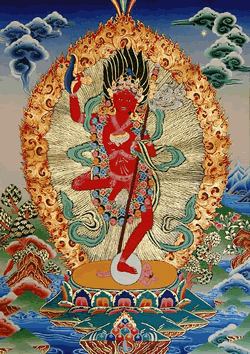
"Vajrayogini/Vajravarahi ranks first and most important among
the dakinis. She is the "Sarva-buddha-dakini" the Dakini Who is the Essence of
all Buddhas. Although there are a number of visual representations of
Vajrayogini, certain attributes are common to all: She is mostly shown as young,
naked, and standing in a desirous or dancing posture. She holds a blood-filled
skull cup in one hand and a curved knife (kartr or dri-gug) in the other. Often
she wears a garland of human skulls or severed heads; has a khatvanga staff
leaning against her shoulder; her usually wild hair flowing down her neck and
back; her face in a semi-wrathful expression. Her radiant red body is ablaze
with the heat of yogic fire and surrounded by the flames of wisdom."
- Vahrayogini
"The word danda, besides
signifying staff, club, stick, rod, has also the meaning of corporeal
punishment, chastisement, subjection, control, restrain. Self-control is
exercised by the danduas (devotees) not only by the way of fasting for a
number of days which varies between 18 and 21 (starting from the full moon of
the month of Chaitra up to the beginning of the solar month of Baisakh), but
also by performing physical exertions of different kind. Although all
sections of population can take part in the rituals, we find that in most
villages where danda is performed, the majority of the danduas are
from the paik or martial communities2 and the pata dandua himself
is the leader of the paik akhada of the same village. It is
certainly difficult to trace the historical reasons for this connection, but
elements of self-discipline, physical fitness and vigorous dance involved in the
performance of danda together with the fact that both forms of physical
expressions placed in the background of the Shiva-Shakti cult can be brought to
explain at least in part the cultural link."
- Danda Ritual Five Elements
"Viparita Danda: Viparita: “inverted,” danda: literally “staff” or “stick.” A
staff given during investiture of the sacred thread. A staff or sceptre as a
symbol of power and sovereignty. In the Devanagari script, the danda is a
punctuation character. The glyph consists of a single vertical stroke. In Hindi,
the danda marks the end of a sentence, a function which it shares with the full
stop (period) in many written languages based on the Latin, Cyrillic, or Greek
alphabets. Because of the shape of the danda glyph, the word danda is also
a slang term for penis."
-
Leaping Lanka
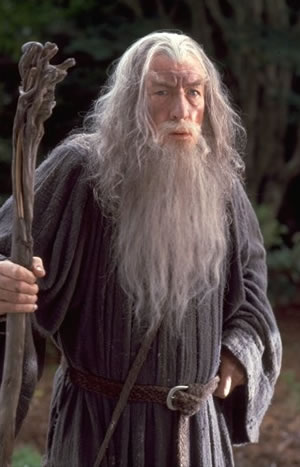
"Staff, Scepter. Sanskrit: Danda. Tibetan: Berk-Ka, dByug-pa,
hprul-gyis. Many of the various staffs, sticks, and scepters occurring in
depictions of Indo-Tibetan deities are often simply named danda, a term
that is rather ambivalent; i.e. not discriminating between the specific forms,
shapes and symbolism associated with this attribute. Although usually made from
wood, a danda is sometimes made from human bone. Sometimes, it is topped by a
human skull, at other times by a vajra; in some cases by both. Gada: Club."
- Danda
"In Chinese shamanism, a staff represents the power
of the universe. With a staff, a shaman had the power to pass on the universal knowledge to others. Later,
when teachers took over part of the shaman's job, they always taught with a small
staff in
their hands like a shaman."
- Master Zhongxian Wu, Vital Breath of the Dao, p. 106
" Li Tie Guai, is one of the Taoist Eight Immortals. 'Tie guai"
means "iron walking cane." Legend says his real name was Li Xuan. There are many
stories about him. Originally he was a handsome, strong, tall man. One day he
told his disciple that he was going to meet Lao zi and would be gone for seven
days. If his shen spirit did not return to his body form on the seventh day, his
disciple should burn the body. So he sat in deep meditation and his soul went to
the meeting. Unfortunately on the sixth day the disciple's mother was in
critical condition and he had to leave the temple to take care of her. The
disciple had no other choice but to burn his teacher's body. Soon Li's soul came
back but could not find his body. In the forest he found a man who had just died
of hunger, so he went inside. He discovered the body had only one leg. Just when
he was going to get out of that body he heard someone laughing and clapping
hands. It was Lao zi, who stopped him from jumping out of the body. "Tao does
not care about the appearance," he said. "This look of yours is fine. As long as
your hair is plenty, you are still a real celestial." Lao zi gave him a gold
band to hold the messy hair and an iron walking cane. Li Tie guai often carries
a bottle gourd on his back when he comes to visit our world. The bottle gourd
contains herbal remedies that have magic powers and he uses them to cure people
and save their lives."
- Taoist Eight
Immortals,
Eight Immortals
"The Daoist Rituals of the
Pervasive Mystery and Numinous Treasure states: "all those who learn Daoism
should master the Nine-Segment Staff. It assists old people and saves people in
emergencies, and has different names. It is necessary to know it." The
nine segments of the staff are named after the constellations, namely the
Taihuang Constellation, the Yinghuo Constellation, the Jiao Constellation, the
Heng Constellation, the Zhang Constellation, the Yingshi Constellation, the Zhen
Constellation, the Dongjing Constellation and the Ju Constellation. When Daoist
priests make Magical Staffs, "they must select famous mountains and Blissful
Realms, clean the region and any ruins, take clean bamboo facing south on an
auspicious day, measuring five chi and five fen long and containing nine
segments, and put it in a quiet and clean place. On the days of Jiawu, Bingwu
and Dingmao, or the third day of the third lunar month, the fifth day of the
fifth month, the seventh day of of the seventh month, and the ninth day of the
ninth month, the priests slightly bend the first segment of bamboo to the left
and to the right slightly. Then they open four holes below the the first segment
to insert the secret names of the Four Sacred Mountains, and open one hole in
the center at the top of the bamboo to insert the secret name of the Sacred
Mountain of the Centre. Later, they fill the middle part of the bamboo with
Numinous Scriptures and seal the whole with wax. Those who specially take the
staff with them for cultivation fill it with the Talisman of the Five Emperors.
Silk fabrics with yellow figures are used as pouches that are just large enough
to hold a staff". In the rituals of Fasts and Offerings, Daoist priests can
summon spirits or heavenly generals and destroy hells according to rules with
Magical Staffs made in this way. "Point to Heaven with the staff and the
heavenly spirits will pay homage; point to Earth with the staff and the Earth
Spirits will welcome the Daoist; point to the northeast with the staff and the
bodies of all the ghosts will be controlled". When the Ritual Master performs
rituals, he often hangs a small yellow seven-cun long streamer under the second
segment of the staff, on which are written the title of the Heavenly Lord of
Salvation from Misery in the Ten Directions15
and the Talisman of Mysterious Transformations of the Ten Directions. The
Great Law of the Numinous Treasure of the Highest Clarity by Wang Qizhen
says that when the ritual master destroys hells, he gazes at the staff and
"transforms it into a pillar in the form of the dragon's head and the tiger's
tail. The dragon is brilliant and holds a splendid streamer in its mouth.
Numinous wind and auspicious clouds coil around the dragon, shining
limitlessly".
- Chen Yaoting.
Magical Staffs in Taoist Rituals
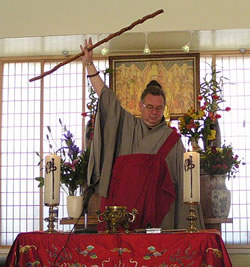
Chinese Chan Buddhist Master Baqiao said to a group, "If you have a
staff, I will give you a staff; if you have no staff, I will take your staff away."
Wumen added, "It helps you across a river where bridges are out, and gets
you back to the village when there is no moon. If your call it a staff, you go
to hell
fast as an arrow."
Zen Master Wuzhou added, "Baqiao raised his staff, startling all creation:
shrimp may fly past the heavens, but eyebrows are still above eyes."
"With this staff in my hand
I can measure the depths and shallows of the world.
The staff supports the heavens and makes firm the earth.
Everywhere it goes the true teaching will be spread."
- "Unlocking the Zen Koan: A New Translation of the Zen Classic
Wumenguan." Translated by Thomas Cleary, 1993, 1997, p.
195.
"The peerless master moves with his group from place to place in the
mountains. His small band contains
two highly advanced American disciples. After Babaji has been in one
locality for some time he says,
'Dera danda uthao,' 'Let us lift our camp and staff.' He carries a
symbolic danda (bamboo staff). His words
are the signal for moving with his group instantaneously to another place.
He does not always employ
this method of astral travel; sometimes he goes on foot from peak to peak."
- Told by Swami Kebalananda to Paramhansa Yogananda in 1920, Autobiography
of a Yogi, p. 294.
"A monk asked,
"What's the essential meaning of Zen?"
Xita replied, "You don't have Buddha nature."
The monk said, "What is sudden enlightenment?"
Xita drew a circle in the ground with his staff.
The monk asked, "What is gradual enlightenment?"
Xit poked the middle of the empty space three times with his staff."
- Zen's Chinese Masters, 2000, p. 208
Translated by Andy Ferguson
Deshan said to the monks,
"If you speak you get thirty blows. If you don't speak, you get
thirty blows."
Yantou later said, "Old Deshan usually just relied on a white staff.
If the Buddha came he hit him.
If an ancestor came he hit him. Why
does he have so many students."
- Zen's Chinese Masters, 2000, p. 199
"The morality-jewel inherent in the Buddha-nature stamps itself on the
mind-ground of the enlightened one;
Whose robe is cut out of mists, clouds, and dews,
Whose bowl anciently pacified the fiery dragons,
And whose staff once separated the fighting tigers;
Listen now to the golden rings of his staff giving out mellifluous tunes.
These are not, however, mere symbolic expressions, devoid of historical
contents;
Wherever the holy staff of Tathagatahood moves, the traces are distinctly
marked."
- Sacred Buddhist
Scriptures
"Unmon showed his staff to the assembly and said, "This staff has changed
into a dragon and has swallowed up the heaven and the earth. Where do
mountains, rivers and the great earth come from?"
Hekiganroku, Case 60, Unmon's Staff
"The staff (Danda) is symbolic for the spine supporting the body.
Since man's emergence
for the animal kingdom he has walked erect. The levels of consciousness
are in the spine
where the life force is dominant. The base of the spine [Muladhara Cakra]
is the place where the Kundalini Energy (Divine Coiled Serpent) is located.
Khatvanga (Staff with Skull on Top) is symbolic of a pure or empty mind, one
which is free
from preconceived ideas which block the way for new perceptions, particularly
Divine
insight, that is, insight by intuition during meditation, reflection or
quietness. In contrast
to the perconceived ideas stands true knowledge, which is knowing from
personal experience. Information is often mistaken for knowledge. The skull
is mounted on a staff (the spine). The Kundalini Energy can then rise in the
Sahasrara. The flow of the Divine energy through the staff or spine, into the empty skull, the mind free of
preconceived
ideas, is an experience that shakes one's whole foundation."
- Kundalini: Yoga for the West. By Swami Sivananda
Radha. Timeless Books, 1978. p.41
"With his staff across his back, he pays no heed to
men;
Quickly entering the myriad peaks, he goes upon his way.
Fearsome and solitary in mien, he does not boast of himself;
But, dwelling gravely in his domain, decides who is snake, who is Dragon."
- Zenrin Kushu,
Miura and Sasaki
"The bo, or staff, is one of the earliest tools to be used by man. Initially it may have been merely a sapling or a long, straight branch which was used for hunting animals for sources of food or fur hides. The wooden staff also facilitated passage over rugged and mountainous terrain. In an agrarian setting it served as a multi-purpose tool for planting crops, carrying supplies, and transporting buckets of water for the irrigation of crops.
In the ancient records of Chinese martial arts, the bo is discussed as the
first weapon taught to the Zen Buddhist disciples who studied at the Shaolin
Temple. There are literary and pictorial references to Bodhidharma carrying a bo
on his journeys as he taught Zen Buddhism in the regions near the Shaolin
Temple. One account from a biography on Bodhidharma tells of his death in 528 AD
from the poison of a jealous monk. It is told that three years later his body
was exhumed due to rumors he had been seen travelling in the mountains of
Central Asia. Bodhidharma was said to carry a staff from which hung a single
sandal. He had stated he was on his way back to India. When the curious monks
opened his tomb, all they found inside was a single sandal. Ever since then
Bodhidharma has been pictured carrying a staff from which hangs the missing
sandal."
- Sa Kwon:
Chinese Bo
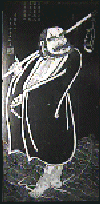
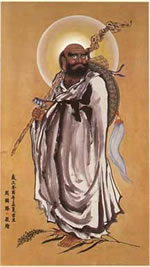
Legend of Bodhidharma's (Damo) Single Sandal on His Staff
"So I took the bright red stick and at the center of the nation's hoop I
thrust it in the earth.
As it touched the earth it leaped mightily in my hand and was a waga chun,
the rustling
tree [cottonwood], very tall and full of leafy branches and of all birds
singing. And beneath
it all the animals were mingling with the people like relatives and making happy
cries.
The women raised their tremolo of joy, and the men shouted all together;
"Here we shall
raise our children, and be as little chickens under the mother sheo's
[prairie hen] wing."
Then I heard the white wind blowing gently through the tree and singing there,
and from the east the sacred pipe came flying on its eagle wings, and stopped before me there
beneath
the tree, spreading deep peace around it."
- Black Elk Speaks, 1932, p. 29, as told to John G.
Neihardt.
"Whirled by the three passions, one's eyes go blind;
Closed to the world of things, they see again.
In this way I live; straw-hatted, staff in hand,
I move illimitably, through earth, through heaven."
- Ungo (1580-1659)
"Jodo should be done to build one's character. Jodo should
be like a steering wheel. The road is life. There are
all kinds of ways one can go down the road. Use Jodo to steer as straight
a course as possible through life."
-
Sensei Shimizu Takaji
Chan (Zen) Buddhist
Kungans (Koans) Including a Mention or Featuring a Cane, Staff, or Stick
Zen Koans: Quotations, Index, Bibliography, Notes By Mike Garofalo.
"The stick here is a kind of cane about seven feet long. It was at first a
practical walking stick carried by a Zen monk on his training journey. Now it is
often used in ceremonies, and Zen Masters frequently make use of it in mondo
and teisho. In some cases it symbolically represents "the One Truth
pervading the universe," "original Buddha Nature," "True Self," or "the
fundamental 'it' "."
- Zenkei Shibayama Roshi, The Gateless Barrier, 2000, p. 304, Case 44 "Basho
and a Stick."
"Shuzan held out his short staff and said: "If you call this a short staff,
you oppose its reality. If you do not call it a short staff, you ignore the
fact. Now what do you wish to call this?"
Mumon's comment: If you call this a short staff, you oppose its reality. If you
do not call it a short staff, you ignore the fact. It cannot be expressed with
words and it cannot be expressed without words. Now say quickly what it is.
Holding out the short staff,
He gave an order of life or death.
Positive and negative interwoven,
Even Buddhas and patriarchs cannot escape this attack."
- Mumonkan #43
Chinese Chan Buddhist Master Shoushan held up a bamboo staff before a group and said, "If you call it a bamboo staff, you are clinging. If you do not call it a bamboo staff, you are ignoring. So tell me, what do you call it?" - Wumenquan, # 43.
Chinese Chan Buddhist Master Baqiao said to a group, "If you have a
staff, I will give you a staff; if you have no staff, I will take your staff away."
Wumen added, "It helps you across a river where bridges are out, and gets
you back to the village when there is no moon. If your call it a staff, you go
to hell
fast as an arrow."
Zen Master Wuzhou added, "Baqiao raised his staff, startling all creation:
shrimp may fly past the heavens, but eyebrows are still above eyes."
"With this staff in my hand
I can measure the depths and shallows of the world.
The staff supports the heavens and makes firm the earth.
Everywhere it goes the true teaching will be spread."
- "Unlocking the Zen Koan: A New Translation of the Zen Classic
Wumenguan." Translated by Thomas Cleary, 1993, 1997, p.
195.
"A monk asked Kenpo, "The one road of Nirvana leads into the ten
quarters. But where does it begin?"
Kenpo raised his staff and traced a
horizontal line in the air and said, "Here."
Disappointed, the monk went to Yunmen
asked him the same question.
Ummon held up his staff and said, "This staff
leaps up to the 33rd heaven and hits the presiding deity on the nose, then it
dives down into the Eastern Sea where it hits the holy carp.
The carp becomes a
dragon which then brings a flood of rain."
List of
Koans by Yunmen Wenyan
"Zen Master Yunmen once took
his staff and struck a pillar in the hall, saying, "Are the three vehicles and
twelve divisions of scripture talking?"
He then answered himself by saying, "No, they're not talking."
Then he shouted, "Bah! A wild fox spirit!"
A monk asked, "What does the master mean?"
Yunmen said, "Mr. Shang drinks the wine, and Mr. Li gets drunk."
Zen's Chinese Heritage: The Masters and Their Teachings
"Zen Master Seung Sahn, holding up the Zen stick, asked "Do you see?"
Hitting the ground with the Zen stick, he asked "Do you hear?"
He then said, "Already you see clearly. Already you hear clearly.
Then, what are this stick, this sound and your mind?
Are they the same or different?
If you say "same," I will hit you thirty times.
If you say "different," I will also hit you thirty times.
Why?
KATZ!"
-
Zen
Master Seung Sahn
"Mayoku arrived at Shokei's place holding his staff. He walked three times
around the meditation seat of Shokei and then thumped his staff once.
Shokei said, "Right! Right!"
Later, Mayoku went to Nansen's place, walked three times around the meditation
seat of Nansen, and then thumped his staff once. Nansen said,
"Wrong! Wrong!" Mayoku asked Nansen, "Shokei said 'right.' Why do you say
'wrong?." Nansen said, "For Shokei it is right. For you it is wrong. What
comes from the power of wind in the end becomes broken and crumbled."
- Gerry Wick and Bernie Glassman, Book of Equanimity, p. 51
"One of the standard themes of Zen art is the staff. The staff is an
all-purpose Zen tool -- a symbol of authority, a walking stick, an implement for
imparting discipline. This single-stroke Zen staff has no other writing on the
paper, but it is filled with seal impressions -- one of Unmon Sokudo's
(1690-1765) trademarks. One interpretation would be that Sokudo is telling his
students. "Anywhere you look, I will be there, ready to give you a good whack!""
-
Shambhala Publications
Blue Cliff Record, Hekiganroku, Case 60: Ummon's Staff Becoming a Dragon
Two Zen Classics: Mumonkan and Hekiganroku
Ummon's Staff Becoming a Dragon, Case 60, Blue Cliff Record
"Engo's Introduction: Buddhas and sentient beings are not, by nature, different. Mountains, rivers, and your own self are all just the same. Why should they be separation and constitute two worlds? Even if you are well versed in Zen koans and know how to deal with them, if you stop then everything is spoiled. If you do not stop, the whole world will be dissolved, with not a particle of it left behind. Now tell me, what does it mean to be well versed in Zen koans? See the following.
MAIN SUBJECT: Ummon held out his staff and said to the assembled monks, "The staff has transformed itself into a dragon and swallowed up the universe! Where are the mountains, the rivers, and the great world?"
Setchō's Verse:
The staff has swallowed up the universe?
Don't say peach blossoms float on the waters.
The fish that gets it tail singed
May fail to grasp the mist and clouds.
The ones that lie with gills exposed
Need not loose heart.
My verse is done.
But do you really hear me?
Only be carefree! Stand unwavering!
Why so bewildered?
Seventy-two blows are not enough
I want to give you a hundred and fifty.
[Setchō descended from the rostrum waving his staff. The whole crowd ran away.]"
-
Two Zen Classics: Mumonkan and Hekiganroku
Mike Garofalo's Comments on Case 60
Zen Master Hakuin (1686-1768) painted a Dragon Staff with horsehair whisk
attached.
He would give this painting to his lay students who passed the Zen koan,
"What is the sound of one hand clapping."
Shifu Miao Zhang Points the Way
The Wise Teacher with the Magic (Wondorous, Amazing, Powerful) Staff, Shifu Miao Zhang, 师傅妙杖
Sayings and Answers to Questions by Shifu Miao Zhang

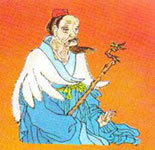
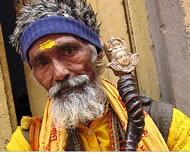
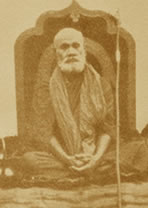
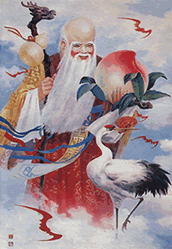
"Mayoku walked around his old Daoist friend, Shifu
Miao Zhang (师傅妙杖), three times
and then thumped his staff on the ground.
Maio Zhang stood up, walked around Mayoku once, tapped his cane three times on
the wall, and said "The power of the wind can topple trees and is gone by
morning. My cane can cut through the wind."
Zhaozhou, who had been in poor
health, asked his friend Miao Zhang, "Do the bees have Buddha nature?"
Miao Zhang smiled and said, "The roses are so fragrant today, and the cherries
so sweet. Let's walk in the garden and leave our crutches behind."
Gathering together in an orchard of blooming sweet lime trees, the students
waited for their esteemed teacher, Kasyapa. Slowly walking down the dirt
path, relying on his danda walking staff for balance, Kasyapa joined his students.
He sat quietly for a long time, enjoying the fragrance of the lime blossoms.
Finally, he raised his danda staff. Everyone stared at Kasyapa - serious,
intent, focused, and silent. Only Shifu Miao Zhang smiled, and then lifted his
cane and pointed at a lime blossom. Kasyapa pointed his danda at Shifu Zhang. Another transmission
was completed. The sacred thread remained unbroken.
Nan-ch'uan asked Miao Zhang, "Is Ordinary Mind the Dao?"
Miao Zhang said, "No. My mind is not ordinary, so the Dao is a dream
within a dream. My cane is ordinary, so it walks with me along the
Watercourse Way, pointing to the Abode of the Dao in the new forest."
Zen Master
Seung Sahn held up his staff in front of old Shifu Miao Zhang, and said "Then,
Miao Zhang, what are this staff, this sound and your mind? Are they the same or
different? If you say "same," I will hit you thirty times. If you
say "different," I will also hit you thirty times. Why?"
Miao Zhang lifted his cane slowly, grounded himself, prepared to block a strike and
then said, "Don't know! Same or different, nobody can hit the sound of our
minds."
Zen Master
Shuzan held out his short staff in front of his Daoist friend, Shifu Miao Zhang, and said "If you call this a short staff, you oppose its reality and
are clinging. If you do not call it a short staff, then you ignore the fact. Now
what do you wish to call this?"
Miao Zhang smiled, dropped and pointed to his cane, and said "Yesterday it was a wooden walking stick that
helped without speaking. Tomorrow it may become firewood, crackling in the
flames."
Zen Master Yunmen Wenyan and Shifu Miao Zhang were walking
together in the hills behind the monastery one cloudy autumn afternoon. It
began to rain steadily on the two old friends. Yunmen said, “My staff has
changed into a dragon and is swallowing up the heaven and earth. So, my friend,
where do mountains, rainfall, rivers and the great earth come from?”
Miao Zhang was quiet for awhile, stopped on the trail, and then held his cane
in his hand with the tip pointing to the sky. He said, “Yunmen, as for the
source of their coming, the tip of my cane points to the fecund depths of vast
emptiness, the crook end to the endless inter-marriages of ten thousand
realities, and my hand grasps the heartwood of the ordinary mind. So, my friend, Yunmen, where are they all going?”
Xita asked Shifu Miao Zhang,
"What is sudden enlightenment?"
Shifu Zhang threw his staff on the muddy ground. Xita asked Miao Zhang, "What is
gradual enlightenment?" Shifu Zhang stomped on his staff three times.
Zen Master
Ummon held up his staff in front of his Daoist friend, Shifu Miao Zhang, and said "This staff leapt up to the Eighth Heaven into the hands of
the lame Zhong Kui who used it to awaken the Green
Dragon in the Eastern Sea."
Miao Zhang said, "Ummon your poetry is lovely, but my gnarled cane cannot hear you."
Toju Zenchu brandished his staff before Daoist Shifu Miao Zhang
and challenged him "Miao Zhang, speak and you get
whacked with Nanten's
staff.
Do not speak and you still get whacked with Nanten's staff."
Shifu Zhang stood up quickly, lifted his cane
strongly in defense, and
quietly said, "Yunmen's shit stick stinks and Nanten's staff is cracked! I am leaving now to take my
evening walk. Goodbye."
"Master Yellow-Bitterroot Mountain asked Miao
Zhang,
'What is the meaning of Old Pahto emerging in the West?'
Miao Zhang lifted his cane and placed in in his mouth, saying nothing.
Later, zany Zen liar that he was, he wrote:
"No minds, no dharmas. No-mind, much Dharma."
Return to the Index at the Top of This Webpage
Workshops,
Seminars, Retreats, Demonstrations in 2015
Cane, Jo, Walking Stick, Short Staff
What, Where, When, Who?? Send information to Mike Garofalo and I will list here.
Return to the Index at the Top of This Webpage
Techniques
Martial Arts Techniques for Short Staff and Cane:
Using One Hand or Two Hands on the Wooden Stick
Strikes, Swing Strikes, Chops, Crook Strikes, Pokes, Punches, Jabs
Blocks, Sweeps, Pull Downs, Spinning and Twirling
Instructional Tips, Tools, and Suggestions
1. General Techniques
Martial Arts Techniques for the Cane and Short Staff. By Michael P. Garofalo, M.S., Valley Spirit Taijiquan, Red Bluff, California. Includes Strikes, Blocks, Sweeps, Chops, Crook Strikes, Pokes, Punches, Jabs, Pull Downs, Spinning and Twirling. This document provides a bibliography, links, and resources. The document includes a brief description for each short staff and/or cane technique. Specific citations to standard reference works are provided for techniques. Directional schemes, counting in various languages, and various school charts for staff or cane techniques. Under development in 2009; and new items added weekly. 384Kb+ in PDF Read Only Format.
Way of the Short
Staff. By Michael P. Garofalo, M.S. Green Way Research,
Valley Spirit Taijiquan,
Red Bluff, California. A detailed and annotated guide, bibliographies, lists of links, resources,
instructional media, online videos, and lessons. Includes numerous
lists
of movements for short staff forms, e.g., Eight Immortals Cane I form, Northern
Energy Taiji Cane form, Wudang Tiger Tail short staff
form, Chen Taijiquan short staff form, etc. A comprehensive guide to the practice of the
short staff, cane, jo, walking stick, gun, zhang, whip
staff, 13 Hands Staff, and related wood short staff weapons.
Includes use of the short staff and cane in martial arts, self-defense, walking
and hiking. Separate sections on Aikido Jo, Cane, Taijiquan cane and
staff, Jodo, exercises with a short staff, selected quotations, techniques,
selecting and purchasing a short staff, tips and suggestions, and a long section
on the lore, legends, and magick of the short staff. Includes "Shifu
Miao Zhang Points the Way." Updated on a regular basis since October 2008.
File size: 355Kb. Related to Mike's popular webpage on the
Staff.
Here is the directional scheme that I use when describing a sequence of movements. I always assume that you start the sequence facing to the North, facing the 12 o'clock direction, or facing N12. In my webpage on the subject, I give alternative directional schemes.
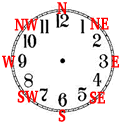
3. Counting
| Number | English | Japanese | Chinese | Chinese | Spanish | French | German |
| 1 | One | Ichi | Yī | 一 | Uno | Un | Eins |
| 2 | Two | Ni | Èr | 二 | Dos | Deux | Zwei |
| 3 | Three | San | Sān | 三 | Tres | Trois | Drei |
| 4 | Four | Shi | Sì | 四 | Quatro | Quarte | Vier |
| 5 | Five | Go | Wǔ | 五 | Cinco | Cinq | Fünf |
| 6 | Six | Roku | Liù | 六 | Seis | Six | Sechs |
| 7 | Seven | Shichi | Qī |
七 |
Siete | Sept | Sieben |
| 8 | Eight | Hachi | Bā |
八 |
Ocho | Huit | Acht |
| 9 | Nine | Kyu |
九 |
Nueve | Neuf | Neun |
|
| 10 | Ten | Ju | Shí |
十 |
Diez | Dix | Zehn |
Return to the Index at the Top of This Webpage
Red Bluff, Tehama County, North Sacramento Valley, Northern California, U.S.A.
Cities in the area: Oroville, Paradise, Durham, Chico, Hamilton City, Orland,
Willows, Corning,
Rancho Tehama, Los Molinos, Tehama, Proberta, Gerber, Manton, Cottonwood,
Anderson, Shasta Lake, Palo Cedro, Igo, Ono, Redding, Shasta, Dunsmuir,
Shingletown, Burney, Mt. Shasta City, Weaverville, Yreka, Williams, Colusa,
Chester, Susanville, Weed, Gridley, Marysville, Yuba City, CA, California.
© Michael P. Garofalo, 2008-2015, Green Way Research, Valley Spirit Taijiquan, Red Bluff, California, All Rights Reserved
Biography of Michael P. Garofalo
Qigong: Links and Bibliography
Cuttings: Haiku and Short Poems
Cloud Hands: T'ai Chi Ch'uan and Chi Kung Website Index

Martial Arts Using the Staff, Stick, Walking Stick, Cane, Handbo, Bo, Gun,
Jo, Walking Staff
Cane Martial Arts, Cane Self Defense, Cane Fighting Arts
Short Staff Martial Arts, Short Staff Self Defense, Short Staff Fighting Arts
Walking Stick Martial Arts, Walking Stick Self Defense, Walking Stick Fighting
Arts
Jo Martial Arts, Jo Self Defense, Jo Fighting Arts
Bo Martial Arts, Bo Self Defense, Bo Fighting Arts
Gun Martial Arts, Gun Self Defense, Gun Fighting Arts,
Gung Bang wooden short staff weapon
Japanese Short Wooden Staff Martial Arts Weapons, Jo, Bo
Chinese Short Wooden Staff Martial Arts Weapons, Gun, Zhang
Zhang Martial Arts, Zhang Self Defense, Zhang Fighting Arts
Shaolin Staff Cane Martial Arts, Shaloin Staff Cane Self Defense, Shaolin Staff
Cane Fighting Arts
Wudang Wu Dang Staff Cane Martial Arts, Wudang Staff Cane Self Defense, Wudang
Staff Cane Fighting Arts
Taijiquan Tai Chi Chuan Staff Cane Martial Arts, Taijiquan Staff Cane Self
Defense, Taijiquan Staff Cane Fighting Arts
Chinese Japanese Stick Cane Staff Gun Whip Staff Fighting Arts
Martial Arts Using the Staff, Stick, Walking Stick, Cane, Handbo, Bo, Gun,
Jo
Self-Defense Self Defense with the Walking Stick, Hiking Stick, Cane, Staff,
Short Staff
Exercise Techniques Methods Using With a Walking Stick, Hiking Stick, Cane,
Staff, Short Staff, Danda, Weighted Bar
Aikido Japanese Jo, Short Staff, Cane, Walking Stick, Walking Staff
Cane, Short Staff Martial Arts Weapons Training
Combat Fighting Cane, Short Staff, Walking Stick
Hapkido, Karate, Aikido, Aikijo, Karate Do, Jo Do Combat Martial Arts Self
Defense Cane, Short Staff, Jo, Bo, Gun
Martial Arts Cane, Short Staff, Jo, Bo
Fighting Stick, Fighting Cane, Fighting Staff
Walking Stick Fighting, Walking Stick Martial Arts, Walking Stick Combat
Exercises with the Cane, Cane Exercise, Geriatric Exercise with a Cane
Cane Fu, Kane Fu, Cane Kung Fu, Staff Kung Fu, Short Staff Kung Fu, Gun Kung Fu
Self-Defense Walking Cane, Stout Irish Shillelaghs, Sheperd's Crooks, Walking
Sticks, Swagger Sticks, Strolling Sticks, Hiking Poles
New Additions Not Yet Catalogued:
http://www.chinatown-taichi.com/fall2k3-caneform2.jpg
http://www.thewushucentre.net/_Media/huandahai2.jpeg
http://www.shaolins.com/encyclopedia/
This webpage was last modified or updated on December 12, 2014.
This webpage was first posted on the Internet in April of 2007.
Vacation and Learn in Beautiful Red Bluff, California
Beginning T'ai Chi Ch'uan Options: Yang 24, Chen 18, Sun 24, Cane 18
Beginning Chi Kung (Qigong) Options: Five Animal Frolics, Eight Brocades , Daoist Temple, Magic Pearl, Yoga
Lectures, Private Lessons,
Classes, Consulting,
Workshops, Questions and Answers
Reasonable Hourly Rates
Instructor: Michael P. Garofalo, M.S.
Excellent Recreational
Opportunities
for Persons of All Ages in the North Sacramento Valley
The Perfect Weekend Getaway for You, Friends and Family
Beautiful Scenery, Pleasant Weather, and Clear Skies for the Outdoor
Enthusiast
Activities: Sight Seeing, Bicycling, Walking, Shopping, Spas,
Reading, Relaxing, Internal Arts Studies
The Valley Spirit
Center includes extensive gardens for Tai Chi practice and a
Sacred Circle
A Full Array of Services and Excellent and Reasonably Priced
Accommodations in
Redding or
Red Bluff
Contact Mike: Email or Phone 530-200-3546
My Daily Tai Chi Chuan and Chi Kung Training Program


Photographs around the
Valley Spirit Center near the City of Red Bluff
in the North Sacramento Valley Area, California