January 17, 2011
© Green Way
Research, Red Bluff, California, 2011
By Michael P. Garofalo, All Rights Reserved.
Wu
Dang Mind/Body Arts
Taoism, Qigong, Meditation,
Martial Arts, Taijiquan, Nei Jia Quan, Kung Fu, Weapons, Arts, Lore
Bibliography, Links,
Resources
Academy of Wudang Mountain Taoist Wushu Arts
Alphabetic Index to the Cloud Hands Website
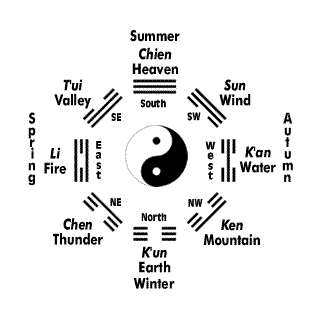
Bagua - Eight Trigrams Symbolism and attributions.
Beautiful
Heart, Beautiful Spirit. Shing-Ling-Mei Wudang Qigong as taught
by Master Qing Chuan Wang. By Katherine Orr. Dragongate
Publishing, 2005.
256 pages. ISBN: 0976517809. VSCL.
Chang San Feng
Taoist Master from Mt. Wudang, circa 1300 CE.
Chang
San Feng and Wudang Mountain. Dan Docherty.
The Chief Priest of Wudang Mountain.
The first English Interview with Taoist Grandmaster Zhong Yun Long
by Gene Ching (with Yun Xiang Tseng). Kung Fu Magazine, 2003.
Chinese Wudang
Boxing: Nei Jia Gong Fu
Cloud Hands Website: Taijiquan
The
Complete Book of Chinese Health and Healing: Guarding the Three Treasures. By Daniel Reid. Boston, Shambhala, 1995. Appendices, index, 484 pages. ISBN: 1570620717. VSCL.
Crouching
Tiger, Hidden Dragon. Directed by Ang Lee. Columbia Tri Star,
2000.
ASIN: B00003CXR4. Starring Yun-Fat Chow and Michaelle Yeoh.
Dao De Jing (Tao Te Ching)
by Lao Tzu : Verses, Bibliography, Notes, Commentary. Compiled
by Mike Garofalo.
Dragon Door Qigong. VHS or DVD, 112 minutes. Instructional videotape
by Jiang Jian-ye.
A 14 posture form created by Taoists at Wu Dang mountains.
Website:
Jiang's Tai Chi Videos.
Dragon Gate Chi Kung. VHS format, 60 minutes. Instructional
videotape by Gordon Xu. China's Living Treasures Series, Volume 26. Available from
Wayfarer Publications.
Dragon Qigong, Dragon Yoga: Bibliography, Links, Instructions, Notes
Eight Trigrams (Bagua) Chart
for the I Ching
Essence of Taoism Qigong. Book and 2 DVDs. By Fengming
Wang.
Available from
Wayfarer Publications.
History and
Development of Wudang Weng Shun Kuen Weng Shun Kuen (Everlasting
Springtime Fist).
Index to the Cloud Hands Website
Introduccion al Taiji De
Wudang
Kohn, Livia
Ph.D. Daoist scholar.
KungFu Dragons of
the Wudang Video, 10:14. \
Leaping Over the
Dragon's Gate
Lao Tzu, Dao De Jing:
Verses, Bibliography, Notes, Commentary. Compiled by Mike Garofalo.
The Martial Arts of WuDang. Wushu Scholar Magazine.
Nourishing
the Essence of Life: The Outer, Inner and Secret Teachings of Taoism.
By Eva Wong. Boston, Shambhala, 2004. 112 pages.
ISBN: 1590301048. VSCL.
Magic Tortoise Taijiquan School
Mount Wudang and Wudang
Kung Fu
One Old Druids Final
Journey: Notebooks of the Librarian of Gushen Grove
The Origins of
Taijiquan. By Gerald Sharp.
Pan Long Men Wudang Martial Arts.
Featuring Sun, Xiang.
Primordial Wuji
Qigong from Wudang Mountain Taoists. By Mike Garofalo.
Qigong: Bibliography, Links, Resources, Quotes, Notes,
Lessons By Mike Garofalo.
Qigong
Empowerment: A Guide to Medical, Taoist, Buddhist, and Wushu Energy
Cultivation. By Liang, Shou-Yu and Wu, Wen-Ching. Edited by
Denise Breiter-Wu.
Rhode Island, Way of the Dragon Publishing, 1997. Index, glossary, 348
pages. ISBN: 1889659029. VSCL.
Qigong Research at the Valley Spirit Center
By Mike Garofalo
Qigong:
Small Circulation. By Yang Jwing-Ming. YMAA Publication Center,
2006. 360 pages. ISBN: 1594390673. VSCL. Essential
reading!
Ripening Peaches:
Daoist Studies and Practices. Taoist scriptures, bibliography,
Quanzhen Daoism, Neidan, gardening, tea, history, qigong/daoyin, readings, etc.
She
Yan: Mountain Mystic Bradon Zatt travels to Wudang
Mountain.
Standing Taoist Meditation - Zhan Zhuang
Tai
Chi: A Way of Centering and the I Ching: A Book of Oracle Imagery.
By Feng, Gia-Fu and Jerome Kirk. London, Collier MacMillan, 1969. 157
pages. ASIN: 0025372904.
T'ai
Chi Classics. By Waysun Liao. New translations of three
essential texts of T'ai Chi Ch'uan with commentary and practical instruction by Waysun Liao.
Illustrated by the author.
Boston, Shambhala, 1990. 210 pages. ISBN: 087773531X. VSCL.
T'ai
Chi Ch'uan and Meditation. By Da Liu. New York, Schocken
Books, 1986, 1991. Index, 173 pages. ISBN: 080520993X.
Taoism and the
Philosophy of Tai Chi Chuan. An excellent and content rich website!
By Christopher Majka and Empty
Mirrors Press.
Tao Te Ching (Dao De Jing)
by Lao Tzu : Verses, Bibliography, Notes, Commentary. Compiled
by Mike Garofalo.
Taoism, Nature Mysticism, Alchemy, and Chinese Philosophy
Taoist
Meditation: Methods for Cultivating a Healthy Mind and Body.
Translated by Thomas Cleary. Boston, Shambhala Publications, 2000. 130 pages. ISBN: 1570625670. VSCL.
23 Internal/External Forms from Wu Dang Mountain and Qingdao City. VHS or
DVD, 120
minutes. A variety of forms are demonstrated. Based on Jiang
Jian-ye's trip to Wu Dang
Mountain and Qingdao.
Website: Jiang's
Tai Chi Videos.
Valley Spirit Center.
Red Bluff, California
Vital Breath of the Dao: Chinese Shamanic Tiger Qigong (Laohu Qigong). By Master Zhongxian Wu. Little Canada, Minnesota, Dragon Door
Publications, 2006. 246 pages. ISBN: 0938045687. There is also a DVD to accompany this book
with a running time of 65 minutes called "Chinese Shamanic Tiger Qigong." For
more information
call 1-800-899-5111. Master Wu is the lineage holder of four
different schools of Qigong and martial arts: • 18th generation lineage holder of the Mt. Wudang Dragon Gate
style of Qigong (Wudang Longmen Pai) • 8th generation lineage holder of the Mt. Emei Sage/Shaman style
Qigong (Emei Zhengong) • 7th generation lineage holder of the Dai Family Heart Method style
of Xin Yi (Dai Shi Xinyi Quan) • 12th generation lineage holder of the Wudang He style of
Taijiquan.
Vitality,
Energy, Spirit: A Taoist Sourcebook. Translated and edited
by Thomas Cleary. Boston,
Shambhala, 1991. 281 pages. ISBN: 0877735190. VSCL.
VSCL Valley
Spirit Center Library, Red Bluff, California
Warriors
of Stillness: Meditative Traditions in the Chinese Martial Arts.
Volume 1.
The Teachings of Grandmaster Cai Song Fang. Qigong Qi of the Center,
Essence of Taijiquan. By Jan Diepersloot. Walnut Creek,
California,
Center for Healing and the Arts. Glossary, 226 pages. ISBN:
0964997606. A study
of Wu Ji meditation, 13 postures, and push hands. VSCL.
The Way
of Qigong: The Art and Science of Chinese Energy Healing. By Kenneth
S. Cohen.
Foreword by Larry Dossey. New York Ballantine Books, 1997. Index,
notes, appendices, 427 pages. ISBN: 0345421094. One of my favorite books:
comprehensive, informative, practical, and scientific. VSCL.
The Ways of Walking:
Quotes, Bibliography, Links, Resources
The Web
That Has No Weaver: Understanding Chinese Medicine. By Ted J.
Kaptchuk,
O.M.D.. Chicago, McGraw Hill Contemporary Books, 2nd Edition, 2000.
Index, bibliography,
appendices, notes, 500 pages. Foreword by Margaret Caudill, M.D., and by
Andrew
Weil, M.D. ISBN:
0809228408. An excellent introduction to traditional
Chinese medicine and modern research on the topic. VSCL.
WuDang BaGua.
By Fei YinTao & Fei YuLiang. Translated by Joseph Crandall
85 pages, Velo-bound.
Wu Dang Bagua Broadsword. VHS or DVD, 115 minutes. Instructional
videotape by Jiang Jian-ye. 16 forms are taught.
Website:
Jiang's Tai Chi Videos.
Wu Dang Bagua Palm. VHS or DVD: Part 1, 120 minutes, Part 2, 118
minutes. Instructional
videotape by Jiang Jian-ye.
Website: Jiang's
Tai Chi Videos. For beginning and intermediate
students. Also available from
Wayfarer Publications.
Wu Dang Bagua Palm. VHS or DVD: Part 1, 123 minutes, Palms 1-2; Part 2,
120 minutes, Palms 203; Part 3, 120 minutes, Palms 3-4; Part 4, 120 minutes, Palms 5, 6, 7; Part 5, 120
minutes, Palms 7-8.
Instructional videotapes by Jiang Jian-ye. For advanced and master
levels. Website: Jiang's Tai Chi Videos. Also available from
Wayfarer Publications.
Wudang Baguazhang
Master Loriano Belluomini.
Wudang Boxing Series.
Instruction by Master Liang, Qiang-Ya of the Inernational WuDang Association.
Wu Dang 5 Element Cascade Chuan. VHS or DVD, 100 minutes.
Instructional videotape
by Jiang Jian-ye. 18 movement form.
Website:
Jiang's Tai Chi Videos.
Also available from
Wayfarer Publications.
Wudang
Internal Elixir Method for Life Enhancement: The Wudang Esoteric Kung
Fu Series. DVD, 67 minutes.
Wudang Martial Arts Demonstration. Video, 60 minutes.
Wudang Martial Arts by Master
You, Ming Sheng Wudang Song Xi Branch Series.
Wudang
Mountain - Google Search
Wudang Mountain
Badunjin Qigong 20Kb. Original written
in Hong Kong by Woo Kwong Fat, the 28th Generation Master of Dragon Gate Branch,
Wudang Mountain.
Interesting theory about the Eight Section Brocade Qigong.
Wudang Mountain Qigong with
Master Woo Kwong Fat
Wudang
Mountain Taijiquan Series. VCDs, 55 minutes each. A series on the Wudang Mountain San Feng Natural Sect branch. The demonstrator is Master Ping Wong, 26th generation.
Wu Dang Protect Mountain Boxing. VHS or DVD, 114 minutes.
Instructional videotape
by Jiang Jian-ye. 20 forms using fast, slow and flowing movements.
Website:
Jiang's Tai Chi Videos.
Wu Dang Qigong: Bibliography, Links, Quotes,
Resources, Notes, Lessons
Wudang
Qigong: China's Wudang Mountain Daoist Breath Exercises. By Yuzeng
Liu,
and Terri Morgan. International Wudang Internal Martial Arts,
1999. 244 pages. ISBN: 0967288908.
Wudang
Qigong. Instruction DVD, 120 minutes. Directed by Giovanni
Galvez. ASIN: B000GEYNP8.
English and Chinese audio tracts.
Wu Dang San Feng Tai Chi Chuan Simplified. VHS or DVD, 120 minutes. Instructional
videotape by Jiang Jian-ye. A 15 movement form, similar to the First Section
of the Yang
long hand form. Website: Jiang's
Tai Chi Videos. Also available from
Wayfarer Publications.
Wu Dang San Feng Tai Chi. VHS or DVD: Part 1, 121 minutes, 22 postures;
Part 2, 121 minutes,
51 postures; Part 3, 120 minutes, 34 postures. Instructional videotape by
Jiang Jian-ye. Website: Jiang's
Tai Chi Videos.
Wu Dang San Feng Tai Chi Sword. VHS or DVD format, 117 minutes.
Instructional videotape
by Jiang Jian-ye. A 19 form set.
Website:
Jiang's Tai Chi Videos.
Wu Dang Secret
Taoist Style. DVDs or VCDs from Plum Publications. "President You XuanDe is headmaster of Wudong Internal Boxing School. His teachers were all foremost WuDong taoists: Tongshen Wang (a hermit at Wudang Temple);
Zhu Chengde (Taosit headmaster);, Wang Weishen (headmaster of WuDang Xiongxi School); Lu Ming Dao (who lived
over 100 years old). In early 90s, You established San Feng Wushi College & becaming its first president. Among his titles: President of China Wudang Taoist Culture Research Institute, Chairman of Wudang Taoist Health Improvement Association, Chairman Compilers Board of Wudang Fighting Virtures magazine , Chairman
Wudang International Taiji Quan Association, Senior Advisor of Dalian Wudang Quan Research Institute and others.
The Wu Dang Mountain is the home of Wu Dang's many styles of Kung Fu just as Shaolin is revered to be the home of Shaolin Style. A Taoist sanctuary and home of many temples martial arts from this area take on distinct qualities associated with Taoist: flexibility, looseness and an emphasis on Chi. This series of VCDs show some of this style and certainly one of the most beautiful backgrounds, an old Taoist temple, of our series."
Wudang Tai Chi Quan
13 Form, Performed by Master Yuan Xiu Gang. Video, 6:05.
Wu Dang Tai Chi Sword. VHS or DVD, 120 minutes. Instructional videotape
by Jiang Jian-ye.
Created by Li Tian-Ji.
Website: Jiang's
Tai Chi Videos. Also available from
Wayfarer Publications.
Wu Dang Tai Yi Xian Yao Shang. VHS or DVD, 120 minutes.
Instructional videotape by Jiang Jian-ye. Website: Jiang's
Tai Chi Videos. Also available from
Wayfarer Publications.
Wudang Taoist Traditional Internal Kung
Fu Academy
Wu Dang Tiger Tail Short Staff. VHS or DVD, 114 minutes.
Instructional videotape by Jiang Jian-ye. 48 movement short staff form.
Website:
Jiang's Tai Chi Videos.
Wu Dang Wuji Sword. VHS or DVD, 120 minutes. Instructional videotape
by Jiang Jian-ye.
A 30 movement form. Website: Jiang's
Tai Chi Videos.
Wudang
Wushu Real Wushu Scholar, 2003.
Wu Dang Xuan Wu Staff. VHS or DVD, 120 minutes. Instructional videotape
by Jiang Jian-ye.
A 51 movement form intended to display the spirit of the snake and
turtle. Website: Jiang's Tai Chi Videos. Also available from
Wayfarer Publications.
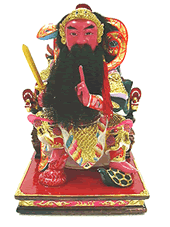
Xuan Wu - Lord of Wudang Matial Arts
A Snake and Turtle are at his feet.
His One Finger is more a Shaolin gesture.
Wudang Style of Martial Arts.
Chinese Taoist Martial Arts Association.
Wu Qin Xi,
Five Animal Frolics Qigong
Wuji (Primordial)
Qigong from Wudang Mountain Taoists. By Mike Garofalo.
Xuan Wu Quan:
Master Yuan Xiu Gang performing a Wudang Kungfu form. Video, 45 seconds.
Zhang San Feng Taoist Master from Mt. Wu
Dang, circa 1300
CE.
Zhan Zhuang: Standing Taoist Meditation
Wu
Dang
Mind/Body Arts
Taoism, Qigong, Meditation, Taijiquan, Nei Jia Quan,
Kung Fu, Weapons
Quotations, Poems, Notes
"Joseph Lee in 'The History of Chinese Science and
Technology' remarked, "The name of Zhang Sanfeng is now firmly related with Taijiquan, a major
school of Chinese Wushu". He goes on to say, "if one really wants to track
down the roots of Taijiquan one cannot fail to value Zhang Sanfengs theistic thoughts on
Taoism."
In 'The Origins of Wudang Taiji' Du Yuwan says, "Taijiquan is
generally said to be passed down from Zhang Sanfeng, but when we get down to the roots we find its beginnings further back in history".
- The
History and Legend of Tai Chi Chuan
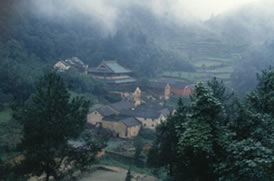
Wu Tang Mountain (Wudangshan)
Taoist Temple
"Mount Wudang, also known as Can Shang Mountain or Tai He Mountain, is located in the Qin Ling Mountain Range of northwestern Hubei Province. Because the scenery around Mount Wudang is so majestic and beautiful, it has been given the name 'The Famous Mountain Under Heaven.' Wudang is a major center for the study of Daoism and self-cultivation.
The legendary founder of Wudang wushu was Zhang San Feng. Zhang San Feng was a Daoist who lived in these mountains to cultivate the Dao during the Ming Dynasty.
Zhang San Feng was born in 1247 A.D. in the area of what is known today as Liao Ning.
Zhang San Feng is a very famous figure in the history of Chinese wushu. His martial abilities and healing techniques were superb and he was known to have cured many people of illnesses. This brought about great admiration from the common people.
The emperor of the Ming Dynasty erected a monument on the mountain to commerate the contributions of Zhang San Feng. During Zhang's younger years he met Daoist Huo Lung (Fire Dragon) with whom he studied the Dao. After attaining the Dao, Zhang moved to Wudang Mountain and cultivated an additional nine years. Many historical documents suggest that Zhang San Feng was the person responsible for synthesizing the wushu of the common people with the internal methodology and philosophical principles of Daoism. Wudang wushu is primarily known for its internal styles.
Zhang San Feng created Wudang wushu by researching the basic theory of Yin and Yang, the Five Elements, and the Eight Diagrams (Ba Gua). Wudang wushu has a very close relationship with the theories of Taiji, Yin and Yang, the Five Elements, the Eight Diagrams, and the Nine Palaces. Zhang San Feng was able to incorporate the Daoist practice of changing the Essence into Internal Energy , Internal Energy into Spirit,
and Spirit into Emptiness to form the theory of Wudang wushu. "
- Introduction
to Wudang Martial Arts
"Laozi's Dao Te Jing in the third chapter says
"Empty the mind, fill the belly. Weaken the ambition, strengthen the character." So then, this is the motto for practicing
China's Wudang Daoist Qigong. To study each method, each method must be understood, the energy processed must be
understood. If there is one type of practice Daoist qigong method not mastered, temporarily
don't practice other training methods. If one type of movement has not been mastered, concentrate on
that posture, do not study or practice other postures. Do not reach too high, must empty the
mind, have patience, cultivate both inside and outside, step-by-step achieve an abdomen relaxed inside and
breath ascending correctly, so then cultivate the breath continuously, and you will not contract illness.
When the dan tian is full and sufficient, the inner breath is unimpeded and not obstructed. Breath and
strength are sent out from the spine, following that which the mind desires. Strive for the substantial, don't
let practice become lax, maintain it so it will be lasting; abide by the regulations, follow the rules;
refine the breath, cultivate the body; cultivate the MIND, develop the character; thus seek emptiness and
stillness, complete emptiness, and long life. ...
Wudang Qigong has eighteen types of practice exercises and
methods: Extreme Emptiness, Pushing the Mountain, Wild Goose Flying, Crane Bending, Supporting Heaven, Both Appear,
Four Directions, Ward Off and Pull Down, Pipa, Shaking Tail Feathers, Offering Fruit, Facing the
Sun, Stirring the Grass, Dragon and Tiger, Coiling Snake, Spitting a Core, Climbing a Tree, and
Bowing To The Top."
- Wudang Qigong: China's Wudang Mountain Daoist Breath Exercises.
By Yuzeng Liu,
and Terri Morgan.
"Wudang Mountain,also known as Taihe Mountain, in the northwest of Hubei Province, is perhaps the best known of China's Taoist holy mountains and also known as the site of an ancient architectural complex both at home and abroad. It was listed by UNESCO as a World Cultural Heritage Site in 1994.
Wudangshan stretches 400 kilometres and covers an area of more than 30 square kilometres. Wudang Mountain's beautiful scenery of tranquil valleys juxtaposed with precipitous peaks offers three main areas of interest to travellers:Ancient Taoist temple complex, Wudang kung fu, Spectacular natural scenery.
Tianzhu (Column) Peak, the main peak, rises 1,612 meters above sea level, like a column supporting the sky, and is famous for its uniqueness, silence and beauty. Clustering around it are numerous strikingly outstanding peaks and exotic scenery as if "ten thousands peaks are paying their homage". Its scenic spots include 72 peaks, 36 rocky cliff, 24 streams, 3 pools, 9 wells, and 10 lakes. Wudang Mountain, well-covered with vegetation, has a rich resources of plants; 600 of the 1,800 medicinal herbs recorded in "Compendium of Materia Medica" compiled by the Ming Dynasty pharmacist Li Shizhen are chosen from Wudang Mountain. Therefore the mountain is also known as a "natural herbary".
On the mountain there are several thousand cultural relics from the Yuan, Ming and other historical periods as well as a huge Taoist architectural complex. The solemn ancient buildings are well ordered, symmetrical and are spaced so that an echo occurs between them. The complex was started in 1412, the 10th year of the reign of Emperor Yongle of the Ming Dynasty, and was completed 12 years later. It extends 70 kilometers from Jingle Palace in Gujunzhou City to Golden Hall at the top of Tianzhu Peak.
There are eight palaces, two Taoist temples, 36 nunneries, 72 temples on cliffs, 39 bridges, 12 pavilions and 10 ancestral temples. The main tourist spots are Xuanyue Gate, Yuanhe Taoist Temple, Yuzhen Palace, Yuxu Palace, Mozhen Well, Fuzhen Taoist Temple, Zixiao Palace, Southern Rock, Taihe Palace and Golden Hall. Two of them, Zixiao Palace and Golden Hall have been placed under state protection."
- China
Travel Information
"Wudang Mountain is renowned as Immortals' Mountain of Taoism and the World for Swordsman.
It is a famous Taoist center in China with a long history of Taoist practice and a profound Taoist culture.
Wudang Mountain is also well-known for its deep-rooted tradition of wushu (martial arts). As an old saying goes: "Shaolin wushu is the best in the north, while
Wudang wushu is the best in the south."
- Wudang Mountain
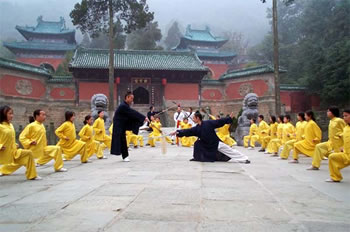
"Shaolin wushu is the best in the north,
while Wudang wushu is the best in the south."
"Wudang kung fu is one of two main streams of Chinese martial arts. Shaolin kung fu is famous for its strength and explosive power, its external power. Wudang kung fu is exactly the opposite. Softness or yin power is used to overcome hardness. Stillness overcomes motion. Four ounces overcomes 1000 pounds. Of course, it also has a hard part. There is external power. Wudang forms appear soft on the outside, but internally it is really hard. By hard, I mean qi, because internal forms cultivate qi. When you train in this, the qi is very strong and becomes hard inside. But on the outside, touching and seeing it, it is very soft. It’s also like lightning when it comes - fresh and electric. When it explodes, fajin (explosive power) is like thunder.
These days, mainstream Wudang focuses on Taiji. But Taiji is the big brother, so to speak. Beneath Taiji are three concepts: Liangyi (literally "two gifts" but it can be analogous to "heaven and earth"), Taiji (literally "grand utmost") and Wuji (literally "void utmost.") We say Zhang San Feng absorbed a hundred different styles. He took these specific styles, ideals and philosophies and focused them on the life nourishing culture that is Taoism to invent internal martial arts. According to Taoist beliefs, from Wuji arises Taiji, from Taiji arises Liangyi. Liangyi became sixiang (literally "four elephants" - this represents the four pillars or forms) and this created Bagua (eight trigrams, same as used in I Ching divination). From this we say "one created two, two created three, three created ten thousand." This philosophy is the foundation of internal form. That’s why Liangyi, Taiji and Wuji are all under the Taiji umbrella."
Yin and yang combined together in balance creates Taiji. When you separate yin and yang, we call it Liangyi. Liangyi separates the hard and the soft. Put them together and they become Taiji. Within the taiji is the Tao of life nourishing culture. Before, I said that Zhang San Feng absorbed a hundred styles and mixed them with Taoist life nourishing culture. What is really meant by this is that our style has combined the methods of tuna (breathing methods), daoyin (stretching techniques), caibu (collecting and nourishing) and hunyuan (akin to qigong). Now under Taiji there are three different levels, first Liangyi, then Taiji, then Wuji. But if you talk about the form itself, it also has different levels. First is tuna, the breathing method, second is caibu, collecting and nourishing, and third is called hunyuan. Hunyuan means combining yin and yang, so it’s an internal meditation method. These three levels comprise Taijiquan
technique.
We use internal power to support external movement. Through many years of study, Wudang has developed many internal forms. In different periods, each form had a different creator. And each creator had his own basic form to base the foundation of his style. At Wudang, we have a basic entry-level form called Wudang changquan (long fist) but this is not like Shaolin long fist. It trains the stances, hand techniques and body techniques, combining all of them together.
It's very hard to say how many lineages there are at Wudang today. Through the centuries so many masters have created their own styles. When each master breaks through, when they attain a higher level, they become their own style. When they become their own style, they create another branch of the lineage. Most of the lineages are out in the community among the folk people of the country. Today, there might be thirty or fifty of them, but the Wudang Zhang San Feng branch is the main stream. Now we still call it Wudang San Feng Pai (Pai means
"school.") All of the others came out of the San Feng Pai - they were created and branched out. Under Wudang San Feng Pai are eight men (gates): Taiji, Xingyi (form mind), Bagua (eight trigrams), Baji (eight extremes), Baxian (eight immortals), Xuangong (mystic work), Liuhe (six harmonies) and Jiugong (nine directions). I still focus mainly on Taiji. Wudang Taiji consists of 15 forms. Then from that it also branches out into 18 weapons."
- Taoist Grandmaster Zhong Yun Long,
Wudang Kung Fu Defined, 2003
"Wudang is like the mother - tai chi is like the son"
- Master Cai Xing Sheng, Vice-Chairman, Wudang Research Association
"The Wudang Temple is still exists and there are still Taoist sages managing the temple and they still teach Wudang martial arts there. It is interesting to note that there is a form called Wudang Taijiquan practiced there. Its postures bear little resemblance to the main styles practiced today even though it has many common characteristics, in terms of technique and principles, of the major styles. The last head of the Wudang Temple, Taoist Xu Ben Shan (1860-1932) was skilled in it and taught it to his disciples together with other Wudang arts. Xu spent most of his life in the Wudang Temple having entered the temple when young. It is unlikely that his art came from the outside since his life is quite well documented. But whether Wudang Taijiquan is the seminal form of all the others cannot be concluded since there is no firm link between the practitioners of the Wudang arts and Wang Tsung Yueh who is the earliest common personage of the the early styles of modern Taijiquan. But it should be noted that there are common theorems between the Wudang Internal Boxing and Taijiquan. and it is possible that Wudang Internal Boxing influenced Taijiquan though it should be considered a separate art."
- Competition
and Tradition: Tai Chi Inside China
Only the soft overcomes
the hard,
by yielding,
bringing it to peace.
Even where there is no space,
that which has no substance enters in.
- Dao De Jing, Chapter 43
"The Order of Wudang set its foundation deep in Wudang Mountain, also called Taihe Mountain, or Mountain of Supreme Harmony. It is located in Junxian district (in the northwestern part of Hubei Province). Wudang Mountain stretches out for more than 400 km. Tianzhu Peak is the highest elevation at 1612 m. This peak rises loftily towards the sky and was named Pillar to the Sky by the local inhabitants. It is surrounded by 71 neighnouring peaks.
Wudang Mountain is one of the sacred mountains of Taoism. Consequently, the Order of Wudang is the central Taoist disciplinary command. Many temples sprang up during the Song era, but most of them were destroyed when the Mongols invaded China. After the fall of Yuan Empire, the Ming emperor allocated 300,000 workers to his master builders and ordered them to carry out a tremendous construction project on Wudang Mountain. Within six years, 46 temples and halls, 72 grottoes, 39 bridges, 12 pavilions and terraces had been completed. Once again, the Order of Wudang wields an authoritative sceptre in the wonderful world of wulin.
An amazing site in the mountain is the Heavenly Column, Tianzhu Peak (or Golden Summit), on which stands the Golden Hall. The hall is 5.54 m high and 4.4 m wide. It is built in the style of a timber frame construction (no nail at all) and is the only one of its kind in China of this magnitude. The hall, which rests upon a granite base, contains several bronze sculptures embellished with gold. One of these represents the Taoist deity Zhen Wu. The symbol for it and Wudang Mountain is tortoise and snake.
Xuanyue Gate stands at the foot of Wudang Mountain. It is 20 m high and is embellished with 5 roofs of remarkably beautiful carvings. Yuzhen Temple is located at the northern foot of the mountains, about 1 km from Xuanyue Gate, within which there is a huge bronze statue of the Taoist Zhang Sanfeng--once a great leader of the order. Yuxu Temple with its 2,000 rooms is the largest complex on Wudang Mountain. Inside the Red Gate and the Red Wall with colorful ceramic models and stele pavilions are built. The temple is very impressive of its size and splendour."
- Dragons and
Tigers of Wulin
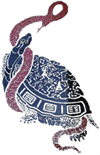
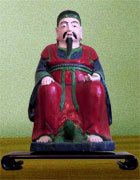
"Xuan Wu Dadi (Dark Lord of the North) Lord Xuan Wu (variously called The Dark Lord of the North, The Lord of True Martiality, the North Lord Xuan Wu, Lord Black, The Lord of Black Martiality, etc.) is one of the most widely revered Gods of traditional China, ranking in popularity behind only Guan Yin and Guan Gong. The God is usually depicted in black robes, holding a sword and sometimes wearing a jade belt. His long black hair flows freely down his back.
Lord Xuan Wu is always depicted with a tortoise and a snake, sometimes beneath one of his feet. He is revered as a powerful God, able to control the elements (worshipped by those wishing to avoid fires), and capable of great magic. He is particularly revered by martial artists, and is the 'patron saint' of Wudang Mountain in China's Hubei Province, where he allegedly attained immortality. The name "wudang" roughly translates as "only Xuan Wu deserves it."
- Joss
House: Taoist Temples of California
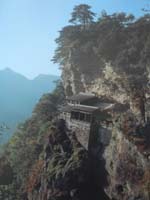
"South Cliff Palace is a cliff-embedded temple at Wudang shan 武當山(Mount Wudang), which is located in Junxian, Hubei. Mount Wudang, also known as Taihe shan 太和山 (Mount Taihe [Great Harmony]), is home of the Zhenwu 真武 (Perfected Warrior) cult. Zhenwu, also known as Xuanwu 玄武 (Mysterious Warrior) and represented as an entwined snake-turtle, is the guardian of the north. Mount Wudang is also believed to have been the place where Zhang Sanfeng 張三丰 (14th c.?) engaged in Daoist cultivation and created the internal martial arts, such as Taiji quan 太極拳 (Yin-yang Boxing)."
- South Cliff
Palace, Nanyan Gong 南巖宮
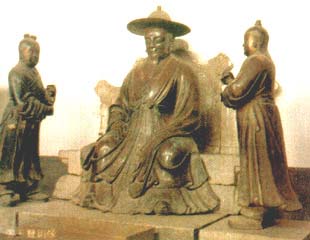
"Después de practicar durante mucho tiempo las
técnicas taoístas de meditación y alquimia interior, el monje Zhang Sanfeng
(siglo XIII) creó las teorías de las artes marciales internas, basándose en los
principios de combinar el movimiento externo
con la quietud interior; vencer gracias a la suavidad; atacar siguiendo los
principios del I-Ching (Yijing, Libro de los
Cambios), y combinar las técnicas de lucha con las de la alquimia espiritual.
Según una conocida leyenda, el taoísta Zhang se inspiró al ver la lucha entre una garza (no una grulla) y una
serpiente, viendo allí un símbolo del Cielo,
comprendiendo que la suavidad y la ligereza pueden vencer a la fuerza.
Todos los estilos de Taijiquan, (a excepción del Estilo Chen),
reconocen a Zhang Sanfeng como padre fundador del
arte), y hasta pleno siglo XX; entre 1930 y 40, esta teoría no ha sido puesta en
duda. Desde entonces, los partidarios
del origen del Taijiquan en Chenjiakou (Valle de la Familia
Chen) han ido ganando popularidad. Nosotros mismos,
en las notas a nuestra traducción del libro T’ai-Chi Ch’uan, Aspectos
Marciales (versión Guttmann, Libros de la
Liebre de Marzo) hemos defendido esta posición. Ha sido solamente
después, a partir de nuestro viaje a Wudang
y teniendo acceso al nuevo material de investigación en lengua china, cuando
hemos tenido noticia de las nuevas teorías
sobre el origen del Taiji. Existen actualmente bastantes posibilidades de
que el Taiji del estilo Wudang sea el método
embrionario que dará a luz diferentes estilos, y llegado a la aldea Zhaobao,
saltará al valle de los Chen para originar
el famoso estilo Chen (que no tiene ni un solo nombre en sus movimientos
relacionado con el Taoísmo, ni la más remota
conexión con conceptos taoístas). Dejamos para otro momento la interesante
discusión sobre el origen del Taiji
y vayamos a centrarnos en el método de Wudang."
- Introduccion al
Taiji de Wudang
Wu Dang Mind/Body Movement Arts
Taoism, Qigong, Meditation,
Martial Arts, Taijiquan, Nei Jia Quan, Kung Fu, Weapons
Lessons, Instructions, Postures
Baguazhang (Eight Trigrams Boxing)
Zhan Zhuang: Standing Taoist Meditation
© Michael P.
Garofalo, Green Way Research, Valley Spirit Qigong, Red Bluff, California
©
Green
Way Research, Red Bluff, California, 2011
This webpage was first published on the Internet WWW on March 17, 2007
Wuji Standing (Zhan Zhuang) Meditation
Taoism: Bibliography, Links, Resources
Alphabetical Index to the Cloud Hands Website