Compilation and Indexing by Michael P. Garofalo
Green Way Research, Valley Spirit Center, Gushen Grove Notebooks, Vancouver, Washington
Chapter 21 Chapter 23 Index to All 81 Chapters Daoism Concordance Cloud Hands Blog
Classic Book (Ching) about the Tao (Way, Nature, Patterns, Processes) and Te (Virtue, Potency, Power, Integrity, Wise Person, Sage)
Concordance: Indexing, Search Terms, Topics, Themes, Keys, Subjects, Words
English and Chinese (Wade-Giles) Terms: Humility, Few Desires, Crooked or Warped (wang),
Straight or Made True (chih), Imperfect, Quarrel or Compete or Content (chêng),
Earth or Below (hsia), Perfect or Whole or Complete (ch'üan), Partial, Complete,
Shine or Illustrious (ming), Embrace or Hold (pao), Full or Surplus (ying), Humility,
Confused or Bewildered (huo), Forbearance, Rejuvenate or Refreshed (hsin), Humility,
Not Gloating, Setting an Example, Avoid Idle Talking, Striving, Exactly or
Precisely (wei), Ancients, Little
or Few (shao), Endures or Lasts (ch'ang), Bend or Yield (ch'ü),
Model or Standard (shih), Destruction, Rebirth, Sage,
Adaptation, Empty or Holow (wa), Honor, Right or Correct (shih), Merit,
Unity or One or Absolute (yi), Virtue, See or Display or Show (chien),
Boast or Brag or Show Off (fa), Obtain or Possess
or Gain (tê), Heaven (t'ien), Perfected or Completion (ch'üan),
Merit or Credit or Achievement (kung), Famous or Distinguished (chang), Empty, Full,
Vacant or Empty or Useless (hsü), Yielding, Return or Restore (kuei), Old or Worn Out (pi),
Holy or Wise or Saintly Person (shêng jên), Words or Sayings or Spoken (yen), Then or To Be or Becomes (tsê),
益謙
Términos en Español: Humildad, Pocos Deseos, Chueca, Recto, Hecho,
Imperfecto, Pelea, Competir, Tierra, Abajo, Perfect, Entero, Parcial, Completa,
Illustrious, Superátiv, Confundido, Tolerancia, Rejuvenecer, Actualizar, No
Regodeo, Luchar, Exactamente, Precisamente, Ancestros, Poco, Pedura, Curva,
Rendimiento, Modelo, Destrucció, Sabio, Santo, Vacío, Hora, Derecha, Correcta,
Unidad, Virtud, Ver, Obtener, Cielo, Perfeccionado, Mérito, Famoso, Distinguido,
Vacío, Lleno, Vacant, Ceder, Devolució, Antiguo, Palabras, Dichos, Hablado,
Continuación.
Electronic Concordance for all 81 Chapters of the Tao Te Ching
English Language Translations of the Tao Te Ching
"The partial becomes complete; the crooked,
straight; the empty, full; the worn out, new.
He whose desires are few gets them; he whose desires are many goes astray.
Therefore the sage holds in his embrace the one thing of humility, and manifests
it to all the world.
He is free from self-display, and therefore he shines; from self-assertion, and
therefore he is distinguished;
from self-boasting, and therefore his merit is acknowledged;
from self-complacency, and therefore he acquires superiority.
It is because he is thus free from striving that therefore no one in the world
is able to strive with him.
That saying of the ancients that 'the partial becomes complete' was not vainly
spoken.
All real completion is comprehended under it."
- Translated by
James Legge, 1891,
Chapter 22
"Surrender brings perfection?
The crooked become straight
The empty become full
The worn become new
Have little and gain much
Have much and be confused
So the Sage embraces the One and become a model for the world
Without showing himself, he shines forth
Without promoting himself, he is distinguished
Without claiming reward, he gains endless merit
Without seeking glory, his glory endures
The Sage knows how to follow so he comes to command
He does not compete so no one under Heaven can compete with him
The ancient saying, "Surrender brings perfection," is not just
empty words
Truly, surrender brings perfection and perfection brings the
whole universe"
- Translated by
Jonathan Star, 2001, Chapter 22
"In cultivating the Tao there are first the sprouts; then perfection.
First, there is perversion; then rectification.
First there is hollowness and receptivity; then plenitude.
First there is destruction of the old; then renovation.
First there is humility; then acquisition.
Self-sufficiency is followed by suspicion on the part of others.
Therefore, the Sage preserves unity in his heart and becomes a pattern to the
whole world.
He does not say of himself that he can see, and therefore he is perspicacious.
He does not say of himself that he is right, and therefore he is manifested to
all.
He does pot praise himself, and therefore his merit is recognized.
He is not self-conceited, and therefore he increases in knowledge.
And as he never strives with anybody, so the world does not strive with him.
Can that saying of the olden times—"First the sprouts, then perfection"—be
called meaningless?
The attainment of genuine perfection implies a reversion to the original nature
of man."
- Translated by
Frederic H. Balfour, 1884, Chapter 22
"Stepping aside keeps one's wholeness intact.
Bending makes one straight.
Being empty makes one full.
Being worn out keeps one new.
Having little gives one access.
Having much leads one astray.
In this way, the sage embraces the One and becomes a model for all under Heaven.
He does not flaunt himself, thus he shines.
He does not insist that he is right, thus his rightness is manifest.
He does not boast about himself, thus his merit is acknowledged.
He avoids self-importance, thus he long endures.
It is because he does not contend that none among all under Heaven can contend with him.
As the ancient saying has it, "Stepping aside keeps one's wholeness intact."
How could this ever be an empty saying!
Truly, such a one will revert to it [nonexistence] with his wholeness intact."
- Translated by
Richard John Linn, Chapter 22
"Surrender brings perfection.
The crooked become straight
The empty become full
The worn become new
Have little and gain much
Have much and be confused
So the Sage embraces the One and become a model for the world
Without showing himself, he shines forth
Without promoting himself, he is distinguished
Without claiming reward, he gains endless merit
Without seeking glory, his glory endures
The Sage knows how to follow so he comes to command
He does not compete so no one under Heaven can compete with him
The ancient saying, "Surrender brings perfection" is not just
empty words
Truly, surrender brings perfection and perfection brings the
whole universe."
- Translated by
Jonathan Star, 2001, Chapter 22
"Strength to the Humble
I Ch'ien
To be crooked is to become perfect;
To be bent is to become straight;
To be hollow is to become full;
To be worn out is to be renewed;
To have little is to receive more;
To have plenty is to be perplexed.
Therefore, the Sage embraces the One,
And serves as model for the world.
As he does not like to show off, he is enlightened;
As he is not prone to be self-righteous, he is distinguished;
As he does not blow his own horn, he acquires merit;
As he does not extol himself, he is fit to be a leader.
And it is precisely because he does not contend,
That no one under heaven can contend with him.
The ancient saying "To be crooked is to become perfect"
Surely is not an empty remark.
The world goes to him who is truly perfect."
- Translated by
Henry Wei, 1982, Chapter 22

Created by Michael P. Garofalo, Green Way Research, Valley Spirit Center, Gushen Grove Notebooks, Vancouver, Washington © 2011-2021 CCA 4.0
 Translation and elucidation by Hua Ching Ni
 Translated by Brian Walker
The Feminine Tao: Early Women Masters East and West
 Translated by Arthur Waley
 Translated by Lionel and and Herbert Giles
 By Eva Wong
"The crooked shall be straight,
Crushed ones recuperate,
The empty find their fill.
The worn with strength shall thrill;
Who little have receive,
And who have much will grieve.
The holy man embraces unity and becomes for all the world a model.
Not self-displaying he is enlightened;
Not self -approving he is distinguished;
Not self-asserting he acquires merit;
Not self-seeking he gaineth life.
Since he does not quarrel, therefore no one in the world can quarrel with
him.
The saying of the ancients: "The crooked shall be straight," is it in any
way vainly spoken?
Verily, they will be straightened and return home."
- Translated by
Daisetsu Teitaro Suzuki and
Paul Carus, 1913, Chapter 22
"The imperfect is
completed.
The crooked is straightened.
The empty is filled.
The old is
renewed.
With few there is attainment.
With much there is
confusion.
Therefore the sage grasps the one and becomes the model for
all.
She does not show herself, and therefore is apparent.
She does
not affirm herself, and therefore is acknowledged.
She does not boast and
therefore has merit.
She does not strive and is therefore successful.
It
is exactly because she does not contend, that nobody can contend with
her.
How could the ancient saying, "The imperfect is completed" be
regarded as empty talk?
Believe in the complete and return to
it."
- Translated by
Charles Muller, 1891, Chapter 22
"The crooked shall be made straight,
And the rough places plain;
The pools shall be filled
And the worn renewed;
The needy shall receive
And the rich shall be perplexed.
So the Wise Man cherishes the One,
As a standard to the world:
Not displaying himself,
He is famous;
Not asserting himself,
He is distinguished;
Not boasting his powers,
He is effective;
Taking no pride in himself,
He is chief.
Because he is no competitor,
No one in all the world
can compete with him.
The saying of the men of old
Is not in vain:
"The crooked shall be made straight-"
To be perfect, return to it."
- Translated by
Raymond Blakney, 1955, Chapter 22
"Bend to not break.
Wrong leads to right,
Depletion to expansion,
Ruin to revival,
Deprivation to acquisition.
Thus the wise hold fast to oneness,
Their measure for this world below;
They make no display and thus shed light,
Put forward no claim and thus set patterns,
Do not advance and thus succeed,
Do not assert and thus preside.
By their refusal to contend
The world cannot with them contend.
Those ancient words “Bend to not break”
Have pith and point
Truly those unbroken credit them.
“Spare speech and let things be.” "
- Translated by
Moss Roberts, 2001, Chapter 22
"Through tolerance can perfection be attained.
By "indirect way" can "direct way" be reached.
Through lowness can highness be maintained.
Through old fashion can new fashion be created.
By "have less" can "have more" be possible.
By having plenty only confusion will result.
Hence one who does not show off is enlightened.
One who does not boast of himself has merit.
One who does not claim credit for himself is popular.
One who does not brandish his success thus leads all.
Because of non-struggle, therefore there is nothing under heaven which can struggle with him.
The ancient saying:
"Through tolerance can perfection be attained."
Is it an empty talk?
Thus, if one attains perfection everything under heaven will follow him."
- Translated by
Tang Zi-Chang, Chapter 22
"Bent but then whole.
Curled but then straight.
Empty but then full.
Worn but then new.
Little but then gain.
Much but then doubtful.
Therefore, the sage embraces the One, and becomes an example for the world.
He does not make a show of himself, hence he shines.
He does not justify himself, hence he becomes known.
He does not boast of his ability, hence he gets his credit.
He does not brandish his success, hence he endures.
He does not compete with anyone, hence no one can compete with him.
Indeed, the ancient saying "Bent but then whole" is not an empty word.
If you have really attained wholeness, everyone will flock to you."
- Translated by
Tran Tien Cong, Chapter 22
Tao Te Ching
Lao Tzu: Tao Te Ching
 Translated by Livia Kohn
Dao De Jing: The Book of the Way
"Submit to Nature if you would reach your goal.
For, whoever deviates
from Nature's way, nature forces back again.
Whoever gives up his desire
to improve upon Nature will find Nature satisfying all his needs.
Whoever finds his desires extinguished will find more desires arising of
their own accord.
Whoever desires little is easily satisfied. Whoever
desires much suffers frustration.
Therefore, the intelligent person is at one with Nature, and so serves as a model for others.
By not showing off, he is exemplary.
By not asserting that he is
right, he does the right thing.
By not boasting of what he will do, he
succeeds in doing more than he promises.
By not gloating over his successes, his achievements are acclaimed by
others.
By not competing with others, he achieves without opposition.
Therefore the old saying is not idle talk: "Submit to Nature if you would reach your goal."
For that is the only genuine way."
- Translated by
Archie J. Bahm, 1958, Chapter 22
A Chinese Language Version of Chapter 22 of
the Tao Te Ching by Lao Tzu
A
note
on my style of displaying the Chinese characters of the Tao Te Ching
曲則全.
枉則直.
窪則盈.
弊則新.
少則得.
多則惑.
是以聖人抱一為天下式.
不自見故明.
不自是故彰.
不自伐.
故有功不自矜故長.
夫唯不爭, 故天下莫能與之爭.
古之所謂曲則全者, 豈虛言哉.
誠全而歸之.
- Chinese characters, Tao Te Ching,
Chapter 22
ch'ü tsê ch'üan.
wang tsê chih.
wa tsê ying.
pi tsê hsin.
shao tsê tê.
to tsê huo.
shih yi shêng jên pao yi wei t'ien hsia shih.
pu tzu chien ku ming.
pu tzu shih ku chang.
pu tzu fa.
ku yu kung pu tzu ching ku ch'ang.
fu wei pu chêng, ku t'ien hsia mo nêng yü chih chêng.
ku chih so wei ch'ü tsê ch'üan chê, ch'i hsü yen tsai.
ch'êng ch'uan erh kuei chih.
- Wade-Giles Romanization, Tao Te Ching, Chapter 22
Audio Version in Chinese of Chapter 22 of the Tao Te Ching
qu ze quan.
wang ze zhi.
wa ze ying.
bi ze xin,
shao ze de,
duo ze huo.
shi yi sheng ren bao yi wei tian xia shi.
bu zi jian gu ming.
bu zi shi gu zhang.
bu zi fa.
gu you gong bu zi jin gu zhang.
fu wei bu zheng, gu tian xia mo neng yu zhi zheng.
gu zhi suo wei qu ze quan zhe, qi xu yan zai.
cheng quan er gui zhi.
-  Pinyin Romanization, Daodejing, Chapter 22
Tao Te Ching in Chinese characters and English (includes a word by word key) from YellowBridge
Tao Te Ching in Chinese characters, Pinyin Romanization, English and German by Dr. Hilmar Alquiros.
Laozi Daodejing: Chapters with Chinese characters, seal script, detailed word by word concordance, Pinyin (tone#), German, French and English.
Chinese and English Dictionary, MDGB
Dao De Jing Wade-Giles Concordance by Nina, Dao is Open
Dao De Jing English and Wade-Giles Concordance by Mike Garofalo
Tao Te Ching in Pinyin Romanization with Chinese characters, WuWei Foundation
Tao Te Ching in Pinyin Romanization
Tao Te Ching in Chinese characters and English
The Feminine Tao: Early Women Masters East and West Seal script, simplified Chinese, and English translation scheme.
Tao Te Ching in Chinese characters, English, Word by word analysis, Zhongwen
Tao Te Ching: The Definitive Edition
Tao Te Ching in Chinese characters: Big 5 Traditional and GB Simplified
Chinese Characters, Wade-Giles and Pinyin Romanizations, and 16 English Translations for Each Chapter of the Daodejing by Mike Garofalo.
Tao Te Ching in Chinese characters, Pinyin and Wade Giles Romanization spellings, English; a word for word translation of the Guodian Laozi Dao De Jing Version.
Lao Zi's Dao De Jing: A Matrix Translation with Chinese Text by Bradford Hatcher.
"Be humble, and you will remain entire.'
Be bent, and you will remain straight.
Be vacant, and you will remain full.
Be worn, and you will remain new.
He who has little will receive.
He who has much will be embarrassed.
Therefore the Sage keeps to One and becomes the standard for the world.
He does not display himself; therefore he shines.
He does not approve himself; therefore he is noted.
He does not praise himself; therefore he has merit.
He does not glory in himself; therefore he excels.
And because he does not compete; therefore no one in the world can compete with him.
The ancient saying 'Be humble and you will remain entire' -
Can this be regarded as mere empty words?
Indeed he shall return home entire."
- Translated by
Ch'u Ta-Kao, 1904, Chapter 22
 By Alexander Simkins.
  By Derek Lin.
 By Ming-Dao Deng.
 By Benjamin Hoff.
 By Ming-Dao Deng.
 Translated by Thomas Cleary.
"'Yield and you need not break:
Bent you can straighten,
Emptied you can hold,
Torn you can mend;
And as want can reward you
So wealth can bewilder.
Aware of this, a wise man has the simple return
Which other men seek:
Without inflaming himself
He is kindled,
Without explaining himself
Is explained,
Without taking credit
Is accredited,
Laying no claim
Is acclaimed
And, because he does not compete,
Finds peaceful competence.
How true is the old saying,
'Yield and you need not break'!
How completely it comes home!"
- Translated by
Witter Bynner, 1944, Chapter 22
"Give up, and you will succeed.
Bow, and you will stand tall.
Be empty, and you will be filled.
Let go of the old, and you will be new.
Have little, and there is room to receive more.
The wise stand out, because they see themselves as part
of the Whole.
They shine, because they don't want to impress.
They achieve great things, because they don't look for recognition.
Their wisdom is contained in what they are, not their opinions.
They refuse to argue, so no one argues with them.
The Ancients said:
'Give up and you will succeed.'
Is this empty nonsense?
Try it.
If you are sincere, you will find fulfillment."
- Translation by
Timothy Freke, 1995, Chapter 22
"Yield to be Whole. Bend to be Straight.
Keep low to be Full. Wear out to Renew.
Having little allows gain. Having much causes confusion.
Thus does the wise man embrace the One, and is a model under Heaven.
Not self-centered, and therefore discerning.
Not self-absorbed, and therefore distinguished.
Not boastful, and therefore effective.
Not proud, and therefore fit for leadership.
Because he avoids disputes, he avoids worldly conflict.
Hence the old saying 'Yield to be whole'.
How else can Emptiness speak?
Indeed, keep whole and complete."
- Translated by
Karl Kromal, 2002, Chapter 22
"He who surrenders attains completion.
"To be crooked is to be perfected; to be
bent is to be straightened; to be lowly is to be filled;
To be
senile is to be renewed; to be diminished is to be able to
receive; to be increased is to be deluded.
Therefore the Holy Man embraces unity, and becomes the world
model.
He is not self-regarding, therefore he is cognizant.
He is not egotistic, therefore he is distinguished.
He is not boastful, therefore he has merit.
He is not conceited, therefore he is superior.
Inasmuch as he strives with none, there are none in the world
able to strive with him.
That ancient maxim ?o be crooked is to become perfected??was it
an idle word?
Verily, it includes the whole."
- Translated by
C. Spurgeon Medhurst, 1905, Chapter 22
Created by Michael P. Garofalo, Green Way Research, Valley Spirit Center, Gushen Grove Notebooks, Vancouver, Washington © 2011-2021 CCA 4.0
 By Hu Xuzehi
 Annotated translation by Victor Mair
  By Ha Poong Kim
 By Hans-Georg Moeller
 Ripening Peaches: Taoist Studies and Practices By Mike Garofalo
 By Roger T. Ames and David T. Hall
 By Arthur Waley
"Bent, thus (tse) preserved whole,
Unjustly accused, thus exonerated (chih),
Hollow, thus filled (ying),
Battered (pi), thus renewed,
Scanty, thus receiving (te),
Much, thus perplexed.
Therefore the sage embraces the One (pao i).
He becomes the model (shih) of the world.
Not self-seeing, hence he is enlightened (ming).
Not self-justifying, hence he is outstanding.
Not showing off (fa) his deeds, hence he is meritorious.
Not boasting (ching) of himself, hence he leads (chang).
Because he is not contentious (pu cheng),
Hence no one under heaven can contend with him.
What the ancients say: "Bent, thus preserved whole,"
Are these empty words?
Be preserved whole and return (kuei)."
- Translated by
Ellen Marie Chen, 2000, Chapter 22
"Crippled become whole,
Crooked becomes straight,
Hollow becomes full,
Worn becomes new,
Little becomes more,
Much becomes delusion.
Therefore the Sages cling to the One And take care of this world;
Do not display themselves
And therefore shine.
Do not assert themselves
and therefore stand out.
Do not praise themselves
And therefore succeed.
Do not contend
And therefore no one under heaven
Can contend with them.
The old saying "Crippled becomes whole." Is not empty words.
It becomes whole and returns."
- Translated by
Stephen Addis and Stanley Lombardo, 1993, Chapter 22
"If you want to become whole,
first let yourself become broken.
If you want to become straight,
first let yourself become twisted.
If you want to become full,
first let yourself become empty.
If you want to become new,
first let yourself become old.
Those whose desires are few get them,
those whose desires are great go astray.
For this reason the Master embraces the Tao,
as an example for the world to follow.
Because she isn't self centered,
people can see the light in her.
Because she does not boast of herself,
she becomes a shining example.
Because she does not glorify herself,
she becomes a person of merit.
Because she wants nothing from the world,
the world can not overcome her.
When the ancient Masters said,
"If you want to become whole,
then first let yourself be broken,"
they weren't using empty words.
All who do this will be made complete."
- Translated by
John H. McDonald,
1996, Chapter 22
"Yield, and maintain integrity.
If you want to become whole; let yourself become partial.
If you want to become straight; let yourself become crooked.
If you want to become full; let yourself become empty.
If you want to be reborn; you must let yourself die.
If you want to be given everything; you must give everything up.
The sage accepts the world as the world accepts the Way.
He is free from self-display; and therefore he shines.
Freed from self-assertion; he is distinguished.
Removed from self-boasting; his merit is acknowledged.
removed from self-complacency; he acquires superiority.
It is because he is free from striving that
no one in the world is able to strive with him.
When the ancient Masters said,
"If you want to be given everything, give everything up,"
they weren't mouthing empty phrases.
Only in being lived by the Tao can you be truly complete."
- Translated by
John Dicus,
2002, Chapter 22
 Translated by Eva Wong
  Translated by Philip Ivahoe
 By James Miller
 Translated by Stephen Bokencamp
By Alexander and Annellen Simpkins
Translated by Stephen Bokencamp
By Alexander and Annellen Simpkins Translated by Thomas Cleary
 By Livia Kohn
"Yield, and become whole,
Bend, and become straight.
Hollow out, and become filled.
Exhaust, and become renewed
Small amounts become obtainable,
Large amounts become confusing.
Therefore the Sage embraces the One, and so is a shepherd fro the whole world.
He does not focus on himself and so is brilliant.
He does not seek self-justification and so becomes his own evidence.
He does not make claims and hence is given the credit.
He does not compete with anyone and hence, no-one in the world can compete with him.
How can that which the ancients expressed as "yield, and become whole" be meaningless?
If wholly sincere, you will return to them."
- Translated by
Tam C Gibbs, 1981, Chapter 22
"“To remain whole, be twisted!”
To become straight, let yourself be bent.
To become full, be hollow.
Be tattered, that you may be renewed.
Those that have little, may get more,
Those that have much, are but perplexed.
Therefore the ; Sage
Clasps the Primal Unity,
Testing by it everything under heaven.
He does not show himself; therefore he seen everywhere.
He does not define himself, therefore he is distinct.
He does not boast of what he will do, therefore he succeeds.
He is not proud of his work, and therefore it endures.
He does not contend,
And for that very reason no one under heaven can contend with him.
So then we see that the ancient saying “To remain whole, be twisted!” was no idle word;
For true wholeness can only be achieved by return."
- Translated by
Arthur Waley, 1934, Chapter 22
"To remain whole, be twisted.
Become bent, and be straightened.
Become hollow, and be filled.
Wear out, and be renewed.
Possess little, and have much.
Have much, and be confused.
So the sage identifies opposites as one,
And becomes a model for the world.
Shining forth with no display;
eminent by never asserting;
honored by never taking credit;
enduring by never boasting.
If you never quarrel, no one will ever quarrel with you.
Thus the ancients said:
To remain whole, be twisted."
- Translated by
Ned Ludd,
Chapter 22
Walking the Way: 81 Zen Encounters with the Tao Te Ching
The Tao of Zen
Tao Te Ching: Zen Teachings on the Taoist Classic
Buddhism and Taoism Face to Face: Scripture, Ritual, and Iconographic Exchange in Medieval China
"Whosoever adapteth himself shall be preserved to the end.
Whosoever bendeth himself shall be straightened.
Whosoever emptieth himself shall be filled.
Whosoever weareth himself away shall be renewed.
Whosoever humbleth himself shall be exalted.
Whosoever exalteth himself shall be abased.
Therefore doth the Sage cling to simplicity, and is an example to all men.
He is not onstentatious, and therefore he shines.
He is not egotistic, and therefore he is praised.
He is not vain, therefore he is esteemed.
He is not haughty, and therefore he is honoured.
And because he does not compete with others, no man is his enemy.
The ancient maxim, "Whosoever adapteth himself shall be preserved to the end,"
verily it is no idle saying.
Without doubt he shall go back to his Home in peace."
- Translated by
Walter Gorn Old, 1904, Chapter 22
"Flexibility,
then comes wholeness
Being twisted, then comes straightness
Emptiness, then comes fullness
Shabbiness, then comes newness
Scarcity, then comes obtainment
Abundance, then comes perplexity.
Appropriately
it happens that sages
Embrace oneness
Act as the model of the world
Are not showing themselves so they are luminous
Are not justifying themselves so they are conspicuous
Are not boasting of themselves so outstanding service is
performed
Are not bragging of themselves so they grow
In the end only lack contending
So noone in the world is able to be contending with them.
In
ancient times there was a saying,
That which is flexible becomes whole.
How can these be empty words?
The
essence, whole yet being merged together."
- Translated by
David Lindauer,
Chapter 22
"To
yield is to be preserved whole.
To be bent is to become straight.
To be hollow is to be filled.
To be tattered is to be renewed.
To be in want is to possess.
To have plenty is to be confused.
Therefore
the Sage embraces the One,
And becomes the model of the world.
He does not reveal himself,
And is therefore luminous.
He does not justify himself,
And is therefore far-famed.
He does not boast of himself,
And therefore people give him credit.
He does not pride himself,
And is therefore the chief among men.
Is
it not indeed true, as the ancients say,
"To yield is to be preserved whole?"
Thus he is preserved and the world does him homage."
- Translated by
Lin Yutang, 1948, Chapter 22
Further Teachings of Lao-Tzu: Understanding the Mysteries (Wen Tzu)
 By Thomas Cleary
The Lunar Tao: Meditations in Harmony with the Seasons
 By Lui I-Ming (1780) and translated by Thomas Cleary
Ripening Peaches: Taoist Studies and Practices By Mike Garofalo
Zhuangzi: The Essential Writings with Selections from Traditional Commentaries
"Who is deficient shall become complete,
He who is bent and twisted shall be straight,
He who is empty shall be filled again.
He who is worn-out shall new strength obtain,
He who has little then shall be supplied,
He who has many things shall be denied.
Therefore the sage holds fast in his embrace
The Unity, and its example shows,
From self-display is free, and therefore shines,
From self-assertion, so distinguished grows,
From self-praise free, his merit is confessed,
From self-exalting, so will standing gain,
And since he strives not, none with him can strive;
Therefore the ancient sayings are not vain,
They shall come home, and all
complete remain."
- Translated by
Isaac Winter Heysinger, 1903, Chapter 22
|
Tao Te
Ching |
|||||||||
| 1 | 2 | 3 | 4 | 5 | 6 | 7 | 8 | 9 | 10 |
| 11 | 12 | 13 | 14 | 15 | 16 | 17 | 18 | 19 | 20 |
| 21 | 22 | 23 | 24 | 25 | 26 | 27 | 28 | 29 | 30 |
| 31 | 32 | 33 | 34 | 35 | 36 | 37 | 38 | 39 | 40 |
| 41 | 42 | 43 | 44 | 45 | 46 | 47 | 48 | 49 | 50 |
| 51 | 52 | 53 | 54 | 55 | 56 | 57 | 58 | 59 | 60 |
| 61 | 62 | 63 | 64 | 65 | 66 | 67 | 68 | 69 | 70 |
| 71 | 72 | 73 | 74 | 75 | 76 | 77 | 78 | 79 | 80 |
| 81 | |||||||||
"Be humble; you will remain yourself.
Be flexible, bend, and you will be straight.
Be ever receptive and you will be satisfied.
Become tired and weary and you will be renewed.
Have little, you will have enough;
to have abundance is to be troubled.
Thus, the truly wise seek Unity, they embrace oneness,
and become examples for all the world.
Not revealing themselves, they shine;
not self-righteous, they are distinguished;
not self-centered, they are famous;
not seeking glory, they are leaders.
Because they are not quarrelsome no one quarrels with them.
Thus it is as the ancients said: "To yield is to retain
Unity."
The truly wise have Unity, and the world respects them."
- Translated by
Frank J. MacHovec, 1962. Chapter 22
"Was halb ist, wird ganz werden.
Was krumm ist, wird gerade werden.
Was leer ist, wird voll werden.
Was alt ist, wird neu werden.
Wer wenig hat, wird bekommen.
Wer viel hat, wird benommen.
Also auch der Berufene:
Es umfaßt das Eine
und ist der Welt Vorbild.
Er will nicht selber scheinen,
darum wird er erleuchtet.
Er will nichts selber sein,
darum wird es herrlich.
Er rühmt sich selber nicht,
darum vollbringt er Werke.
Er tut sich nicht selber hervor,
darum wird es erhoben.
Denn wer nicht streitet,
mit dem kann niemand auf der Welt streiten.
Was die Alten gesagt: Was halb ist, soll voll werden,
ist fürwahr kein leeres Wort.
Alle wahre Vollkommenheit ist darunter befaßt."
- Translated by Richard Wilhelm, 1911, Chapter
22
"Das Gesetz des inneren Ausgleichs
Was unvollkommen ist, wird vollkommen werden;
was krumm, gerade;
was leer, voll;
wenn sich etwas löst, wird Neues werden;
wo Mangel ist, wird Fülle werden;
wo Fülle ist, wird Mangel werden.
Der Weyse, das Unergründliche in sich hegend,
wird der Welt Vorbild:
Er achtet nicht auf sich- und wird beachtet.
Er kümmert sich nicht um sich- und wird verehrt.
Er sucht nichts für sich- und hat Erfolg.
Er sorgt nicht um sich- und ist allem überlegen.
Da er wunschlos ist, ist er unantastbar.
So ist viel Wahrheit in dem alten Wort:
Was unvollkommen ist, wird vollkommen werden.
Der innere Zielwille unseres Lebens bestätigt es."
- Translated
by Rudolf
Backofen, 1949, Chapter 22
"Bowed down then preserved;
Bent then straight;
Hollow then full;
Worn then new;
A little then benefited;
A lot then perplexed.
Therefore the sage embraces the One and is a model for the empire.
He
does not show himself, and so is conspicuous;
He does not consider himself right, and so is illustrious;
He does not brag, and so has merit;
He does not boast, and so endures.
It
is because he does not contend that no one in the empire
is in a position to
contend with him.
The
way the ancients had it, 'Bowed down then preserved', is no empty saying.
Truly it enables one to be preserved to the end."
- Translated by
D. C. Lau, 1963, Chapter 22
Created by Michael P. Garofalo, Green Way Research, Valley Spirit Center, Gushen Grove Notebooks, Vancouver, Washington © 2011-2021 CCA 4.0
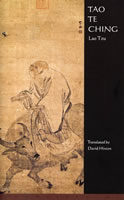
Tao Te Ching: An Illustrated Journey
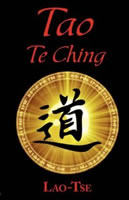
Tao Te Ching
The Book of Tao: Tao Te Ching - The Tao and Its Characteristics
Ripening Peaches: Taoist Studies and Practices
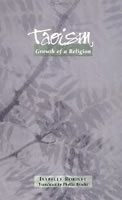
Taoism: Growth of a Religion
Zhuangzi (Chuang Tsu), Daoist Scripture: Bibliography, Links, Resources, Quotations, Notes
Zhuangzi: Basic Writings
Zhuangzi Speaks: The Music of Nature
Lifestyle Advice from Wise Persons
"That which is incomplete becomes complete.
The crooked becomes straight,
The empty becomes full,
The worn-out becomes new.
He who obtains has little,
He who scatters has much.
That is why the self-controlled man holds to Unity and brings it into manifestation for men.
He looks not at self, therefore he sees clearly;
He asserts not himself, therefore he shines;
He boasts not of self, therefore he has merit;
He glorifies not himself, therefore he endures.
The Master indeed does not strive, yet no one in the world can strive against him.
The words of the Ancients were not empty words:
"That which is incomplete becomes complete."
Acquire completeness by returning it."
- Translated by
Isabella Mears, 1916, Chapter 22
"Bowed down, you are preserved.
Sometimes bent, you are made straight.
When you are empty, you are made full.
When you are worn, you can be newly made.
When you have little, contentment is simple.
When you have too much, you are perplexed.
Therefore the wise embrace the One
and become an example to all.
They do not display themselves and are
therefore visible.
They do not justify themselves and are
therefore great.
They do not make claims and are
therefore given merit.
They do not seek glory and can
therefore endure.
Because they do not contend,
nothing contends with them.
Is not the ancient saying true?
When you bow down, you are preserved.
Turning back, you are preserved to the end."
- Translated by
Kari Hohne, 2009, Chapter 22
"Yield, and maintain integrity.
To bend is to be upright;
to be empty is to be full.
Those who have little have much to gain,
but those who have much
may be confused by possessions.
The wise man embraces the all encompassing;
he is unaware of himself, and so has brilliance;
not defending himself, he gains distinction;
not seeking fame, he receives recognition;
not making false claims, he does not falter;
and not being quarrelsome,
is in conflict with no one.
This is why it was said by the sages of old,
"Yield, and maintain integrity;
be whole, and all things come to you"."
-  Translated by Stan Rosenthal, 1984, Chapter 22
"Ce qui est incomplet devient entier.
Ce qui est courbé devient droit.
Ce qui est creux devient plein.
Ce qui est usé devient neuf.
Avec peu de désirs on acquiert le Tao; avec beaucoup de désirs on s'égare.
De là vient que le saint homme conserve l'Unité le Tao, et il est le modèle du monde.
Il ne se met pas en lumière, c'est pourquoi il brille.
Il ne s'approuve point, c'est pourquoi il jette de l'éclat.
Il ne se vante point, c'est pourquoi il a du mérite.
Il ne se glorifie point, c'est pourquoi il est le supérieur des autres.
Il ne lutte point, c'est pourquoi il n'y a personne dans l'empire qui puisse lutter contre lui.
L'axiome des anciens : Ce qui est incomplet devient entier, était-ce une expression vide de sens?
Quand l'homme est devenu véritablement parfait, le monde vient se soumettre à lui."
-  Translated by Stanislas Julien, 1842, Chapter 22
Spanish
Language Versions of the Tao Te Ching (Daodejing)
Tao Te Ching en Español
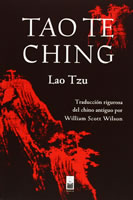
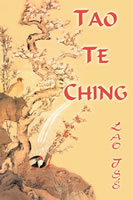
Lao Tsé Tao Te Ching 
Tao Te Ching Traducido por Stephen Mitchell, versión española
Tao Te Ching Traducido al español por el Padre Carmelo Elorduy
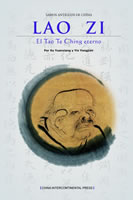
Lao Tzu-The Eternal Tao Te Ching
Ripening Peaches: Taoist Studies and Practices By Mike Garofalo Maduración Duraznos: Estudios y Prácticas Taoístas por Mike Garofalo
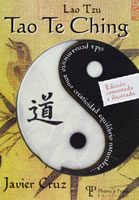
Tao Te Ching
Lao Tzu - Tao Te Ching
Tao te king
Daodejing Español, Inglés, y Chino Versiones Lingüísticas de la Daodejing
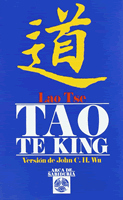
Spanish Language Translations of the Tao Te Ching
"Acepta y serás completo,
Inclinate y serás recto,
Vacíate y quedarás lleno,
Decae, y te renovarás,
Desea, y conseguirás,
Buscando la satisfacción quedas confuso.

El Sabio acepta el Mundo
Como el Mundo acepta el Tao;
No se muestra a si mismo, y así es visto claramente,
No se justifica a si mismo, y por eso destaca,
No se empeña, y así realiza su obra,
No se glorifica, y por eso es excelso,
No busca la lucha, y por eso nadie lucha contra él.

Los Santos decían, "acepta y serás completo",
Una vez completo, el Mundo es tu hogar."
-  Translated by Antonio Rivas, 1998, Capítulo 22
"El Sabio Es La Regla Del Mundo
Lo encorvado se endereza, lo torcido se rectifica,
lo hueco se llena,lo v~ejo se renueva,
lo poco se logra, mientras que lo numeroso se embrolla.
Por eso el sabio, que se abraza a la unidad, es la regla del mundo.
Luce, porque no aparece, brilla, porque no se estima.
Hace su obra, porqueno se empeña.
Crece, porque no se cuida.
Nadie le disputa nada, porqueél con nadie disputa.
¿Es, acaso, falsa la sentencia de los antiguos: «loencorvado se endereza»?
Resulta del todo verdadera."
- Translated by Carmelo Elorduy,
2006, Capítulo # 22
"Quien se desdobla quedará entero.
Quien se inclina
será enderezado.
Quien está vacío será llenado.
Quien anda andrajoso será
adornado.
Poseer poco es adquirir.
Poseer mucho es e! error.
Por eso el sabio
está consigo mismo, y se vuelve arquetipo de! mundo.
No se luce y por eso
resplandece.
No se justifica y por eso brilla.
No se alaba y por eso es
alabado.
No se exalta y por eso es exaltado.
Como no discute con nadie, en e! mundo no hay quién dispute con él.
Lo que dijeron los antiguos, de que "el
medio será entero."
¿acaso son palabras vanas?
Por eso mantiene su integridad."
- Translation from
Logia Medio Dia, 2015,
Capítulo 22
"Inclínate, y estarás completo; cúrvate, y serásenderezado.
Mantente vacío, y serás llenado.
Envejece, y serás renovado.
Si tienes poco, ganarás.
Si tienes mucho, estarás confuso.
Por ello, el Sabio abraza la Unidad, y se convierte en Modelo de todocuanto
se halla bajo el Cielo.
No se vanagloria, y por eso brilla; no se justifica, y por eso es
conocido;
no proclama sus capacidades, y por ello merece confianza; no exhibe
suslogros, y por eso permanece.
No rivaliza con nadie, y por ello nadie compite con él.
Ciertamente, no son palabras vanas el antiguo dicho: "Inclínate,y estarás
completo."
Más aún: si has alcanzado realmente la plenitud, todaslas cosas acudirán en
tropel a ti."
- Translated into Spanish by
Alfonso Colodrón from
the English translation by John C. H. Wu,
1993, Tao Te Ching, Capítulo # 22
"Lo humillado será engrandecido.
Lo inclinado será enderezado.
Lo vacío será lleno.
Lo envejecido será renovado.
Al que menos tenga, más se le dará.
Al que más tenga, más le será quitado.
Lo sencillo y puro será alcanzado,
pero lo complicado y extenso causará confusión.
Por esto, el sabio abraza la unidad
y es el modelo del mundo.
Destaca porque no se exhíbe.
Brilla porque no se guarda.
Merece honores, porque no se ensalza.
Posee el mando, porque no se impone.
Nadie le combate porque él a nadie oprime.
“Si eres humilde, te conservarás resplandeciente”
dice un antiguo proverbio.
¿Quién es capaz de considerar vanas estas palabras?
Pues por esto mismo, el sabio preservará su grandeza."
-  Translation from Wikisource, 2013, Capítulo 22
Created by Michael P. Garofalo, Green Way Research, Valley Spirit Center, Gushen Grove Notebooks, Vancouver, Washington © 2011-2021 CCA 4.0
Next Chapter of the Tao Te Ching #23
Previous Chapter of the Tao Te Ching #21
Chapter and Thematic Index to the Tao Te Ching
Tao Te Ching
Commentary, Interpretations, Research Tools, Resources
Chapter 22
Das Tao Te King von Lao Tse. Complete versions of all 81 Chapters of the Tao Te Ching by many different translators in many languages: 124 English, 24 German, 14 Russian, 7 Spanish, 5 French and many other languages. Links are organized first by languages, and then alphabetically by translators. Formatting varies somewhat. The original website at Onekellotus went offline in 2012; but, the extensive collection of these Tao Te Ching versions was saved for posterity by the Internet Archive Wayback Machine and available as of 9/9/2015. This is an outstanding original collection of versions of the Daodejing─ the Best on the Internet. Caution: copyright infringement may sometimes be an issue at this website.
Tao Te Ching, Translations into English: Terebess Asia Online (TAO). 124
nicely formatted complete English language translations, on separate webpages, of the Daodejing.
Alphabetical index by translators. Each webpage has all 81 chapters of the Tao Te
Ching translated into English. A useful collection! Many
reformatted and colored versions from the original collection at
Das Tao Te King von Lao Tse. Caution: copyright infringement may
sometimes be an
issue at this website.
Lao Tzu: Te-Tao Ching - A New Translation Based on the Recently Discovered Ma-wang-tui
Texts (Classics of Ancient China)
Daodejing by Laozi: Chapters with Chinese characters, seal script,
detailed word by word concordance, Pinyin (tone#), German, French and English.
This is an outstanding resource for serious students of the Tao Te Ching.
Tao Te
Ching: A New Translation and Commentary. By Ellen Chen. Paragon
House, 1998. Detailed glossary, index, bibliography, notes, 274 pages.
The Tao
and Method: A Reasoned Approach to the Tao Te Ching. By Michael
Lafargue. New York, SUNY Press, 1994. 640 pages. Detailed
index, bibliography, notes, and tables. An essential research tool.
Two Visions of the Way: A Study of the Wang Pi and the Ho-Shang Kung Commentaries on the Lao-Tzu.
By Professor by Alan Kam-Leung Chan. SUNY Series in Chinese
Philosophy and Culture. State University of New York Press, 1991.
Index, bibliography, glossary, notes, 314 pages.
ISBN: 0791404560.
Tao Te Ching: The Definitive Edition
Chinese Reading of the Daodejing
Wang Bi's Commentary on the Laozi with Critical Text and Translation.
By Professor Rudolf G. Wagner. A SUNY Series in Chinese Philosophy and
Culture. English and Mandarin Chinese Edition.
State University of New York Press; Bilingual edition (October 2003). 540
pages. ISBN: 978-0791451823.
Wang Bi (Wang Pi, Fusi), 226-249 CE,
Commentary on the Tao Te
Ching.
Tao Te Ching
The Taoism Reader
Change Your Thoughts - Change Your Life: Living the Wisdom of the Tao
The Tao of Being: A Think and Do Workbook
The Lunar Tao: Meditations in Harmony with the Seasons
The Classic of the Way and Virtue: A New Translation of the Tao-te Ching of Laozi as Interpreted by Wang Bi.
Translated by Richard John Lynn. Translations from the Asian Classics
Series. New York, Columbia University Press, 1999. Extensive index,
glossaries, notes, 244 pages.
Tao Te Ching in Chinese characters,
Pinyin Romanization, English and German by Dr. Hilmar
Alquiros.
Stoicism and Hellenistic
Philosophy
How to Live a Good Life:
Advice from Wise Persons
One Old Philosopher's
Notebooks Research, Reading, and Reflections by Mike Garofalo.
Yellow Bridge
Dao De Jing Comparison Table Provides side by side comparisons of
translations of the Tao Te Ching by James Legge, D. T. Suzuki, and Dwight
Goddard. Chinese characters for each paragraph in the Chapter are on the
left; place your cursor over the Chinese characters to see the Pinyin
Romanization of the Chinese character and a list of meanings.
Translators Index,
Tao Te Ching Versions in English, Translators Sorted Alphabetically by Translator, Links to Books and
Online Versions of the Chapters
Taoism and the Tao Te
Ching: Bibliography, Resources, Links
Spanish Language
Translations of the Tao Te Ching, Daodejing en Español, Translators Index
The Tao of Zen
Chapter 41 in the
Rambling
Taoist Commentaries by Trey Smith. The
Rambling Taoists are Trey Smith and Scott Bradley.
By Hans-Georg Moeller. Columbia University Press, 2006, 176 pages.
Valley Spirit, Gu Shen,
Concept, Chapter 6
Valley Spirit Center in Red
Bluff, California.
Sacred
Circle in the Gushen Grove.
Lao-tzu's Taoteching
Reading Lao Tzu: A Companion to the Tao Te Ching with a New Translation
Dao De Jing: A Philosophical Translation
Thematic Index to the
81 Chapters of the Tao Te Ching
Lieh-Tzu: A Taoist Guide to Practical Living
Revealing the Tao Te Ching: In-depth Commentaries on an Ancient Classic
Cloud Hands Blog
Mike Garofalo writes about Mind-Body Arts, Philosophy, Taoism, Gardening, Taijiquan, Walking, Mysticism,
Qigong, and the Eight Ways.
The Whole Heart of Tao:
The Complete Teachings From the Oral Tradition of Lao Tzu.
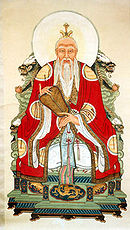
Gushen Grove Notebooks for the Tao Te Ching
Green Way Research, Valley Spirit
Center, Gushen Grove Notebooks, Vancouver, Washington
Green Way Research, 2017-2021.
Green Way Research, Valley Spirit
Center, Gushen Grove Notebooks, Red Bluff, California
Green Way Research, 1998-2016.
Indexed and Compiled by
Michael P. Garofalo
This webpage was last edited, improved, modified or updated on
October 1, 2020.
This webpage was first distributed online on March 11, 2010.
Created by Michael P. Garofalo, Green Way Research, Valley Spirit Center, Gushen Grove Notebooks, Vancouver, Washington © 2011-2021 CCA 4.0
Brief Biography of Michael P. Garofalo, M.S.

Ripening Peaches: Daoist Studies and Practices
Zhuangzi (Chuang Tzu, Zhuang Zhou, Master Chuang) 369—286 BCE
Taoist Perspectives: My Reading List
Bodymind Theory and Practices, Somaesthetics
Pragmatism and American Philosophy
How to Live a Good Life: Advice from Wise Persons
Pleasures, Satisfaction, Desires
Qigong (Chi Kung) Health Practices
One Old Daoist Druid's Final Journey: Notebooks of the Librarian of Gushen Grove
Index to Cloud Hands and Valley Spirit Websites
Index to English Language Translators of the Tao Te Ching
Recurring Themes (Terms, Concepts, Leimotifs) in the Tao Te Ching
Spanish Language Translations of the Tao Te Ching
The Tao Te Ching (Dao De Jing) by Lao Tzu (Laozi) circa 500 BCE
|
Tao Te
Ching |
|||||||||
| 1 | 2 | 3 | 4 | 5 | 6 | 7 | 8 | 9 | 10 |
| 11 | 12 | 13 | 14 | 15 | 16 | 17 | 18 | 19 | 20 |
| 21 | 22 | 23 | 24 | 25 | 26 | 27 | 28 | 29 | 30 |
| 31 | 32 | 33 | 34 | 35 | 36 | 37 | 38 | 39 | 40 |
| 41 | 42 | 43 | 44 | 45 | 46 | 47 | 48 | 49 | 50 |
| 51 | 52 | 53 | 54 | 55 | 56 | 57 | 58 | 59 | 60 |
| 61 | 62 | 63 | 64 | 65 | 66 | 67 | 68 | 69 | 70 |
| 71 | 72 | 73 | 74 | 75 | 76 | 77 | 78 | 79 | 80 |
| 81 | |||||||||
Return to the Top of this Webpage