Chuang Tzu (Zhuangzi)Daoist
Studies and Practices
|
|
Chuang Tzu (Zhuangzi)Daoist
Studies and Practices
|
|
Zhuangzi, Chuang Tzu, Zhuang Zhou, Master Chuang
Bibliography, Links, Resources
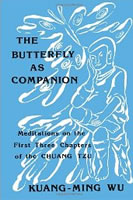
The Butterfly as Companion: Meditations on the First Three Chapters of the Chuang Tzu.
 Translation and commentary by Professor Kuang-Ming Wu. English and
Mandarin Chinese Edition. SUNY Series in Religion and Philosophy.
New York, State University at New York, 1990. 512 pages. ISBN:
978-0887066863.
Translation and commentary by Professor Kuang-Ming Wu. English and
Mandarin Chinese Edition. SUNY Series in Religion and Philosophy.
New York, State University at New York, 1990. 512 pages. ISBN:
978-0887066863.
Chuang Tsu: Inner Chapters
Chuang Tsu (Zhuang Zi) Translated by Burton Watson.
Chuang Tzu.
Translated by James Legge, 1891. Chapters 1-14. Chinese Text
Project: English translation and Chinese characters.
Chuang Tzu.
Translated by James Legge, 1891. Chapters 1-33. Brief notes.
Prepared by Tormod Kinnes, 2001.
Chuang Tzu.
Translated by James Legge, 1891. Chapters 1-33. Complied by Stephen
McIntyre.
Chuang Tzu. Translated by James
Legge, 1891. Chapter 1-33. Extensive footnotes for each Chapter.
Prepared by RatMachines - Philosophy.
Chuang
Tzu. Translated by James Legge, 1891.
Chapter 1-33. Sacred Text Archive. This version includes an
introduction for each Chapter and detailed footnotes.
Chuang Tzu.
Translated by James Legge, 1891. Chapter 6. Includes selected
translations of specific passages in Chapter 6 from other translators besides
James Legge. Prepared by Mike Garofalo, 2013.
Chuang Tsu (Zhuang Zi) Translated by Lin Yutang.
Chuang Tzu.
Translated by Tao Study Group and Derek Lin.
The Chuang-tzu or Zhuang-zi, The World Wide Web Virtual Library
Chuang Tsu: Inner Chapters
Zhuangzi: The Essential Writings with Selections from Traditional Commentaries
Wandering on the Way: Early Taoist Tales and Parables of Chuang Tzu
Further Teachings of Lao-Tzu: Understanding the Mysteries (Wen
Tzu).
Ripening Peaches: Taoist Studies and Practices. By Mike Garofalo
The Lunar Tao: Meditations in Harmony with the Seasons
 By Lui I-Ming (1780) and translated by Thomas Cleary
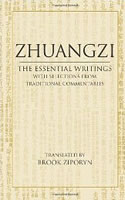
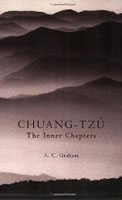
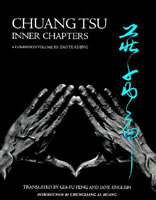
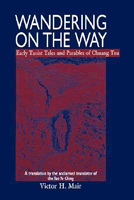
Chuang Tzu, Zhuangzi, Zhuang Zhou, Master Chuang, Master Zhuang,
Chuang Chou, Chuang Tse, Chuang Tsu, Tchuang Tzu, etc.. Pronounced jwawng dz
or Jwahng dzuh per Victor Mair. Master Chuang lived from 369-286 BCE,
and died at the age of 83 years of age.
Chuang-Tzu or
Zhuang-Zi: Information Page
Chuang Tsu (Zhuangzi):
Bibliography, Links, Resources, Quotations, Notes.
Chuang Tzu: Basic Writings.
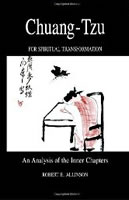
Chuang-Tzu for Spiritual Transformation: An Analysis of the Inner Chapters
Chuang Tzu: The Inner Chapters
Chuang-Tzu: The Inner Chapters
Translated with commentary by Angus C. Graham (1919-1991). Indianapolis, Hackett
Pub. Co., 1981, 2001 edition. Index, extensive footnotes, 293 pages.
ISBN: 0872205819. VSCL.
Chuang Tzu, The Inner Chapters: The Classic Taoist Text
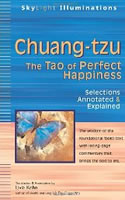
Chuang-tzu: The Tao of Perfect Happiness.
By Livia Kohn. Selections annotated and explained. Woodstock,
Vermont, Skylight Paths
Pub., 2011. Reading lists, 210 pages. ISBN: 978-1594732966. VSCL.
Dao De Jing (Tao Te Ching) by Lao Tzu (Laozi): Selected translations by Chapters, Index of Translators, Themes
Daoism, Daoists: Bibliography, Links,
Quotations, Notes
Hiding the World in the World: Uneven Discourses on the Zhuangzi.
Edited by Scott Cook. S.U.N.Y. Series in Chinese Philosophy and
Culture. New York, State University of New York Press, 2003. 328
pages. ISBN: 978-0791458662.
Hunger Mountain: A Field Guide to Mind and Landscape
The Inner Chapters of Chuang Tzu (Zhuangzi)
Translated by A. C. Graham. Hackett Publishing Co., 2001. 304 pages.
ISBN: 978-0872205819. VSCL.
Lao Tzu's Tao Te Ching (Dao De
Jing) by Lao Tzu (Laozi): Selected translations by Chapters, Index of
Translators, Themes. Prepared by Mike Garofalo.
Liberation As Affirmation: The Religiosity of Zhuangzi and Nietzsche
Ripening
Peaches: Taoist Studies and Practices
Chuang-Tzu for Spiritual Transformation: An Analysis of the Inner Chapters
Chuang-tzu: The Tao of Perfect Happiness. By Livia Kohn
The Butterfly as Companion: Meditations on the First Three Chapters of the Chuang Tzu.
Taoism: Growth of a Religion
 By Isabelle Robinet. Translated by Phyllis Brooks. Stanford
University Press, 1997. 320 pages. ISBN: 978-0804728393. VSCL.
By Isabelle Robinet. Translated by Phyllis Brooks. Stanford
University Press, 1997. 320 pages. ISBN: 978-0804728393. VSCL.
Taoism, Taoists: Bibliography, Links,
Quotations, Notes
Tao Te Ching (Dao De Jing) by Lao Tzu (Laozi):
Selected translations by Chapters, Index of Translators, Themes
VSCL = Valley Spirit Center Library, Red Bluff, California
Wandering at Ease in the Zhuangzi.
Edited by Roger T. Ames. S.U.N.Y. Series in Chinese Philosophy and
Culture. New York, State University of New York Press, 1998. 250
pages. ISBN: 978-0791439227.
Wandering on the Way: Early Taoist Tales and Parables of Chuang Tzu
The Way of Chuang Tzu (Second Edition)
Zhuangzi: Basic Writings
Zhuangzi Speaks: The Music of Nature
Zhuangzi: The Essential Writings with Selections from Traditional Commentaries.
Translated with an introduction and notes by Brook Ziporyn. Indianapolis, Hackett Pub. Co., 2009.
Notes, index, bibliography, 238 pages.
ISBN: 9780872209114. VSCL.
Zhuangzi, The Internet Encyclopedia of Philosophy. A commentary on the
first 6 Chapters.
Zhuangzi. Translated
with and introduction by Hyun Hochsmann and Yang Guorong. New York,
Pearson Longman,
2007. Index, bibliography, glossary, notes, 342 pages. Longman
Library of Primary Sources in Philosophy. ISBN:
0321273567. VSCL.
|
Tao Te
Ching |
|||||||||
| 1 | 2 | 3 | 4 | 5 | 6 | 7 | 8 | 9 | 10 |
| 11 | 12 | 13 | 14 | 15 | 16 | 17 | 18 | 19 | 20 |
| 21 | 22 | 23 | 24 | 25 | 26 | 27 | 28 | 29 | 30 |
| 31 | 32 | 33 | 34 | 35 | 36 | 37 | 38 | 39 | 40 |
| 41 | 42 | 43 | 44 | 45 | 46 | 47 | 48 | 49 | 50 |
| 51 | 52 | 53 | 54 | 55 | 56 | 57 | 58 | 59 | 60 |
| 61 | 62 | 63 | 64 | 65 | 66 | 67 | 68 | 69 | 70 |
| 71 | 72 | 73 | 74 | 75 | 76 | 77 | 78 | 79 | 80 |
| 81 | |||||||||
Chuang Tsu, Zhuang Zi, Master Chuang
Quotations from Zhuangzi
Source of Quotations: [Z 2] = Zhuangzi, Chapter 2
Zhuangzi (Chuang Tzu)
Inner Chapters
Chapter 1
Chapter 2
Chapter 3
Chapter 4
Chapter 5
The Great Source as Teacher, The Great Ancestral Teacher, The Great and Honored Teacher
Chapter 6, Zhuangzi (Chuang Tzu), Inner Chapters
"Assured! his stability, but not rigid:
Pervasive! his tenuous influence, but it is not on display.
Lighthearted! Seems to be doing as he pleases:
Under compulsion! Inevitable that he does it.
Impetuously! asserts a manner of his own:
Cautiously! holds the Power which is his own.
So tolerant! in his seeming worldliness:
So arrogant! in his refusal to be ruled.
Canny! Seems he likes to keep his mouth shut:
Scatterbrained! Forgets every word that he says."
Chuang-Tzu, Chapter 6.4
Translation by Angus Graham,
Chuang-Tzu: The Inner Chapters, 1981, 2000, p. 85
'The Genuine Human Beings of old seemed to do whatever
was called for but were not partisan to any one course. They appeared to
be in want but accepted no assistance. Taking part in all things, they
were solitary but never rigid. Spreading out everywhere, they were empty
but never insubstantial. Cheerful, they seemed to be enjoying themselves.
Impelled along, they did what they could not help doing. The let
everything gather within them but still it manifested outwardly to the world as
their own countenance. They gave it all away, but still it rested securely
with them as their own Virtuosity. Leprous with symptoms, they seem just
like everyone else. Haughty, nothing could control them. Oblivious,
they would forget what they were saying."
Zhuangzi, Chapter 6.4
Translation by Brook Ziporyn,
Zhuangzi: The Essential Writings, 2009, p. 41
"The true man in ancient times was upright but
impartial, humble but not servile. He had distinct natural characteristics
but was not adamant about them; his humility was evident but not displayed.
Pleasant and composed, he seemed to be content. His actions appeared to
spring from necessity. People were drawn to his virtue; he seemed to
comply with the age but with a certain reserve. His independence of spirit
was limitless. Endeavoring to remain silent, he forgot what he wished to
say."
Zhuangzi, Chapter 6.4
Translated by Hyun Hochsmann and Yang Guorong,
Zhuangzi,
2007, p.117
"The true man of old
Was towering in stature but never collapses,
Seem insufficient but accepted nothing.
Aloofly independent but not obstinate,
Amply empty but not ostentatious,
Demurring, as though he were compelled,
Suffused with an alluring charm,
Endowed with an arresting integrity,
Stern, as though he were worldly,
Arrogant, as though he were uncontrollable,
Reticent, as though he preferred to clam up,
Absent-minded, as thought he forgot what to say."
Chuang Tzu, Chapter 6.4
Translated by Victor H. Mair,
Wandering on the Way: Early Taoist Tales and Parables of Chuang Tzu

"Yan Hui saw Confucius again and said, "I have made progress."
"What do you mean?" asked Confucius.
"I sit and forget everything."
Confucius was alarmed and asked, "What do you mean by sitting down and
forgetting everything?"
Yan Hui replied, "I leave behind my body, perception and knowledge.
Detached from both material form and mind.
I become one with that which penetrates all things. This I call sitting
and forgetting everything."
Confucius said, "If you are one with that which penetrates all things you will
be free from partiality. If you are
transformed thus you have become evanescent. You are truly a worthy man.
I ask to follow your steps."
- Zhuangzi, Book 6
Translated by Hyun Hochsmann and Yang Guorong,
Zhuangzi,
2007,
p. 123.
Zuowang: Sitting and
Forgetting, Taoist Meditation
***********************
"Great wisdom is generous; petty wisdom is contentious."
"Rewards and punishments are the lowest form of education."
"The quintessence of the utmost Way is Dark, dark, secret, secret: the apex of the utmost Way is mystery, mystery, silence, silence. Look at nothing, listen to nothing."
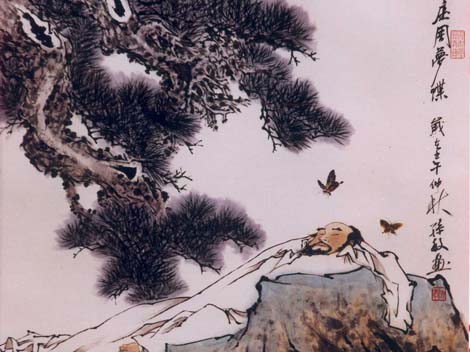
"Once Zhuangzi dreamt he was a butterfly, a butterfly flitting
and fluttering around, happy with himself and doing as he pleased. He didn't
know he was Zhuangzi. Suddenly he woke up and there he was, solid and
unmistakable Zhuangzi. But he didn't know if he was Zhuangzi who had dreamt he
was a butterfly, or a butterfly dreaming he was Zhuangzi. Between Zhuangzi and a
butterfly there must be some distinction! This is called the
Transformation of Things."
- Zhuangzi, Chapter 2, Translated by Burton Watson
"We cling to our own point of view, as though everything depended on it. Yet our opinions have no permanence; like autumn and winter, they gradually pass away."
"If water derives lucidity from stillness, how much more the faculties of the mind! The mind of the sage, being in repose, becomes the mirror of the universe, the speculum of all creation."
"Once upon a time, I, Chuang Tzu, dreamt I was
a butterfly, fluttering hither and thither, to
all intents and purposes a butterfly. I was conscious only of following my
fancies as a
butterfly, and was unconscious of my individuality as a man. Suddenly, I
awaked, and
there I lay, myself again. Now I do not know whether I was then a man
dreaming I was a
butterfly, or whether I am now a butterfly, dreaming I am a man. Between a
man and a
butterfly there is necessarily a barrier. The transition is called
Metempsychosis."
- Zhuangzi, Chapter 2, Translated by Herbert A. Giles
"All existing things are really one. We regard those that are beautiful and rare as valuable, and those that are ugly as foul and rotten The foul and rotten may come to be transformed into what is rare and valuable, and the rare and valuable into what is foul and rotten."
"Flow with whatever is happening and let your mind be free. Stay centered by accepting whatever you are doing. This is the ultimate."
"The wise man looks into space and does not regard the small as too little, nor the great as too big, for he knows that, there is no limit to dimensions."
"A frog in a well cannot conceive of the ocean."
"Those who realize their folly are not true fools."
"Life comes from the earth and life returns to the earth."
"In the primeval mass there is no shape, spreading and
scattering, leaving no trail behind, in the darkness of its depths there is no
sound. It moves without direction, resides in Mystery."
"Forget the years, forget distinctions. Leap into the boundless and make it your home!"
"I know the joy of fishes in the river through my own joy, as I go walking along the same river."
"There is order in chaos, and certainty in doubt. The wise are guided by this order and certainty."
"When Zhuangzi was about to die, his
disciples wanted to bury him in a well-appointed tomb. Zhuangzi said, ''I have
the sky and the earth for inner and outer coffins the sun and the moon for jade
disks the stars for pearls and the ten thousand things for farewell gifts. Isn't
the paraphernalia for my burial adequate without adding anything?" ''We
are afraid the crows and kites will eat you master," a disciple said.
"Above ground, I will be eaten by crows and kites; below
ground by ants. You are robbing from the one to give to the other. Why play
favorites'''
"I know the joy of fishes in the river through my own joy, as I go walking along the same river."
"Those who seek to satisfy the mind of man by hampering it with ceremonies and music and affecting charity and devotion have lost their original nature."
"Happiness is the absence of the striving for happiness."
"A way is made by walking it. A thing is so by calling it."
"In ultimate sameness you have no self; and without self from where would you get to have anything."
"Easy is right. Begin right and you are easy. Continue easy and you are right. The right way to go easy is to forget the right way and forget that the going is easy."
The Way of Chuang Tzu (Second Edition).
Translated by Thomas Merton
Chuang Tzu: The Inner Chapters
Ripening Peaches: Taoist Studies and Practices. By Mike Garofalo
The Book of Chuang Tzu. Translated by Martin Palmer and Elizabeth Breuilly
Wandering on the Way: Early Taoist Tales and Parables of Chuang Tzu
"Those who value what is on the outside are clumsy on the inside."
"Root of Heaven roamed on the south side of
Mount Vast. When he came to the bank of Clear Stream he met Nameless Man and
asked him. "Please tell me how to manage the world."
"Go away you dunce." Nameless Man said. "Such questions are
no fun I was Just about to join the Creator of Things. If I get bored with that,
I'll climb on the bird Merges with the Sky and soar beyond the six directions.
I'll visit Nothing Whatever town and stay in Boundless country. Why do you bring
up managing the world to disturb my thoughts?"
Still Root of Heaven repeated his question and Nameless Man
responded "Let your rnind wander among the insipid, blend your energies with the
featureless, spontaneously accord with things, and you will have no room for
selfishness. Then the world will be in order.""
"Men honor what lies within the sphere of their knowledge, but do not realize how dependent they are on what lies beyond it."
"To stop leaving tracks is easy. Not to walk upon the ground is hard."
"You can’t talk to hole-in-the-corner scholars about the Way, because they are constricted by their doctrines."
"As for goods and possession, the great man does not compete for them."
"How do I know that enjoying life is not a delusion? How do I know that in hating death we are not like people who got lost in early childhood and do not know the way home? Lady Li was the child of a border guard in Ai. When first captured by the state of Jin, she wept so much her clothes were soaked. But after she entered the palace, shared the king's bed, and dined on the finest meats, she regretted her tears. How do I know that the dead do not regret their previous longing for life? One who dreams of drinking wine may in the morning weep; one who dreams weeping may in the morning go out to hunt. During our dreams we do not know we are dreaming. We may even dream of interpreting a dream. Only on waking do we know it was a dream. Only after the great awakening will we realize that this is the great dream. And yet fools think they are awake, presuming to know that they are rulers or herdsmen. How dense! You and Confucius are both dreaming, and I who say you are a dream am also a dream. Such is my tale. It will probably be called preposterous, but after ten thousand generations there may be a great sage who will be able to explain it, a trivial interval equivalent to the passage from morning to night."
"You will always find an answer in the sound of water."
"Where there is no opposition between this view and that view, there is the pivot of the dao. As soon as this pivot is found, we stand in the centre where we can respond without an end to changing views. So I say that there is nothing which can surpass the light of the mind." [Z 2]
Information about Zhuangzi and Taoism
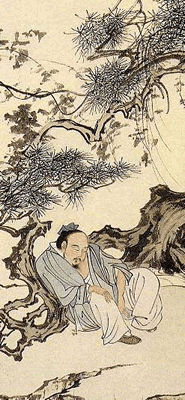
"Not much is known of the life of Chuang Tzu. The Shih
Chi (Historical Records, written about 100 B.C.) tells us that he was a
contemporary of King Hui of Liang (370-319) and King Hsüan of Ch'i
(319-301). Thus Chuang Tzu seems to have been a contemporary of
Mencius (372-289), but neither was mentioned by the other in his extant
writings. The Shih Chi also says that Chuang Tzu was born in Meng on
the border of Shantung and
Honan and that he held a petty official post for a time in Ch'iyüan.
However, he seems to have lived most of his life as a recluse, "to be
intoxicated in the wonder and the power of Nature. Legend has it that
Chuang Tzu declined the honor of being prime minister to King Wei of Ch'u
(339-329), saying that he much preferred to be a live tortoise wagging its
tail in the mud than a dead one venerated in a golden casket in a king's
ancestral shrine. (The story is
apocryphal, but it is highly illustrative of the mentality of the Taoist
mystic, who cared more for personal freedom than for high office.
Chuang Tzu's greatness lay in his bringing early Taoism to its full
completion. While he was true to the Taoist doctrine of wu-wei
(refraining from action contrary to Nature), he extended the Taoist system
and carried out
metaphysical speculations never heard of by the early Taoists. The
philosophy of Chuang Tzu, as characterized by its emphasis on the unity and
spontaneity of the Tao, its assertion of personal freedom, and its doctrine
of relativity of things, is essentially a plea for the "return to Nature"
and free development of man's inherent nature. It is in fact a kind of
romantic philosophy that favors anarchistic individualism and condemns
Confucian virtues and institutions - a philosophy, in short, that idealizes
the state of natural simplicity marked by no will, no consciousness, no
knowledge."
-
Zhuangzi: A Brief Biography
"The currently extant text known as the Zhuangzi is
the result of the editing and arrangement of the Jin dynasty thinker and
commentator Guo Xiang (Kuo Hsiang, d. 312 CE). He reduced what was then a work
in fifty-two chapters to the current edition of thirty-three chapters, excising
material that he considered to be spurious. His commentary on the text provides
an interpretation that has been highly influential over the subsequent
centuries. Guo Xiang divided the thirty-three chapters into three
collections, known as the Inner Chapters (Neipian), the Outer Chapters
(Waipian), and the Miscellaneous Chapters (Zapian). The Inner
Chapters are the first seven chapters and are considered to be the work of
Zhuangzi himself. The Outer Chapters are chapters 8 to 22, and the Miscellaneous
Chapters are chapters 23 to 33. The Outer and Miscellaneous Chapters can be
further subdivided."
-
Zhuangzi, The Internet Encyclopedia of Philosophy
Chuang Tsu: Inner Chapters
Zhuangzi: The Essential Writings with Selections from Traditional Commentaries
Wandering on the Way: Early Taoist Tales and Parables of Chuang Tzu
Further Teachings of Lao-Tzu: Understanding the Mysteries (Wen
Tzu)
Ripening Peaches: Taoist Studies and Practices By Mike Garofalo
The Lunar Tao: Meditations in Harmony with the Seasons
By Lui I-Ming (1780) and translated by Thomas Cleary
Gushen Grove Notebooks for the Tao Te Ching
Green Way Research, Valley Spirit Grove, Gushen Grove Notebooks, Red Bluff, California
This webpage was last modified or updated on
February 28, 2015.
This webpage was first distributed online on April 15, 2007.
Brief Biography of Michael P. Garofalo, M.S.
Valley Spirit Grove, Red Bluff, California

Ripening Peaches: Daoist Studies and Practices
Zhuangzi (Chuang Tzu, Zhuang Zhou, Master Chuang) 369—286 BCE
Somaesthetics, Body-Mind Somatic Practices
One Old Druid's Final Journey: Notebooks of the Librarian of Gushen Grove
The Tao Te Ching (Dao De Jing) by Lao Tzu (Laozi) circa 500 BCE
