Classic of the Way and Virtue
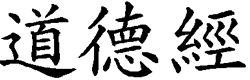
By Lao Tzu (Laozi)
Green Way Research, Valley Spirit Center, Gushen Grove Notebooks, Vancouver, Washington
Chapter 27 Chapter 29 Index to All the Chapters Daoism Concordance Cloud Hands Blog Commentary
Classic Book (Ching) about the Tao (Way, Nature, Patterns, Processes) and Te (Virtue, Potency, Power, Integrity, Wise Person, Sage)
Concordance: Indexing, Search Terms, Topics, Themes, Keys, Subjects, Words
English and Chinese (Wade-Giles) Terms: Simplicity or Purity
or Natural State (p'u), Keep to the Female, Infant or Baby (erh or
ying), Embrace Opposites, Be a Model,
Returning to Simplicity, Tao, Honorable, Leave or Depart (li), Enough or
Satisfied (tsu), None or No or Without (wu), Retaining Integrity, Harmony,
Restore or Revert (fu), Injure or Harm or Cut (ko), Male or
Masculine (hsiung), Always or Everlasting (ch'ang), Know or
Recognize (chih), Female or Feminine (tz'u), Nature of Opposites and Change,
Heaven (t'ien), Wood, Everlasting or Ancient (ch'ang), Carving, Sculpture,
Act or Make (wei), Return (kuei), White or Pure (pai),
Black or Defiled (hei), Keep or Hold (shou), Simplicity, Honor or
Glory (kung), Ruling or Regulated (chih), Faulty or Fail (t'ê),
Official or Magistrate (kuan), Opposite, Form or Rule or Example (shih), Complimentary, Yin, Yang,
Limits or Extreme or Ultimate (chi), Valley or River or Receptive (ch'i),
Holy Man (shêng jen), Scatter or Disperse (san), Possibilities, Open, Model,
Great or Ruler (ta), Humility or Lowly Obscurity (ju), Power or
Virtue (tê), Utensils or Vessels (ch'i), 反樸
Términos en Español:
Simplicidad, Opuestos,
Límites, Modelo, Ejemplo, Antiguo, Simplicidad,
Siempre, Hacer, Honorable, Integridad,
Armonía, Masculino, Femenino, Hembra,
Dispersión, Hombre, Contrarios, Bebé, Infantil, Saber, Conocer, Cielo, Cambio,
Receptivo, Madera, Talla,
Mantener, Escultura,
Cortesía, Blanco,
Puro, Negro, Fallar, Final, Último,
Contaminado, Restaurar, Posibilidades,
Virtud, Potencia, Honor, Abierto, Magistrato, Gran,
Regulado, Sabio, Santos, Valle, Suficiente, Utensilios, Lesionar, Cortada.
Electronic Concordance for all 81 Chapters of the Tao Te Ching
English Language Translations of the Tao Te Ching
"Know the masculine,
but keep to the feminine:
and become a watershed to the world.
If you embrace the world,
the Tao will never leave you
and you become as a little child.
Know the white,
yet keep to the black:
be a model for the world.
If you are a model for the world,
the Tao inside you will strengthen
and you will return whole to your eternal beginning.
Know the honorable,
but do not shun the disgraced:
embracing the world as it is.
If you embrace the world with compassion,
then your virtue will return you to the uncarved block.
The block of wood is carved into utensils
by carving void into the wood.
The Master uses the utensils, yet prefers to keep to the block
because of its limitless possibilities.
Great works do not involve discarding substance."
- Translated by
J. H. McDonald,
1996, Chapter 28
Know the masculine; cleave to the feminine.
Be the valley for the world.
To be the valley for the world,
do not swerve from your innate nature
and return to the state of infancy.
Know the bright; keep to the dull.
Be a guide for the world.
To be a guide for for the world,
follow your innate nature without changing
and return to the pre-conceptual.
Understand glory; keep to humility.
Be the valley for the world.
Innate nature completed, return to original uniqueness.
When original uniqueness is divided,
It then becomes the instrumentalities.
The Sage employs them,
They then become the officers.
Thus, subtle governance shapes not."
- Translated by
Cheng Man-Ch'ing and Tam Gibbs, 1981, Chapter 28
"Who knows his manhood's strength,
Yet still his female feebleness maintains;
As to one channel flow the many drains,
All come to him, yea, all beneath the sky.
Thus he the constant excellence retains;
The simple child again, free from all stains.
Who knows how white attracts,
Yet always keeps himself within black's shade,
The pattern of humility displayed,
Displayed in view of all beneath the sky;
He in the unchanging excellence arrayed,
Endless return to man's first state has made.
Who knows how glory shines,
Yet loves disgrace, nor e'er for it is pale;
Behold his presence in a spacious vale,
To which men come from all beneath the sky.
The unchanging excellence completes its tale;
The simple infant man in him we hail.
The unwrought material, when divided and distributed, forms vessels.
The sage, when employed, becomes the Head of all the Officers of government.
In his greatest regulations he employs no violent measures."
- Translated by
James Legge, 1891,
Chapter 28
"Know your male qualities,
Yet know how to use the female abilities.
Be like a channel for the world's waters;
Open and flowing, like the mind of a child.
Full of virtue, harmony and excellence.
Know the light,
But understand the dark.
Be an example for the world.
Act with honor, and retain humility.
Return to the state of the uncarved wooden block."
- Translated by
Rivenrock, Chapter 28
"Know the male,
yet keep to the female:
receive the world in your arms.
If you receive the world,
the Tao will never leave you
and you will be like a little child. Know the white,
yet keep to the black:
be a pattern for the world.
If you are a pattern for the world,
the Tao will be strong inside you
and there will be nothing you can't do. Know the personal,
yet keep to the impersonal:
accept the world as it is.
If you accept the world,
the Tao will be luminous inside you
and you will return to your primal self. The world is formed from the void,
like utensils from a block of wood.
The Master knows the utensils,
yet keeps to the the block:
thus she can use all things."
- Translated by
Stephen Mitchell, 1988, Chapter 28
"One keeps weakness while knowing what strength is,
And serves as the humblest brook for the world.
Being the humblest, one can receive best
Until one returns to be the weakest infant.
One keeps black while knowing what white is,
And serves as a basic model for the world.
Being the basic model, one can receive properly
Until one returns to the oneness without polar opposition.
One keeps disgrace while knowing what glory is,
And serves as the lowest valley for the world.
Being the lowest, one can receive enough
To return to the most original simplicity.
Followed by people, this simplicity can shape the world
The wise use it as the example for the government.
The big system is, therefore, an indivisible simple whole.
- Translated by
Liu Qixuan,
Chapter 28

Created by Michael P. Garofalo, Green Way Research, Valley Spirit Center, Gushen Grove Notebooks, Vancouver, Washington © 2011-2021 CCA 4.0
 Translation and elucidation by Hua Ching Ni
 Translated by Brian Walker
 Translated by Arthur Waley
 Translated by Lionel and and Herbert Giles
 By Eva Wong
"Who his manhood shows
And his womanhood knows
Becomes the empire's river.
Is he the empire's river,
He will from virtue never deviate,
And home he turneth to a child's estate.
Who his brightness shows
And his blackness knows
Becomes the empire's model.
Is he the empire's model,
Of virtue ne'er shall he be destitute,
And home he turneth to the absolute.
Who knows his fame
And guards his shame
Becomes the empire's valley.
Is he the empire's valley,
For e'er his virtue will sufficient be,
And home he turneth to simplicity."
Simplicity, when scattered, becomes a vessel of usefulness.
The holy man,
by using it, becomes the chief leader;
And truly, a great principle will never
do harm."
- Translated by
Daisetsu Teitaro Suzuki and
Paul Carus, 1913, Chapter 28
"The first assignment for Daisetz "Great Simplicity" T.
Suzuki in 1898 was to help Paul Carus with the Tao Te Ching. Dr.
Carus knew no Chinese, but he wanted this translation to a scholarly one and he
had Suzuki supply a character by character gloss, as best he could, but Suzuki
found himself unable to check Carus's use of Teutonic abstractions. "The
Chinese are masters in reproducing the most subtle changes in their innermost
feelings," Suzuki wrote of his first collaboration with Carus, "thus, in order
to translate passages from Lao Tzu, I had to explain to Dr. Carus the feeling
behind each Chinese term. But being himself a German writing in English,
he translated these Chinese ideas into abstract conceptual terms. If only
I had been more intellectually equipped then," he thought later, "I might have
been better able to help him understand the original meaning."
In order to supply a corresponding Chinese text, Suzuki cut out the Chinese
characters from Chinese and Japanese books, and pasted them in the proper places
on the manuscript pages, which where then reproduced photographically [and then
printed in 1913]."
- "How the Swans Came to the Lake," by Rick Fields, 1981, p. 139
"Knowing the excitement of proactivity, you settle for quietude.
Everyone will converge to you like water flowing towards the valley.
Thus, you are like the valley to the world.
Holding fast to the "absolute virtue" (Dao),
You try to return to the pristine innocence of an infant.
You know the benefit of the limelight, but choose to be anonymous.
You set this example for others to follow.
Holding fast to the "absolute virtue" unerringly,
You hope to return to the path of Dao.
Knowing the lure of fame and glory, you choose humility instead.
By your taking a low profile, everyone converges to you like water flowing
towards the ravine.
Thus, you are the ravine to the world.
The "absolute virtue" is bountiful.
Finally, it returns to the naturalness of a raw timber.
The natural block once carved becomes useful utensils.
The sage utilises them as leaders.
The system set up by the sage should cause no harm."
- Translated by
Han Hiong
Tan, Chapter 28
"Know
the male, but keep to the female and be thus a valley to the world.
When one
is a valley to the world, the constant virtue will not desert one and one will
return to the state of being an infant.
Know the white but keep to the black
and be thus a model to the world.
If one is a model to the world, then the constant
virtue will not decline and you will return to the limitless.
Know glory but
keep to disgrace and so be a valley to the world.
If one is a valley to the
world then constant virtue will be sufficient and you will return to the Uncarved
Block.
When the Uncarved Block is cut asunder it then becomes utensils.
But
should a Sage use such a man, that person would become a senior official.
Truly
great fabrication does not involve cutting."
- Translated by
Patrick E.
Moran, Chapter 28
"Be aware of what's masculine in you,
But preserve what is feminine in you,
And serve as a conduit for the world.
When you serve as a conduit for the world
Your true virtue will never be gone.
And you'll return again to the state of a newborn child.
Be aware of what is bright in you,
But preserve what is dark in you,
And serve as a guide for the world.
When you serve a guide for the world
Your true virtue will never falter,
And you'll return again to the state of boundlessness.
Be aware of what's praiseworthy in you,
But preserve what is base in you,
And serve as a valley for the world.
When you serve as a valley for the world
Your true virtue will grow ample enough,
And you'll return again to the simplicity of uncut wood.
Divided, the wood becomes a rod.
Used by a sage, the rod becomes a ruler's staff.
A great ruler keeps things whole; he does not divide."
- Translated by
Agnieszka
Solska, 2005, Chapter 28
 Translated by Eva Wong
  Translated by Philip Ivahoe
 By James Miller
 Translated by Stephen Bokencamp
 By Alexander and Annellen Simpkins
 Translated by Thomas Cleary
 By Livia Kohn
"He
who is aware of the Male
But keeps to the Female
Becomes the ravine of the world.
Being the ravine of the world,
He has the original character (teh) which is not cut up.
And returns again to the (innocence of the) babe.
He
who is conscious of the white (bright)
But keeps to the black (dark)
Becomes the model for the world.
Being the model for the world,
He has the eternal power which never errs,
And returns again to the Primordial Nothingness.
He
who is familiar with honor and glory
But keeps to obscurity
Becomes the valley of the world.
Being the valley of the world,
He has an eternal power which always suffices,
And returns again to the natural integrity of uncarved wood.
Break
up this uncarved wood
And it is shaped into vessel
In the hands of the Sage
They become the officials and magistrates.
Therefore the great ruler does not cut up."
- Translated by
Lin Yutang,
1948, Chapter 28
A Chinese Language Version of Chapter 28 of
the Tao Te Ching by Lao Tzu
A
note
on my style of displaying the Chinese characters of the Tao Te Ching
知其雄, 守其雌, 為天下谿.
為天下谿, 常德不離, 復歸於嬰兒.
知其白守其黑, 為天下式.
為天下式, 常德不忒, 復歸於無極.
知其榮, 守其辱, 為天下谷.
為天下谷, 常德乃足, 復歸於樸.
樸散則為器.
聖人用之, 則為官長.
故大制不割.
- Chinese characters, Tao Te Ching, Chapter 28
chih ch'i hsiung, shou ch'i tz'u, wei t'ien
hsia ch'i.
wei t'ien hsia ch'i, ch'ang tê pu li, fu kuei yü ying erh.
chih ch'i pai shou ch'i hei, wei t'ien hsia shih.
wei t'ien hsia shih, ch'ang tê pu t'ê, fu kuei yü wu chi.
chih ch'i jung, shou ch'i ju, wei t'ien hsia ku.
wei t'ien hsia ku, ch'ang tê nai tsu, fu kuei yü p'u.
p'u san tsê wei ch'i.
shêng jên yung chih, tsê wei kuan ch'ang.
ku ta chih pu ko.
- Wade-Giles Romanization, Tao Te Ching, Chapter 28
Audio Version in Chinese of Chapter 28 of the Tao Te Ching
zhi qi xiong, shou qi ci, wei tian xia xi.
wei tian xia xi, chang de bu li, fu gui yu ying er.
zhi qi bai shou qi hei, wei tian xia shi.
wei tian xia shi, chang de bu te, fu gui yu wu ji.
zhi qi rong, shou qi ru, wei tian xia gu.
wei tian xia gu, chang de nai zu, fu gui yu pu.
pu san ze wei qi.
sheng ren yong zhi, ze wei guan zhang.
gu da zhi bu ko.
-  Pinyin Romanization, Daodejing, Chapter 28
Tao Te Ching in Chinese characters and English (includes a word by word key) from YellowBridge
Tao Te Ching in Chinese characters, Pinyin Romanization, English and German by Dr. Hilmar Alquiros.
Laozi Daodejing: Chapters with Chinese characters, seal script, detailed word by word concordance, Pinyin (tone#), German, French and English.
Chinese and English Dictionary, MDGB
Dao De Jing Wade-Giles Concordance by Nina, Dao is Open
Dao De Jing English and Wade-Giles Concordance by Mike Garofalo
Tao Te Ching in Pinyin Romanization with Chinese characters, WuWei Foundation
Tao Te Ching in Pinyin Romanization
Tao Te Ching in Chinese characters and English
Tao Te Ching in Chinese characters, English, Word by word analysis, Zhongwen
Tao Te Ching: The Definitive Edition
Tao Te Ching in Chinese characters: Big 5 Traditional and GB Simplified
Chinese Characters, Wade-Giles and Pinyin Romanizations, and 16 English Translations for Each Chapter of the Daodejing by Mike Garofalo.
Tao Te Ching in Chinese characters, Pinyin and Wade Giles Romanization spellings, English; a word for word translation of the Guodian Laozi Dao De Jing Version.
Lao Zi's Dao De Jing: A Matrix Translation with Chinese Text by Bradford Hatcher.
"He who, conscious of manly strength, guards a womanly
weakness, becomes the channel of the whole Empire to which all minor streams
converge.
Being thus the channel of the whole Empire, the cardinal virtues will never
depart from him, and he will revert to a condition of childlike innocence.
He who, conscious of light, keeps in obscurity,
will become a model for the whole Empire.
Being a model for the whole
Empire, the cardinal virtues will never fail him, and he will revert to
the Unconditioned.
He who, conscious of his glory, guards humility,
will become the valley of the whole Empire.
Being the valley of the
Empire, he will revert to his original simplicity.
When this simplicity is distributed, the man becomes a thing of utility to the State.
The Sage employs men of this simplicity, and advances them to high
rank; therefore his administration is on a grand scale, and never comes
to an end."
- Translated by
Frederick Balfour,
1884, Chapter 28
Tao Te Ching
Lao Tzu: Tao Te Ching
 Translated by Livia Kohn
Dao De Jing: The Book of the Way
"The Nature of Opposites and Change ...
Be aware of your masculine nature;
But by keeping the feminine way,
You shall be to the world like a canyon,
Where the Virtue eternal abides,
And go back to become as a child.
Be aware of the white all around you;
But remembering the black that is there,
You shall be to the world like a tester,
Whom the Virtue eternal, unerring,
Redirects to the infinite past.
Be aware of your glory and honor;
But in never relinquishing shame,
You shall be to the world like a valley,
Where Virtue eternal, sufficient,
Sends you back to the Virginal Block.
When the Virginal Block is asunder,
And is made into several tools,
To the ends of the Wise Man directed,
They become then his chief officers:
For "The Master himself does not carve."
- Translated by
Raymond
Blackney, 1955, Chapter 28
"If you know your masculinity,
And maintain yourself to be female,
You will become the Valley for heaven and earth.
If become the Valley for heaven and earth,
You will be inseparable with the constant virtue (potency),
And you will returns to a new born baby.
If you know the white,
And comprise the black,
You become exemplary for heaven and earth.
If you become exemplary for heaven and earth,
You will never be against the constant virtue,
And will return to the infinite principle.
If you know your honor,
And embrace your disgrace,
You will be the Valley of heaven and earth.
If you become the Valley of heaven and earth,
You will be filled with the constant virtue,
And will return to the uncarved block.
If the uncarved block is cut into pieces,
It will become a vessel (specialist).
The sage employs it merely for a provincial governor.
Thus the great severing cuts no pieces.."
- Translated by
Eichi
Shimomisse, 1998, Chapter 28
"Encompass the male but reside within the female.
In the
world, be a valley,
a source
of waters, pure:
an
infant.
Know
cleanness, but affirm even filth.
The
stream, but also the bank.
The
water and its channel.
The
spring and the fall.
The
origin and the outcome.
Gaze
upon the white, but always from within the darkness
that has
no borders.
There
you will find your essence.
The sage
is not an official.
The
block of wood is not a tool.
The
fabric is not clothing."
- Translated by
Crispin Starwell, Chapter 28
"Whilst developing creativity,
also cultivate receptivity.
Retain the mind like that of a child,
which flows like running water.
When considering any thing,
do not lose its opposite.
When thinking of the finite,
do not forget infinity;
Act with honour, but retain humility.
By acting according to the way of the Tao,
set others an example.
By retaining the integrity
of the inner and external worlds,
true selfhood is maintained,
and the inner world made fertile."
-  Translated by Stan Rosenthal, 1984, Chapter 28
Created by Michael P. Garofalo, Green Way Research, Valley Spirit Center, Gushen Grove Notebooks, Vancouver, Washington © 2011-2021 CCA 4.0
By Alexander Simkins.  By Derek Lin.
 By Ming-Dao Deng.
 By Benjamin Hoff.
 By Ming-Dao Deng.
 Translated by Thomas Cleary.
"Balance thy male strength with thy female weakness and
thou shalt attract
all things,
as the ocean absorbeth all rivers; for thou shalt formulate the
excellence of the Child
eternal, simple, and perfect.
Knowing the light, remain in the Dark.
Manifest not thy Glory, but thine obscurity.
Clothed in this Child-excellence eternal, thou hast attained the Return of the
First State.
Knowing splendour of Fame, cling to Obloquy and Infamy;
then shalt
thou remain as in the Valley to which flow all waters, the lodestone to fascinate
all men.
Yea, they shall hail in thee this Excellence, eternal, simple and perfect,
of the Child.
The raw material, wrought into form, produceth vessels.
So the sage King formulateth his Wholeness in divers Offices;
and his Law is without violence
or constraint."
- Translated by
Aleister Crowley, 1918, Chapter 28
"Know the masculine,
but keep to the feminine:
and become a watershed to the world.
If you embrace the world,
the Tao will never leave you
and you become as a little child.
Know the white,
yet keep to the black:
be a model for the world.
If you are a model for the world,
the Tao inside you will strengthen
and you will return whole to your eternal beginning.
Know the honorable,
but do not shun the disgraced:
embracing the world as it is.
If you embrace the world with compassion,
then your virtue will return you to the uncarved block.
The block of wood is carved into utensils
by carving void into the wood.
The Master uses the utensils, yet prefers to keep to the block
because of its limitless possibilities.
Great works do not involve discarding substance."
- Translated by
John H.
McDonald, 1996, Chapter 28
"To know the masculine, to keep to the feminine, that is to be the brook of
the world.
To be the brook of the world is to move constantly in the path of Virtue
without swerving from it, and to return again to infancy.
To know the white, to keep to the black, that is to be the model of the
world.
To be the model of the world is to move constantly in the path of Virtue
without erring a single step, and to return again to infinite nothingness.
To know the glorious, to keep to the humble, that is to be the fountain of
the world.
To be the fountain of the world is to live the abundant life of Virtue, and
to return again to the uncarved block.
When the uncarved block stops being uncarved, it becomes useful vessels.
When the sage uses them, they become officials.
Hence, "A great tailor does not cut.""
- Translated by
Tien Cong
Tran, Chapter 28
"He who knows the male yet sustains the female will be a river valley for all under Heaven.
He who is a river valley for all under Heaven never separates himself from constant virtue and always reverts to the infant.
He who knows the white yet sustains the black will be a model for all under Heaven.
He who is a model for all under Heaven never deviates from constant virtue
And always reverts to the infinite.
He who knows glory yet sustains disgrace will be a valley for all under Heaven.
He who is a valley for all under Heaven is filled completely by constant virtue, for he always reverts to the uncarved block.
When the uncarved block fragments, it turns into implements.
As the sage would make use of them, he stands as chief of officials over them.
Thus the great carver never cuts."
- Translated by
Richard
John Linn, Chapter 28
 By Hu Xuzehi
 Annotated translation by Victor Mair
  By Ha Poong Kim
 By Hans-Georg Moeller
 Ripening Peaches: Taoist Studies and Practices By Mike Garofalo
 By Roger T. Ames and David T. Hall
 By Arthur Waley
"He who knows the male (active force), yet
keeps to the female (the passive
force or receptive element), becomes like a ravine, receiving all
sort of
things.
Being the all-encompassing ravine he knows a power that he never
calls upon in
vain. This is returning to the state of infancy.
He who knows the white, yet keeps and cleaves to the black becomes
the standard
by which all things are tested, he becomes the model for the world.
As such he has all the time the eternal power that never errs; and
he returns to
the limitless, a primordial nothingness.
He who knows glory, yet keeps to obscurity or even cleaves to
ignominy,
turns into the valley that receives into it all kind of things. And
being such a
valley he has all the time a power that suffices. So he returns
again to some
pristine simplicity, returns to the state of simplicity: its the
raw, uncarved
block.
Break up simple awareness and it becomes shaped. Next it becomes
someone's tool
in the hands of the wise man. For when a block is sawed up it's made
into
subordinates or implements.
When the wise man uses it, it becomes chief.
So the greatest carver does the least cutting, as they say. The
great ruler
doesn't cut up."
- Translated by
T.J. Byrn,
1996, Chapter 28
"He who while recognizing his manhood
Yet holds also to his womanhood,
Becomes a channel for all the world.
Being a channel for all the world,
Everlasting virtue will never leave him:
He goes back to the state of childhood.
He who knows the light that shines within him,
Yet veils himself in darkness,
Becomes a standard for the world.
Being a standard for the world,
Everlasting virtue cleaves to him:
He returns to the Never-changing.
He who, knowing honour, yet dwells in humility
Becomes a valley for all the world.
Being a valley for all the world,
Everlasting virtue will abide in him:
He returns to Wholeness.
This Wholeness when broken may produce many useful instruments;
But used by the Sage, it becomes the minister of ministers.
And truly, the Greatest Ruler interferes the least."
- Translated by
Herman
Ould, 1946, Chapter 28
"Know the male but keep to the female, and become the valley of the world.
As a valley, you have all your original powers, becoming like a baby.
Know the light but stay in the dark, and become a model for the world.
As a model, you have eternal power, returning to the beginning.
Know honor but stay humble, and become valley of the universe.
As valley of the universe, you are like uncarved wood.
When the wood is cut up, it becomes tools.
The sage uses the uncarved wood, and becomes a perfect tool.
Truly, the greatest carver does the least cutting."
- Translated by
Ned Ludd,
Chapter 28
"Return to Simplicity
Fan P'u
He, who knows the Male
And yet holds on to the Female,
Becomes the ravine of the world.
Being the ravine of the world,
He is always in union with Eternal Virtue,
And returns to the state of the new-born babe.
He, who knows the white (Yang)
And yet holds on to the black (Yin),
Becomes a model for the world.
Being a model for the world,
His Eternal Virtue becomes unerring,
And he returns to the Infinite.
He, who is aware of glory
And yet holds on to ignominy,
Becomes the valley of the world.
Being the valley of the world,
His Eternal Virtue becomes sufficient,
And he returns to the state of virgin wood (simplicity).
The virgin wood, on being cut up, is used as implements.
Sages, who make use of the implements,
Become high officials and leaders.
The Supreme Ruler uses the wood without cutting it."
- Translated by
Henry Wei,
1982, Chapter 28
Walking the Way: 81 Zen Encounters with the Tao Te Ching
The Tao of Zen
Tao Te Ching: Zen Teachings on the Taoist Classic
Buddhism and Taoism Face to Face: Scripture, Ritual, and Iconographic Exchange in Medieval China
"To know manly strength, to guard womanly gentleness,
Is to be the central channel of the kingdom.
To be the central channel of the kingdom, always manifesting life, never guilty, is to return to the innocence of childhood.
To know light, to guard the darkness,
Is to be the model of the kingdom.
To be the model of the kingdom, always manifesting life, never at fault, is to return to the bounds of the Inner Kingdom.
To know glory, to guard humility,
Is to be the valley of the kingdom.
To be the valley of the kingdom, always manifesting life becoming perfect, is to return to a condition like undressed wood.
Undressed wood, being made into many utensils,
The self-controlled man uses them,
Then he becomes Ruler for a long time,
Thus he achieves greatness without hurt to anyone."
- Translated by
Isabella
Mears, 1916, Chapter 28
"Know masculinity,
Maintain femininity,
and be a ravine for all under heaven.
By being a ravine for all under heaven,
Eternal integrity will never desert you.
If eternal integrity never deserts you,
You will return to the state of infancy.
Know you are innocent,
Remain steadfast when insulted,
and be a valley for all under heaven.
By being a valley for all under heaven,
Eternal integrity will suffice.
If eternal integrity suffices,
You will return to the simplicity of the unhewn log.
Know whiteness,
Maintain blackness,
and be a model for all under heaven.
By being a model for all under heaven,
Eternal integrity will not err.
If eternal integrity does not err,
You will return to infinity.
When the unhewn log is sawn apart,
it is made into tools;
When the sage is put to use,
he becomes the chief of officials.
For great carving does no cutting."
- Translated by
Victor H.
Mair, 1990, Chapter 28
"The Good, the Bad, and the Ugly: Seeing who we are
By knowing the masculine, and keeping in touch with the feminine, we are of use
to the world.
By being of use in the world, we are true to our original nature,
and we return to the innocence of a child.
By seeing our clarity, and also acknowledging our obscurity,
we serve as a model in the world.
By serving as a model for the world, our integrity is unimpaired,
and we return to our limitless nature.
Even when receiving praise, we remember our faults,
and are receptive to the world.
By being receptive to the world, our true nature is perfected,
and we return to our natural state.
When wood is carved, it becomes a mere tool.
When wise people are called upon to serve,
they become the ones in charge.
Thus the best principle is not to carve things up."
- Translated by
Roderic and Amy Sorrell, 2003, Chapter 28
Further Teachings of Lao-Tzu: Understanding the Mysteries (Wen
Tzu)
The Lunar Tao: Meditations in Harmony with the Seasons
 By Lui I-Ming (1780) and translated by Thomas Cleary
Ripening Peaches: Taoist Studies and Practices By Mike Garofalo
Zhuangzi: The Essential Writings with Selections from Traditional Commentaries
"He who knows the masculine, and yet retains the feminine,
Will be the whole world's channel, being so,
Eternal virtue will with him remain forevermore,
And infant innocency to him go.
He who knows the spotless white, yet keeps the darkness of the night,
Will be the whole world's model, and the sage
Will hold eternal virtue in his hands forevermore,
And go home again to greet the golden age.
He who knows how glory shines, yet degradation never declines,
Will be the whole world' s valley, him alone
Will the spirit of eternal virtue fill forevermore,
And simplicity will claim him as her own.
This unwrought simplicity, when scattered comes to be
The universal vessels, and the sage
May use them as the rulers of the realm forevermore,
And every hurt and injury assuage."
- Translated by
Isaac Winter Heysinger, 1903, Chapter 28
|
Tao Te
Ching |
|||||||||
| 1 | 2 | 3 | 4 | 5 | 6 | 7 | 8 | 9 | 10 |
| 11 | 12 | 13 | 14 | 15 | 16 | 17 | 18 | 19 | 20 |
| 21 | 22 | 23 | 24 | 25 | 26 | 27 | 28 | 29 | 30 |
| 31 | 32 | 33 | 34 | 35 | 36 | 37 | 38 | 39 | 40 |
| 41 | 42 | 43 | 44 | 45 | 46 | 47 | 48 | 49 | 50 |
| 51 | 52 | 53 | 54 | 55 | 56 | 57 | 58 | 59 | 60 |
| 61 | 62 | 63 | 64 | 65 | 66 | 67 | 68 | 69 | 70 |
| 71 | 72 | 73 | 74 | 75 | 76 | 77 | 78 | 79 | 80 |
| 81 | |||||||||
"Be familiar with Masculinity but watch over Femininity - and become
the Valley of the World.
Being the Valley of the World, invariant Te
will not leave you.
Turn back to being an infant.
Be familiar with what is pure and white but watch over what is dark
and black - and become the Pattern for the World.
Being the Pattern for
the World, your invariant Te Will be constant.
Turn back to being
limitless.
Be familiar with what is praiseworthy but watch over what is
disgraceful - and become the Valley of the World.
Being the Valley of
the World, your invariant Te will be sufficient.
Turn back to being an Uncarved Block.
When the Uncarved Block is cut up then it becomes a government tool.
When the Wise Person instead uses it then it becomes head of the
government.
Yes: A great carver does no cutting, a great ruler makes no
rules."
- Translated by
Michael LaFargue, 1992, Chapter 28
"Wer seine Mannheit
kennt und seine Weibheit wahrt, der ist die Schlucht der Welt.
Ist er die Schlucht des Welt, so verläßt ihn nicht das ewige Leben,
und er wird wieder wie ein Kind.
Wer seine Reinheit kennt und seine Schwäche wahrt, ist Vorbild für
die Welt.
Ist Vorbild er der Welt, so weicht von ihm nicht das ewige Leben,
und er kehrt wieder zum Ungewordenen um.
Wer seine Ehre kennt und seine Schmach bewahrt, der ist das Tal der
Welt.
Ist es das Tal der Welt, so hat er Genüge am ewigen Leben, und er
kehrt zurück zur Einfalt.
Ist die Einfalt zerstreut, so gibt es brauchbare Menschen.
Übt der Berufene sie aus, so wird er der Herr der Beamten.
Darum: Großartige Gestaltung bedarf nicht des Beschneidens."
- Translated by Richard Wilhelm, 1911, Chapter
28
"Herzenseinfalt die weltordnende Kraft
Wer kraftvoll in seinem Mannestum wurzelt
und zugleich empfänglich ist wie ein Weib:
in dem vermag das strömende Leben zu gründen.
Ist er das Strombett der Welt,
so werden die in seinem Selbst wirkenden Kräfte
ihn nie verlassen:
er kehrt zu des Kindes Ursprünglichkeit zurück.
Wer vom Licht der Erkenntnis durchdrungen
dennoch im Dunklen bleibt, wird zur Leuchte der Welt.
Ist er Leuchte der Welt,
wird er von des Lichtes Mächten nie verlassen:
er kehrt zum Urgrund des Lebens zurück.
Wer um seine innere Größe weiß
und dennoch bescheiden bleibt,
durch den vermag die Welt zu werden.
Wird die Welt durch ihn,
wird der quellenden Kräfte in ihm kein Ende sein:
er hat seines Herzens Einfalt wieder gefunden.
Breitet sich die Herzenseinfalt unter den Menschen aus,
so vermögen diese das Unergründliche wieder zu fassen.
Der Weyse setzt solche Menschen
als Vorgesetzte und Verwalter ein.
Durch solche Verwaltung wird die Welt unmerklich geordnet.
Echte Macht wächst aus sich selbst."
- Translated
by Rudolf
Backofen, 1949, Chapter 28
"Know your masculine.
Maintain your feminine.
Act in Heaven below's (the sacred body) valley.
Act in Heaven below's valley.
The eternal action of the soul does not divide or separate.
Return and revert to your original state like that of a new born child.
Know your purity.
Observe your evil.
Become an example of Heaven below.
Become an example of Heaven below.
The eternal action of the soul does not falter.
Return and revert to the origin through the highest emptiness.
Know your beauty.
Observe your shame.
Act in Heaven below's empty spaces.
Act in Heaven below's empty spaces.
Eternal action of the soul is enough.
Return and restore the purity of uncarved wood or uncut jade.
Purity disperses and becomes the vessel.
The sage uses it and becomes an enduring leader.
Hence great rulers do no harm."
- Translated by
Alan Sheets and Barbara Tovey, 2002, Chapter 28
Created by Michael P. Garofalo, Green Way Research, Valley Spirit Center, Gushen Grove Notebooks, Vancouver, Washington © 2011-2021 CCA 4.0
Tao Te Ching: An Illustrated Journey
Tao Te Ching
The Book of Tao: Tao Te Ching - The Tao and Its Characteristics
Ripening Peaches: Taoist Studies and Practices
Taoism: Growth of a Religion
Zhuangzi (Chuang Tsu), Daoist Scripture: Bibliography, Links, Resources, Quotations, Notes
Zhuangzi: Basic Writings
Zhuangzi Speaks: The Music of Nature
Lifestyle Advice from Wise Persons
"Know the male
But keep to the role of the female
And be a ravine to the empire.
If you are a ravine to the empire,
Then the constant virtue will not desert you
And you will again return to being a babe.
Know
the white
But keep to the role of the sullied
And be a model to the empire.
If you are a model to the empire,
Then the constant virtue will not be wanting
And you will return to the infinite,
Know
honour
But keep to the role of the disgraced
And be a valley to the empire.
If you are a valley to the empire,
Then the constant virtue will be sufficient
And you will return to being the uncarved block.
When
the uncarved block shatters it becomes vessels.
The sage makes use of these and becomes the lord over the officials.
Hence
the greatest cutting does not sever."
- Translated by
D. C. Lau, 1963, Chapter 28
"Know the male,
yet keep to the female:
receive the world in your arms.
If you receive the world,
the Tao will never leave you
and you will be like a little child.
Know the white,
yet keep to the black:
be a pattern for the world.
If you are a pattern for the world,
the Tao will be strong inside you
and there will be nothing you can't do.
Know the personal,
yet keep to the impersonal:
accept the world as it is.
If you accept the world,
the Tao will be luminous inside you
and you will return to your primal self.
The world is formed from the void,
like utensils from a block of wood.
The Master knows the utensils,
yet keeps to the the block:
thus she can use all things."
- Translated by
Edwin Shaw,
1996, Chapter 28
"He who, being a man, remains a woman, will become an universal channel.
As an universal channel the eternal virtue will never forsake him. He will re-become a child.
He who, being in the light, remains in obscurity, will become an universal model.
As an universal model the eternal virtue will not pass him by. He will go back to the all-perfect.
He who, being glorious, continues in humility, will become an universal valley.
As an universal valley the eternal virtue will fill him. He will revert to the first essence.
This first essence is that which, being differentiated, gives rise to innumerable vessels of life.
A wise man, by embracing it, becomes the wisest of governors.
A liberal government is that which neither disregards not hurts anyone."
- Translated by
Walter
Gorn Old, 1904, Chapter 28
"Celui qui connaît
sa force et garde la faiblesse est la vallée de l'empire
c'est-à-dire le centre où accourt tout l'empire.
S'il est la vallée de l'empire, la vertu constante ne l'abandonnera
pas; il reviendra à l'état d'enfant.
Celui qui connaît ses lumières et garde les ténèbres, est le modèle
de l'empire.
S'il est le modèle de l'empire, la vertu constante ne faillira pas
en lui, et il reviendra au comble de la pureté.
Celui qui connaît sa gloire et garde l'ignominie est aussi la vallée
de l'empire.
S'il est la vallée de l'empire, sa vertu constante atteindra la
perfection et il reviendra à la simplicité parfaite au Tao.
Quand la simplicité parfaite le Tao s'est répandue, elle a formé les
êtres.
Lorsque le saint homme est élevé aux emplois, il devient le chef des
magistrats.
Il gouverne grandement et ne blesse personne."
- Translated by Stanislas Julien, 1842, Chapter 28
Spanish
Language Versions of the Tao Te Ching (Daodejing)
Tao Te Ching en Español
Lao Tsé Tao Te Ching 
Tao Te Ching Traducido por Stephen Mitchell, versión española
Tao Te Ching Traducido al español por el Padre Carmelo Elorduy
Lao Tzu-The Eternal Tao Te Ching
Ripening Peaches: Taoist Studies and Practices By Mike Garofalo Maduración Duraznos: Estudios y Prácticas Taoístas por Mike Garofalo
Tao Te Ching
Lao Tzu - Tao Te Ching
Tao te king
Daodejing Español, Inglés, y Chino Versiones Lingüísticas de la Daodejing
Spanish Language Translations of the Tao Te Ching
"Conoce la fuerza del hombre,
aunque conserva la suavidad de una mujer.
Sé la corriente del universo.
Siendo la corriente del universo,
La verdad y el no desvío se torna inocente
Como un niño pequeño.
Conoce el blanco, aunque conserva el negro.
Sé un ejemplo para el cosmos.
Siéndolo, cada verdad y no desvío
regresa al infinito.
Conoce el honor, conserva la humildad.
Sé el valle del universo.
Mientras seas como el valle del universo
la virtud eterna te colmará
y retornarás a la sencillez.
Al volver a la sencillez se regresa a lo primordial, al tronco en
bruto,
y en manos del sabio, el tronco es convertido en utencillos.
Estos utencillos son funcionarios del sabio,
por eso el Sabio no destruye el tronco,
sino que lo convierte en herramientas útiles para el mundo."
- Translation from
Wikisource, 2013, Capítulo
28
"El que conoce el principio masculino y se mantiene conforme a` lo femenino
es como el profundo cauce del mundo donde
confluye todo bajo el cielo.
Siendo el eje del mundo no deja la constante
virtud y vuelve a su primera juventud.
Quien conoce lo luminoso, pero elige
lo oscuro, se vuelve el eje del mundo.
Siendo el eje del mundo su poder es
estable y no mutable, y sin moverse vuelve al estado primordial.
Quien
conoce su gloria y sigue siendo humilde es el valle del mundo.
Siendo el
valle del mundo, donde la virtud eterna es inagotable, realiza su retorno a
lo informal.
Lo informal al dispersarse produce todas las formas.
Por eso,
el sabio siendo señor de los vasallos preside el imperio en su conjunto y no
se ocupa de detalles."
- Translation from
Logia Medio Dia, 2015,
Capítulo 28
"Conoce lo masculino, manténte en lo femenino y sé elArroyo del Mundo.
Ser el Arroyo del Mundo es caminar constantemente por el sendero dela Virtud
sin desviarse del mismo, y retornar de nuevo a la infancia.
Conoce lo blanco, manténte en lo negro, y sé el Modelodel Mundo.
Ser el Modelo del Mundo es caminar constantemente por el sendero dela Virtud
sin errar un solo paso, y retornar de nuevo a lo Infinito.
Conoce la gloria, manténte en la humildad, y sé la Fuentedel Mundo.
Ser la Fuente del Mundo es vivir la vida fértil de la Virtud,y retornar de
nuevo a la Simplicidad Primordial.
Cuando la Simplicidad Primordial se divide, se convierte en
recipientesútiles, que, en manos del Sabio, se transforman en funcionarios.
Por ello, "un gran sastre da pocos cortes"."
- Translated into Spanish by
Alfonso Colodrón from
the English translation by John C. H. Wu, 1993, Tao Te Ching, Capítulo # 28
"Conocer al macho pero seguir a la hembra.
Ser el torrente del mundo.
Siendo el torrente del mundo
La naturaleza eterna no se separa,
Y una vez más se retorna al niño recién nacido.
Conocer lo blanco pero seguir lo negro.
Ser el modelo del mundo.
Siendo el modelo del mundo,
La naturaleza eterna no se modifica,
Y una vez más se retorna a la no-realidad.
Conocer la gloria pero seguir la deshonra.
Ser el valle del mundo.
Siendo el valle del mundo,
La naturaleza eterna se completa,
Y una vez más se retorna al bloque intallado.
El bloque intallado se dispersa
Para convertirse en utensilios que el sabio usa
Como convertidos en los oficiales del gobierno.
Por lo tanto las grandes instituciones no cercenan."
- Translated
by Álex Ferrara,
2003, Capítulo # 28
"Conociendo lo masculino, y convirtiendose
en lo femenino,
Se llega a ser la vía a través de la cual se mueve el Mundo,
Estar unido a la virtud,
Y renacer de nuevo.
Conociendo la luz y convirtiendose en la oscuridad,
Uno se convierte en el Mundo,
Llegando a ser la virtud,
Y volviendo al Tao.
Conociendo el honor y siendo humilde,
Uno se convierte en el valle del Mundo,
Llenandose de la virtud,
Y siendo como un tronco no cortado.
Cuando el tronco es cortado se convierte en herramientas.
Usadas por el sabio, son poderosas;
Así pues, un buen carpintero no desperdicia madera."
- Translated by
Antonio Rivas Gonzálvez, 1998, Capítulo
28
Created by Michael P. Garofalo, Green Way Research, Valley Spirit Center, Gushen Grove Notebooks, Vancouver, Washington © 2011-2021 CCA 4.0
Next Chapter of the Tao Te Ching #29
Previous Chapter of the Tao Te Ching #27
Chapter and Thematic Index to the Tao Te Ching
Commentary on Chapter 28
The following commentary was sent to me by Bo Chen, apromise.andrew@gmail.com, on 1/24/2021.
"《道德经》 第二十八章
Reading with Chinese pronunciation:
zhī qí xióng,shǒu qí cí,wèi tiān xià xī。
wèi tiān xià xī,cháng dé bù lí。cháng dé bù lí,fù guī yú yīng ér。
zhī qí bái,shǒu qí hēi,wèi tiān xià shì。
wèi tiān xià shì,cháng dé bù tè。cháng dé bù tè,fù guī yú wú jí。
zhī qí róng,shǒu qí rǔ,wèi tiān xià gǔ。
wèi tiān xià gǔ, cháng dé nǎi zú,fù guī yú pǔ。
pǔ sàn zé wèi qì,shèng rén yòng zhī,zé wèi guān zhǎng,gù dà zhì bù gē。
Chinese original text:
知其雄,守其雌,为天下谿。
为天下谿,常德不离,复归于婴儿。
知其白,守其黑,为天下式。
为天下式,常德不忒,复归于无极。
知其荣,守其辱,为天下谷。
为天下谷,常德乃足,复归于朴。
朴散则为器,圣人用之,则为官长,故大制不割。
Chinese Translation:
知道雄强的力量
却持守住卑微地位
让自己处于柔弱谦逊
柔弱谦逊那么德行日盛
最终回归于婴儿般的状态
知道是非分明
但是却持守住包容
作为天下的榜样
最终回归到无极的状态
知道什么是显达荣耀
但是却不张扬甘于保持谦逊低调
好像回归到山谷般的状态
这样的行为德行越发醇厚
回归到质朴无华的状态
这种朴质发扬光大就是功德
圣人采用这种原则和方法就成为万民的楷模
所以看上去宏大抽象
但是使用起来无所不包并且效果让人难以置信
English translation
Tao Te Ching Chapter 28
Aware of the advantage of great power and strong strength
Retain this competitiveness but act with weakness and modesty
The feeling for humble behavior just like peaceful stream
More and more gentle finally approach to infant’s breath
Aware of the benefit of obvious persuasion and clear justice
Maintain the kindness but tolerate other’s mistakes and selfishness
The mind for tolerant treatment just like patterns all over the country
More and more tolerant finally return to a limitless boundary
Aware of the glory of privileged position and prominent reputation
Keep the admirable honor but respect the lowest class of citizens equally
The morality for respect just like deep and profound valley
More and more modesty finally go back to a simple and unadorned origin
Saint inherits above principles and act as the model for all the people
The guidelines seem broad and abstract with no clear logic restrictions
But once think deeply and grasp the essence of life philosophy
Nothing will be omissive and practical effects will be incredibly perfect.
Comments and interpretation about Chapter 28
Chapter 28 mainly emphasizes how people should properly make the responses for the traditional values about external indicators, such as keep modesty, gentle and tolerance, because these principals will bring harmonious and wonderful relationships, and harmony is one important guideline to seek for Taoism. The writer Lao Tzu clearly understood how people easily be induced to show their strength, square accounts in every detail, enjoy superficial fame. Of course, these actions will make contradictions and will be far away from the Tao, so Lao Tzu reminds people don’t be to pragmatic and materialistic too much, and pay attention to Taoism and ideal life philosophy. This is an interesting topic, you get more from life and don’t dedicate, you will be rich but your life will lack of spiritual and real life value, and if you tend to serve the society and provide the assistance for others, you will be happy and excited, of course, maybe you will not to take care of wealth and reputation. Please keep the balance between materialism and spiritualism to achieve the ideal situation, and this is wonderful life style approach to Taoism. In text of Chapter 28, Lao Tzu lists three comparisons to illustrate, we can deduce various other relative concepts should also be the same principal as above. Lao Tzu only provide one method to seek for Taoism, not absolute detailed answer, this is a relativity theory. So every person has different judgments and understanding, this is why Tao Te Ching is profound and magical for most people."
The above commentary was sent to me by Bo Chen, apromise.andrew@gmail.com, on 1/24/2021.
Tao Te Ching
Commentary, Interpretations, Research Tools, Resources
Chapter 28
Das Tao Te King von Lao Tse. Complete versions of all 81 Chapters of the Tao Te Ching by many different translators in many languages: 124 English, 24 German, 14 Russian, 7 Spanish, 5 French and many other languages. Links are organized first by languages, and then alphabetically by translators. Formatting varies somewhat. The original website at Onekellotus went offline in 2012; but, the extensive collection of these Tao Te Ching versions was saved for posterity by the Internet Archive Wayback Machine and available as of 9/9/2015. This is an outstanding original collection of versions of the Daodejing─ the Best on the Internet. Caution: copyright infringement may sometimes be an issue at this website.
Tao Te Ching, Translations into English: Terebess Asia Online (TAO). 124
nicely formatted complete English language translations, on separate webpages, of the Daodejing.
Alphabetical index by translators. Each webpage has all 81 chapters of the Tao Te
Ching translated into English. A useful collection! Many
reformatted and colored versions from the original collection at
Das Tao Te King von Lao Tse. Caution: copyright infringement may
sometimes be an
issue at this website.
Lao Tzu: Te-Tao Ching - A New Translation Based on the Recently Discovered Ma-wang-tui
Texts (Classics of Ancient China)
Daodejing by Laozi: Chapters with Chinese characters, seal script,
detailed word by word concordance, Pinyin (tone#), German, French and English.
This is an outstanding resource for serious students of the Tao Te Ching.
Tao Te
Ching: A New Translation and Commentary. By Ellen Chen. Paragon
House, 1998. Detailed glossary, index, bibliography, notes, 274 pages.
The Tao
and Method: A Reasoned Approach to the Tao Te Ching. By Michael
Lafargue. New York, SUNY Press, 1994. 640 pages. Detailed
index, bibliography, notes, and tables. An essential research tool.
Two Visions of the Way: A Study of the Wang Pi and the Ho-Shang Kung Commentaries on the Lao-Tzu.
By Professor by Alan Kam-Leung Chan. SUNY Series in Chinese
Philosophy and Culture. State University of New York Press, 1991.
Index, bibliography, glossary, notes, 314 pages.
ISBN: 0791404560.
Tao Te Ching: The Definitive Edition
Chinese Reading of the Daodejing
Wang Bi's Commentary on the Laozi with Critical Text and Translation.
By Professor Rudolf G. Wagner. A SUNY Series in Chinese Philosophy and
Culture. English and Mandarin Chinese Edition.
State University of New York Press; Bilingual edition (October 2003). 540
pages. ISBN: 978-0791451823.
Wang Bi (Wang Pi, Fusi), 226-249 CE,
Commentary on the Tao Te
Ching.
Tao Te Ching
The Taoism Reader
Change Your Thoughts - Change Your Life: Living the Wisdom of the Tao
The Tao of Being: A Think and Do Workbook
The Lunar Tao: Meditations in Harmony with the Seasons
The Classic of the Way and Virtue: A New Translation of the Tao-te Ching of Laozi as Interpreted by Wang Bi.
Translated by Richard John Lynn. Translations from the Asian Classics
Series. New York, Columbia University Press, 1999. Extensive index,
glossaries, notes, 244 pages.
Tao Te Ching in Chinese characters,
Pinyin Romanization, English and German by Dr. Hilmar
Alquiros.
Stoicism and Hellenistic
Philosophy
How to Live a Good Life:
Advice from Wise Persons
One Old Philosopher's
Notebooks Research, Reading, and Reflections by Mike Garofalo.
Yellow Bridge
Dao De Jing Comparison Table Provides side by side comparisons of
translations of the Tao Te Ching by James Legge, D. T. Suzuki, and Dwight
Goddard. Chinese characters for each paragraph in the Chapter are on the
left; place your cursor over the Chinese characters to see the Pinyin
Romanization of the Chinese character and a list of meanings.
Translators Index,
Tao Te Ching Versions in English, Translators Sorted Alphabetically by Translator, Links to Books and
Online Versions of the Chapters
Taoism and the Tao Te
Ching: Bibliography, Resources, Links
Spanish Language
Translations of the Tao Te Ching, Daodejing en Español, Translators Index
The Tao of Zen
Chapter 41 in the
Rambling
Taoist Commentaries by Trey Smith. The
Rambling Taoists are Trey Smith and Scott Bradley.
By Hans-Georg Moeller. Columbia University Press, 2006, 176 pages.
Valley Spirit, Gu Shen,
Concept, Chapter 6
Valley Spirit Center in Red
Bluff, California.
Sacred
Circle in the Gushen Grove.
Lao-tzu's Taoteching
Reading Lao Tzu: A Companion to the Tao Te Ching with a New Translation
Dao De Jing: A Philosophical Translation
Thematic Index to the
81 Chapters of the Tao Te Ching
Lieh-Tzu: A Taoist Guide to Practical Living
Revealing the Tao Te Ching: In-depth Commentaries on an Ancient Classic
Cloud Hands Blog
Mike Garofalo writes about Mind-Body Arts, Philosophy, Taoism, Gardening, Taijiquan, Walking, Mysticism,
Qigong, and the Eight Ways.
The Whole Heart of Tao:
The Complete Teachings From the Oral Tradition of Lao Tzu.
Gushen Grove Notebooks for the Tao Te Ching
Green Way Research, Valley Spirit
Center, Gushen Grove Notebooks, Vancouver, Washington, 2011-2021
Indexed and Compiled by
Michael P. Garofalo
This webpage was last modified, revised, improved,
edited or updated on
January 27, 2021.
This webpage was first distributed online on February 24, 2011.
Created by Michael P. Garofalo, Green Way Research, Valley Spirit Center, Gushen Grove Notebooks, Vancouver, Washington © 2011-2021 CCA 4.0
Brief Biography of Michael P. Garofalo, M.S.

Ripening Peaches: Daoist Studies and Practices
Zhuangzi (Chuang Tzu, Zhuang Zhou, Master Chuang) 369—286 BCE
Taoist Perspectives: My Reading List
Bodymind Theory and Practices, Somaesthetics
How to Live a Good Life: Advice from Wise Persons
Pleasures, Satisfaction, Desires
Qigong (Chi Kung) Health Practices
One Old Daoist Druid's Final Journey: Notebooks of the Librarian of Gushen Grove
Index to Cloud Hands and Valley Spirit Websites
Index to English Language Translators of the Tao Te Ching
Recurring Themes (Terms, Concepts, Leimotifs) in the Tao Te Ching
Spanish Language Translations of the Tao Te Ching
The Tao Te Ching (Dao De Jing) by Lao Tzu (Laozi) circa 500 BCE
|
Tao Te
Ching |
|||||||||
| 1 | 2 | 3 | 4 | 5 | 6 | 7 | 8 | 9 | 10 |
| 11 | 12 | 13 | 14 | 15 | 16 | 17 | 18 | 19 | 20 |
| 21 | 22 | 23 | 24 | 25 | 26 | 27 | 28 | 29 | 30 |
| 31 | 32 | 33 | 34 | 35 | 36 | 37 | 38 | 39 | 40 |
| 41 | 42 | 43 | 44 | 45 | 46 | 47 | 48 | 49 | 50 |
| 51 | 52 | 53 | 54 | 55 | 56 | 57 | 58 | 59 | 60 |
| 61 | 62 | 63 | 64 | 65 | 66 | 67 | 68 | 69 | 70 |
| 71 | 72 | 73 | 74 | 75 | 76 | 77 | 78 | 79 | 80 |
| 81 | |||||||||
Return to the Top of this Webpage