Classic of the Way and Virtue
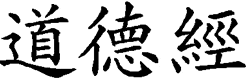
By Lao Tzu (Laozi)
Green Way Research, Valley Spirit Center, Gushen Grove Notebooks, Vancouver, Washington
Chapter 73 Chapter 75 Index to All the Chapters Daoism Concordance Commentary Cloud Hands Blog
Classic Book (Ching) about the Tao (Way, Nature, Patterns, Processes) and Te (Virtue, Potency, Power, Integrity, Wise Person, Sage)
Concordance: Indexing, Search Terms, Topics, Themes, Keys, Subjects
English and Chinese (Wade-Giles) Terms:
The
Fear (wei) of Death (ssu), Executioner, Carpenter, Kill or Execute
(sha), Danger, Skill, Hazards, Threaten (chü), Overcoming Delusions,
Worries, Professions, Skills, Rare or Few (hsi), Avoiding Inappropriate Occupations,
Constantly (ch'ang), Having Relevant Skills at Work, Law, Government,
Intimidation, Dishonest or Bizarre (ch'i), Lumberjack, Get or Take (tê),
Tree, Safety, Criminals,
Lord of Death, Injury or Wound (shang), People (min), Seize or
Hold (chih),
Cutting Your Hands, Craftsman or Artisan (chiang), Dare or Venture (kan),
Chopping, Wood, Inevitable,
Carpenter (cho), Master or Great (ta), Capital Punishment
制惑
Términos en Español: El miedo de la Muerte, Verdugo,
Carpintero, Mata,
Ejecutar, Peligro, Habilidad,
Peligros, Amenazar, Superación
Delirios, Preocupaciones,
Profesiones, Habilidades,
Raras, Pocos, Constantemente, Derecho,
Gobierno, Intimidación, Deshonesto,
Leñador, Árbol, Seguridad, Delincuentes,
Señor de la Muerte, Lesión, Herida,
Personas, Incautar, Artesano, Picar, Madera, Inevitable,
Maestría, Gran.
Electronic Concordance for all 81 Chapters of the Tao Te Ching
English Language Translations of the Tao Te Ching
"The people do not fear death,
Why threaten them with death?
Suppose the people always fear death,
One who does strange things,
I shall seize and kill,
Then who dares to do strange things?
Killing is carried out by the executioner.
To replace the executioner and kill,
Is like chopping wood in place of the master carpenter.
To chop wood in place of the master carpenter,
Rarely one does not hurt one's own hand."
- Translation by
Ellen M. Chen,
Chapter 74
"If people don't love life, they won't fear death, and
threatening them with it won't work.
If people have lives worth living, then the threat of death is meaningful,
and
they'll do what is right to avoid it.
But killing itself should be the province of the great executioner alone.
Trying to take his place and kill is like cutting wood in the place of the
master carpenter:
The odds are you'll hurt your own hand."
- Translation by
Brian Walker,
Chapter 74
"If the people do not fear death,
For reasons of extreme poverty or suffering,
What is the point of threatening them with death?
If the people fear death,
And if the outlaws are captured and killed,
Who will dare to break the law?
Yet, the act of killing should always be
The exclusive province of the Great Executioner.
Therefore, to kill in place of the Great Executioner is
Like hewing wood in place of the master carpenter;
Few, if ever, will escape cutting their own hands."
- Translated by
Yasuhiko Genku Kimura, Chapter 74
"The people are not frightened of death.
What then is the use of trying to intimidate them with the death-penalty?
And even supposing people were generally frightened of death
And did not regard it as an everyday thing,
Which of us would dare to seize them and slay them?
There is the Lord of Slaughter always ready for this task,
And to do it in his stead is like thrusting oneself into the master-carpenter's place
And doing his chipping for him.
Now “he who tries to do the master-carpenter's chipping for him
is lucky if he does not cut his hand.”
- Translated by
Arthur Waley, 1934, Chapter 74
"The
people are not afraid of death;
Why threaten them with death?
Supposing that the people are afraid of death,
And we can seize and kill the unruly,
Who would dare to do so?
Often it happens that the executioner is killed.
And to take the place of the executioner
Is like handling the hatchet for the master carpenter.
He who handles the hatchet for the master carpenter
seldom escapes injury to his hands."
- Translated by Lin
Yutang, 1948, Chapter 74
"Since the people do not fear death,
What is it for to frighten them with death?
If the people fear death and I can catch and kill those who make trouble,
Who dares to make trouble?
There is always someone who is in charge of inflicting death.
Inflicting death in place of those who are in charge of it can be described
as hewing wood in place of a skillful carpenter.
Of those who hew wood in place of skillful carpenters, few have not cut their own hands."
- Translated by
Ren Jiyu, Chapter 74
"If people don’t fear death
How will you frighten them with death?
If people always fear death
And I seize and execute
Anyone who does anything new,
Who will dare to move?
There is a public executioner who kills.
Killing on behalf of the public executioner,
Is called cutting wood on behalf of the carpenter.
In cutting wood on behalf of the carpenter,
There are few who escape hurting their hands."
- Translated by
A. S. Kline, 2003, Chapter 74
"The people have no fear of death;
why then seek to awe them by the threat
of death?
If the people feared death and I could put to death evil-doers,
who would dare to offend?
There
is one appointed to inflict death.
He who would usurp that position
resembleth a hewer of wood
doing the work of a carpenter.
Such an one,
presumptuous, will be sure to cut his own hands."
- Translated (Interpolated) by
Aleister Crowley,
1918, Chapter 74
"It is not the leader's role to play judge and jury, to punish people for
'bad' behaviour.
In the first place, punishment does not effectively control behaviour.
But even if punishment did work, what leader would dare to use fear as a
teaching method?
The wise leader knows that there are natural consequences for every act.
The
task is to shed light on these natural consequences, not to attack the behaviour itself.
If the leader tries to take the place of nature and act as judge and jury,
the best you can expect is a crude imitation of a very subtle process.
At the very least, the leader will discover that the instrument of justice
cuts both ways.
Punishing others in punishing work."
- Translated by
John Heider, 1985, Chapter 74
"If the citizens do not fear
death,
How can you use death to
frighten them?
Assuming you could ensure
that the citizens always fear
death,
And I get hold of those who
act strange and unusual and
kill them,
Then who would be daring?
There will always exist an
executioner.
Now, to take the place of
the executioner to do the
killing,
This is called taking the
place of a great craftsman to carve
wood.
Now, of those who take the
place of a great craftsman to
carve wood,
Few will not injure their
hand!"
- Translated by
Bruce R. Linnell,
2015, Chapter 74
"If the people fear death, why frighten them with death?
Even if one could cause the people always to fear death
and could
seize and kill those who make ingenious things,
who would dare to act
thus?
There is always a Chief Executioner who kills.
To kill in the place of
the Chief Executioner may be called:
to chop in the place of the Master
Carpenter.
Now in chopping in place of the Master Carpenter,
few will escape maiming their hands!"
- Translated by
Jan Julius Lodewijk Duyvendak, 1954, Chapter 74
"If people are not afraid of death,
how can they be threatened by it?
But if they always live in fear of death,
and still continue in their lawlessness,
we can arrest and kill them.
Who then would dare?
And yet there is a Lord of Death whose charge it is to kill.
To take his place and kill would be like carving wood in place of the master
carpenter.
Few would escape without injuring their hands."
- Translated by
Tim Chilcott,
2005, Chapter 74

Created by Michael P. Garofalo, Green Way Research, Valley Spirit Center, Gushen Grove Notebooks, Vancouver, Washington © 2020 CCA 4.0
 By Alexander Simkins.
  By Derek Lin.
 By Ming-Dao Deng.
Tai Chi Chuan, Qigong, Taoist Body-Mind Arts and Practices
How to Live a Good Life: Advice from Wise Persons
 By Benjamin Hoff.
 By Ming-Dao Deng.
 Translated by Thomas Cleary.


"If people do not fear death
How can you threaten them with it?
If people live in constant fear of death,
Because those who break the law are seized and killed,
Who would dare to break the law?
There has always been an officia executioner.
If you take the law into your own hands
And try to take his place,
It is like trying to take the place of a
master carpenter
In which case you would probably hurt your hands."
- Translated by
John R. Mabry,
Chapter 74
"If the people do not stand in awe of death,
What is the point of threatening them with the death penalty?
But even suppose the people were in constant fear of death,
Who would dare to seize the evil-doers and slaughter them?
Leave killing to the Great Slayer.
He who usurps the place of the Great Slayer
Is like one who seeks to assist a master joiner with an axe.
Now he who assists a master joiner with an axe
Rarely fails to injure his own hands."
- Translated by
Herman Ould, 1946,
Chapter 74
"If the people no longer fear death,
How can one threaten them with death?
If one causes them constantly to fear death and captures and kills those who are tricky,
Who would dare to be tricky?
The one who constantly is the executioner can kill.
One who kills by taking the place of the great executioner
is like one who takes the place of the great carpenter in cutting wood.
Of those who have taken the place of the great carpenter,
Few have not hurt their own hands!"
- Translated by
Yi Wu, Chapter 74
"When people are no longer afraid of death, how can they be disciplined by
death?
And if someone likes to be abnormal he may be arrested and punished, then
who else would dare to be abnormal?
Since the one to kill is killed, a great professional killer is like a great
professional chopper whose hands are subject to be hurt."
- Translated by
Tang Zi Chang, Chapter 74
 By Hu Xuzehi
 Annotated translation by Victor Mair
  By Ha Poong Kim
 By Hans-Georg Moeller
 Tai Chi Chuan, Qigong, Taoist Body-Mind Arts and Practices
How to Live a Good Life: Advice from Wise Persons
 By Roger T. Ames and David T. Hall
 By Wes Burgess
 By Arthur Waley
"If the people do not fear death, how can one frighten
them with death?
If we teach people to fear death, then when one rebels he can be seized and
executed; after that who will dare to rebel?
There is always an officer to execute a murderer, but if one takes the place of
the executioner, it is like taking the place of a skilled carpenter at his
hewing.
If one takes the place of the skilled carpenter he is liable to cut himself.
Therefore do not interfere with Tao."
- Translated by
Dwight Goddard,
1919, Chapter 74
A Chinese Language Version of Chapter 74 of the Tao Te
Ching by Lao Tzu
A
note
on my style of displaying the Chinese characters of the Tao Te Ching
民不畏死.
奈何以死懼之.
若使民常畏死, 而為奇者, 吾得執而殺之, 孰敢.
常有司殺者殺.
夫司殺者.
是大匠斲.
夫代大匠斲者, 希有不傷其手矣.
- Chinese characters, Tao Te Ching, Chapter 74
min pu wei ssu.
nai ho yi ssu chü chih.
jo shih min ch'ang wei ssu, erh wei ch'i chê, wu tê chih erh sha chih, shu kan.
ch'ang yu ssu sha chê sha.
fu tai ssu sha chê sha.
shi wei tai ta chiang cho.
fu tai ta chiang cho chê, hsi yu pu shang ch'i shou yi.
- Wade-Giles (1892) Romanization, Tao Te Ching, Chapter 74
Audio
Version in Chinese of Chapter 74 of the Tao Te Ching
min bu wei si.
nai he yi si ju zhi.
ruo shi min chang wei si, er wei qi zhe, wu de zhi er sha zhi, shu gan.
chang you si sha zhe sha.
fu dai si sha zhe sha.
shi wei dai da jiang zhuo.
fu dai da jiang zhuo, xi you bu shang qi shou zhe yi.
- Hanyu Pinyin (1982) Romanization, Daodejing, Chapter 74

Tao Te Ching in Chinese characters and English (includes a word by word key) from YellowBridge
Tao Te Ching in Chinese characters, Hanyu Pinyin (1982) Romanization, English and German by Dr. Hilmar Alquiros.
Laozi Daodejing: Chapters with Chinese characters, seal script, detailed word by word concordance, Pinyin (tone#), German, French and English.
Chinese and English Dictionary, MDGB
Dao De Jing Wade-Giles Concordance by Nina, Dao is Open
Dao De Jing English and Wade-Giles Concordance by Mike Garofalo
Tao Te Ching in Pinyin Romanization with Chinese characters, WuWei Foundation
Tao Te Ching in Pinyin Romanization
Tao Te Ching in Chinese characters and English
Tao Te Ching in Chinese characters, English, Word by word analysis, Zhongwen
Tao Te Ching: The Definitive Edition
Tao Te Ching in Chinese characters: Big 5 Traditional and GB Simplified
Chinese Characters, Wade-Giles and Pinyin Romanizations, and 16 English Translations for Each Chapter of the Daodejing by Mike Garofalo.
Tao Te Ching in Chinese characters, Wade-Giles and Pinyin Romanization spellings, English; a word for word translation of the Guodian Laozi Dao De Jing Version.
Lao Zi's Dao De Jing: A Matrix Translation with Chinese Text by Bradford Hatcher.
"When the people are not afraid of death, why threaten
them with death sentences?
Even supposing the people are constantly afraid of death and we can seize
and
kill those who are unruly or vicious, who would dare to slay them?
There's always the master executioner.
To kill in his stead is like thrusting oneself into he master-carpenter's place
and doing his chipping for him.
"He who tries it is lucky if he doesn't cut his hand," they say.
To undertake executions for the master executioner is like hewing wood for him.
It rarely happens you escape injuring your own hands.
Now, often it happens as well that the executioner is killed.
And to take the place of the executioner is in part like handling the hatchet
for the master carpenter.
He who handles the hatchet for the master carpenter seldom escapes injury to his
hands.
- Translated by
Tormond Byrd,
1997, Chapter 74
"When the people are not afraid of death, what use is it to frighten them
with the punishment of death?
If the people were constantly afraid of
death and we could arrest and kill those who commit treacheries,
who
then would commit such?
Only the Supreme Executioner kills.
To kill in
place of the Supreme Executioner is to hack instead of a great
carpenter.
Now if one hacks in place of a great carpenter one can
scarcely avoid cutting one's own hand."
- Translated by
Ch'u Ta-Kao, 1904, Chapter 74
The Routledge Encyclopedia of Taoism
The Complete Works of Lao Tzu: Tao Teh Ching & Hua Hu Ching
Tai Chi Chuan, Qigong, Taoist Body-Mind Arts and Practices
The Dao De Jing: A Qigong Interpretation by Dr. Yang Jing-Ming
How to Live a Good Life: Advice from Wise Persons
Dao De Jing: A Philosophical Translation by Roger T. Ames and David L. Hall
Practicing the Tao Te Ching: 81 Steps on the Way by Solala Towler
"When people do not fear death,
What is the use of frightening them with the death penalty?
When people are constantly afraid of death,
And we can arrest and execute criminals,
Who would dare to commit crimes?
Only the executioner kills.
To kill instead of the executioner is like a woodcutter
taking a master-carpenter's place.
When someone carves instead of the master-carpenter,
He can usually expect to injure his hand."
- Translated by
Chohan Chou-Wing, Chapter 74
"Subdue Delusion
Chih Huo
When the people are not afraid of death,
What avails it to scare them with death?
Assuming that they often do fear death,
And that any pervert can be seized and killed,
Who dares to do the killing?
It is the job of the Director of Death to kill.
To take over the job of the Director of Death
Is like wielding the hammer for the master-builder.
He who wields the hammer for the master-builder
Seldom escapes wounding himself in the hand."
- Translated by
Henry Wei, 1982, Chapter 74
"Since the people do not fear death,
What is it for to frighten them with death?
If the people fear death and I can catch and kill those who make trouble,
Who dares to make trouble?
There is always someone who is in charge of inflicting death.
Inflicting death in place of those who are in charge of it can be described as hewing wood in place of a skillful carpenter.
Of those who hew wood in place of skillful carpenters, few have not cut their own hands."
- Translated by
Jiyu Ren, 1985, Chapter 74
 Translated by Eva Wong
  Translated by Philip Ivahoe
 By James Miller
 Translated by Stephen Bokencamp
Tai Chi Chuan, Qigong, Taoist Body-Mind Arts and Practices
How to Live a Good Life: Advice from Wise Persons
By Alexander and Annellen Simpkins Translated by Thomas Cleary
 By Livia Kohn
"If the people are not afraid to die,
How can you threaten them with death?
If the people are kept in constant fear of death,
And if it were possible to arrest and put to death the law-breakers,
Who would dare do this?
It is the master executioner who does the killing.
To assume the role of the master executioner and do the killing for oneself
Is like carving wood for oneself
Instead of leaving it to the master carpenter.
Those who carve wood for themselves
Instead of leaving it to the master carpenter
Rarely escape without cutting their own hands."
- Translated by
Keith H. Seddon, Chapter 74
"It is futile to threaten people with death.
If they are not afraid to
die, they cannot be frightened by the death penalty;
and if they are
afraid to die, why should we kill them?
Only Nature knows the proper time for a man to die.
To kill is to
interrupt Nature's design for dying,
Like a blundering apprentice
judging himself to be wiser than his master.
Whenever an apprentice thinks he is smarter than his master, he is very likely to hurt himself."
- Translated by
Archie J. Bahm, 1958, Chapter 74
"If people are not afraid to die, what is the use of threatening them with the punishment of death?
On the other hand,
if people value their lives, and if outlaws are seized and killed or are killed by what they are doing,
who would dare risk a life of peace for the sake of an insecure future?
Yet it is always true that one who takes charge of killing is killed in turn.
To become the executioner of artificial righteousness is like the
inexperienced lad who would brandish a sharp axe of a master carpenter.
He can seldom escape cutting himself."
- Translated by
Hua-Ching Ni, 1995, Chapter 74
Created by Michael P. Garofalo, Green Way Research, Valley Spirit Center, Gushen Grove Notebooks, Vancouver, Washington © 2020 CCA 4.0
Translation and elucidation by Hua Ching Ni Translated by Brian Walker
 Translated by Arthur Waley
 Translated by Lionel and and Herbert Giles
 By Eva Wong
Tai Chi Chuan, Qigong, Taoist Body-Mind Arts and Practices
How to Live a Good Life: Advice from Wise Persons
"If people have no fear of death
It's pointless to threaten them with it.
If people were in constant fear of death,
And if anyone acting deviously
Were to be seized and executed,
Who would dare to do so?
The Master Executioner is always there to kill.
If you attempt to play his role
It is like trying to do the work of a master lumberjack.
The one who has no skill to do this work
Seldom escapes with his hands unhurt."
- Translated by
Angieszka Solska,
2005, Chapter 74
"When the people are no longer afraid of death, why threaten them with the executioner?
If the people feared death, and execution was imposed as a penalty; who would dare transgress The Law?
Heaven is the Master Executioner.
Whoever tries to take Heavens place is like an amateur trying to use the master carpenters' tools to hew wood,
if he tries to use the tools he will likely hew himself."
- Translated by
Rivenrock, Chapter 74
If there is someone who doesn't fear death, why threaten
to kill them?
If people did fear death and one were to capture and kill the devious few, who
would dare to be devious?:
Iff the people are always at risk of execution, there will never lack an
executioner.
Now, to kill like an executioner is like-hacking at wood.
Instead of masterful carpentry, few are there who can escape cutting their own
hands!"
- Translated by
Jerry C. Welch,
1998, Chapter 74
Tao Te Ching
Tai Chi Chuan, Qigong, Taoist Body-Mind Arts and Practices
How to Live a Good Life: Advice from Wise Persons
Lao Tzu: Tao Te Ching
 Translated by Livia Kohn
Dao De Jing: The Book of the Way
"If people are not afraid to die, how death can be used to threaten them?
If we make people afraid of death, and execute a few extreme offenders, who
would dare to offend again?
It is normal to have executioners who kill.
Substituting an executioner in killing is like substituting a master lumberjack
in chopping trees.
Chopping trees by non-professionals rarely results in no hand injuries."
- Translated by
Thomas Z. Zhang,
Chapter 74
"When people are at one with Infinity,
they have no fear of death
and so they are indifferent to threats.
When people are confused
with the distinction of life and death,
they fear death.
If death is the penalty for breaking the law,
the vast majority will be law abiding.
There are always official executioners
and they are at one with killing.
If you try to take their place,
it is the same as trying to cut wood
in place of the master carpenter.
If you try to take the master carpenter's place,
you will only succeed in cutting
your hands."
- Translated by
John Worldpeace, Chapter 74
"If people were content with their own deaths
You could not use force on them; they would be immune
But this is not the way the world is
If you threaten them with death to make them behave
You must assign someone to kill them, or do it yourself
Who, then, kills: you, or the executioner, or the state?
Someone must take the responsibility
Whoever is responsible for death has put his way above the tao
Yet though he can end a life, the tao will by its nature find a way to return
Any sane man would find in that cause for worry."
- Translated by
Ted Wrigley,
Chapter 74
Walking the Way: 81 Zen Encounters with the Tao Te Ching
The Tao of Zen
Tai Chi Chuan, Qigong, Taoist Body-Mind Arts and Practices
How to Live a Good Life: Advice from Wise Persons
Tao Te Ching: Zen Teachings on the Taoist Classic
Buddhism and Taoism Face to Face: Scripture, Ritual, and Iconographic Exchange in Medieval China

"If the people do not fear death,
How then can you frighten them by death?
But if you cause the people continually to fear death,
And if one of them becomes a great criminal,
Can you take hold of him and slay him?
Would you dare to this?
There is always one, the Executioner, who kills men.
But, on the contrary, if you kill as if you were Executioner,
It would be as if you tried to do the work of a Master Carpenter.
In attempting to do the work of a Master Carpenter,
Few there be who do not wound their own hands."
- Translated by
Isabella Mears, 1916, Chapter 74
"It makes no sense to threaten with death him who is not
afraid of death.
Yet he who threatens others with death and takes pleasure in
this will be destroyed.
The theme of life and death is under control of Tao alone.
No
one is allowed to control it instead of Tao!
He who decides to
do such a thing only harms himself."
- Translated by
Mikhail Nilolenko, Chapter 74
"When the people are not afraid of death, wherefore
frighten them with death?
Were the people always afraid of death, and were I able to arrest and put to
death those who innovate, then who would dare?
There is a regular executioner whose charge it is to kill.
To kill on behalf of the executioner is what is described as chopping wood on
behalf of the master carpenter.
In chopping wood on behalf of the master carpenter, there are few who escape
hurting their own hands instead."
- Translated by
D. C. Lau, 1963,
Chapter 74
Further Teachings of Lao-Tzu: Understanding the Mysteries (Wen Tzu)
 Translated by Thomas Cleary
The Lunar Tao: Meditations in Harmony with the Seasons
 By Lui I-Ming (1780) and translated by Thomas Cleary
Ripening Peaches: Taoist Studies and Practices By Mike Garofalo
Zhuangzi: The Essential Writings with Selections from Traditional Commentaries
Tai Chi Chuan, Qigong, Taoist Body-Mind Arts and Practices
How to Live a Good Life: Advice from Wise Persons
"When people fear not death, then why
Affright them with its fear?
If kept in awe of it could I
Seize one for some wild deed to die,
And slay him? Who would dare?
To slay the slayer stands always
The executioner,
Now, if some one his work essays,
And seeks to slay the one who slays,
That man is sure to err.
Great carpenter, we call him, who
To slay the slayer stands,
And hewing is his work to do,
Who takes the hewer's place, to hew,
Is sure to cut his hands."
- Translated by
Isaac Winter Heysinger, 1903, Chapter 74
|
Tao Te
Ching |
|||||||||
| 1 | 2 | 3 | 4 | 5 | 6 | 7 | 8 | 9 | 10 |
| 11 | 12 | 13 | 14 | 15 | 16 | 17 | 18 | 19 | 20 |
| 21 | 22 | 23 | 24 | 25 | 26 | 27 | 28 | 29 | 30 |
| 31 | 32 | 33 | 34 | 35 | 36 | 37 | 38 | 39 | 40 |
| 41 | 42 | 43 | 44 | 45 | 46 | 47 | 48 | 49 | 50 |
| 51 | 52 | 53 | 54 | 55 | 56 | 57 | 58 | 59 | 60 |
| 61 | 62 | 63 | 64 | 65 | 66 | 67 | 68 | 69 | 70 |
| 71 | 72 | 73 | 74 | 75 | 76 | 77 | 78 | 79 | 80 |
| 81 | |||||||||
"If you do not fear death,
then how can it intimidate you?
If you aren't afraid of dying,
there is nothing you can not do.
Those who harm others
are like inexperienced boys
trying to take the place of a great lumberjack.
Trying to fill his shoes will only get them seriously hurt."
- Translated by
John H. McDonald, 1996, Chapter 74
Vom Gericht über Leben und Tod
Wenn das Volk den Tod nicht fürchtet,
wer wollte es dann mit Todesfurcht regieren?
Fürchtet es den Tod,
und es wird dennoch ein abscheuliches Verbrechen begangen,
wer getraute sich dann zu tö-ten?
Es findet sich immer ein Gerichtsherr,
der Todesurteile fällt und vollstreckt.
Wer aber sich selbst zum Richter über Leben und Tod macht,
der gleicht einem, der,
an Stelle des Zimmermeisters die Axt benutzend,
sich nur zu leicht selbst in die Hand haut.
- Translated
by Rudolf
Backofen, 1949, Chapter 74
"Wenn die Leute den Tod nicht scheuen,
wie will ich sie dann mit dem Tode einschüchtern?
Wenn ich aber die Leute
beständig in Furcht vor dem Tode halte,
und wenn einer Wunderliches treibt,
soll ich ihn ergreifen und töten?
Wer traut sich das?
Es gibt immer eine Todesmacht, die tötet.
Anstelle dieser Todesmacht zu töten, das ist,
wie wenn man anstelle eines Zimmermanns
die Axt führen wollte.
Wer statt des Zimmermanns
die Axt führen wollte,
kommt selten davon,
ohne das er sich die Hand verletzt."
- Translated by Richard Wilhelm, 1911, Chapter
74
"The people do not fear at all to die;
What's gained therefore by threatening them with death?
If you could always make them fear decease,
As if it were a strange event and rare,
Who then would dare to take and slaughter them?
The executioner is always set
To slay, but those who substitute for him
Are like would-be master carpenters
Who try to chop as that skilled craftsman does
And nearly always mangle their own hands!"
- Translated by
Raymond Blakney, 1955, Chapter 74
Created by Michael P. Garofalo, Green Way Research, Valley Spirit Center, Gushen Grove Notebooks, Vancouver, Washington © 2020 CCA 4.0
Tao Te Ching: An Illustrated Journey
Tao Te Ching
The Book of Tao: Tao Te Ching - The Tao and Its Characteristics
Ripening Peaches: Taoist Studies and Practices
Taoism: Growth of a Religion
Zhuangzi (Chuang Tsu), Daoist Scripture: Bibliography, Links, Resources, Quotations, Notes
Zhuangzi: Basic Writings
Zhuangzi Speaks: The Music of Nature
Tai Chi Chuan, Qigong, Taoist Body-Mind Arts and Practices
How to Live a Good Life: Advice from Wise Persons

"When the people do not fear death, of what use is it to overawe them with it as a penalty?
And if they were always held in fear of death, and I could lay my hand upon all evil doers and slay them, would I dare to do it?
There is always the Great Executioner!
For one to usurp that office is like a novice cutting out the work of a great architect.
Such a one rarely fails to cut his own hands!"
- Translated by
Walter Gorn Old, 1904, Chapter 74
"Why use death as a deterrent, when the
people have no fear of death?
Even supposing they shrank from death as from a monster, and by
playing on their terror I could slay them, should I dare?
There is one who inflicts sentence of death.
To usurp his
functions and to kill would be to assume the role of
Master-Carpenter.
There are few who can act as Master-Carpenter
without cutting their hands."
- Translated by
C.
Spurgeon Medhurst, 1905, Chapter 74
"If you do not fear death,
then how can it intimidate you?
If you aren't afraid of dying,
there is nothing you can not do.
Those who harm others
are like inexperienced boys
trying to take the place of a great lumberjack.
Trying to fill his shoes will only get them seriously hurt."
- Translated by
John H. McDonald, 1996, Chapter 74
"Lorsque le peuple ne craint pas la mort, comment
l'effrayer par la menace de la mort?
Si le peuple craint constamment la mort, et que quelqu'un fasse le mal, je puis
le saisir et le tuer, et alors qui osera l'imiter?
Il y a constamment un magistrat suprême qui inflige la mort.
Si l'on veut remplacer ce magistrat suprême, et infliger soi-même la mort, on
ressemble à un homme (inhabile) qui voudrait tailler le bois à la place d'un
charpentier.
Lorsqu'on veut tailler le bois à la place d'un charpentier, il est rare qu'on ne
se blesse pas les mains."
- Translated by Stanislas Julien, 1842, Chapter
74
Spanish
Language Versions of the Tao Te Ching (Daodejing)
Tao Te Ching en Español
Lao Tsé Tao Te Ching 
Tao Te Ching Traducido por Stephen Mitchell, versión española
Tao Te Ching Traducido al español por el Padre Carmelo Elorduy
Lao Tzu-The Eternal Tao Te Ching
Ripening Peaches: Taoist Studies and Practices By Mike Garofalo Maduración Duraznos: Estudios y Prácticas Taoístas por Mike Garofalo
Tao Te Ching
Lao Tzu - Tao Te Ching
Tao te king
Daodejing Español, Inglés, y Chino Versiones Lingüísticas de la Daodejing
Spanish Language Translations of the Tao Te Ching
"Sí los hombres no temen a la muerte,
¿Cómo atemorizarlos con la muerte?
Pero si temen a la muerte,
como siempre temen,
y el que viola la ley puede ser apresado y ejecutado,
¿quién se atreverá entonces a violar la ley?
Existe siempre un funcionario Ejecutor.
Matar, para el Gran Ejecutor,
es como cortar madera para el maestro carpintero;
será afortunado si no se hiere su propia mano."
- Translation from
Wikisource, 2013,
Capítulo 74
¿A aquel que no teme a la muerte, no tiene sentido
amenazarle con la muerte?
Con todo, quien amenaza a los demás con la muerte, deleitándose con esto, será
derrotado.
El asunto de la vida y de la muerte es manejado exclusivamente por Tao.
A nadie más le compete hacerlo.
Y aquel que se atreva a tal cosa sólo se hará daño."
- Translated by Anton Teplyy, 2008,
Tao Te Ching, Capítulo 74
"Sí el pueblo no teme la muerte,
¿Cómo atemorizarlo con la muerte?
Pero si teme la muerte,
lo que siempre teme,
y el que viola la ley puede ser apresado y matado,
¿quién se atreverá a hacer este mal?
La muerte solo es propia de un verdugo.
Quien mata en su lugar
es como sustituir al carpintero en el uso de su herramienta,
raro es que no se hiera la mano."
- Spanish Version Online at
RatMachines,
Capítulo 74
"Si el pueblo no temiera la muerte, sería inútil atemorizarlocon ella.
Si
teme morir, como siempre teme, y aún comete desmanes, puedo cogerlo y
matarlo.
¿Quién se atreverá a continuar en el mal?
Debe matarlo el
encargado para ello.
Si lo matara otro por él, sería usando el hacha
ensustitución del maestro.
Raro será el que, sustituyendo almaestro, no
hiera su propia mano."
- Translated by
Carmelo Elorduy,
2006, Capítulo 74
"Cuando un pueblo ya no teme a la muerte
¿Por qué
asustarlo con el espectro de la muerte?
Si puedes hacer que un pueblo tema
siempre a la muerte y si hay criminales que desafían la ley.
¿Quién tendrá el
valor de atraparlos y darles muerte?
Para eso existe siempre el gran magistrado a él compete aplicar la ley de la muerte y no a otros.
Quien levanta el hacha
sin ser carpintero se hiere con sus propias manos."
- Translation from
Logia Medio Dia, 2015,
Tao Te Ching, Capítulo 74
Created by Michael P. Garofalo, Green Way Research, Valley Spirit Center, Gushen Grove Notebooks, Vancouver, Washington © 2020 CCA 4.0
Commentary, Notes, Links,
Comparisons, Suggestions
Chapter 74
By Mike Garofalo
A concordance search on the word "kill" brings up 'murder or killing (sha)' in Chapters 31, 73, and 74.
"Those that live by the sword, die by the sword." Bible, Matthew 26:52
Every occupation involves consequences to body, mind, and spirit. Some occupations are very dangerous, and require highly trained and skilled employees to do the task, e.g., a nuclear reactor operations supervisor. Beginners are more likely to injure or kill themselves and many others.
Here, Lao Tzu is questioning the value of the execution of criminals. We still debate this topic in 2020. Is capital punishment a deterrent? Back in 700 BCE in China, criminals and enemies could also have their nose, ears, fingers, hands, or feet amputated as "punishment." Lao Tzu also questions the need for so many governmental laws (Chapter 57, 58) and regulations that redefine our various behaviors as criminal activity. For example, selling or possessing cannabis was a criminal activity in the State of Washington until 2012; now it is not.
If a person is not afraid of dying and/or thinks it is heroic and noble to die, he or she is less likely to become bothered by their conscience about their questionable actions, might become amoral, and might become indifferent to threats and punishments. A number of mass killers commit suicide at the end of their murderous sprees. A realist would contend that severe or capital punishment might be a deterrent to criminal activity amongst criminals who are fearful of capture, trial, and punishment by death or amputation. To the average Joe and Jane, an utterly fearless person is insane but culpable .
Next Chapter of the Tao Te Ching #75
Previous Chapter of the Tao Te Ching #73
Chapter and Thematic Index to the Tao Te Ching
Tao Te Ching
Commentary, Interpretations, Research Tools, Resources
Chapter 74
Das Tao Te King von Lao Tse. Complete versions of all 81 Chapters of the Tao Te Ching by many different translators in many languages: 124 English, 24 German, 14 Russian, 7 Spanish, 5 French and many other languages. Links are organized first by languages, and then alphabetically by translators. Formatting varies somewhat. The original website at Onekellotus went offline in 2012; but, the extensive collection of these Tao Te Ching versions was saved for posterity by the Internet Archive Wayback Machine and available as of 9/9/2015. This is an outstanding original collection of versions of the Daodejing─ the Best on the Internet. Caution: copyright infringement may sometimes be an issue at this website.
Tao Te Ching, Translations into English: Terebess Asia Online (TAO). 124
nicely formatted complete English language translations, on separate webpages, of the Daodejing.
Alphabetical index by translators. Each webpage has all 81 chapters of the Tao Te
Ching translated into English. A useful collection! Many
reformatted and colored versions from the original collection at
Das Tao Te King von Lao Tse. Caution: copyright infringement may
sometimes be an
issue at this website.
Lao Tzu: Te-Tao Ching - A New Translation Based on the Recently Discovered Ma-wang-tui
Texts (Classics of Ancient China)
Daodejing by Laozi: Chapters with Chinese characters, seal script,
detailed word by word concordance, Pinyin (tone#), German, French and English.
This is an outstanding resource for serious students of the Tao Te Ching.
Tao Te
Ching: A New Translation and Commentary. By Ellen Chen. Paragon
House, 1998. Detailed glossary, index, bibliography, notes, 274 pages.
The Tao
and Method: A Reasoned Approach to the Tao Te Ching. By Michael
Lafargue. New York, SUNY Press, 1994. 640 pages. Detailed
index, bibliography, notes, and tables. An essential research tool.
Two Visions of the Way: A Study of the Wang Pi and the Ho-Shang Kung Commentaries on the Lao-Tzu.
By Professor by Alan Kam-Leung Chan. SUNY Series in Chinese
Philosophy and Culture. State University of New York Press, 1991.
Index, bibliography, glossary, notes, 314 pages.
ISBN: 0791404560.
Tao Te Ching: The Definitive Edition
Chinese Reading of the Daodejing
Wang Bi's Commentary on the Laozi with Critical Text and Translation.
By Professor Rudolf G. Wagner. A SUNY Series in Chinese Philosophy and
Culture. English and Mandarin Chinese Edition.
State University of New York Press; Bilingual edition (October 2003). 540
pages. ISBN: 978-0791451823.
Wang Bi (Wang Pi, Fusi), 226-249 CE,
Commentary on the Tao Te
Ching.
Tao Te Ching

The Taoism Reader
Change Your Thoughts - Change Your Life: Living the Wisdom of the Tao
The Routledge Encyclopedia of Taoism.
Lao Tzu's Tao Teh Ching, A Parallel Translation Collection. Compiled by B.
Boisen.
Tao Te Ching: The Book of the Way. Revised by Sam Torode based on the
translation by Dwight Goddard, 1919. Independent Pub., 2009, 88 pages.
Tao Te Ching: Annotated
and Explained. By Derek Lin. Foreword by Lama Surya Das.
Skylight Illuminations, SkyLight Paths, 2006. 208 pages.
Comparison and Analysis of Selected English Interpretations of the Tao Te Ching.
By Damian J. Bebell and Shannon M. Fera.
Practicing the Tao Te Ching: 81 Steps on the Way. By Solala Towler.
Foreword by Chunglang Al Huang. Sounds True, 2016. 320 pages.
The Lunar Tao: Meditations in Harmony with the Seasons
The Classic of the Way and Virtue: A New Translation of the Tao-te Ching of Laozi as Interpreted by Wang Bi.
Translated by Richard John Lynn. Translations from the Asian Classics
Series. Columbia University Press, 2004. 256 pages.
Tao Te Ching in Chinese characters,
Pinyin Romanization, English and German by Dr. Hilmar
Alquiros.
Yellow Bridge
Dao De Jing Comparison Table Provides side by side comparisons of
translations of the Tao Te Ching by James Legge, D. T. Suzuki, and Dwight
Goddard. Chinese characters for each paragraph in the Chapter are on the
left; place your cursor over the Chinese characters to see the Pinyin
Romanization of the Chinese character and a list of meanings.
Translators Index,
Tao Te Ching Versions in English, Translators Sorted Alphabetically by Translator, Links to Books and
Online Versions of the Chapters
Taoism and the Tao Te
Ching: Bibliography, Resources, Links
Spanish Language
Translations of the Tao Te Ching, Daodejing en Español, Translators Index
The Tao of Zen
Chapter 1 in the
Rambling
Taoist Commentaries by Trey Smith. The
Rambling Taoists are Trey Smith and Scott Bradley.
By Hans-Georg Moeller. Columbia University Press, 2006, 176 pages.
Valley Spirit, Gu Shen,
Concept, Chapter 6
Valley Spirit Center in Red
Bluff, California.
Sacred
Circle in the Gushen Grove.
Lao-tzu's Taoteching
Reading Lao Tzu: A Companion to the Tao Te Ching with a New Translation
Dao De Jing: A Philosophical Translation
Thematic Index to the
81 Chapters of the Tao Te Ching
Lieh-Tzu: A Taoist Guide to Practical Living
Revealing the Tao Te Ching: In-depth Commentaries on an Ancient Classic
Cloud Hands Blog
Mike Garofalo writes about Mind-Body Arts, Philosophy, Taoism, Gardening, Taijiquan, Walking, Mysticism,
Qigong, and the Eight Ways.
The Whole Heart of Tao:
The Complete Teachings From the Oral Tradition of Lao Tzu.

Gushen Grove Notebooks for the Tao Te Ching
Green Way Research, Valley Spirit
Center, Gushen Grove Notebooks (2001-2020)
Red Bluff, California from 1998-2017;
Vancouver, Washington from 2107-
Green Way Research, Tao Te Ching, Chapter 74, 2011-2020.
Indexed and Compiled by
Michael P. Garofalo
This webpage was last changed, modified, edited,
maintained, expanded, reformatted, improved or updated on
November 29, 2019.
This webpage was first distributed online on July 17, 2011.
Created by Michael P. Garofalo, Green Way Research, Valley Spirit Center, Gushen Grove Notebooks, Vancouver, Washington © 2020 CCA 4.0
Brief Biography of Michael P. Garofalo, M.S.

Ripening Peaches: Daoist Studies and Practices
Zhuangzi (Chuang Tzu, Zhuang Zhou, Master Chuang) 369—286 BCE
Taoist Perspectives: My Reading List
Bodymind Theory and Practices, Somaesthetics
How to Live a Good Life: Advice from Wise Persons
Qigong (Chi Kung) Health Practices
One Old Daoist Druid's Final Journey: Notebooks of the Librarian of Gushen Grove
Index to Cloud Hands and Valley Spirit Websites
Index to English Language Translators of the Tao Te Ching
Recurring Themes (Terms, Concepts, Leimotifs) in the Tao Te Ching
Spanish Language Translations of the Tao Te Ching
Chinese Characters, Wade-Giles (1892) and Hanyu Pinyin (1982) Romanizations
The Tao Te Ching (Dao De Jing) by Lao Tzu (Laozi) circa 500 BCE
|
Tao Te
Ching |
|||||||||
| 1 | 2 | 3 | 4 | 5 | 6 | 7 | 8 | 9 | 10 |
| 11 | 12 | 13 | 14 | 15 | 16 | 17 | 18 | 19 | 20 |
| 21 | 22 | 23 | 24 | 25 | 26 | 27 | 28 | 29 | 30 |
| 31 | 32 | 33 | 34 | 35 | 36 | 37 | 38 | 39 | 40 |
| 41 | 42 | 43 | 44 | 45 | 46 | 47 | 48 | 49 | 50 |
| 51 | 52 | 53 | 54 | 55 | 56 | 57 | 58 | 59 | 60 |
| 61 | 62 | 63 | 64 | 65 | 66 | 67 | 68 | 69 | 70 |
| 71 | 72 | 73 | 74 | 75 | 76 | 77 | 78 | 79 | 80 |
| 81 | |||||||||
Return to the Top of this Webpage


Mike Garofalo at the Klickitat River in Southwest Washington, 2019
Cloud Hands Blog of
Michael P. Garofalo

Facebook of
Michael P. Garofalo

Return to the Alphabetical
Index of Mike Garofalo's Hypertext Documents
Return to the Top of this Webpage