Rooting and Centering Wuji (Empty State) and Standing Meditation
Somaesthetic Practices and Theory
Taijiquan Qigong Index Chen Style Taijiquan
Bibliography
and Links
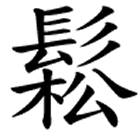
Relaxation, Looseness, Openness, Effortlessness, Calmness
(Song Sung Shoong Ching
Song Fang Song)
Aligned, Relaxed, Resilient: The Physical Foundations of Mindfulness. By Will Johnson. Boston, Shambhala, 2000. 137 pages. ISBN: 1570625182. VSCL.
Alphabetical Index to the Cloud Hands Website
Anatomy of Hatha Yoga: A Manual for Students, Teachers and Practitioners. By H. David Coulter. Foreward by Timothy McCall. Honesdale,
Pennsylvania, Body and Breath, 2001. Index, bibliography, appendices, 623
pages. ISBN: 0970700601. 2002 winner of the Benjamin Franklin Award
for
Health, Wellness and Nutrition. VSCL.
Autogenic Therapy: Vol. 1. Autogenic Methods. By Johannes H.
Schultz and Wolfgang Luthe. New York, Grune and Stratton, 1969.
Autogenic Training: A Psychophysiologic Approach in Psychotherapy.
By Johannes H. Schultz and Wolfgang Luthe. New York, Grune and Stratton,
1959.
Chinese
Boxing: Masters and Methods. By Robert W. Smith. Berkeley, CA,
North Atlantic Books, 1974, 1990. ISBN: 155643085X.
Cloud Hands Blog By
Mike Garofalo.
Cloud Hands
Blog Posts about Relaxing, Being Loose, Song
Cultivating
Stillness: A Taoist Manual for Transforming Body and Mind. Translated
with an introduction by Eva Wong. With a commentary by Shui-ch'ing Tzu.
Illustrated
by Hun-yen Tsu. Boston, Shambhala Press, 1992. 156 pages.
ISBN: 0877736871. VSCL.
Dao De Jing, Laozi
(The Tao Te Ching by Lao Tzu)
Dao House: Of Discourses and
Dreams "A compendium of
links to great online Daoist (Taoist) resources." An excellent selection of
fine
links with informative and fair annotations; all presented in an attractive
and easy to read format. The in-depth and creative collection of links are arranged by 18 topics.
Daoism: Bibliography, Links,
Resources, Quotations, Lessons
The
Dao of Taijiquan: Way to Rejuvenation. By Tsung Hwa Jou.
Charles E. Tuttle, 1998.
3rd Edition. 233 pages. ISBN: 0804813574. An outstanding
textbook on Tai Chi Chuan.
All styles are introduced and explained. A very informative introduction
to the philosophy
and practices of Tai Chi Chuan. VSCL.
Discussion on
Relaxation 10Kb.
Eight Section Brocade
Qigong By Michael P. Garofalo. History and
purpose of
this popular chi kung practice. Descriptions for each of the eight
movements, health benefits,
comments, variations, extensive links and bibliography, resources, quotations,
animated
.gif photographs of the movements, and charts. HTML format. 65
pages in Word.doc
format. This file is
updated
on a regular basis as I add new material, links, notes, and resources. A.K.A: Baduanjin, Pa Tuan Jin, Eight Silken
Treasures, Ba Duan Jin, Pal Dan Gum, Ba Duan Gin, Pa Tin Kam, Otto Pezzi di Tesoro, Acht Delen
Brokaat,
Les Huit Exercices del la Soie, Eight Silken Treasures, Brocade Qigong, Wudang
Brocade Qigong, Silk Treasures Qigong, First Eight Buddha Lohan Hands.
The
Essence of T'ai Chi. By Waysun Liao. Boston, Shambhala,
1995.
Shambhala Pocket Classics. 162 pages. ISBN: 1570620392. A
discussion of shoong on pages 56-61. VSCL.
Gateway
to the Miraculous: Further Explorations in the Tao of Cheng Man-ch'ing.
By Wolfe Lowenthal. Berkeley, California, North Atlantic Books, Frog Ltd., 1994. 124
pages.
ISBN: 1883319137. Wolfe Lowenthal was a student of Cheng Man-ch'ing
from 1967-1975; and later taught Taijiquan at the Long River Tai Chi Circle. VSCL.
The
Healing Path of Yoga. Time-Honored Wisdom and Scinetifically Proven
Methods that
Alleviate Stress, Open Your Heart, and Enrich Your Life. By Nischala
Joy Devi. New York, Three Rivers Press, 2000. Index, 238 pages. ISBN:
0609805029. VSCL.
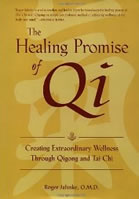
The Healing Promise of Qi: Creating Extraordinary Wellness Through Qigong and Tai Chi
"How Do I Relax?" By Marvin Smalheiser. T'ai Chi,
Vol. 23, No. 6, December 1999, p. 49.
How to
Calm Down: Three Deep Breaths to Peace of Mind. By Fred L. Miller and
Mark Bryan. Warner Books, 2003. 128 pages. ISBN:
0446679712.
The
Intrinsic Energies of T'ai Chi Ch'uan. Compiled and translated by
Stuart Alve Olson. Chen Kung Series, Volume Two. Saint Paul, Minnesota, Dragon Door
Publications, 1994.
Index, 194 pages. ISBN: 093804513X. VSCL.
Learn
to Relax: A Practical Guide to Easing Tension and Conquering Stress.
By Mike George.
San Francisco, Chronicle Books, 1998. Index, bibliography, 159
pages. High quality layout, artwork, and typography. ISBN: 0811819086. 25 good techniques
for helping you relax and reduce stress. A beautiful book with sage advice.
Lifestyle Advice From Wise Persons
"Li Yaxuan On Relaxation and Skills." Interview with Chen
Longxiang. T'ai Chi: The International Magazine of T'ai Chi Chuan. Vol. 27, No. 4, August, 2003, pp. 21-25.
Lohan Shaolin Buddhist Qigong Eighteen Buddha
Hands Qigong.
Magic Pearl
Qigong: A Tai Chi Medicine Ball Exercise Routine and Meditation Technique.
Developed by Mike Garofalo.
Mastering
Yang Style Taijiquan. Bu Fu Zhongwen (1903-1994). Translated by Louis
Swaim. Berkeley, California, Blue Snake Books, North Atlantic Books, 1999,
2006. Glossary, bibliography, 226 pages. Translations of many Tai Chi
classics are included. A list of the 85 movement long form and detailed
notes and descriptions of each movement are provided. Originally published
in Chinese in 1963. VSCL.
Meditation: Links,
Bibliography, Notes, Quotes.
Meditation Therapy. By
Andrew Shugyo Bonnici.
Muscle and Tendon Changing Qigong - Yi
Jin Jing
One Old Druid's Final
Journey: Notebooks of the Librarian of Gushen Grove
Philosophy
in the Flesh: The Embodied Mind and Its Challenge to Western Thought.
By Geogre Lakoff and Mark Johnson. Basic Books, Perseu Books, 1999.
Index,
bibliography, 624 pages. ISBN: 0465056741.
"The mind is inherently
bebodied. Thought is mostly unconscious. Abstract concepts are
largely
metaphorical." VSCL.
The
Power of Relaxation. By Sifu John Adams. Instructional
videotape.
The
Practice of Happiness: Exercises and Techniques for Developing
Mindfulness, Wisdom and Joy. By Mirko Fryba. Translated by Michael H.
Kohn. Boston, Shambhala, 1995. Index, 214 pages. MGC. ISBN:
1570621233.
Progressive
Muscle Relaxation By Bernd Harmsen. PMR.
Progressive Muscle Relaxation.
By Raymond Lloyd Richmond. 34Kb. PMR. "There
are two steps in the self-administered Progressive Muscle Relaxation procedure:
(a) deliberately tensing muscle groups, and (b) releasing the induced
tension."
Progressive Relaxation. By E. Jacobson. Chicago, IL,
University of Chicago Press, 1938. PMR.
Qigong: Links and Bibliography
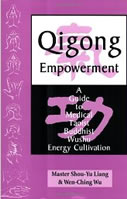
Qigong Empowerment: A Guide to Medical, Taoist, Buddhist and Wushu Energy Cultivation
Qigong Relaxation Therapy and Mind
Expansion. By Bill Douglas. CD.
Relax
and Renew: Restful Yoga for Stressful Times. By Judith Lasater,
Ph.D., P.T. Introduction
by Mary Pullig Schatz. Illustrated by Halstead Hannah. Rodmell
Press, 1985. ISBN: 0962713848. VSCL.
The
Relaxation and Stress Reduction Workbook. By Martha Davis, Matthew
McKay, and
Elizabeth R. Eshelman. New Harbinger Publications, 5th Edition,
2000. 276 pages.
ISBN: 1572242140.
Relaxation, Calmness,
Sung, Poise, Effortlessness
Relaxation
Techniques for Relief of Anxiety and Stress. By Susan M. Lark,
M.D..
Relaxation Techniques -
Sports Coach
"Relaxing and Integrating Body Movement." By Nando
Raynolds. T'ai Chi, Vol. 25, No. 4, August, 2001, pp. 33-35.
Relaxing into Your Being: The Water Method of Taoist Meditation Series, Vol. 1
Relaxing More Effectively
Through Yoga
Rooting, Grounding, Centering, and Balancing in T'ai Chi Ch'uan and Chi Kung
Rooting: Posts
to the Cloud Hands Blog
The Root of Chinese Qigong: Secrets of Health, Longevity, & Enlightenment. By Yang Jwing-Ming, PhD., 1946-.
YMAA Chi Kung Series #1. Jamaica Plain, Massachusetts, Yang's
Martial Arts Association, 1989. Glossary, 272 pages. ISBN:
0940871076. VSCL.
Secrets of the Dragon Gate: Ancient Taoist Practices for Health, Wealth, and the
Art of Sexual Yoga. By Dr. Steven Liu and Jonathan Blank. New York,
Jeremy P. Tarcher, Penguin, 2011. 214 pages. ISBN: 9781585428434.
VSCL.
Self Relaxation: Chinese Qigong Meditation. By Yang,
Jwing-Ming.
Somaesthetic Practices and
Theory
Standing
Meditation, Wuji Posture, Rooting, Zhan Zhuang Qigong
Strength Training: Taijiquan, Qigong,
Kung Fu and Yoga
Stress Management.
Melissa Stoppler, M.D. Articles, news and links.
Stress Management and
Emotional Wellness Links.
Subject Index to the Cloud Hands Website
Sun Style of Taijiquan: Bibliography, Links, Resources,
Quotes, Lists.
T'ai Chi Ch'uan: Links and Bibliography
Tai Chi for Health and
Relaxation
Tai
Chi: Health for Life. How and Why It Works for Health, Stress Relief,
and Longevity.
By Bruce Frantzis. Berkeley, California, Blue Snake Books, Energy Arts
Inc., c 2006. Index, 320 pages. ISBN: 1583941444. VSCL.
Tai Chi
Qigong For Stress Control and Relaxation. By Gary
Kohr. Heian International
Publishing Col, 1995. ISBN: 0893467952.
Review
Take
Your Time: Finding Balance in a Hurried World. By Eknath Easwaran
(1909-1999). Hyperion Press, 1998. 240 pages. ISBN: 0786883545.
The Taoist Body. By Kristofer Schipper. Translated by Karen C.
Duval. Foreword by Norman Girardot. Berkeley, California, University of California
Press, 1993. Originally published in French in 1982 as Le Corps Taoiste.
Notes, bibliography, index, xx, 273 pages. ISBN: 0520082249. VSCL.
Taoist
Classics. The Collected Translations of Thomas Cleary. Boston,
Shambhala Press. Four Volumes:
Volume
One, 296 pages, 2003.
Volume
Two, 640 pages, 1999. Volume Three, 304 pages, 2001.
Volume
Four, 464 pages, 2003.
Taoist Meditation and Longevity Techniques. Edited by Livia
Kohn. Michigan Monographs in Chinese Studies, 1989. 398 pages.
ISBN: 0892640855. VSCL.
The Tao Te Ching by
Lao Tzu (Dao De Jing, Laozi) Selected Quotations,
Commentaries, Guides, Indexes
Taoist Studies and
Practices: Ripening Peaches
Therapies
- Autogenics. "Autogenics is a relaxation
technique involving a series of attention-focusing exercises designed to induce relaxation and enhance
the body’s self-healing powers. Similar to self-hypnosis and meditation its
purpose is to enable people to learn how to put themselves in a relaxed state
releasing muscle tension and dealing with anxiety without the need of a trainer or
therapists."
There
Are No Secrets: Professor Cheng Man-ch'ing and His Tai Chi Chuan. By
Wolfe Lowenthal, 1939-. Berkeley, California, North Atlantic Books, 1991.
VSCL.
Thirteen Treasures Walking Qigong.
Thirty Scripts for Relaxation Imagery and Inner Healing. By J. T.
Lusk.
"Training Softly to Develop Strength." By Tu-Ky Lam. T'ai
Chi: The International Magazine of T'ai Chi Ch'uan, Volume 28, No. 3, June 2004, pp.
14-17.
"Understanding Flowing and Firmness." By Ting Kuo-Piao. T'ai
Chi, Volume 24, No. 5, October, 2000, pp. 49-50.
Valley Spirit Center,
Red Bluff, California
VSCL = Valley Spirit Center Library in Red Bluff, California
The Way
of Qigong: The Art and Science of Chinese Energy Healing. By Kenneth
S. Cohen.
Foreword by Larry Dossey. New York Ballantine Books, 1997. Index,
notes, appendices, 427 pages. ISBN: 0345421094. Chapter 8, pp. 97-110: Fang Song Gong -
The Art of
Relaxation. Mr. Cohen describes the attributes of active relaxation:
awareness and tranquility, effortlessness, sensitivity, warmth and rootedness.
VSCL.
Ways to Relax
Notes and links.
The Web
That Has No Weaver: Understanding Chinese Medicine. By Ted J.
Kaptchuk,
O.M.D.. Chicago, McGraw Hill Contemporary Books, 2nd Edition, 2000.
Index, bibliography,
appendices, notes, 500 pages. Foreword by Margaret Caudill, M.D., and by
Andrew
Weil, M.D. ISBN:
0809228408. An excellent introduction to traditional
Chinese medicine and modern research on the topic. VSCL.
Wild Goose Qigong: Links, Bibliography, Quotes, Notes
Wisdom
of the Body Moving: An Introduction to Body-Mind Centering. By Linda
Hartley.
Berkeley, California, North Atlantic Books, 1989, 1905. Index,
bibliography, 346 pages.
ISBN: 1556431740. Excellent information on the human body, movement
patterns in
infants, touching, yoga exercises and sensation-feeling aspects of movements.
BMC
is a therapeutic style of bodywork. VSCL.
Wu Qin Xi, Five Animal Frolics Qigong
Yoga and You: Energizing and Relaxing Yoga for New and Experienced Students.
By Esther Myers. Boston, Shambhala,1997. Index, 244 pages.
ISBN: 1570623201.
The
Yoga of Breath: A Step-by-Step Guide to Pranayama. Boston,
Shambhala, 2002. Index, notes, 304 pages. ISBN: 1570628890.
VSCL.
Yoga of
the Mahamudra: The Mystical Way of Balance. By Will Johnson.
Rochester, Vermont, Inner Traditions, 2005. 151 pages. ISBN:
0892816996. VSCL.
Yoga:
The Spirit and Practice of Moving into Stillness. By Erich
Schiffmann. New York,
Pocket Books, Simon and Schuster, 1996. 357 pages. ISBN: 0671534807.
VSCL.
禽戲
Animal Frolics Qigong
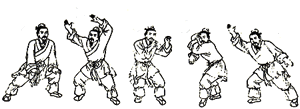
Bear
Tiger
Monkey
Deer
Crane
Dragon
Animal Frolics
Quotations
Relaxation, Looseness, Openness, Calmness, Effortlessness
(Song, Sung, Shoong, Fang Song)
"The principle of sung implies loosening one's muscles and releasing
one's tensions, giving up one's energy externally but preserving it internally so that one's body will
be sensitive and alert enough to adapt itself to any circumstance."
The Ten Guiding
Points of Tai Chi Chuan
"Shoong means "to relax, "to loose, "to give
up," "to yield." It is a term that has been adapted
and incorporated into the specialized terminology traditionally used by T'ai Chi
masters. It is said
that when the famous T'ai Chi master Yang, Chen-fu was training the late master
Cheng
Man-c'hing,
Master Yang reminded his student daily to "be shoong, be really,
really shoong." "If your are
not shoong, " Master Yang would say, "even just a little bit
not shoong, you are not in the stage of shoong. Your are then in the stage of a loser of T'ai Chi;
you will be defeated."
- Waysun Liao,
The
Essence of T'ai Chi, 1995, p. 56
"To be relaxed means to release tension, but not to let go of
substance. There is a quality in-between stiff and loose which is stable, yet flexible, that has
fullness without
being rigid, that is calm in motion yet conveys a vigorous presence. For
lack of an equivalent English word, I refer to this concept as flowing within firmness,
firmness
within flowing. Flowing and firmness do not gain support from a rigid
skeletal posture
or strength from muscular tension. Rather, their integrity comes from
expansion. Expansion is the ability to spread out in all directions. This is the key
to relaxing without collapsing."
- Ting Kuo-Piao, Understanding Flowing and Firmness, 2000
"Relaxation of the whole body means the conscious relaxation of all the
joints, and this
organically links up all parts of the body in a better way. This does not
mean softness.
It requires a lot of practice in order to understand this point
thoroughly. Relaxation also
means the "stretching" of the limbs, which gives you a feeling of
heaviness. (This feeling
of heaviness or stiffness is a concrete reflection of strength.) This
feeling is neither a feeling of softness nor stiffness, but somewhere in between. It should not
be confined to
a specific part, but involves the whole body. It is like molten iron under
high temperature.
So relaxation "dissolves" stiff strength in very much the same
way. Stiff strength, also
called "clumsy strength," undergoes a qualitative change after
thousands of times of "dissolution" exercises. Just like iron which can be turned into
steel, so "clumsy strength"
can be turned into force, and relaxation is a means of gradually converting it
into force.
Our ancestors put it well: "Conscious relaxation will unconsciously produce
force." There
is truth in this statement."
- Yang Zhenduo, "Yang Style Taijiquan", p 16
"The most important point of t'aichi is relax. Relaxation
helps your body repel illness;
it allows your ch'i and blood to flow smoothly; it harmonizes the sinews and
vessels,
balances the Five Internal Organs, and opens the Triple Burners - how can any
disease invade your body? The ancients said that the best doctor cured
those
not yet ill, and t'aichi is the finest medicine of the best doctor."
- Professor Cheng Man-ch'ing, Taijiquan Master and Doctor of Chinese
Medicine,
Cheng
Man-ch'ing: Master of Five Excellences.
"As far as a practitioner of Taijiquan is concerned, most important is
that he should
calm himself, banish distracting thoughts from his mind, relax both body and
mind
and not be constrained. In this way, the inborn inspiration and
natural stableness
will revive from varieties that are twisted. Do not be distracted, the
quietness and stableness are important."
- Li Yaxuan
"To see the Self (Atman) one must become calm, controlled,
quiet, patiently enduring,
and contented."
- Brhadaranyaka Upanisad, 800 BCE
"'Sung' is often translated as 'relax', however as Louis Swaim
observes etymologically the term 'Sung' is based on a character for 'long hair that hangs down' - that is,
hair that is loosened and expanded, not 'drawn up'. This 'loose' and 'expanded' feeling is
what is meant by relaxed in the context of Tai Chi Chuan."
-
Bath
Tai Chi Chuan
"We are told to be in a state of "Sung" which has been
mistranslated as to "relax". So the early instructors did the whole form with even paced movements, slow and
calm for the whole form. This is not yin and yang! Sung actually means something like
"moving without the conscious knowledge of movement". It does not mean to
completely relax, as we would fall on the ground if we were to do that. However, within this state
of sung, there must also be yin and yang balance without losing the "sung". So
built into the "Old Yang Style of Yang Lu-ch'uan" we have movements that balance each other out
by having both yin and yang movements. We will be moving along calmly, slowly and in as a
relaxed state as possible, then will come an energy release point in the form where we
perform a movement or set of moves that are totally explosive. Not tense, but explosive
still retaining that sung ideal. Then we will be back instantly into the calm and the flowing
movements, just like the great river or nature in general."
- Erle Montaigue,
The
Nature of Tai Chi Chuan
"Activities like T'ai Chi and Yoga offer an incredible opportunity for
promoting optimal health. These exercises train a high degree of internal awareness and
powerfully stimulate the relaxation response. This combination of awareness, relaxation
and exercise has tremendous benefits for reducing stress, enhancing the immune
system and generating physical and emotional health."
-
Fitness Matters - Life
Matters
"The rigid person is a disciple of death;
the soft, supple, and delicate are lovers of live."
- Tao Te Ching, Chapter 76
"This is not to say that T'ai-chi does not require
effort. It does. But it requires quite
as much faith. I asked Cheng Man-ch'ing once whey none of his students
approached
him in skill. His terse answer: "No faith." Faith in
what? Simply in the twin principles of relax and sink, in not resisting and always remaining gently
attached to the opponent."
- Robert W. Smith,
Chinese
Boxing: Masters and Methods, 1974, p. 26.
"There are three golden steps to relaxation. First,
have your body symmetrical. For example, if you are standing, check that you are standing upright, with your
shoulders level and your arms hanging loosely at your sides. Then loosen all your muscles. Don't worry how or why you do it; just do it. Second, have your lips gently open
and smile from your heart. Again, just do it. Third, close your eyes gently and do not think of
anything.
Then just let go. All these are easier done than described, and need not worry
about the principles behind them. Just do them and enjoy the benefits."
- Sifu Wong Kiew Kit,
On
Shoong
"A flower is relaxed."
- Charlotte Selver
"The Chen Old Frame First
Routine helps to instill the three characteristics of song
(looseness), yuan (roundness, centerness), and rou (pliancy).
Song means not using stiff force. Many practitioners of Taijiquan
will probably have been exhorted repeatedly to look for the quality of
fangsong, or to
let loose. Western texts often translate the term simply as "to
relax," which fails to capture the energetic state that is actually required.
the renowned Taijiquan historian Gu Luixin describes this state as one of the
essential features of Chen style Taijiquan. He explained, "... you reuire
looseness (song)
to get pliancy (rou) and then softness to get hardness (gang).
From hardness you need to be able to revert to softness. So the goal is to
simultaneously have softness as well as hardness and to be able to alternate
hardness and softness."
- David Gaffney and Davidine Siaw-Voon Sim, The Essence of Taijiquan,
2012, p.185
"In meditation, effort must be applied in a direction opposite to what
we are used to.
Our "effort" must be to relax ever more deeply. We must
ultimately release the tension
from both our muscles and our thoughts. When we relax so deeply that we
are able to internalize the energy of the senses, the mind becomes focused and a tremendous
flow of energy is awakened. ... Meditation is a continuous process, and
can be said to have
three stages: relaxation, interiorization, and expansion."
- John Novak, Lessons in Meditation, p. 14
"To practice mindfulness of the body, we need to kindle an awareness of
sensations,
accept what we have kindled exactly as it appears, and then surrender to the
process
of change that inevitably occurs. Kindling is a function of
alignment. Acceptance is
experienced through relaxation. Surrender is made possible through
resilience. It is not really possible to separate out these three aspects of the posture of
meditation into discrete units any more than it would be possible to conceive of the three
faces of a pyramid as distinct entities, unrelated to one another."
- Will Johnson,
Aligned,
Relaxed, Resilient, 2000, p. 15
"Song is translated into English as
relax. But this meaning is generally regarded as incomplete. It also can mean loosening, releasing tension, relaxed
alertness. To my mind the state of Song is directly related to correct posture and structural
alignment as described in the Ten Essential Points by Yang Chen-fu. By realigning the body to
attain and maintain correct natural alignment of the skeleton several things result. Internal organs
are able to locate in the body as they were designed to enabling them the opportunity to
function at their optimum. Secondly, correct natural alignment enables the skeleton to
assume its job of supporting the body as it was designed to do. Consequently the ligaments,
tendons, tissue and muscles of the body can also assume the particular job they were
designed for, namely to support the skeleton and not expend additional energy or create
unnecessary tensions. If we can achieve and maintain this natural state, then we can
allow the body to function naturally and optimally. In this state, we have a chance of achieving
the state of Song from the inside out rather than superficially from the outside in as
we all tend to do."
- Ian Etcell,
How
to Improve Your Tai Chi, 2003
"Relaxation occurs by degrees. On one
hand, a too-high level of relaxation or lack of muscle tone will produce limpness and will undermine our ability to both
maintain our
structure and get the job done. On the other hand, to much tension
produces stiffness
and a lack of sensivity and responsiveness. ... Relaxation is where
the level of tone
in the muscles is balanced and the joint is mobile or loose."
- Nando Raynolds, Relaxing and Integrating Body Movement, 2001
"The first principle of Tai Chi Chuan is relaxation, without which there
is no Tai Chi. The
initial lecture Professor Cheng Man-ch'ing gave to each beginning class was on
the importance of relax. "The whole body must be relaxed, loose
and open, so that the ch'i,
the vital energy, can pass through without blockage. This is the principle
of Tai Chi as a health exercise, as well as a system of self-defense." Relaxation
is not simply becoming limp. There should be a quality of vitality about it. The
beginner must focus
entirely on letting go of tension and hard force, but, building on that
foundation, the practitioner must contemplate the difference between going limp, which is
lifeless,
and the relaxation of a cat, which is completely vital and alert."
-
There
Are No Secrets: Professor Cheng Man-ch'ing and His Tai Chi Chuan, p. 6.
"The essence of collecting body and mind is in openness and calm.
Empty and open
the mind, and spirit and essence join. Calm the body, and vitality and
sense are still.
When the will is greatly stabilized, the three bases - vitality, energy, and
spirit - merge
into one. This is called "the three flowers gathering on the
peak," "the five energies
returning to the source," and "the spiritual embryo
congealing." Refining vitality into
energy is the first pass - the body is not agitated. Refining energy into
spirit is the middle pass - the mind is not agitated. Refining spirit back into openness
is the
upper pass - the will is not agitated."
-
The
Book of Balance and Harmony: A Taoist Anthology of the 13th Century,
Translated with an Introduction by Thomas Cleary, 1989, p. 27
"To develop listening energy in accordance with t'ai chi ch'uan
principle you must
first rid yourself of the hindrances of external muscular force. Loosen and relax
the waist and legs; meditate on stilling the mind; accumulate the ch'i and
concentrate
the spirit, otherwise you cannot develop listening."
- Chen Kung, Intrinsic Energies of T'ai Chi Ch'uan
"The more an individual advances his development the greater will be
his ease of action, the ease synonymous with harmonious organization of the senses and the
muscles. When activity is freed of tension and superfluous effort the resulting ease
makes for greater sensitivity and better discrimination, which make for still greater ease
in action.
He will now be able to identify unnecessary effort even in actions that formerly
seemed
easy to him. As this sensitivity in action is further refined, it
continues to become increasingly delicate up to a certain level. In order to pass this limit
there must be
improved organization of the entire personality. But at this stage further
advance will no
longer be achieved slowly and gradually, but by a sudden step. Ease of
action is developed to the point where it becomes a new quality with new horizons."
- Moshe Feldenkrais,
Awareness
Through Movement, p. 87.
"Perfections in an asana is achieved when the effort to perform it
becomes effortless
and the infinite being within is reached.
- Patañjali, Yoga Sutras, 300 B.C.
"A yoga practitioner can be considered firm in his postures when
persevering effort
is no longer needed. In this stability, he grasps the physiology of each
asana [yoga posture] and penetrates within, reaching the minutest parts of the body.
Then he gains the art of relaxation, maintaining the firmness and extension of the body
and
consciousness. In this way he develops a sensitive mind. With this
sensitivity,
he trains his thinking faculty to read, study and penetrate the infinite.
He is immersed
in the boundless state of oneness which is indivisible and universal."
- B.K.S. Iyengar, Light on the Yoga Sutras of Pantañjali, p.
151
"Song is not merely the absence of tension, but rather the absence
of unnecessary tension. Song is the art of becoming aware of an inhibiting the
habitual contraction of muscles due to emotional stress and poor habits of posture, breathing and movement. ... Active relaxation is a form of qigong in itself; it is
also essential
preparation for all styles of qigong. It includes the following
attributes: awareness
and tranquility, effortlessness, sensitivity, warmth and rootedness."
- Kenneth Cohen, The Way of Qigong, 1997, p 97.
"Throughout this book one encounters the terms song
and fang song. These are often translated as "relaxed" and "relax."
Etymologically the term song is based on a character for "long hair that
hangs down ─that is, hair that is loosened and expanded, not "drawn up."
Therefore, "loosened" and "loosen" are more accurate renderings for song
and fang song. The phonetic element that gives the character
song its pronunciation means, by itself, "a pine tree,"" which carries an
associated imagery of "longevity," much as evergreens are associated with
ongoing vitality in the West. This may provide a clue to the Taijiquan
usage of this term, which must not be confused with total relaxation, but is
closer to an optimal state of the condition referred to as tonus
in English anatomical parlance: that is, the partial contraction of the
musculature, which allows one to maintain equilibrium and upright posture.
The aligned equilibrium that is prescribed in Taijiquan is associated with
imagery of being "suspended" from the crown of the head. One can,
therefore, draw upon the available imagery of both something that is loosened
and hangs down, and that of the upright pine, whose limbs do not droop down, but
are buoyant and lively."
-
Mastering
Yang Style Taijiquan. Bu Fu Zhongwen (1903-1994). Translated by Louis
Swaim. p. xv.
"The reason that one can acquire the art of T'ai Chi
by slow motion is that its
practice is based entirely upon the natural way, not stressing external
muscular force and holding of the breath, but emphasizing the use of the mind to direct
all movements. Using external muscular force make movement clumsy; holding
the breath hinders the circulation of the blood. Therefore it is of the
utmost importance to sink the ch'i to the tan t'ien and completely relax the entire
body,
without exerting the slightest energy. The principle of T'ai Chi is to
control action by tranquility and to conquer the forceful and unyielding with the gentle
and yielding. From nothingness something is produced: it look s like
nothing,
though it is something; it looks soft, but in reality it is firm."
- T. T. Liang, T'ai Chi Ch'uan for Health and Self-Defense,
1977, p. 74.
"True relaxation is always a dropping into ourselves, a
movement toward our core and very center of self. In addition to
distorting what we can see, hear, and feel, the inability to relax and release
tension will inevitably fuel the involuntary internal monologue of the mind.
As we become more enmeshed in the drama that our mind is scripting about
ourselves, our ability to relate in a wholesome and relaxed manner with the
current condition and circumstances of our lives becomes further distorted. ...
The relaxation of tension in our bodies melts the armoring that keeps our bodies
hard and inflexible. This hardening of the tissue creates a layer of
numbness that keeps our awareness of the rich web of shimmering sensations
concealed and contained. Relaxation allows the armoring to begin to soften
and melt away. The inevitable result is a much greater awareness of
sensational presence and a diminution of the ongoing involuntary monologue of
the mind. Learning how to relax by surrendering the weight of the body to
the pull of gravity and remaining standing at the same time significantly
catalyzes the practice of mindfulness."
- Will Johnson, Aligned, Relaxed and Resilient, 2000, p. 55
"Asana now refers to all the yoga postures. In Pantanjali's Yoga Sutras, it meant the
place on which the yogi sits and the manner in which he sits there. All of
the postures
require a clear, conscious awareness of contact with the ground. According to Pantanjali, asana is both firm and
relaxed. This is achieved through relaxation of effort, or by a mental state of balance. The idea that firm
and stable
posture could be achieved through relaxation of effort seems to be a
contradiction.
We need to learn how to find strength and stability without effort and
stress."
- Esther Myers, Yoga and You, 1996, p. 14
"Sung [Relax] the waist. The waist is the commander of the whole body.
If you
can sung the waist, then the two legs will have power and the lower part will be
firm and stable. Substantial and insubstantial change, and this is based on the
turning of the waist. It is said "the source of the postures lies in the
waist.
If you cannot get power, seek the defect in the legs and waist."
- Yang Cheng-fu (1883-1936),
Yang's
Ten Important Points
"Harmony is itself paradise. The "miraculous" element is
the way that relaxation, well-being, and harmony allow the heart-mind to take control of and focus
the greatness of the ch'i, the power of thought, and the effect that this can
have in ourselves and in the world."
- Wolfe Lowenthal, Gateway to the Miraculous, 1994, p. 14.
"Sung is probably one of the most important terms in t'ai chi
ch'uan. It implies
a very high level of alertness, sensitivity, nimbleness and lightness, with
an inordinate mindfulness for the conservation of energy. ... Sung
is the very modus operandi of all energies in t'ai chi ch'uan."
- Stuart A. Olson, Intrinsic Energies of T'ai Chi Ch'uan,
1994, p. 55
"In Taiji, "relaxation" (fang song) has a very specific
meaning: it is active and
it is connected. Any part of the body that is completely limp is, in fact,
not
relaxed. Limpness usually implies a stiffness or blockage
effectively disconnecting the limp part from the rest of your structure. Many beginners,
when
they see the quality of movement that a Taiji expert exhibits in doing forms,
think that the expert is actually using a lot of force and that the concept
of relaxation is more philosophical than practical. This is exactly
wrong. By concentrating on total relaxation, you will eventually develop a sort of
deep
coordination that allows you to move with superb economy and cohesiveness. The subjective experience of correct relaxation is a feeling of
aliveness and consciousness throughout your whole body. Your body feels substantial
when it moves, as if possessing great internal mass, yet movement is
effortless."
- Mark Chen,
Old
Frame Chen Family Taijiquan, pp. 53-56.
"The whole body relaxed, the spirit focused.
Apply intention to circulate chi, the whole body coordinated.
Relaxation better for chi flow, relaxation better for blood circulation.
Relaxation better to transmit the intention, relaxation better for the mind.
Nimbleness produces understanding, relaxation produces buoyancy.
Release from one touch, relaxation produces chi growth."
-
Tai Chi
Classic, Translated by Vincent Chu
"First, last, and always the student must relax. Various
calisthenics aid him in achieving this. All rigidity and strength must be emptied from the upper
torso and
must sink to the very soles of the feet, one of which is always firmly rooted to
the
ground. Without proper relaxation the student can never hope to achieve
the
trueness of the T'ai-chi postures. The student relaxes completely and
breathes as a child - naturally through the nose, the diaphragm being aided by the
abdominal
rather than the intercostal muscles. Man's intrinsic energy, the ch'i,
should be
stored just below the navel. The mind directs this energy throughout the
body
according to need. But the ch'i cannot circulated in an unrelaxed
body."
- Robert W. Smith,
Chinese
Boxing: Masters and Methods, 1974, p. 26.
"I did not get it. He then
demonstrated what he meant with two piles of coins. He put the first pile
in a paper bag and laid a knife next to it. He said, "You want sung be
like money. Make body be like money." Then he took the knife and cut
the bag. The coins poured out (letting go of physical tension), fell
(releasing the chi downward), separated (loosening the insides of the body),
scattered over the floor and soon stopped moving (the body fully sung).
I tried again. He saw that I was just half getting it.
So he made fists and raised his hands above his navel and suddenly, with his
entire body loosening, opened his hand and let them fall to his sides. He
grabbed the second pile of coins and brought them up to the same place above his
navel and suddenly let go of them. They fell, separated and scattered on
the floor. Then just as suddenly, he again let his body relax as his hand
and arms visibly loosened and dropped to his sides just as the coins had to the
floor. I put the two images in my head and got it."
- Bruce Frantzis, Opening the Energy Gates of Your Body, 1993,
2006, p. 114.
"Yoga is the focusing of attention to whatever object
is being contemplated to the exclusion
of all others. This is not merely a matter or preventing thoughts from
arising. It is a whole-bodily focusing in which one's entire being is quieted. ... Patanjali explains that when this psycho-mental stoppage has
been successful accomplished,
the transcendental Witness-Consciousness shines forth. This
Witness-Consciousness, or
"Seer" (drashtri), is the pure Awareness (cit) that abides eternally
beyond the senses and the
mind, uninterruptedly apperceiving all the numerous and changeable contents of
consciousness.
All schools of Hinduism agree that the ultimate Reality is not a condition of
stone like stupor but super-consciousness."
- Georg Feuerstein,
Yoga:
The Technology of Ecstasy, 1989, p. 13.
"When you train, free yourself from distracting thoughts:
Keep your hear buoyant, your body buoyant, too.
Do not forget the principle of "return to the center":
Strive and strive, with single-minded devotion.
This is the true path of softness.
This is the true path of softness."
- Kyuzo Mifune (1883-1965), Judo Master, The Song of Judo
Budo
Secrets: Teachings of the Martial Arts Masters, p. 30
"Alive, a man is supple, soft;
In death, unbending, rigorous.
All creatures, grass and trees, alive
Are plastic but are pliant too,
And dead, are friable and dry.
Unbending rigor is the mate of death,
And wielding softness, company of life:
Unbending soldiers get no victories;
The stiffest tree is readiest for the axe.
The strong and mighty topple from their place;
The soft and yielding rise above them all."
- Translated by
Raymond Blakney, 1955, Chapter 76
"But am I relaxed? What does it really
mean to relax in terms of Tai Chi practice? Why is that first movement, so
important? The English translation of Fu Zhongwen’s book, Mastering Yang
Style Taijiquan (essential reading) is by Louis Swaim. In his introduction
he talks about translation issues and points out that the terms, song and
fang song are usually translated as “relaxed” and “relax.” He says:
"Etymologically the term song is based on a character for “long hair that
hangs down”--- that is, hair that is loosened and expanded, not “drawn up.”
Therefore, “loosened” and “loosen” are more accurate renderings for song
and fang song." Fu Zhongwen, in speaking of the Preparatory Posture, says the
“…spirit of vitality (jingshen) should be naturally elevated. The mind should be
calm, without a trace of distracting thoughts.” And therein lies another
important element of relaxation: emptying the mind. Thinking causes stress and
stress increases tension in the muscles. Therefore, it makes sense to empty the
mind of daily problems. Standing correctly relaxed at the beginning (or, some say,
before the beginning) puts one in the proper state of mind and of body for
continuing to be loose during movement: moving, as they say, like a string of
pearls. The story goes that Sun Lu Tang went to study the martial art of Xing Yi Quan with the master, Li Kui Yuan. Li taught him only the Standing Posture which
he practiced for a whole year. One day as Sun was in the Standing Posture, Li
approached him from behind and struck him on his back. Sun was unmoved by the
blow and so was allowed to advance in his studies. Sun Lu Tang (originator of
Sun Style Taijiquan) wrote about Wu Ji: "Wu Ji is the natural state occurring
before one begins to practice martial arts. The mind is without thought; the
intent is without motion; the eyes are without focus; the hands and feet are
still; the body makes no movement; yin and yang are not yet divided; the clear
and the turbid have not yet separated; the qi is united and undifferentiated.""
- Byron Grush,
Tai
Chi Snob
"The first level of stillness is about being with yourself in order to know
yourself. This is
accomplished by being wide awake and aware as you deliberately relax into
yourself.
The idea is to consciously enter into a state wherein you temporarily suspend
everything
you think you know about who you are, including anything you have ever been
taught,
and simply be attentive to what's going on right there where you are. You
practice being quiet, both physically and mentally, as you pay attention to the
sensations in
your body, the various thoughts in your mind, and your current experience of
being conscious and alive. You practice simple body-mind awareness, being
conscious
of the moment you are now in, and thereby experience with clarity the energy of
you.
You consciously experience yourself as you actually are. In this way you
open yourself
to a new, truer, less distorted experience of you and the world."
- Erich Schiffmann, Yoga: The Spirit and Practice of Moving Into
Stillness, 1996, p. 7.
"Whole Body Relaxed: Quan Shen Fang Song. The word fang
means "to release," and it
implies that relaxation is not merely the lack of tension. It is an
activity. Quan shen fang
song is alive, alert relaxation. It means eliminating unnecessary
tension, being supple
and alert to the environment. Relaxation is the first and most important
principle of qigong. It is often considered a system of qigong in itself."
- Kenneth Cohen, The Way of Qigong, 1997, p 88.
"To study Tai Chi Chuan means to learn to relax," were
his first words to my beginners' class, and it was his constant message.
"Relax. Let go of all tension, all hardness. Be soft. Hardness
is the discipline of death; softness is the discipline of life. So,
wherever you identify tension or hardness, let it go. Relax completely.
This is what it means to study Tai Chi Chuan."
- The words of the Tai Chi Chuan Master Cheng Man-ch'ing,
1967.
Gateway
to the Miraculous: Further Explorations in the Tao of Cheng Man-ch'ing.
By Wolfe Lowenthal, p. 41.
"Human beings are
soft and supple when alive,
stiff and straight when dead.
The myriad creatures, the grasses and trees are
soft and fragile when alive
dry and withered when dead.
Therefore, it is said:
The rigid person is a disciple of death;
The soft, supple, and delicate are lovers of life.
An army that is inflexible will not conquer;
A tree that is inflexible will snap.
The unyielding Yongey Mingand mighty shall be brought low;
The soft, supple, and delicate will be set above."
- Lao Tzu, Tao Te Ching,
Chapter 76
Translated by Victor H. Mair, 1990
"You've probably experienced something similar after
finishing a long and difficult job, whether it involved physical labor or the
type of mental effort involved in writing a report or completing some sort of
financial analysis. When you finish the job, your mind and body naturally
come to rest in a state of happy exhaustion. This perfectly effortless
state of relaxation is what is meant by natural peace." ...
"First, assume a position in which your spine is straight, and you body is
relaxed. Once your body is positioned comfortably, allow your mind to
simply rest for three minutes or so. Just let your mind go, as though you just
have finished ad long and difficult task.
Whatever happens, whether thoughts or emotions occur, whether you notice some
physical discomfort, whether you are aware of sounds or smells around you, or
you mind is a total blank, don't worry. Anything that happens or ─doesn't
happen─ is simply part of the experience of allowing you mind to rest.
So now, just ret inn the awareness of whatever is passing through you mind ...
Just rest ...
Just rest ..."
"Let me confide in you a big secret. Whatever you experience when you
simply rest your attention on whatever's going on in your mind at any moment
is meditation. Simply resting in this way is the experience of natural
mind." ...
"In fact, experiencing natural peace is easier than drinking water. In
order to drink, you have to expend effort. You have to reach for the
glass, tip the glass so that the water pours into your mouth, swallow the water,
and then put the glass down. No such effort is required to experience
natural peace. All you have to do is rest your mind in its natural
openness. No special focus, no special effort is required."
- Yongey Mingyur Rinpoche, "The Joy of Living," 2007, pp. 55-58
So, I relax, breathe gently and easily, stand up straight, unloosen myself from thinking and judging, settle down into ease, rest the mind, and begin a slow and easy Taiji form ... a path to natural peace.
Notes
Relaxation, Looseness, Openness, Effortless
(Song, Sung, Shoong, Fang Song)
Fearlessness
When threatened or attacked one's natural reaction is to tense up the muscles and still the breath. Dangerous situations can suddenly cause the muscles to tighten, sweat to appear, emotions of fear to overpower one's consciousness, and even one's hair to stand on end. A frightening experience can lead to extreme muscular tension to the point of shaking, paralysis, and even moving into a state of shock. A martial artist can ill afford to allow this kind of bodily reaction to occur during a martial confrontation.
Reflexive reactions to being startled or placed in threatening situations can involve fighting back, fleeing, paralysis or fainting. The martial artist needs to remain alert, on guard, relatively relaxed, and ready or fight or flee as circumstances dictate.
One approach to overcoming this natural tendency is to toughen the body - physically condition it to a high level by rigorous and painful training. Appropriate response to attack becomes more automatic, thoughtless, conditioned. The martial artist might not be relaxed during combat, but he is not physically paralyzed by fear.
The martial artist must use psychological training techniques, value systems, and religious beliefs that encourage him to face danger with fearlessness, courage, tenacity, bravery and resoluteness. A belief that he is willing to die in battle as a worthy sacrifice to a higher social-religious-political cause is a strong foundation for fearlessness. The Way of the Warrior, Bushido, the Goodness of the Martyr, and other Soldier's Codes of Conduct provide these sorts of value systems that contribute to courage, bravery, self-sacrifice and fearlessness. This pathway can sometimes produce the fighter who is more relaxed during combat.
One can also train consistently in staying relaxed, centered, focused, and loose during combat simulation situations. This practice leads to confidence in his or her improved fighting skills insofar as relaxed movements can be more agile, quicker, correct, and technically proficient. He comes to realize that superior performance requires that he stay relaxed, calm, loose, and in control of emotions. This confidence leads martial artist to believe that she will succeed, will prevail, will overcome the opponent. Relaxed confidence contributes to fearlessness.
Waving
Hands Like Clouds Homepage
Valley Spirit Center, Gushen
Grove, Red Bluff, Tehama
County, North Sacramento Valley, California (1998-2017)
Valley Spirit Taijiquan,
Vancouver, Clark County, Columbia River Valley, Washington (2017-)
State of Washington: Vancouver, Salmon Creek,
Orchards, Camas, Washougal,
Ridgefield, Battleground, Woodland, Kalama, Longview, Kelso.
Vancouver, Clark County Neighborhoods: Sunnyside, Four Corners, Orchards,
Minehaha.
State of Oregon: Portland, Gresham, Troutdale, Oregon City, Hillsboro,
Beaverton,
Clackamas, Tigard, Lake Oswego, McMinville, Wisonville, Canby, Woodburn, Salem.
Columbia River Valley, Willamette River Valley
© Valley Spirit
Qigong, Green Way Research,
Vancouver, Washington, 2001-2020
By Michael P. Garofalo, M.S., All Rights Reserved.
This webpage was last edited, expanded, revised, modified or updated on September 7, 2020.
This webpage was first published on the Internet in March of 2001.
Alphabetical Subject Index to the Cloud Hands Taijiquan and Valley Spirit Qigong Websites